LEGAL UNIT4 AOS1B - LIMITS ON LAW MAKING??
 Call Kai
 Learn
Learn Practice Test
 Spaced Repetition
 Match
Match Flashcards
 Knowt Play
1/64

There's no tags or description
Looks like no tags are added yet.
Name | Mastery | Learn | Test | Matching | Spaced | Call with Kai | Chat |
|---|
No analytics yet
Send a link to your students to track their progress
65 Terms
KK7 - STATUTORY INTERPRETATION ``
what is law made by the parliament called?
statute law or legislation
what is law made by judges or the courts called?
common law or case law
how do judges in superior courts make laws?
1. By interpreting the meaning of words and phrases in an existing statute so its meaning is clarified, and the statute can be applied to resolve the dispute before the court; this process is called statutory interpretation
2. By establishing a new principle of law (i.e. precedent) when resolving a dispute in which there is no existing applicable law; that is, no existing statute law (legislation) or principle of law that can be applied to resolve the case before the court.
define statutory interpretation
the process undertaken by judges to apply the words of an Act of Parliament to specific fact situations
stautory interpretation
Judges give updated or more specific meaning to words in legislation so the law can be applied to a case.
Their interpretation forms the ratio decidendi and becomes a precedent read alongside the Act in future cases.
Parliament makes laws in futuro (for future situations) but cannot predict every circumstance, especially with changing society and technology.
Laws such as the Online Safety Act 2021 (Cth) require ongoing interpretation as technology evolves.
Judges apply legislation to specific disputes before the courts.
Courts interpret broad, ambiguous or outdated wording to determine how the law applies.
This interpretation develops common law, created ex post facto (after the event) through real cases.
reasons for statutory interpretation
When statutes are applied to particular cases, they may need to be interpreted because:
-Most legislation is drafted in general terms
Thus, needs to be interpreted to be applied to specific circumstances
-The act may have become out of date
Could also have failed to foresee new technologies
-The meaning of the words may be ambiguous
Could also have been used multiple times in contradictory ways
-The act might be silent on a unique issue
The courts need to fill in gaps in the legislation
-Changing values, so words need to be re-interpreted to make the law appropriate
The wording of statues may have unintended consequences
-May result in an undesirable or unforeseen outcome
-Courts may need to be interpret words for a sensible meaning and just outcome
effects of statutory interpretation
Courts give meaning to words, phrases or sections of an Act.
The decision is binding on the parties and creates a binding or persuasive precedent for future cases.
The precedent determines the meaning of the legislation.
Interpretation may broaden or narrow the scope of the Act and may be more or less consistent with Parliament's original intention.
Courts can depart from existing precedent by overruling or reversing decisions, creating new precedent.
Example: In 2017, the High Court interpreted "inflicting" harm to include infecting someone with a disease, not just causing physical injury.
Parliament, as the supreme law-maker, can abrogate (override) or codify the court's interpretation.
A court's interpretation applies to the parties and future cases unless it is overruled, reversed, or abrogated by Parliament.
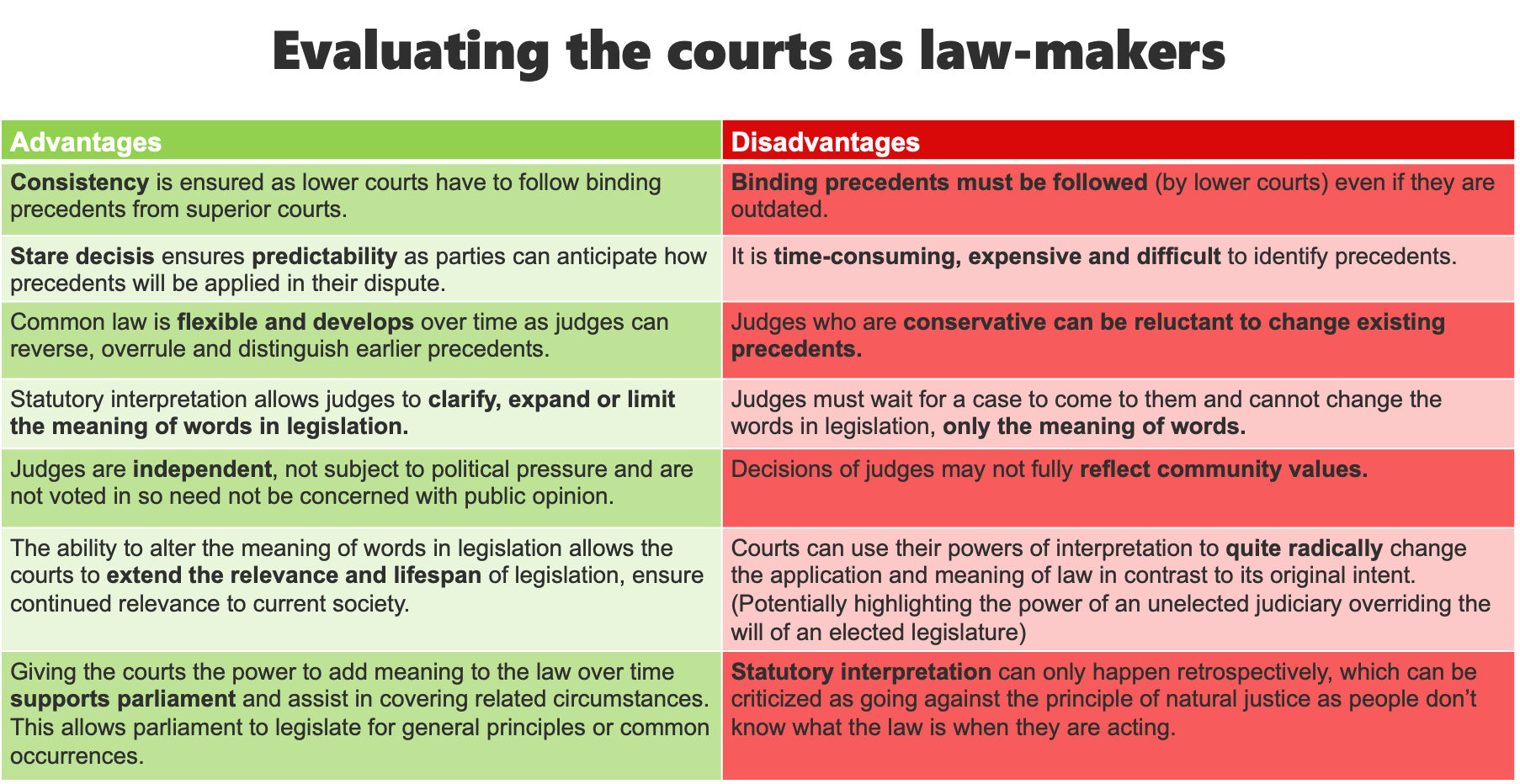
strengths and weaknesses of the courts as law makers
KK8 - THE DOCTRINE OF PRECEDENT
what is the main role of the courts?
to apply existing laws made by parliament to resolve disputes.
victorian courts
Deciding on a case where there is no other law to apply to the case or when a previous principle of law requires expansion to apply to the new situation.
Conducting statutory interpretation – by giving meaning of the words in an Act in order to apply the Act to a case before the court. A precedent will be set by the way in which those words are to be understood in the future. e.g. Studded Belt Case
the high courts
The High Court takes part in law-making when:
Interpreting the Constitution or an Act of Parliament
Expanding or changing the previous principles of law so that it may be applied to a new situation, or when deciding on a case where there is no other law to apply
The High Court acts in a similar way to the Victorian Superior Court of records, however as the highest court in Australia it does not have to follow the interpretation of statutes, or the principles of common law set by any other court in Australia or itself.
It also is able to make laws when interpreting a provision of the Constitution.
common law
Other names include: judge-made law and case law.
It can only be created when a case is brought to the courts.
It develops through the reasons for the decisions of courts being followed by future courts.
the role of the courts in making law - precedent
Judges in superior courts (Supreme Court, High Court) are sometimes able to make law when settling cases. Such law is called common law.
Judges can make common law when the court:Resolves a dispute for which there is no existing statute or common law.
Resolves a dispute for which there is a statute, but the words of the statute need to be interpreted. This is called statutory interpretation.
define doctrine of precedent
also known as stare decisis) is a foundational legal rule in common law systems requiring courts to follow established legal principles from previous, similar cases. It promotes consistency, predictability, and fairness by ensuring "like cases are treated alike".
doctrine of precedent
A precedent is ratio decidendi, that is the reasoning behind a superior court’s decision.
A precedent established by a superior court in the same court hierarchy must be followed by judges and magistrates in lower courts when they are deciding future cases with similar material facts.
Only superior courts (such as the High Court and Supreme Court) are able to set precedents and make law.
The application of precedents to current cases helps ensure common law is consistent and predictable.
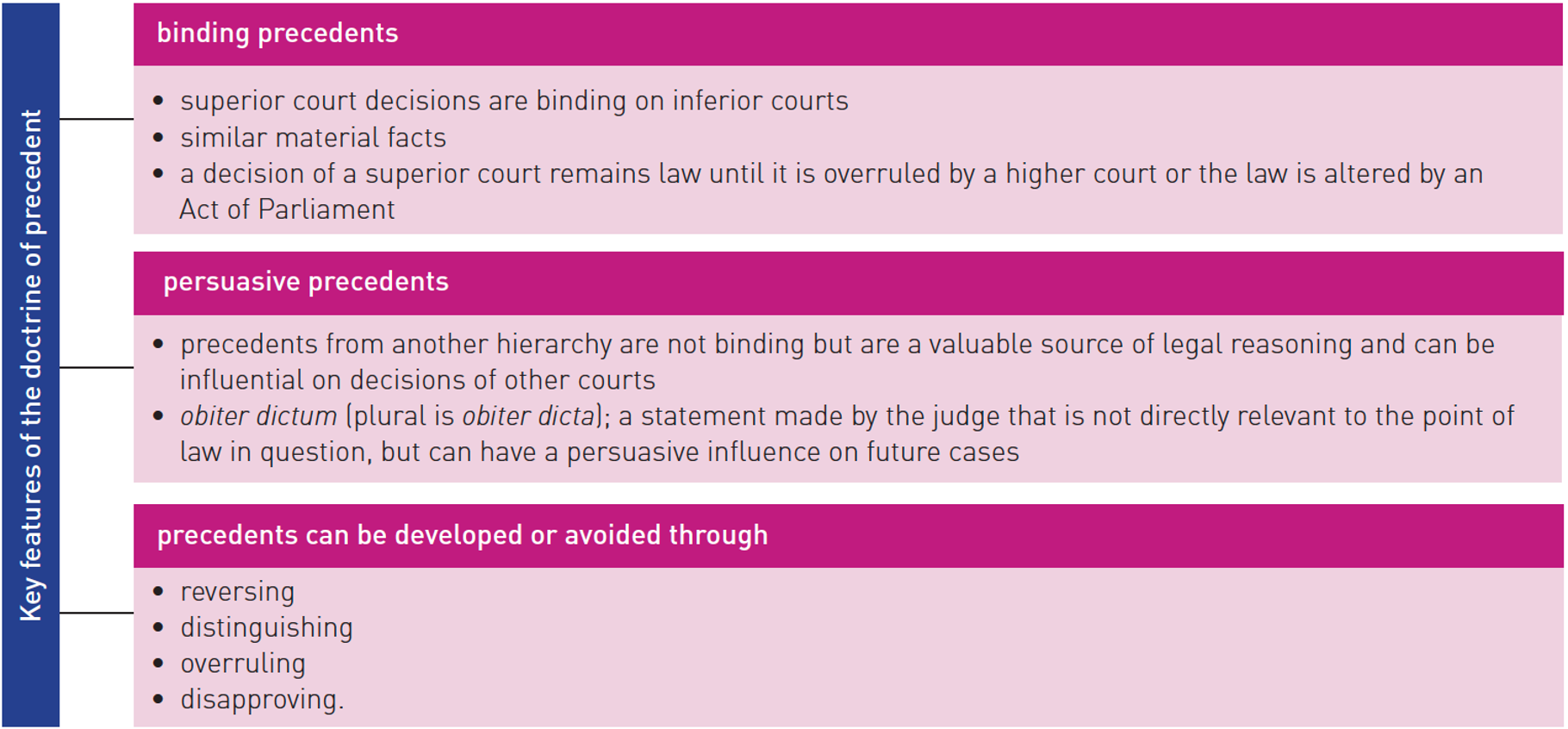
key features of the doctrine of precedent
define binding precedent
a precedent that has been established in the superior courts and must be followed by lower courts in the same hierarchy when resolving disputes with similar material facts.
binding precedent
For a precedent to be binding, it must be set by a superior court within the same court hierarchy.
The binding part of a court judgment is commonly referred to using the Latin phrase ratio decidendi, meaning ‘the reason for the decision’.
Where appropriate and required, judges should stand by previous decisions to ensure common law is consistent and predictable.
Binding precedent is supported and established by the latin principle of Stare decisis meaning ‘to stand by what has been decided’.
it is binding if
The current court is in the same hierarchy than the precedent court
The current court is lower in the hierarchy than the precedent court
The current court is hearing a case on the same area of law and with similar material facts
Precedent was created by a superior court of record
Precedent remarks come from the ratio decidendi of its judgement
NOTE: ALL MUST BE PRESENT OR IT IS SIMPLY PERSAUSIVE PRECEDENT
define persuasive precedent
precedents that are not binding on a court, but may still be considered by a judge and used to influence their decision.
persuasive precedents
precedents that are not binding on a court, but may still be considered by a judge and used to influence their decision.
persusive precedents
Persuasive precedents may be:
Set by courts in another court hierarchy e.g. New South Wales or International court
Set by lower courts in the same court hierarchy
Set by courts of the same standing e.g. Supreme Court of Victoria
Statements made as obiter dicta (a latin term meaning ‘a thing said by the way’) contained in a judgment.
applying earlier precedents
Courts are often required to consider precedents when deciding cases. As they may distinguish, overrule, reverse, disapprove or apply precedents, this allows the common law to evolve over time.
When courts apply precedents, this can involve broadening or narrowing the application of the precedent.
Over time, the common law expands.
NOTE:
NOTE:
The verdict is a result of applying the law to the facts of the case, and the sanction is a result of looking at the offender’s personal situation in relation to their crime. Neither of these is a legal principle, so neither of them is bound by precedent or can form precedent.
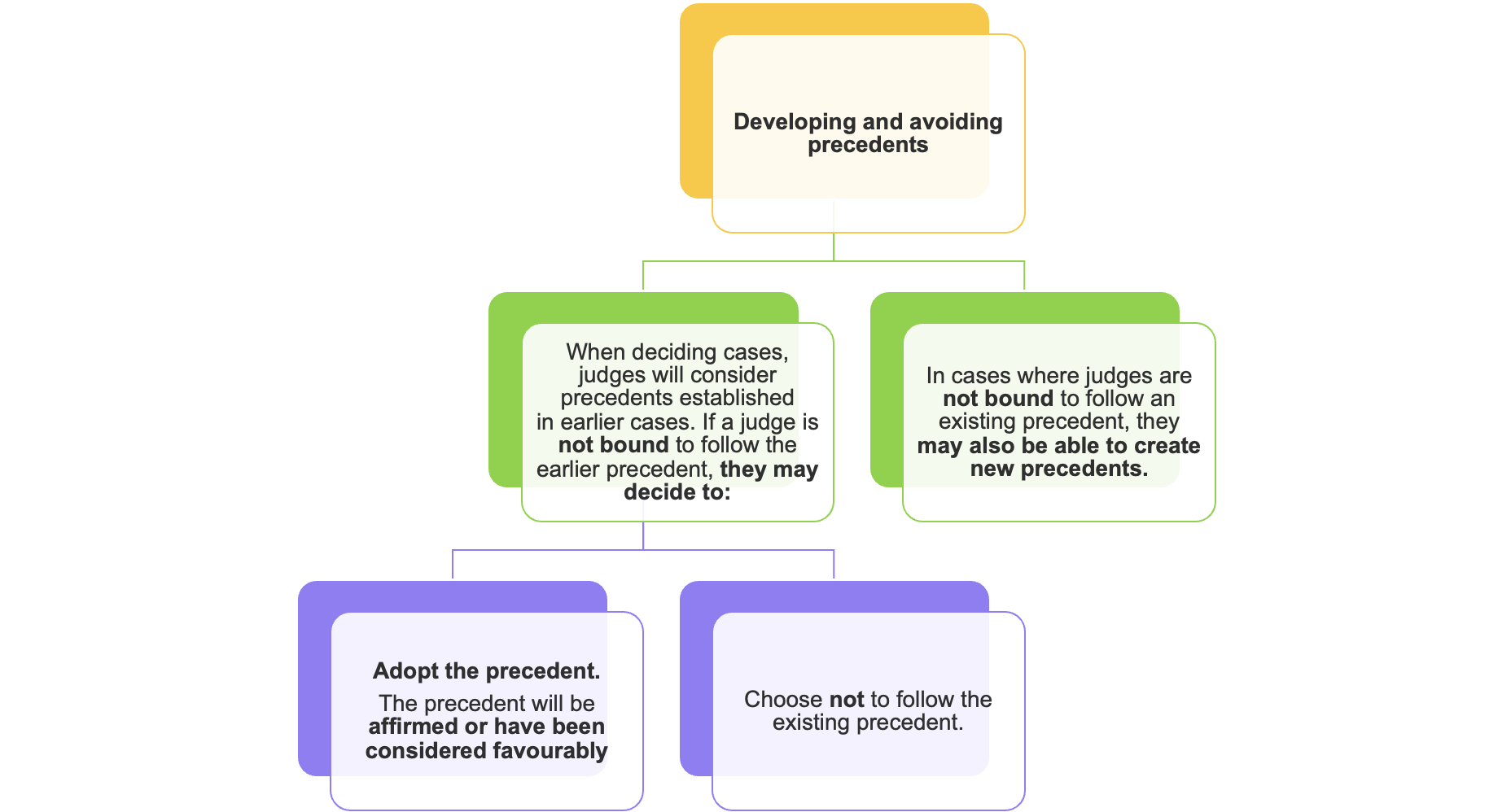
developing and avoiding earlier precedent
Reversing
Overruling
Distinguishing
Disapproving
reversing
THINK: Successful appeal
When a superior court changes a previous precedent set by a lower court in the same case heard on appeal, thereby creating a new precedent which overrides the earlier precedent.
Remember: the role of the court hierarchy
overruling
THINK: Retrospective change or replace
When a superior court changes a previous precedent established by a lower court in a different and later case, thereby creating a new precedent which overrules the earlier precedent.
distinguishing
THINK: Different material facts
The process by which a lower court decides that the material facts of a case are sufficiently different from those of a case in which a precedent was established by a superior court so that they are not bound to follow it.
disapproving
THINK: Criticism
When a court expresses dissatisfaction with an existing precedent but may still be bound to follow it.
Disapproval is not departure from the precedent, rather they are comments usually made in the obiter dicta
Lower courts may disapprove but must follow the precedent
Higher courts may disapprove and still apply the precedent
Signals lower courts to use other principle of law where possible
Strong signal that the law is outdated
developing and avoiding precedents diagram
strengths of doctrine of precedent
The doctrine of precedent helps to ensure that:
Like cases are decided in a like manner, promoting consistency and predictability
Judges can get guidance as to the decisions they ought to make
Decisions made by experienced judges in superior courts are followed in lower courts
Remember: the role of the court hierarchy
Resources are not wasted arguing the same issues repeatedly
weaknesses of doctrine of precedent
It can be hard to find a relevant precedent or to identify the ratio decidendi of a precedent.
The existence of conflicting precedents also creates challenges for parties.
Where a court is faced with a binding precedent, it has no choice but to follow it.
Even if it’s bad precedent
Judges can be reluctant to reverse or overrule earlier decisions or even disapprove of other decisions.
Judges must wait for a case to come before the court
Judges make law ex post facto, or ‘after the event’.
Parliament can override judge made law by legislating.
Legislation overrides common law, reflecting the fact that parliament is considered to be the supreme law-maker.
KK9 - Factors that affect the ability of the Courts to make law.
Factors that affect the ability of the Courts to make law.
define doctrine of precedent
is the process by judges follow the reasons for the decision of courts higher than them in the same court hierarchy, when deciding cases where the material facts are of a similar nature to those which are present when the precedent was originally established.
doctrine of precedent
The common law system of precedent is based on the principle of stare decisis + can have significant impact on whether a court is able to make law when deciding on a case
-Snail in the Bottle case and case – plaintiff had suffered loss or harm due to the negligence of the manufacture (material facts)
ensures there is consistency, predictability, and fairness in court decisions
why doctrine of precedent is good
The doctrine of precedent creates consistency and predictability
A party that takes a case to court can look at past cases and anticipate how the law may apply to their situation.
This gives them some idea of the outcome, because similar cases are decided in a similar manner
Legal representatives can then give advice to their clients on how a court may decide their case, as there may be similar cases with similar facts where a court has ruled a particular way.
why doctrine of precedent is bad
The difficulty and cost involved in locating relevant precedents
The difficulty in identifying the legal reasoning behind a decision
The difficulty in predicting future developments.
doctrine of precedent and flexibility in law making
Through the process of reversing, overruling, distinguishing and disapproving, precedents change and develop over time to allow the gradual expansion of common law.
Judges may also interpret the meaning of the words and phrases used in the past precedents and as they apply a precedent to a new case.
refine the law and make it clearer
doctrine of precedent limitations in law making
The doctrine of precedent restricts the ability of the lower courts to change the law in cases where they are bound to follow a previous precedent established by a higher court.
Judges in superior courts may be reluctant to reverse or overrule existing precedents.
While not being technically bound by their own court’s previous decisions, judges in courts of the same standing consider these precedents to be highly persuasive and rarely overrule them.
judicial conservatism vs judicial activism
Judicial Conservatism | Judicial Activism |
Judges interpret the law narrowly and stick closely to Parliament's original intention. | Judges interpret the law more broadly to ensure it remains relevant in modern society. |
Focuses on the purpose of the legislation, aims to interpret laws in a manner which is removed from politics, individual values or philosophies. | Interprets with the aim to achieve the underlying purposes, working within the law but not in ignorance of future applications or changes in values |
They are reluctant to change existing legal principles. | They are more willing to develop or adapt the common law when necessary. |
Believe Parliament, not the courts, should make significant changes to the law. | Believe courts have an important role in ensuring the law keeps pace with changing community values and technology. Working with contemporary needs, attitudes and values. |
Creates greater certainty and predictability in the law. | Allows the law to respond more quickly to new situations and social change. Considers the law as ever changing and growing. |
judicial conservatism
Judicial conservatism is a cautious approach to interpreting and applying the law.
Judges adopt a narrow interpretation of legislation and avoid making major or controversial changes.
Judges focus on what the law is, not what they think it should be.
Decisions should be based on legal principles and Parliament's intention, not personal, political or community views.
Conservative judges are less willing to extend or develop the law, limiting the courts' law-making role.
They believe judges should interpret the law, not rewrite it.
The main aim of judicial interpretation is to give effect to Parliament's original intention when the statute was passed.
how judicial conservatism limits ability to make law
The conservative judge will follow precedent and be reluctant to take part in law-making
The conservative judge may be more likely to follow previous precedent even if they have the ability to set an alternative principle in common law (i.e. not bound to follow or could distinguish the case)
Overall, conservative judges see their role more as the adjudicator rather than law-maker and generally prefer to leave the law-making process to parliament
judicial activism
Judicial activism (also called judicial creativity or a progressive approach) involves judges interpreting the law to reflect changing social values and circumstances.
Judges consider social, political and community factors, including changing community values and individual rights, when interpreting legislation.
The law is seen as something that should be kept up to date to achieve justice.
Activist judges are more willing to develop the law and establish new precedents where appropriate.
Some view judicial activism as progressive, while others argue it allows judges to change laws beyond Parliament's original intention.
Debate about judicial activism in Australia increased following the Mabo v Queensland (1992) decision.
how judicial activism limits ability to make law
Can have a significant impact on the courts’ ability to make law
An approach that involves Judges willing to depart from previous precedent and create new laws
Unlikely a conservative judge, an activist judge would more likely override a precedent (if able to do so) or alternatively distinguish the case from another
Thus, creating their own principle of law
Activist judges see themselves as both adjudicator and law-maker
Overall, this approach increases the courts’ ability to make law
costs and time
costs involved with a court case
It is very expensive to take a case to court.
The cost can deter people from using the courts to settle disputes
The two main costs are legal representation and court costs.
Legal representation – parties normally retain legal representation to their chances of winning the case.
maximise
Lawyers will research the case, collect and analyse evidence, interview witnesses and present arguments to the court.
A legal rep. will know how best to present the evidence and can follow the strict rules of evidence and procedure
Parties without legal representation can be significantly less likely to win the case.
Court costs – these include filing fees, hearing fees and jury costs. For actions in the Supreme Court, such costs are thousands of dollars each hearing day.
Special Leave | Court Hearing | Jury |
Supreme Court – Court of Appeal | Supreme Court | Supreme Court |
time involved with a court case
Complex cases can take several months to prepare and hear.
The courts can act very quickly in urgent situations (see next slide)
The time it takes the courts to solve a dispute can be delayed by several factors, including complexity of the dispute, pre-trial procedures, lack of court resources and an ever-increasing workload on the courts.
Judges in appeal courts, where most precedents are established, can take months to hear and determine more complex cases.
how costs and time limit the ability to make law
The overall costs of bringing a case to court and the time involved to prepare/attend court can impact the courts’ ability to create law
This means, cases are either not pursued or are abandoned due to cost/time
Unlike parliament, a court can only create a law when an appropriate case comes in
Overall the factors which restricts an individual’s case to the courts also restricts the law-making process by the courts
costs and time
The courts cannot make law until a case is brought before them, which is dependent upon litigants being willing and able to afford to bring a case before the courts.
Costs of taking a case to court:
Two of the main costs involved in taking a case to court are the cost of legal representation and court fees.
Costs can deter litigants who cannot afford these costs from pursuing their case and any subsequent appeals.
requirement for standing
to have standing
Courts can only create precedent when a case is brought before them by a party with jurisdiction and standing (locus standi).
A person must be directly affected by the issue and have a special interest beyond that of the general public to have standing.
Usually, the party must stand to gain a tangible benefit (e.g. money or property) if successful.
Standing is particularly important in High Court constitutional cases.
Examples: McBain (2000) and Roach (2007).
The requirement of standing ensures only genuinely affected parties bring cases and encourages others to seek alternative avenues.
However, it prevents people acting solely in the public interest from challenging laws, meaning some opportunities for law reform may be lost.
how the requirment for standing limits ability ro make law
The person bring the case has to have a ‘legally acceptable’ reason for bring a case
Directly impacted by the law that they are challenging or have a party to the case in question
If they do not meet the requirements, they cannot bring the case forward – thus the courts cannot make law
It’s important to acknowledge the difficulties of having a case heard by superior courts of record (i.e. those who may create law) as this often is on appeal
The grounds for appeal also have to be met and approved
Adds to the difficulty of courts making law
overall for standing
Courts cannot make law until a case is brought before them by a party with standing.
Standing means a person must be directly affected by the issue for the court to hear the case.
This ensures only genuinely affected parties bring cases, preventing frivolous claims and wasting court resources.
However, it can prevent people with only a general or public interest from challenging the law on behalf of others, limiting opportunities for law reform.
KK10 - RELATIONSHIP BETWEEN COURTS AND PARLIAMENT IN LAW - MAKING
the relationship
Parliaments pass acts to establish Courts
Parliament can change or confirm Law made by Courts
Parliament is the supreme law maker and hence courts act within a complementary role
Courts and parliaments have an interconnected role in law-making. What the courts do in law-making will affect parliament and vice versa.
features of the relationship
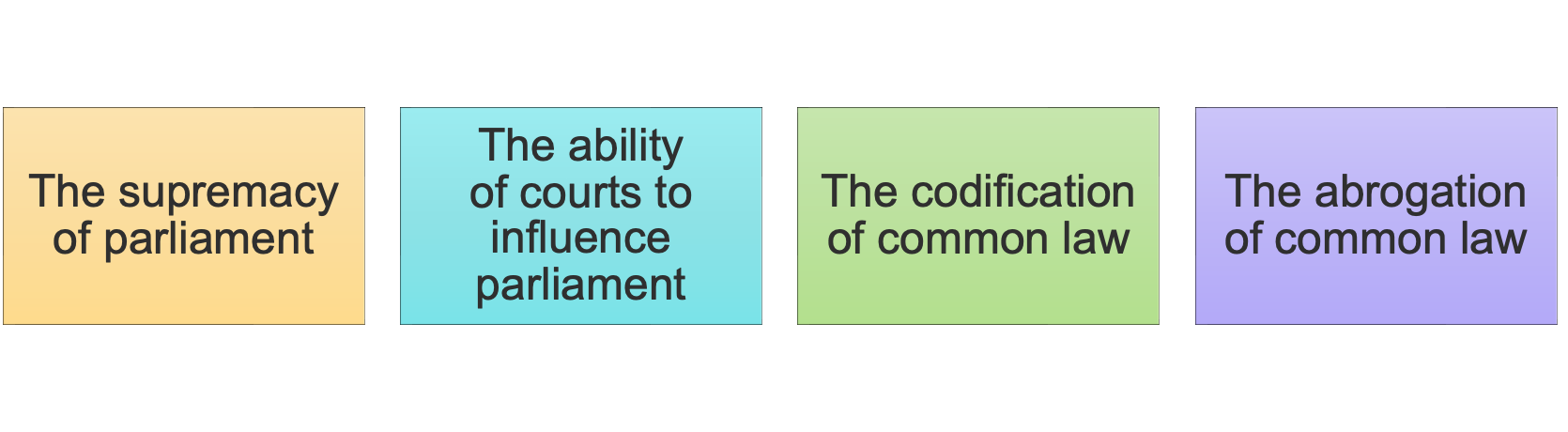
the supremacy of parliament
Parliament is the supreme law-making body with the ability to make and change any law within its constitutional power.
It therefore has the power to pass legislation to either confirm or override (abrogate or cancel) decisions made through the courts (or common law
Parliament is responsible for passing legislation that establishes the courts and states their relevant jurisdiction
For example, the Victorian Parliament passed the Supreme Court Act 1986 (Vic) and the Magistrates’ Court Act 1989 (Vic)
These piece of legislation established the Supreme and Magistrates’ Courts respectively
Both replaced the original legislation which established them
As such, parliament can amend the jurisdiction of the courts
Adjust which cases are heard by which courts
Set up divisions of courts e.g the Koori Court or Drug Court
Therefore, it can restrict the ability of the courts to make decisions with respect to certain matters.
the ability of the courts to influence parliament
Statutory interpretation
Courts interpret Acts of Parliament when resolving disputes.
Their interpretation can broaden or narrow the meaning of legislation.
Parliament can amend legislation to clarify or overturn a court's interpretation.
Judicial decisions and law reform
Court decisions can highlight gaps or problems in the law.
Judges' comments (obiter dicta) may encourage Parliament to reform laws.
Landmark cases and public concern can pressure Parliament to change the law.
Lower court decisions or unjust precedents can also prompt law reform.
Influence on future laws
Court interpretations guide how future laws are drafted.
Parliament may use judicial comments when deciding whether to amend legislation.
codification of common law
As the supreme law-maker
Parliament has the power to pass an Act of Parliament that assembles (or pulls together) all the relevant law in a particular area, both common law and statute law, in an attempt to create one all-encompassing law.
Codification also allows the parliament to pass legislation that reinforces or endorses the principles established in court rulings.
The Native Title Act was passed after the principles set in the Mabo case.
Codification provides greater certainty and accessibility in the law.
It allows parliament to refine or modify common law principles to suit contemporary needs.
purposes of codification
to clarify and consolidate legal principles
to make the law more accessible and certain
to address inconsistencies or uncertainties in the common law
the abrogation of common law
In contrast, parliament is also able to abrogate common law principles
This is where the sovereignty of parliament means it has the power to override common law through the passage of legislation
If a court makes a law deemed to be inappropriate, parliament may pass law overriding (abrogating) the court made-law
The result of abrogation is that the common law is no longer in effect in the courts and the precedent has been overruled by Parliament
Note: the abrogation of common law is fairly limited in relation to constitutional matters – Parliament cannot override or abrogate interpretations of the Constitution
LATIN WORDS *
Ratio decidendi – The reason for the decision in a case. It is the legal principle that forms the binding precedent for future cases.
Obiter dictum – A statement or comment made by a judge that is not essential to the decision. It is not binding but may be persuasive in later cases.
Stare decisis – A Latin term meaning "to stand by what has been decided." It is the principle that courts follow binding precedents set by higher courts in the same hierarchy.
Ex post facto – A Latin term meaning "after the fact." It refers to laws or legal decisions that apply retrospectively to events that occurred before the law or decision was made.
In futuro – A Latin term meaning "for the future." It refers to laws or legal decisions that apply prospectively, affecting future cases rather than past events.
Locus standi – A Latin term meaning "standing to sue." It is the legal right of a person or organisation to bring a case before a court because they are sufficiently affected by the issue.
Ultra vires – A Latin term meaning "beyond the powers." It refers to a law or action that is outside the legal powers or authority of the person or body that made it (e.g. a parliament passing a law beyond its constitutional power).
Terra nullius – A Latin term meaning "land belonging to no one." It was the legal doctrine that Australia belonged to no one before British settlement, a doctrine rejected by the High Court in Mabo v Queensland (No 2), which recognised native title.
cases to use
studded belt - Deing v Tarola [1993]: A 20-year-old man was convicted in the Magistrates' Court for possessing a "regulated weapon" - a black leather belt with raised silver studs used to hold up his trousers
Precedent: Because an ordinary belt is an article of clothing and in common use as an accessory, it cannot be classified as a weapon simply due to decorative studs unless it is used in a threatening or offensive manner’
mabo case - Mabo v Queensland (No 2) (1992) -
overruled the common law doctrine of terra nullius and recognised native title, demonstrating how courts can make law by creating precedent. Parliament later passed the Native Title Act 1993 (Cth), illustrating how courts can influence parliament and how parliament can codify common law.
Courts making law: Parliament had not legislated on native title, so the High Court developed the common law by deciding the case. This demonstrates that courts can make law when resolving disputes before them
trigwell - abrogation of common law
State Government Insurance Commission v Trigwell [1979] HCA 40 established that landowners do not owe a duty of care to road users for livestock straying onto a highway. The High Court of Australia applied an old English common law immunity rule, noting that changing such an outdated law was the responsibility of parliament rather than the judiciary.
Judicial conservatism: The High Court chose not to change the old common law rule, even though it was outdated. The judges believed that changing this area of law was a job for parliament, not the courts.