The Molecular Basis of Mendelian Inheritance Patterns
 Call Kai
 Learn
Learn Practice Test
 Spaced Repetition
 Match
Match Flashcards
 Knowt Play
1/36

There's no tags or description
Looks like no tags are added yet.
Name | Mastery | Learn | Test | Matching | Spaced | Call with Kai | Chat |
|---|
No analytics yet
Send a link to your students to track their progress
37 Terms
Mutant Recessiveness: Recessiveness is observed in mutations in genes that are functionally WHAT (+/m, where m is a mutated allele). The mutated allele is the WHAT allele.
Mutant Recessiveness: Recessiveness is observed in mutations in genes that are functionally HAPLOSUFFICIENT (+/m, where m is a mutated allele). The mutated allele is the RECESSIVE allele.
One wildtype allele (half the genotype) is sufficient for WT phenotype
Mutant Dominance: In genes that are WHAT, in a heterozygote (+/M), the single wild-type allele (+) WHAT provide enough product for normal function. The mutated allele (M) is the WHAT allele.
Mutant Dominance: In genes that are HAPLOINSUFFICIENT, in a heterozygote (+/M), the single wild-type allele (+) CANNOT provide enough product for normal function. The mutated allele (M) is the DOMINANT allele.
One wildtype allele (half the genotype) is insufficient for WT phenotype
Single letter
Denotes MUTANT phenotypes (or recessive, if mutant in unknown)
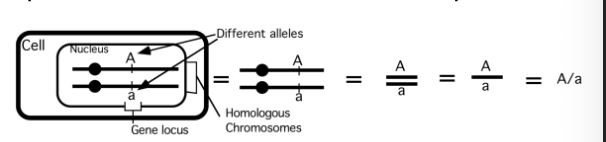
Upper case letters
Denotes DOMINANT allele
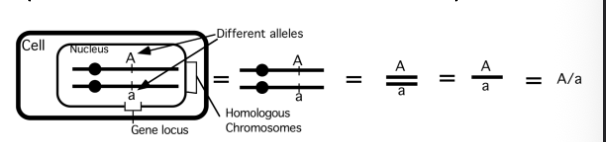
Lower case letter
Denotes RECESSIVE allele

In nomenclature it should ideally be WHAT (or WHAT)
In nomenclature it should ideally be ITALICIZED (or UNDERLINED)
Slashes indicate WHAT
Slashes indicate alleles for genes on HOMOLOGOUS chromosomes
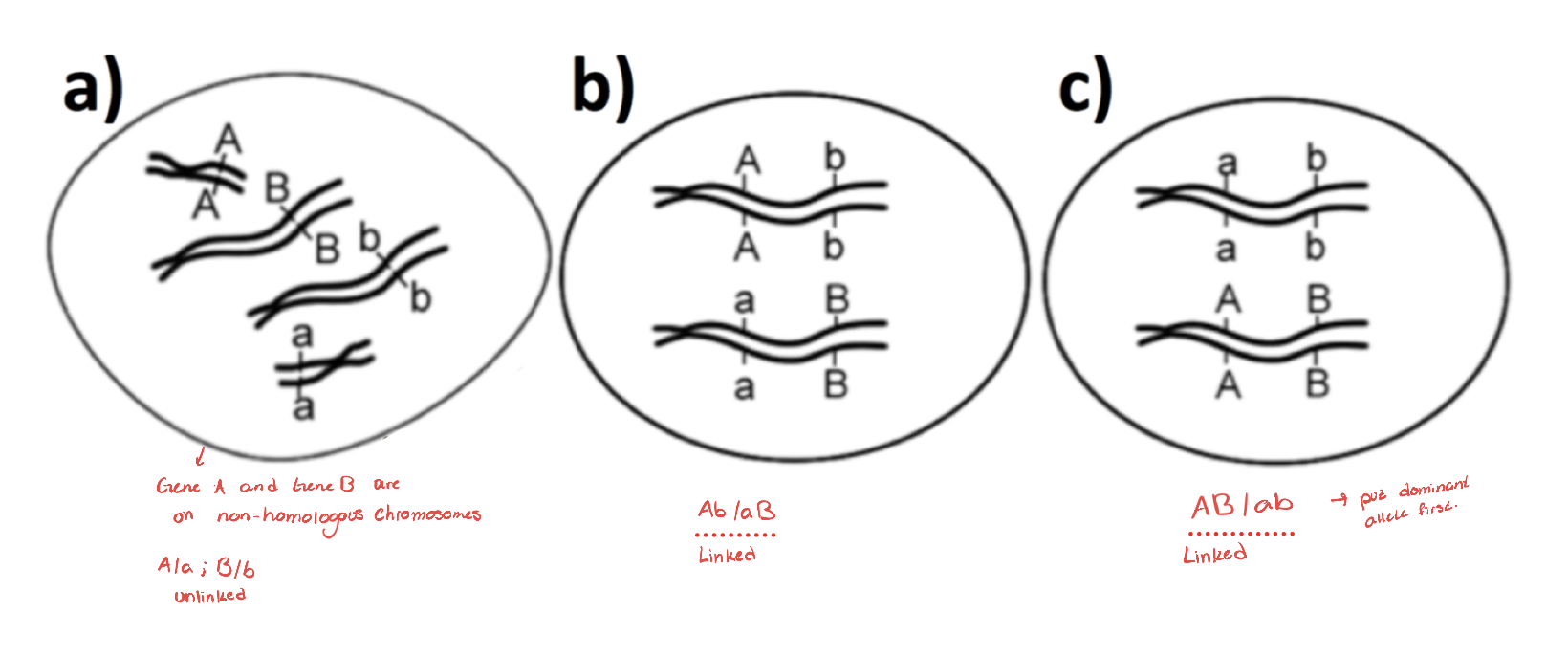
Semicolons indicate WHAT
Semicolons indicate genes on NON-HOMOLOGOUS chromosomes

Many traits are coded for by a WHAT gene
Many traits are coded for by a SINGLE gene
mutations in the WHAT result in an observable change in the WHAT
mutations in the GENE result in an observable change in the PHENOTYPES
Patterns of single gene inheritance first described by WHO
Patterns of single gene inheritance first described by GREGOR MENDEL
Gregor Mendel (1822-1884)
WHAT, Pisum sativum
Examined seven traits through WHAT and WHAT
All WHAT traits (“either/or”)
Gregor Mendel (1822-1884)
GARDEN PEA, Pisum sativum
Examined seven traits through CROSSING and SELFING
All DISCONTINUOUS traits (“either/or”) (either dominant or recessive)

Mendel’s Law Of Equal Segregation
He started with WHAT of pea plants
Mendel’s Law Of Equal Segregation
He started with PURE LINES of pea plants

Mendel’s Law Of Equal Segregation
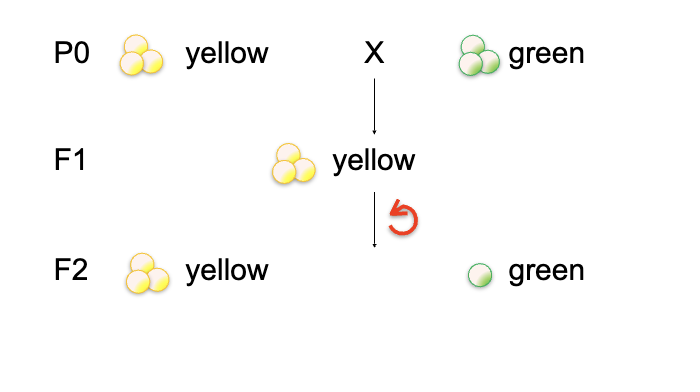
One trait: Flower colour - WHAT
Mendel’s Law Of Equal Segregation
One trait: Flower colour - MONOHYBRID CROSS

Phenotype
What you see (e.g. yellow seeds)
Genotype - WHAT
Genotype - ALLELE combination (symbol indicates MUTANT OR RECESSIVE phenotype)
use same letter for same GENE, different case for different ALLELES (basic)

What is a monohybrid cross
A cross between two heterozygotes for one trait
Test cross
Cross used to determine the genotype of an individual that is expressing a DOMINANT phenotype (the person is either heterozygous or homozygous) (cross with a homozygous recessive)
Test cross
If dominant subject is Homozygous dominant then offspring will all be WHAT
If dominant subject is Heteroygous dominant then offspring will be WHAT and the other WHAT
Test cross
If dominant subject is Homozygous dominant then offspring will all be HETEROZYGOUS
If dominant subject is Heteroygous dominant then offspring will be HALF HETEROZYGOUS and the other HALF HOMOZYGOUS RECESSIVE
Particulate inheritance through equal segregation
Genes are in WHAT – gene may have different WHAT (WHAT)
Particulate inheritance through equal segregation
Genes are in PAIRS – gene may have different FORMS (ALLELES)
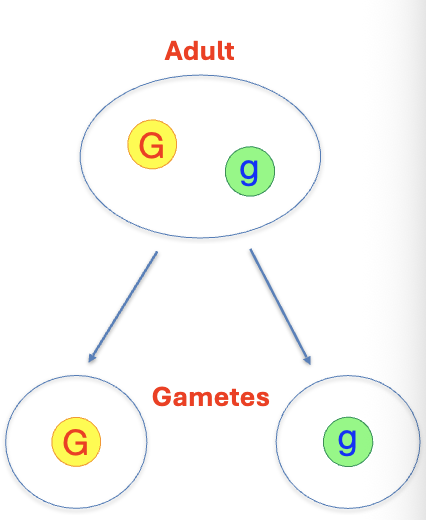
Particulate inheritance through equal segregation
Gametes contain only one WHAT of each WHAT
Particulate inheritance through equal segregation
Gametes contain only one ALLELE of each GENE PAIR
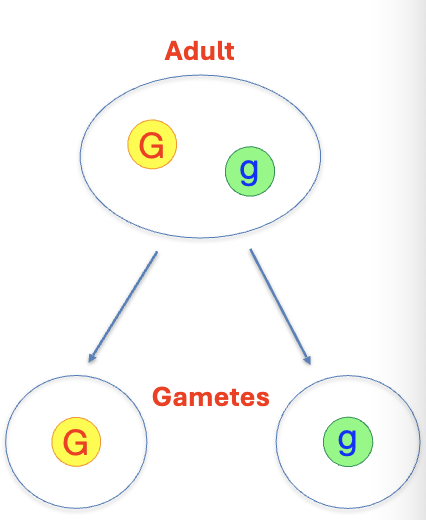
Particulate inheritance through equal segregation
Equal Segregation – WHAT
Particulate inheritance through equal segregation
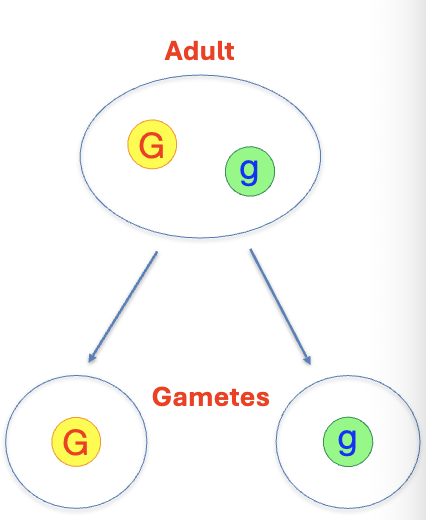
Equal Segregation – Half of gametes carry one allele of gene pair, half carry the other allele - MENDEL’S FIRST LAW

Particulate inheritance through equal segregation
Random WHAT
Particulate inheritance through equal segregation
Random FERTILIZATION

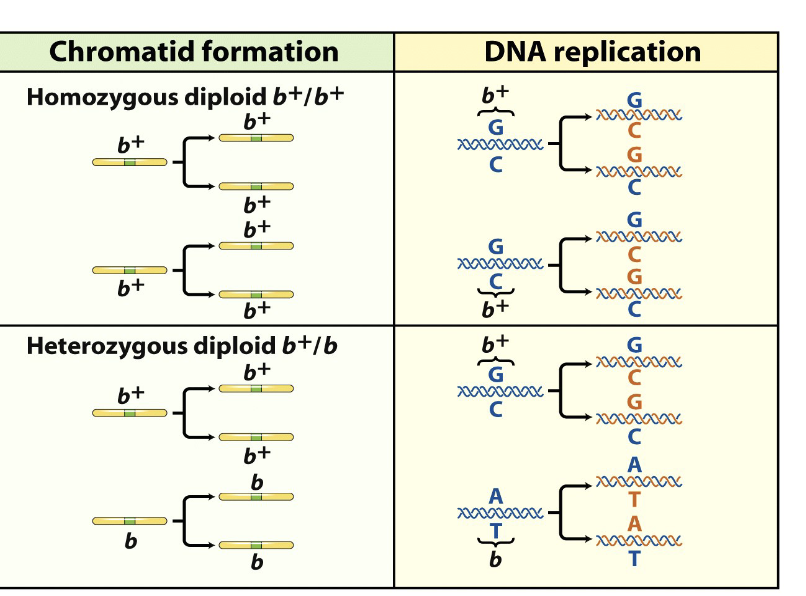
Sister chromatids have the exact WHAT
Non-sister chromatids can be WHAT (WHAT) or WHAT (WHAT)
Sister chromatids have the exact SAME ALLELES
Non-sister chromatids can be SAME (HOMOZYGOUS) or DIFFERENT (HETEROZYGOUS)

Chromosomal Theory of Inheritance (1902-03)
Sutton and Boveri looked at the separation of WHAT during WHAT under a microscope
Chromosomal Theory of Inheritance (1902-03)
Sutton and Boveri looked at the separation of CHROMOSOMES during MEIOSIS under a microscope
Chromosomal Theory of Inheritance (1902-03)
Proposed that Mendel’s “particles” were associated with WHAT
Chromosomal Theory of Inheritance (1902-03)
Proposed that Mendel’s “particles” were associated with CHROMOSOMES
Chromosomal Theory of Inheritance (1902-03)
Morgan was a skeptic, but later proved them WHAT
Chromosomal Theory of Inheritance (1902-03)
Morgan was a skeptic, but later proved them RIGHT
Testing for Mendelian Inheritance – Reciprocal Crosses
mutant parent and wild- type parent are WHAT
WHAT inheritance should give the same results
Testing for Mendelian Inheritance – Reciprocal Crosses
mutant parent and wild- type parent are SWITCHED
AUTOSOMAL inheritance should give the same results

Sex linkage
Non-autosomes = WHAT
Sex linkage
Non-autosomes = SEX CHROMOSOMES
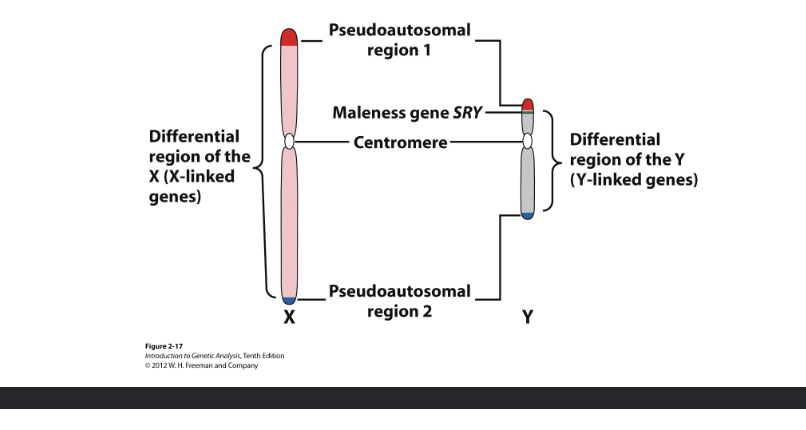
Sex linkage
If one sex does not have a pair of WHAT sex chromosomes, the other WHAT
Sex linkage
If one sex does not have a pair of SIMILAR sex chromosomes, the other DOES
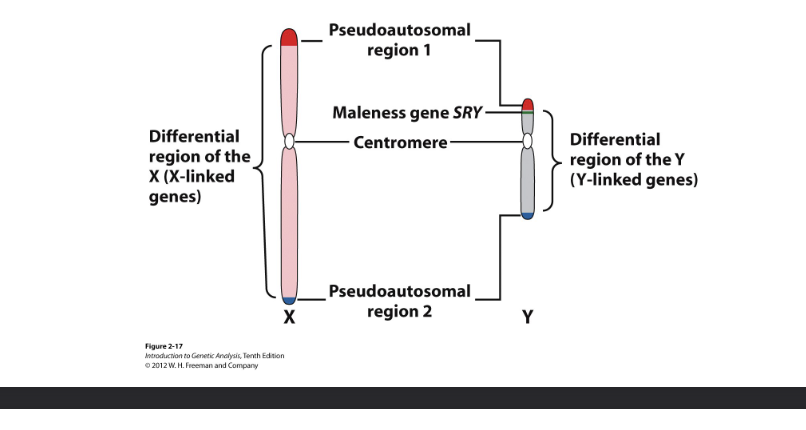
Sex linkage
Homogametic: WHAT
Sex linkage
Homogametic: matching pair of sex chromosomes (ex. XX)

Sex linkage
Heterogametic: WHAT
Sex linkage
Heterogametic: no matching pair (ex. XY)

Testing for sex linkage – Reciprocal Cross
Mutant parent and wild- type parent are WHAT
WHAT inheritance should give the same results
Testing for sex linkage – Reciprocal Cross
Mutant parent and wild- type parent are SWITCHED
AUTOSOMAL inheritance should give the same results

Autosomal

Sex-linked inheritance
