Order Opistorchida and Strigeidida
 Call Kai
 Learn
Learn Practice Test
 Spaced Repetition
 Match
Match Flashcards
 Knowt Play
1/100

There's no tags or description
Looks like no tags are added yet.
Name | Mastery | Learn | Test | Matching | Spaced | Call with Kai | Chat |
|---|
No analytics yet
Send a link to your students to track their progress
101 Terms
Opisthorchiidae
family of fusiform flukes with small weak suckers
Dicrocoeliidae
Fluke family that get mistaken as Opisthorchiidae
anterior; posterior
Opisthorchiidae have their ovaries ____ to the testis; Dicrocoeliidae have theirs ______
Opisthorchiidae
in this family, the eggs must be ingested by snails before they hatch
fish
2nd IH of Opisthorchiidae
duodenum
where do the metacercariae of Opisthorchiidae excyst
liver
predilection site of opisthorchiidae after excysting in the duodenum
Clonorchis
most important genus of the family Opisthorchiidae
Opisthorchis, Metorchis, Parametorchis, Pseudamphistomum
other genera of Family Opisthorchiidae that are of lesser importance
Clonorchis sinensis
Chinese or Oriental Liver Fluke
Cyprinidae fishes (Carp)
2nd IH of Clonorchis sinensis
Operculated snails
1st IH of Clonorchis sinensis
Bithynia
example of genus of operculated snails which are the 1st IH of Clonorchis sinensis
bile&pancreatic ducts; small intestines
Clonorchis sinensis occurs in the _______ and sometimes _____ of humans and carnivores (dog, cat, mink)
cholangitis, pericholangitis, and cholecystitis
the spiny cuticle of Clonorchis sinensis can cause ____, ____, and ____.
praziquantel
TOC against Clonorchis sinensis
Opisthorchis felineus
cat liver fluke
carnivores, humans, pigs, & cetaceans
hosts of Opisthorchis felineus
Opisthorchis viverrini
southeast asian liver fluke
civet cats
host of Opisthorchis viverrini
Opisthorchis
genera that can cause thickening of the ducts, predisposing cholangiocarcinoma, and hepatocellular carcinoma
Praziquantel
TOC vs Opisthorchis
Metorchis albidus
occurs in the bile ducts and gall bladder of carnivores, seal, poultry, and human
freshwater snails
1st IH of Metorchis albidus
fish
2nd IH of Metorchis albidus
Blicca
example of fish genera that serves as the 2nd IH of Metorchis albidus
Metorchis conjunctus
fusiform flukes that occurs in the bile ducts and gallbladder of carnivores, mink, and raccoon
Catostomus
genera of fish that served as the second IH for Metorchis conjunctus
Brachylaemidae
family of flukes that only has minor vet importance
Brachylaemus
parasites of birds from the family of Brachylaemidae
Skrjabinotrema ovis
sheep parasites from Family Brachylaemidae
Postharmostomum suis
pig parasites from family Brachylaemidae
Heterophyidae
family of the parasites of the small intestines of fish-eating mammals and birds
freshwater snails
1st IH of Heterophyidae
fish or frogs
2nd IH of Heterophyidae
Heterophyes, Metagonimus, Crytocotyle, Apophallus
important genera from Family Heterophyidae
small intestines
predilection site of Heterophyidae
Heterophyes heterophyes
Heterophyidae species that occurs on the small intestines of dog, cat, fox, and human
Metagonimus yokogawai
Heterophyidae species that occurs on the small intestine on dog, cat, pig, and human
Apophallus muhlingi
Heterophyidae species that occurs on the small intestines of sea birds, dog, and cat
Cryptocotyle lingua
Heterophyidae species that occurs on the small intestines of sea birds, seal, dogs, and cats
Schistosomatidae, Diplostomatidae, Strigeidae
families under order Strigeidida
Schistosomatidae
family that are mainly parasites of the blood vessels of the alimentary tract and bladder (blood flukes)
Schistosomatidae
family where the smaller female attaches permanently to the male
Schistosomiasis
aka Swimmer’s itch, Rice paddy itch, Hunter’s itch, Clam digger’s itch, Cercarial dermatitis, Sea bather’s eruption, Lakeside disease
redia and metacercaria
phases the Schistosomatidae skips
Schistosomatidae
family that uses the skin/ingestion of contaminated water as its cercaria’s portal of entry
furcocercous
tail classification of schistosomatidae cercaria
systemic circulation (heart and lungs)
the young fluke from the Family Schistosomatidae will travel via the blood stream _______
portal veins
where do Schistosomatidae become sexually mature
mesenteric veins
predilection site of mature Schistosomatidae (blood fluke)
6—7wks
PPP of Schistosomatidae
Haematobium, Indicum, Mansoni, Japonicum
4 genera of blood flukes of vet importance
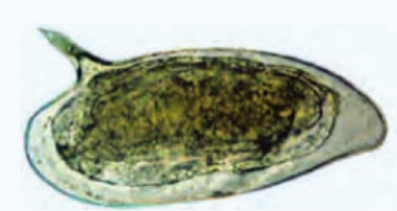
Schistosoma mansoni
one of the groups of Schistosoma found in Africa with a lateral spine on the egg
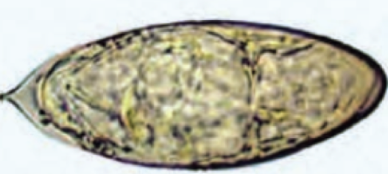
Schistosoma haematobium
One of the groups of Schistosoma found in Africa with a terminal spine on the egg
Schistosoma mansoni
ID the egg
Schistosoma haematobium
ID the egg
Schistosoma bovis, S. haematobium, S. mattheei, S. leiperi
species under Haematobium group
Schistosoma bovis
species from genera of Schistosoma under the Haematobium group that occurs in the portal, mesenteric & urogenital veins of ruminants and camel
Bulinus and Physopsis
Intermediate hosts of Schistosoma bovis (snails)
Schistosoma haematobium
species from genera of Schistosoma under the Haematobium group that occurs in the bladder veins and urethra of man and primates
Bulinus
Intermediate host of Schistosoma haematobium (snails)
Schistosoma mattheei
species from genera of Schistosoma under the Haematobium group that occurs in the mesenteric veins of ruminants and primates
Physopsis
IH of Schistosoma mattheei (snails)
Schistosoma leiperi
species from genera of Schistosoma under the Haematobium group that occurs in the mesenteric veins of cattle and antelope
Bulinus
IH snail of Schistosoma leiperi
Schistosoma indicum, Schistosoma nasalis, Schistosoma spindale
3 spp under the Indicum group of Schistosoma
Schistosoma indicum
sp under Schistosoma under Indicum group that occurs in the portal, pancreatic, hepatic, and mesenteric veins of ruminants and large pseudo-ruminants
Indoplanorbis
IH of Schistosoma indicum
Schistosoma nasalis
sp of Schistosoma under Indicum group that occurs in the nasal mucosa veins of ruminants and large pseudo-ruminants
Lymnaea & Indoplanorbis
IHs of Schistosoma nasalis
Lymnaea, Planorbis, Indoplanorbis
IHs of Schistosoma spindale
Schistosoma mansoni
blood fluke occurring in the mesenteric veins of humans and primates
Biomphalaria
IH of Schistosoma mansoni
Schistosoma japonicum
blood fluke occurring in the portal and mesenteric veins of domestic mammals and humans
Oncomelania
IH of Schistosoma japonicum
Schistosoma incognitum
blood flukes occurring in the mesenteric veins of pigs and dogs
Radix
IH of Schistosoma incognitum
Bilharziella polonica
blood flukes that occurs in the mesenteric and pelvic veins of ducks
Planorbis
IH of Bilharziella polonica
hematuria
this happens when Schistosoma is present in the bladder
Nasal schistosomiasis
associated with cauliflower-like growths on the nasal mucosa
anthiomaline (nasal) or praziquantel
TOC of Schistosomia
Diplostomatidae
Family of flukes of mammals and birds with an ear-like projections anteriorly
snails, frogs
1st and 2nd IH of Diplostomatidae
cercaria
what stage in development do Diplostomatidae infect tadpoles and frogs
mesocercaria
the cercaria will develop into which stage in the muscles of tadpoles and frog?
frog, snake, mouse
paratenic hosts of Diplostomatidae
encyst
what happens to the mesocecaria inside the tadpole when the IH is eaten by the paratenic hosts (mouse, snake, frog)
metacercariae
what is the next stage of development of Diplostomatidae mesocercariae after migrating extensively inside the final host?
small intestines
predilection site of Diplostomatidae
Alaria alata
Diplostomatidae occurring in the small intestines of carnivores & rarely humans; humans—fatal, can be caused by consumption of inadequately cooked frog legs
Praziquantel or Niclosamide
TOC for Alaria alata
severe duodenitis
aside from pulmonary damage, what is the other disease Alaria alata can cause in dogs and cats
Streigidae
these flukes are characterized by a constriction dividing the body into an anterior flattened adhesive organ and a posterior cylindrical or oval part, which contains the reproductive system
anterior
in Streigidei, which region is the cup-shaped adhesive organ located?
The constricted flukes
other name (layman’s term) for Strigeidae
fresh water snails
first IH of Strigeidae
leeches or fish
second IH of Strigeidae
Apatemon, Cotylurus
genera of Strigeidae that occurs in the intestines of pigeons and ducks