Lecture 6: Structure Determines Function
 Call Kai
 Learn
Learn Practice Test
 Spaced Repetition
 Match
Match Flashcards
 Knowt Play
1/11

There's no tags or description
Looks like no tags are added yet.
Name | Mastery | Learn | Test | Matching | Spaced | Call with Kai | Chat |
|---|
No analytics yet
Send a link to your students to track their progress
12 Terms
three common themes in 3d protein structure
Flexible enough to function properly
flexible to move into move stable form; or to change conformation according to their environment
Stable enough that it will not change to another conformation
Exposed amino acids are compatible with the environments where the protein will function
So that they are stable in that environment for it to function
Conformation in protein structure and function
general types of protein function
Three main kinds
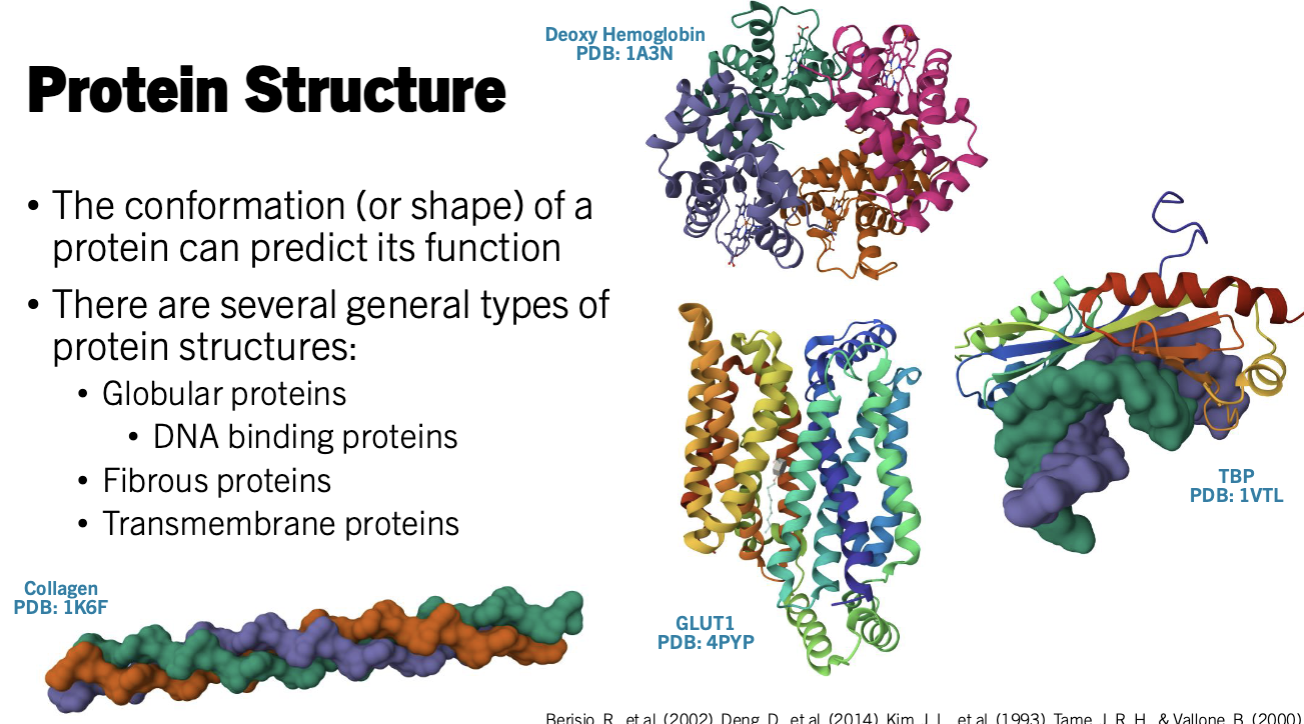
conformation a predict the protein function
General types of protein structures
Globular proteins
found in aqueous environment
DNA binding proteins - bind to DNA (e..g. TATA binding protein) and need
Fibrous proteins
long structural solid proteins
very stable (e.g. actin) compared to other proteins
Transmembrane proteins
found in more hydrophobic environments
Works with the phospholipid bilayer
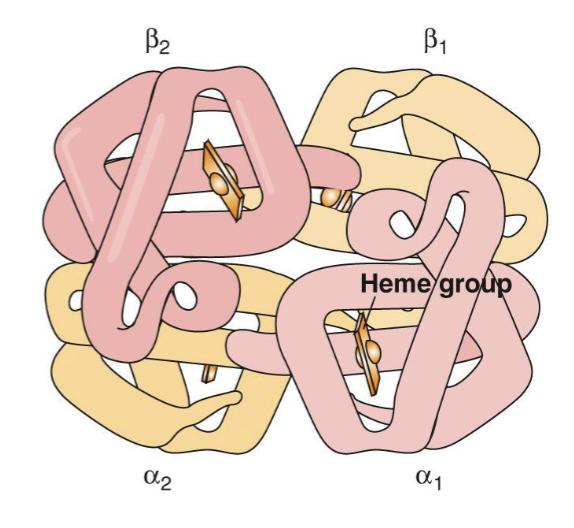
Hemoglobin: O2 transport
type of general protein
Adult ver. called a ____
What does each subunit contain
Explain its characteristic and what it does
What happens when O2 binds
a globular protein found in the cytoplasm of red blood cells
Adult protein is a heterotetramer (different polypeptides)
4 polypeptides
2 is a globin subunits
2 is b-globin subunits
Each subunit contains a cofactor
Heme group (iron-containing porphyrin ring - prosthetic group - not going to dissociate - binds forever with the protein)
Able to bind to O2 and deliver
Binding to O2 causes conformational changes in the protein
Make it more easier for O2 to bind
Binding of O2 with hemoglobin
when bind to o2
When releasing o2
Binding of irons with the heme group makes a conformational change, making the O2 easier to bind
release of o2, making another reverse conformational change for other o2 to be easier to release

hemoglobin -. sickle-cell phenotype
how did this occur - what type of change on which subunit of the hemoglobin
Unaltered blood cell is very flexible and move across tight spaces in the capillaries
singular amino acid change (GLU6Val) on the surface of the b-globin protein
A conformational change

Hemoglobin - explain why the change of glutamate amino acid to valine changes the hemoglobin (the red blood cells)
Increase hydrophobicity promotes protein-protein interactions
Creates sticks of proteins
Cannot change shape easily
Red blood cells bursts and releases these sticks
Antibodies
what type of general protein
What cells are they produced by
Were does it get released into
Characteristic of an anitbody
How can you determine the difference between different antibodies within the same category?
How is it held together
how does it elicit an immune response
More linkers = more flexibility = very useful
Each polypeptide
globular protein
Produced by B cells
released into the blood
a hetero-tetramer - only these can be altered (these specific regions only)
2 light chains
2 heavy chains
Determined the difference by primary sequence
Held together by disulphide bonds
Binding to complementary antigens to elicit an immune response

Glucose transporters
what do they do
bind to the glucose found outside the cell
Glucose is very polar
mediate transport into the cell, through the non-polar plasma membrane
Changes conformational shape
From V to A, changing the opening regions of the transmembrane protein

What if proteins do not fold correctly?
what happens to the proteins themselves
What happens to the over cell/human body
proteins gets degraded by the proteasome or lysosome
Half life typically 7 hours
However, half life depends on the type of cell
Can aggregate (harder to break down; cell is harder to function because they are in the way of other functions in the cell) and result in Diseases
Cystic fibrosis
Parkinson’s disease
Alzheimer’s disease
Huntinton’s diseas
Huntinton’s disease
Cancer
Prions - associated with mad cow’s disease (neural disease)
The Prion protein
cells it is located in
Normal conformation
Misfolded conformation
Interactions (it is kinda bad)
located in all cells (most also expressed in few) - a gene that Encodes the prion protein
Normal conformation: PrP^C - cellular forms
Mostly a-helical
Misfolded conformation: PrP^SC - scrappy form
Mostly B-strands
Results in being able to form stable intermolecular interactions
When SC interacts with C, C will undergo refolding into SC conformation (BAD)

Why would a-helices convert to aligomers of B-sheets
undergo a conformational change with more presence of B-sheets if under certain unique conditions
misfolding
PTM
Mutation
Ligand-binding

Using protein structure for drug design
why is knowing the structure important
What types of molecules can be made/types of drugs
understanding the protein structure can help in designing molecules that can help alter the proteins function by altering the proteins structure
Types of drugs that can be made
Enzyme inhibitors: blocking substrate binding through the blockage of the enzyme active site
Molecular glues: drug that can help bind two proteins to each other - and perhaps change their functions
Receptor activators: A ligand that activates a signally pathway in a cell better than the native ligand
