C11.5 Alkenes
 Call Kai
 Learn
Learn Practice Test
 Spaced Repetition
 Match
Match Flashcards
 Knowt Play
1/6

There's no tags or description
Looks like no tags are added yet.
Name | Mastery | Learn | Test | Matching | Spaced | Call with Kai | Chat |
|---|
No analytics yet
Send a link to your students to track their progress
7 Terms
What is an alkene?
Unsaturated hydrocarbons
They contain at least one double carbon bond C=C
This bond can open up and form new bonds, which makes them more reactive than alkanes
How to distinguish alkane from alkene using a test?
Aqueous bromine test helps check for presence of a C=C bond
Few drops of aqueous bromine are added to the samples and then shaken
Results:
Alkane + bromine → no colour change, solution remains orange
Alkene + bromine → colour does change into a colourless solution, double bond reacts with bromine
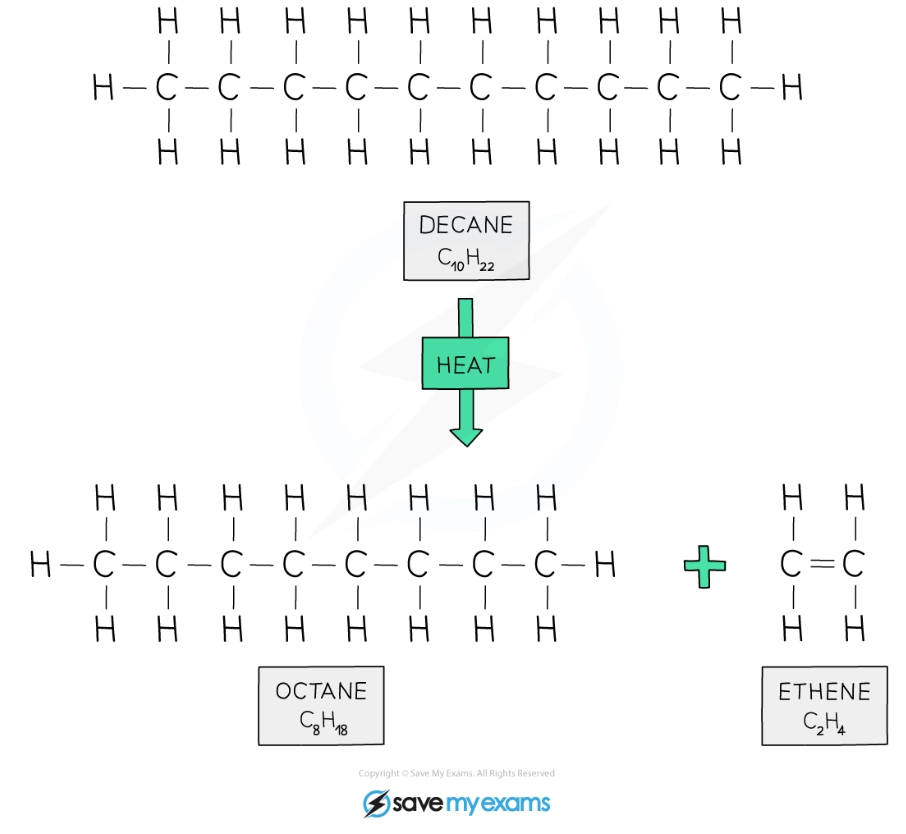
What is cracking?
Thermal decomposition of long-chain alkenes to turn them into:
Shorter alkanes
One or more alkenes
Hydrogen
What are the conditions needed for cracking to occur?
High temperature (between 600 and 700 celsius typically)
Catalyst (aluminium/sulfur dioxide typically)
State the process of cracking
Long-chain alkanes are heated until they vapourise
Vapours pass over the catalyst which breaks the C-C bonds
Large molecules randomly split up into mixture of alkanes, alkenes and hydrogen
What happens during an addition reaction?
Occurs when small molecule adds across double carbon covalent bond
C=C bonds broken
New single bonds formed
Only one product formed
What are examples of addition reactions?
Bromine: aqueous bromine test
Hydrogen: reaction of alkene + hydrogen makes an alkane (with use of catalyst)
Steam: reaction of alkene + steam makes an alcohol (with use of acid catalyst) — also known as hydration reaction