Chapter 5 - DNA & Chromosomes
 Call Kai
 Learn
Learn Practice Test
 Spaced Repetition
 Match
Match Flashcards
 Knowt Play
1/32

There's no tags or description
Looks like no tags are added yet.
Name | Mastery | Learn | Test | Matching | Spaced | Call with Kai | Chat |
|---|
No analytics yet
Send a link to your students to track their progress
33 Terms
Griffith's Experiment (1928)
Discovered the 'transforming principle' using virulent (S) and non-virulent (R) Streptococcus pneumoniae in mice.

Avery, MacLeod, and McCarty Experiment (1944)
Demonstrated that DNA, not protein or RNA, is the chemical nature of genetic material.
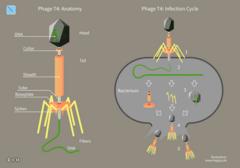
Hershey and Chase Experiment (1952)
Used bacteriophages to confirm that DNA carries genetic information into host bacteria.
Components of a Nucleotide
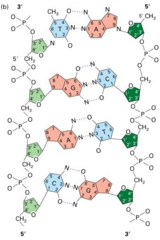
A five-carbon sugar, a nitrogenous base, and a phosphate group.

Phosphodiester Bond
Covalent linkage connecting the 3′-hydroxyl of one sugar to the 5′-phosphate of the next.
DNA Strand Polarity
Determined by 5′ end (free phosphate) and 3′ end (free hydroxyl).

Purine vs Pyrimidine Bonding to Sugar
N9 of purines and N1 of pyrimidines bond to the 1′ carbon of ribose/deoxyribose.

Chargaff's First Rule
In DNA, the amount of adenine equals thymine (A=T) and guanine equals cytosine (G=C).
Chargaff's Second Rule
The percentage of G+C content is constant for a given species.
Rosalind Franklin's Contribution
Provided X-ray diffraction images (Photo 51) proving DNA is helical with stacked base pairs.

Hydrogen Bonds Between Base Pairs
Two hydrogen bonds between A and T; three hydrogen bonds between G and C.
B-DNA Structural Parameters
Right-handed helix, ~20 Å diameter, 10 base pairs per turn, 34 Å pitch.
Antiparallel Strands
The two DNA strands run in opposite 5′-to-3′ chemical directions.
Human Genome Size and Chromosomes
Approximately 3 billion base pairs packaged into 23 pairs of chromosomes.
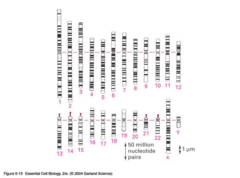
Giemsa Stain Dark Bands
Indicate AT-rich regions of chromosomes.
Reciprocal Chromosomal Translocation
Swapping of segments between non-homologous chromosomes; commonly found in cancer cells.
Origins of Replication
Specialized DNA sequences where DNA replication begins bidirectionally during interphase.
Centromere Function
Attaches duplicated chromosomes to the mitotic spindle for proper segregation during M phase.
Telomeres
Repetitive DNA sequences at chromosome ends that ensure complete replication and protection.
Nucleolus Function
Nuclear site where ribosomal RNAs are synthesized and combined with proteins to form ribosomes.
Euchromatin
Extended, less condensed form of interphase chromatin containing actively expressed genes.
Heterochromatin
Highly condensed interphase chromatin containing mostly gene-poor regions.
Nucleosome Core Structure
DNA wrapped ~1.7 times in a left-handed coil around a histone octamer disc.
Histone Octamer Composition
Two molecules each of histones H2A, H2B, H3, and H4.
Chromatin Looped Domains
Chromatin loops clamped at the base by nonhistone chromosomal proteins.
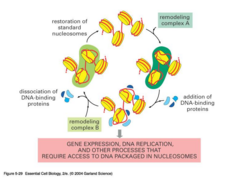
Chromatin-Remodeling Complexes
ATP-dependent protein complexes that loosen and reposition nucleosomes along DNA.
Histone Tail Modifications
Covalent additions (acetyl, methyl, phosphate) to N-terminal tails regulating chromatin accessibility.
Histone Acetylation Effect
Neutralizes positive charge on lysines, loosening chromatin structure to promote gene expression.

Constitutive Heterochromatin
Permanently condensed, repetitive DNA found mainly at centromeres and telomeres.
Facultative Heterochromatin
Reversibly silenced chromatin regions regulated by mechanisms like histone deacetylation or RNAi.
Heterochromatin Protein 1 (HP1)
Binds specifically to methylated H3K9 to facilitate heterochromatin spreading and condensation.
X-Chromosome Inactivation
Random condensation of one X chromosome into heterochromatin in early female mammalian embryos.
Barr Body
The dense, inactive X chromosome observed at the nuclear periphery of female cells.