Sleep & D exam 1
 Call Kai
 Learn
Learn Practice Test
 Spaced Repetition
 Match
Match Flashcards
 Knowt Play
1/38

There's no tags or description
Looks like no tags are added yet.
Name | Mastery | Learn | Test | Matching | Spaced | Call with Kai | Chat |
|---|
No analytics yet
Send a link to your students to track their progress
39 Terms
Polysomnography (PSG)
Overnight tracking of physiological channels:
3 main parts
brain activity (EEG)
eye movements (EOG)
muscle movements (EMG)
more that may be added
nasel flow
respiratory effort
oxygen saturation
cardiac rate and rhythm
…and more
pros:
cons:
lab is an unfamiliar, clinical environment; patients are hooked up to monitors & wires
expensive
Electroencephalogram (EEG)
dates to 1920s
series of macroelectrodes placed across scalp
shows relative (not absolute) brain activity, between 2 adjacent electrodes
EOG and EMG
Sleep onset (SOL)
time it takes to fall asleep
Sleep efficiency (SE)
total time asleep (TST) / the total time in bed
Wake after sleep onset (WASO)
amount of time awake after first sleep
Multiple sleep latency test (MSLT)
Sleepiness test
given 4 or 5 nap opportunities every 2 hours
if patient takes an average of 5 or less mins to sleep = at risk for sleep disorder
if patient has quick entry into REM = likely narcolepsy
Maintenance of wakefulness test (MWT)
Sleepiness test
told to stay awake in bed, in a dark room during the day
Actigraphy and wearables
wristband measures ur movement
the original focus was sleep/wake not includes heart rate, etc.
Advantages:
discrete, forget its there, for research: able to track many people sleep at once, for ex, across regions
Disadvantages:
hard to know how accurate it is, may work different for different people
maybe risk for causing or worsening “Orthosomnia“ - being obsessed with your sleep
Subjective measures of sleep
Intake interviews: before sleep tests, questions like “how much sleep do you get per night”
Sleep diaries: thing were doing for assignment now
Self-report questionnaires: things we did for first assignment
CR 4 activity patterns
Diurnal- awake during day, sleep at night (humans)\
Nocturnal- sleep during day (owls)
Crepuscular- most active at dusk and dawn (foxes, deer)
Cathemeral- don’t fit in the other categories, unpredictable, active & sleep during day & night(lions)
Phase delay
sleep cycle is shifted later (like blue light keeping you awake)
Phase advance
sleep cycle is shifted earlier
Phase peak
top of sleep cycle
Phase nadir
bottom of sleep cycle
Early CR research- de Mairan (1729) - Study of mimosa pudica plant
like sunflowers, this plant follows the patterns of the sun
but found this was actually an internal process not really from the sun
Early CR research- Kleitman & Richardson (1938)- Mammoth cave experiment
studying CR in isolation
slept in cave with no light, or outside cues
they started having a cycle of over 24 hours
found that humans dont have exacly 24 hour internal cycle
Early CR research- Aschoff & Wever (1976)- Bunker experiments
slept in bunkers with no light, or outside cues
able to choose their own light/dark times, and sleep/wake times
people went to bed later and later
found we have an average of 24 hr. 11 min. cycle
Circadian Rhythm (“Process C”)
Internal clock, roughly 24.2 hours
promotes wake or sleep depending on the time
synchronized with external cues
Zeitgebers (“time givers“)
Light/ dark
Others (e.g. feeding times)
Physiology of CR “Process C"
suprachiasmatic nucleus (SCN) as central pacemaker
melatonin as dark signal for body
sleep onset
releases around 9pm for us
process of release is same for diurnal & nocturnal
Pathway: Pineal gland —> SCN
Sleep pressure (“Process S“)
homeostatic
buildup of adenosine while awake
inhibition of regions involved in arousal
depleted during sleep
Two-process model (Borbély, 1982)
interaction of Process C & Process S
smaller gap between the two processes means a smaller desire for sleep
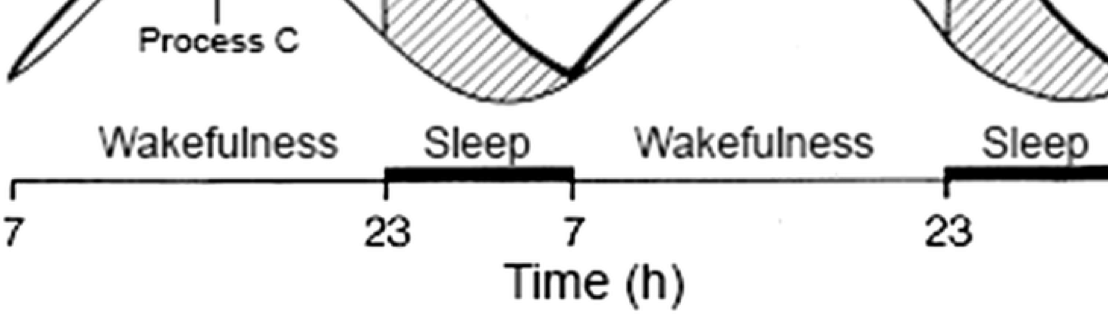
Influence of caffeine
Antagonist for adenosine
adenosine continues to be produced and built up but has no where to go
caffeine fills the receptor sites so adenosine can’t
Peak & Half-life
peak is about a half hour after consuming the caffeine
half-life is about 5-7 hours after consuming the caffeine
Caffeine crash is because adenosine is still building up, so when the caffeine wears off, you notice all the built up sleepiness
Individual differences-
more or less efficient enzymes
age- caffeine effects & lasts longer for old people than young people
Effects of artificial light on CR
Blue light
eye —> thalamus —> SCN —> pineal gland —> melatonin
Light hygiene- getting bright light during day & lowering light exposure at night
CR- Jet lag
Eastbound- wont be tired for bed, no melatonin yet cause we think its earlier than is
Westbound- will be tired before bed
Going eastbound is harder to adjust to than westbound
people find it easier to stay up late than go to bed early
Treatment:
east- phase advance
melatonin
bright light in morning
west- phase delay
light in evening
dark in morning
red-eye- hardest bc you leave one day and arrive the next
sleep on plane
stay awake through day 2
no naps
bright light
CR- Nightshift work
Concerns
shift is inconsistent with light and dark
bright light from sun when you get out of shift may keep you awake
often revert to “normal“ schedule on days off
Health concerns
world health org- classified shift work as a carcinogen in 2007
links with various health impacts
Treatment
days off “compromise“ phase position, go to bed at 3am instead of 8am
melatonin, blackout curtains, white noise
limit light exposure when driving home
Chronotypes
morningness vs. eveningness
factors leading to which a person is
genetic
social
environment
developmental stage
young kids go to bed & wake up earlier than teens/young adults, then older adults revert back to earlier sleep & wake
personality differences
the big 5:
morning ppl high in- conscientiousness
evening ppl high in- extraversion, openness, risk-taking, sensation seeking
health
physical
morning- healthy behaviors
evening- diabetes, heart disease, cancer
psychological-
evening- depression, anxiety
Delayed sleep-wake phase disorder (DSWPD)
Consistent phase delay (fall asleep and wake up much later than most)
Advanced sleep-wake phase disorder (ASWPD)
Consistent phase advance (fall asleep and wake up much earlier than most)
Irregular sleep-wake rhythm disorder (ISWRD)
Sleep occurs in multiple bouts throughout the day and night
Non-24-hour sleep-wake rhythm disorder (N24SWRD)
“Free running disorder” – follow +24 hr. rhythm, mostly seen in blind people
Sleep stages- Stage 1 (N1)
less than 10 minutes spent in this stage
spend the least amount of time in this stage, ab 2-5% of the night
lightest sleep we have
decreased breathing, muscle tone
slow rolling eye movements
hypogogic hallucinations- hearing sounds, feeling like ur falling
hypnic jerks
slight lowering of awareness
may deny or be unaware of being in N1 (“no I wasn’t sleeping”)
Sleep stages- Stage 2 (N2)
Body
no eye movement
decreasing muscle tone
metabolic activity
Brain
mostly theta waves (moderate frequency)
k complexes: (“knock”)
occurs ab 1/min
Sleep spindles
high frequency
occurs ab 2.5/min
may help maintain sleep
hippocampus —> memory cortex
Sleep stages- Stage 3 (N3)
Body
decreased muscle tone, breathing rate, metabolic activity
hormone release (growth hormones)
Brain
delta waves- low frequency
high amplitude
high synchronization
thalamus is turning down signals for environment to protect from waking
parasympathetic NS dominates
Experience
hard to be woken up
confusion/ mental fog/ grogginess
dreaming occurs, less vivid and less common than in REM
parasomnias occur here
Sleep stages- Rapid eye movement (REM)
Body
rapid eye movement, eyes are synchronized
atonia- no muscle tone
blood flow in brain similar to waking
irregular breathing, heart rate
tumescence (genital arousal/ bood engorgement)
Brain
no delta waves, instead “sawtooth waves“ like alpha, beta
phasic vs. tonic
phasic: Rem, irregularities, twitches, no k complexes/sleep spindles, thalamus & amygdala are highly active, less activity in prefrontal cortex
tonic: no REM, less irregularity
Experience
vivid dreaming, most frequent
almost as hard to be woken up as in N3
Brain waves during sleep
Gamma waves - during high alertness and deep focus - 30-100Hz
Beta waves - while awake - 13-30Hz
Alpha waves - while relaxed or sleepy - 8-13Hz
Theta waves - during stage 1 & 2, light sleep - 4-8Hz
Delta waves - during stage 3, deep sleep - 1-4Hz
to remember the order:
Great Big Apples Taste Delicious