Economics ALL
 Call Kai
 Learn
Learn Practice Test
 Spaced Repetition
 Match
Match Flashcards
 Knowt Play
1/67

There's no tags or description
Looks like no tags are added yet.
Name | Mastery | Learn | Test | Matching | Spaced | Call with Kai |
|---|
No analytics yet
Send a link to your students to track their progress
68 Terms
What is a market
A place or situation where commodities are exchanged
Provides an opportunity for buyers and sellers to interact
What is a market economy
A system where individuals own most of the resources and control the use and price of these resources through voluntary decisions made in the marketplace
Microeconomics focuses on…
the study of a market structure and the efficiency of market equilibrium
What are the 4 structures of the market
Perfect Competition - Many sellers and many buyers
Monopoly - Few sellers and many buyers
Monopsony - Many sellers and few buyers
Bilateral Monopoly - Few sellers and few buyers
What conditions must be met to call a commodity market Perfect Competition
Firms produce a homogeneous commodity (exactly same)
Large number of buyers and sellers (no exploitation)
Perfect information (for both buyers and sellers)
All resources are perfectly mobile (labor and capital)
These conditions are rarely satisfied in any real market.
Provides a base for comparing the performances of various kinds of market imperfections
Forest productions are close to a perfect competition
What is Price Determination?
Prices set by consumers or producers or both. Prices governed by relative power of each group, creating Imperfect Markets
Consumers face price determined by the producer
Consumers select a combination of commodities that would maximize his/her utility from a given budget
Producers also face labor and capital prices
Producers decide how much to produce to maximize their profits based on prices of inputs and consumer prices
What are the 3 kinds of producer powered markets in Imperfect Market Conditions
Few sellers and many buyers
Monopoly (one seller)
Duopoly (two sellers)
Oligopoly (few sellers)
Info on a Monopoly
Single seller with a large number of buyers
No good substitutes for a product in a monopolist
Public utility industries (water, power)
Public monopolies are seen as more efficient by the public, however they are inefficient
Government regulated monopolies often used to achieve social objectives beyond the product they supply
Governments usually act to break up monopolies in the private sector
Monopoly vs Perfect Competition
Monopoly - Prices are higehr, Output is lower. There are welfare implications, and monopolies affects consumers and producers’ welfare
Perfect Competition - Prices are lower, output is higher
Disadvantages of Monopoly
Outputs tend to be lower than the social optimum
Prices tend to be higher than the social optimum
Profits tend to be lower than the social optimum
Efficiency of production is lower due to lack of competitive pressures
Advantages of Monopoly
Resource conservation
Concern for future generations
Concern for research
Technological improvement are possible
Patent and intellectual property protections can create short term monopolies. This is considered an incentive to invest and innovate (some research suggests that this benefit may be over estimated)
What is consumer surplus
The difference between the prices consumers are willing to pay and the actual price
Varies by individual and product
Higher demand products that experience production shortages have higher surplus, although sometimes short lived
In theory, over the long - term consumer surplus tends to get reduced as prices move to equilibrium
Consumers’ surplus of the society is the surplus enjoyed by the entire group
Price gouging and natural disasters
What are secondary markets (Sometimes called Black Market)
(high demand products with production shortages = high surplus) Often in these situations the secondary market takes advantage and reduces the consumer surplus (i.e. ticket scalpers)
What is Price Gouging?
The practice of increasing the price of goods or services to a level much higher than is considered reasonably fair
Most jurisdictions have enacted laws to prevent price gouging
Sellers take advantage of the increase in prices to move their goods into an area experiencing scarcity
However, it also allocates more in-demand resources to an area in need
Higher prices discourage hoarding behavior, as consumers are less likely to stock up on an item whose price is artificially increased by shock, and thus create a more equitable distribution of necessary commodities
Why is Law of Supply & Demand important?
It helps investors, entrepreneurs, and economists understand and predict market conditions
It is the main model of price determination used in economic theory
Price of a commodity is determined by the interaction of supply and demand in a market
What is Demand?
The desire, ability, and willingness to buy a product or service
What is a demand schedule?
Is a listing that shows the quantity demanded at all prices
As price increases, quantity demanded _____
Decreases
What causes a shift in demand?
Non - price determinants
What are the 6 non price determinants of demand?
Buyer’s income
Price of substitutes
Market size (immigration)
Consumer tastes (popularity
Consumer expectations
Complement goods (the use of one product increases the use of another. Ex. phone and cellular providers)
What is Demand Elasticity?
The extent to which changes in price cause changes in quantity demanded
What is Elastic and Inelastic demand
Elastic - Occurs when a relatively small change in price causes a relatively large change in the quantity demanded
Inelastic Demand - Occurs when a change in price causes a relatively smaller change in the quantity demanded
5 Factors that determine Elasticity of Demand
Substitutes
Percentage of income
Necessity
Duration
Breadth of definition
3 questions for estimating elasticity of demand
Can the purchase be delayed?
Are there adequate substitutes?
Does purchase use a large portion of income?
2 or more yes = elastic
2 or more no = inelastic
What is supply
The desire, ability, and willingness to offer products for sale
Anyone who offers an economic product for sale is a supplier
When you work at a job, you are offering your services for sale. Your economic product is labor, and you would probably supply more for a higher wage
Law of Supply - as price increases, quantity supplied _____
Increases
What changes the quantity supplied?
Non price determinants of supply
What are the 7 non price determinants of supply
Number of products
Input costs
Labor productivity (skilled workers more productive) (taxes or subsidies) affect cost
Technology
Government action
Number of sellers
Producer expectations (change in production based on whether they believe price will go up or down)
What is market equilibrium, what is the equation?
Situations where prices are relatively stable and the quantity of goods or services supplied is equal to the quantity demanded
QS = QD
What is Equilibrium Price
The price that “clears the market”. No shortage or surplus
What is Surplus?
Where the quantity supplied is greater than the quantity demanded at a given price
QS > QD
P decreases
If there is a surplus, prices generally fall
What is a Shortage
Where the quantity demanded is greater than the quantity supplied
QD > QS
P increases
How does supply and demand reflect in forestry
Boom and Bust cycles of highs and low prices
Forestry is highly sensitive to market fluctuations
Demand for forest products can vary significantly based on economic conditions, housing markets, and global trade dynamics
Forest products are commodities, subject to price volatility
When demand surges, prices rise, leading to a boom
Oversupply or reduced demand can trigger a bust
Revenue = Sales price * number of units sold
Types of revenue
Sales revenue - Generated from sales
Service revenue - Generated from providing services
Interest revenue - Generated from lending money
Rental revenue - Generated from renting assets
Royalties revenue - Generated from licensing intellectual property
Importance of revenue
Measure of a firm’s financial performance
Used to calculate other important financial metrics, such as profitability, revenue growth, and revenue per employee
What are the limitations of revenue
Not a complete measure of a firm’s financial performance. Does not account for expenses that a firm incurs in generating revenue.
Revenue does not account for changes in inventory levels or other balance sheet items
Operating income is revenue less or more than operating expenses?
less
What is Non operating income
Infrequent or non recurring income derived from secondary sources
What are production costs
Reflect all costs a business pays associated with manufacturing or providing a service
Ex. Labor, raw materials, overhead, consumable manufacturing supplies
Total production cost = total direct materials + labor costs + manufacturing overhead costs
Examples of Direct and Indirect costs
Direct - Materials like plastic, metal, worker’s salaries
Indirect - Overhead, rent, utilities
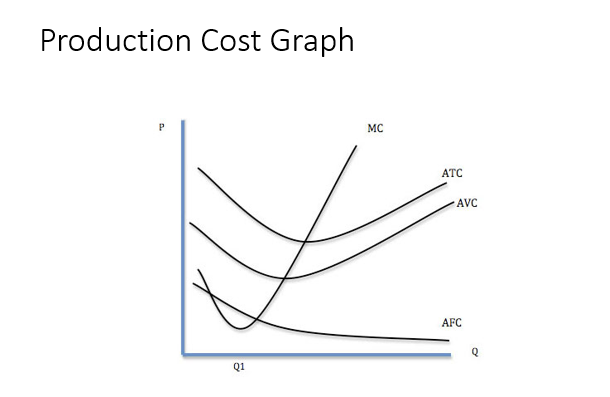
What is marginal cost of production
The total cost to produce one additional unit
Production costs VS Manufacturing costs
Production costs includes both direct and indirect costs, refers to all expenses associated with a business
Manufacturing costs include only direct costs
Examples of a fixed cost
Equipment rental, property tax, office space rent, employee’s salaries and benefits, insurance,
Examples of variable costs
Cost of purchasing materials, hourly employees, utility bills, advertising,
Quantity produced
Determining the number of units a company is producing is also necessary for the cost per unit calculation
What are economies of scale
when the average costs per unit of output decrease as the volume of the output manufactures or sells increases
It cam provide a competitive edge with a cost advantage
What is Survivor Technique
Involves identifying the most efficient firms in a given industry and using their performance as a benchmark to estimate the production frontier
“survivors” because a firm survived the industry by bring more efficient than competitors
What is Size Efficiency in relation to Survivor Technique
Refers to when a firm is able to achieve the maximum possible level of output given its size. Measures how well a firm is able to utilize its scale of production to achieve efficient levels of input
An economic profit or loss id the difference between the __ __ _ _ __ _ _ ___ and the __ _ _ __ and any ____ ____
An economic profit is the difference between the revenue received from the sale of an output and the cost of all inputs used and any opportunity costs
What are opportunity costs
Represent the benefits an individual, investor, or business misses out on when choosing one alternative or another
Opportunity cost calculation
= FO - CO
FO = Return on best foregone option
CO = Return on chosen option
What is time value of money also known as?
Present Discounted Value
What is the idea of Time Value of Money
Money available at the present time is worth more than the identical amount in the future due to potential earning capacity
Present Value Formula
PV = FV / (1+I) ^N
PV = present value
FV = the future value
I = Required return
N = the number of time periods before receiving the money
To determine the current value of future cash flow, evaluate… (2)
Time value of money
Uncertainty risk
How do you determine discount rate (the current value of future cash flow)?
Evaluate the time value of money and the uncertainty risk
What changes TVM? (time value of money)
Inflation causing cash flow of tomorrow to not be worth as much as cash flow today
All prediction models have a level of ________ to their predictions
Uncertainty
Lower discount rate would imply _____ uncertainty the _____ the present value of future cash flow (ans. lower or higher)
Discount rate would imply LOWER uncertainty the HIGHER the present value
What is Net Present Value? What is it used for?
The difference between the present value of cash inflows and the present value of cash outflows over a period of time.
It is used in capital budgeting and investment planning to analyze the profitability of a projected investment or project.
What are Cash Flow Projections?
Cash produced by a company’s business operations after paying for operating expenses and capital expenditures
What is Discount Rate?
The cost of capital (dept and equity) for the business. This rate, which acts like an interest rate on future cash inflows, is used to convert them into current dollar equivalents
What is Terminal Value?
The value of an investment at the end of the projection period
What is Production Function?
The relationship between the flow of quantities of various inputs and the maximum flow of quantity of output
Gives information about increasing or decreasing returns to scale and the marginal products of labor and capital
5

