Hip lab MSK LQ
 Call Kai
 Learn
Learn Practice Test
 Spaced Repetition
 Match
Match Flashcards
 Knowt Play
1/79

There's no tags or description
Looks like no tags are added yet.
Name | Mastery | Learn | Test | Matching | Spaced | Call with Kai | Chat |
|---|
No analytics yet
Send a link to your students to track their progress
80 Terms
Femoral retroversion presentation
Decreased internal rotation, increased external rotation, and a toe-out standing posture.
Femoral anteversion presentation
Increased internal rotation, decreased external rotation, and a toe-in standing posture.
Craig's test purpose
Prone measurement of the angle of femoral anteversion or retroversion.
Craig's test normal range
8 to 15 degrees of internal rotation.
Craig's test interpretation
->15 degrees indicates anteversion;
-<8 degrees indicates retroversion.
Craig's test
patient prone with knee flexed to 90° palpate greater trochanter and slowly move hip through internal/external rotation.
when greater trochanter feels most lateral stop, and measure the angle of leg relative to a line perpendicular with table surface
Normal angle = 8°-15° hip internal rotation
< 8° = retroverted hip; > 15° = anteverted hip
Hip Intra-articular Hip Pathologies:
-Femoroacetabular Impingement Syndrome (FAIS)
-Microinstability
-Hip OA
FABER test components
Flexion, Abduction, and External Rotation.
FABER test pain localization
-Anterior hip/groin indicates hip joint
-PSIS indicates sacroiliac joint.
-Low back: Lumbar spine
- Lateral hip pain may indicate gluteal tendon or trochanteric bursa involvement
Scour test
Flex hip to 90º→hip adduction and apply pressure→move hip through arc of motion while maintaining axial load through the femur
(+) test = reproduction of clicking or popping, if it hurts, then distraction should make it better
Scour test positive signs
-Anterior groin pain indicates hip pathology
-crepitus indicates intra-articular disruption.
FADIR test purpose
Tests for Femoroacetabular Impingement Syndrome (FAIS) or labral tears.
FADIR
flexion, adduction, internal rotation
Posterior impingement test movement
Sweeps hip from FADIR position into abduction, external rotation, and extension.
+ Posterior impingement test
pain= + test for posterior labral tear of the hip
log roll test
-Patient supine with hip in neutral position
-Patient's leg passively rolled into full internal and external rotation
-Positive = increased external rotation indicating iliofemoral ligament laxity
-Positive = clicking, suggestive of labral tear
Log Roll test positive findings
-Groin pain indicates microinstability
-increased ER indicates anterior capsuloligamentous laxity.
HEER test purpose
Tests for anterior microinstability or anterior labral tears.
HEER test maneuver
The patient holds the contralateral extremity in flexion while the examiner rotates the test hip laterally+extension
HEER test findinga
Hyperextension External Rotation (HEER) Test
Suspicion of hip dysplasia or Instability
A sense of apprehension from the patient or reproduction of the patient's symptoms of anterior hip or groin pain
HEER test assesses
anterior microinstability of the hip joint or possible anterior labral tear
Adductor squeeze test
The patient lies on their back with hips bent to 45°, knees at 90°, and feet flat on the table. The examiner places a fist between the patient's knees.
The patient squeezes inward, contracting both adductor muscles.
Adductor squeeze test positive
Pain reproduction during bilateral adductor contraction against examiner's fist.
Gluteal de-rotation test
-Position the hip in 90/90 position +full passive ER
-Instruct the patient to resist your attempt to further externally rotate the hip by performing an isometric internal rotation
-Then assess AROM+PROM IR
Gluteal de-rotation test positive
-Pain at the lateral hip suggests Greater Trochanteric Pain Syndrome (GTPS).
-If passive rotation range into hip IR is >1.5× greater than active and pain occurs in the groin with passive medial rotation, this suggests hip OA.
Gluteal de-rotation test OA indicator
Passive IR range >1.5x active range with groin pain.
trendelenburg test
Have the patient stand on one leg for 6–30 seconds
Trendelenburg sign positive
Pelvis drops >2 cm on the lifted side, indicating gluteus medius weakness.
normal trendelenburg
Pelvis rises slightly on the lifted side.
Trendeleburg progression
corkscrew” test
corkscrew” test
(rotating left and right while squatting).
poor hip stability signs during corkscrew test
Medial hip rotation
Knee valgus
Foot pronation
SLS Pain provocation test
The patient stands on one leg while the examiner provides light support.
SLS Pain provocation test normal
the ability to lift and hold the pelvis on the non-stance side for at least 30 seconds.
SLS Pain provocation test abnormal
Contralateral pelvis drops below horizontal or hip moves into early adduction.
Active piriformis test
1) Pt is side-lying w/hip flexed to 45 degrees and knee flexed 90 degrees
2) Examiner positions superior leg into hip abduction and external rotation. Examiner stabilization superior iliac crest.
3) Patient will resist the examiners force of hip adduction and internal rotation. (do bilaterally)
Active piriformis test +
Resisted active abduction and external rotation reproduces lateral ischial pain and neurological symptoms
Seated piriformis test
Knee extended, flexed hip passively adducted and internally rotated to reproduce pain.
Sidelying ischiofemoral impingement test
Passive hip extension, adduction, and external rotation reproduces pain.
Long stride test: Trailing leg pain
Indicates Ischiofemoral Impingement (IFI) compressing the quadratus femoris.
Long stride test: Heel strike pain
Indicates Proximal Hamstring Tendinopathy (PHT) from rapid eccentric loading.
Long stride test: Pain relieved when stride is shortened
Either condition, but IFI more likely
Long stride test: Pain worsens with faster walking or running
PHT more likely
True vs. Functional leg length discrepancy
True is structural/anatomic bone shortening; Functional is positional/compensatory.
functional leg length can result from
Unilateral foot pronation
Pelvic obliquity
Scoliosis or spinal asymmetry
Hip contractures, muscle imbalance, or spasm
True leg length measurement landmarks
From the distal ASIS to the medial malleolus.
To differentiate which part for a leg length discrepancy
-Iliac crest to GT: for Coxa vara or valga
-GT to knee: for femoral shaft length
-Knee to medial malleolus for tibial shaft length
Weber-Barstow maneuver
The patient is asked to lift the pelvis off the table and then return to the starting position to help equalize pelvic alignment. The examiner then passively extends both legs and compares the levels of the medial malleoli by observing the thumb positions.
Weber-Barstow maneuver reasoning
Visual assessment of leg-length asymmetry using medial malleoli levels after bridging.
Patellar Pubic percussion test positive
A dull or diminished sound on the affected side, indicating bone fracture.
Fulcrum test purpose
Detects femoral stress fractures using progressive downward knee pressure.
-Very sensitive
Prone knee bending test (Nachlas)
-Pain in the lumbar region, buttock, or posterior thigh suggests possible L2-L3 nerve root irritation.
-Pain in the anterior thigh indicates either tight quadriceps or femoral nerve stretching.
-If the rectus femoris is tight, bringing the heel fully to the buttock may cause anterior pelvic torsion, potentially leading to secondary sacroiliac or lumbar discomfort.
Sign of the buttock test positive
Hip flexion remains limited even after bending the knee during SLR.
Ober test positive
Leg remains abducted and fails to drop below horizontal, indicating ITB/TFL tightness.
Variations of obers
-Knee flexed: Ober's original version. Flexion increases femoral nerve tension and reduces ITB stretch.
-Knee extended: Provides greater ITB tension and better isolates ITB contracture.
-Neurological symptoms (pain, paresthesia) during testing may suggest femoral nerve irritation.
Thomas test positive
The opposite thigh rises off the table, indicating hip flexor contracture.
Lateral Rotator Tightness:
-Ask the patient to medially rotate the hip (the foot moves outward).
-Normal range: approximately 30-40° of medial rotation.
-Positive finding: Limited medial rotation (<30-40°) with a muscle stretch end feel, indicating tight lateral rotators (e.g., piriformis, obturator internus, gemelli).
Medial Rotator Tightness:
-Ask the patient to laterally rotate the hip (the foot moves inward).
-Normal range: approximately 40-60° of lateral rotation.
-Positive finding: Limited lateral rotation (<40-60°) with a muscle stretch end feel, suggesting tight medial rotators (e.g., tensor fasciae latae, gluteus minimus).
Adduction contracture test
-The examiner passively abducts the test leg while monitoring pelvic motion.
-Normally, the hip can abduct 30°-50° before the ASIS begins to move.
-If the ASIS shifts before this range, it indicates tightness or contracture in the adductor muscles.
-A positive test occurs when the affected leg forms an angle less than 90° with the line joining the ASISs, or when the pelvis tilts upward on the test side (or downward on the opposite side) during abduction, preventing proper pelvic "balancing."
Abduction contracture test
-The examiner passively adducts the test leg while monitoring for pelvic movement.
-Normally, the hip can adduct about 30° before the ASIS begins to move.
-If the ASIS moves before reaching 30°, and the end feel is that of a muscle stretch, the abductors are tight.
-If a contracture is present, the affected leg forms an angle greater than 90° with the line joining the ASISs.
-When attempting to rebalance the pelvis, the ASIS shifts downward on the affected side or upward on the opposite side, making pelvic alignment difficult.
Ely's test positive
Prone knee flexion causes spontaneous hip flexion, indicating tight rectus femoris.
90/90 hamstring test normal
Active knee extension within 20 degrees of full extension.
Rectus Femoris Contracture Test
also called Modified Thomas Test
patient is positioned at the end of table w/only the butt on the table
___Patient flexes 1 knee to their chest while supine & the other knee should remain at 90 of knee flexion
___If not at 90, examiner tries to passively bring the knee to 90 while palpating the muscle
___Bilaterally performed
___Positive findings: knee does not remain at 90 &/or hip flexes
___Indications: tight rectus femoris &/or iliopsoas
The Star Excursion Balance Test (SEBT)
The test involves standing on one leg in the center of a grid with eight lines extending outward at 45° angles (like a star).
While keeping the stance leg stable, the individual uses the non-stance leg to reach as far as possible along one line, lightly touches the line with the toes, and returns to the center without losing balance.
Y balance test
•Shortened version of star excursion test
•Three directions (forms a Y)
•Anterior
•Posteromedial
•Posterolateral
SEBT simplified version directions
Anterior, posteromedial, and posterolateral.
Step down test
A 20-cm (8-inch) stool or step is placed in front of the patient. The patient is instructed to place one foot on the stool and then stand up fully so they are balanced on that single leg.
The patient then slowly lowers the opposite leg toward the floor, maintaining control throughout the movement.
normal step down test
The movement is done with the arms relaxed at the sides,
The trunk remains upright, and
There is no hip adduction or internal rotation of the weight-bearing leg.
abnormal step down test
Arm abduction for balance,
Forward trunk lean,
Hip adduction or medial rotation, or
Pelvic drop or backward rotation,
Single leg squat tets
The subject stands barefoot with the test leg centered on the vertical line.
The opposite knee is flexed to 90°, keeping it off the ground.
The subject is instructed to squat down until the horizontal tape just disappears from view beyond their toes, then return to the starting position.
coppenhagen hip exercise
Side plank with Top LE on chair and contracting adductors to lift body up
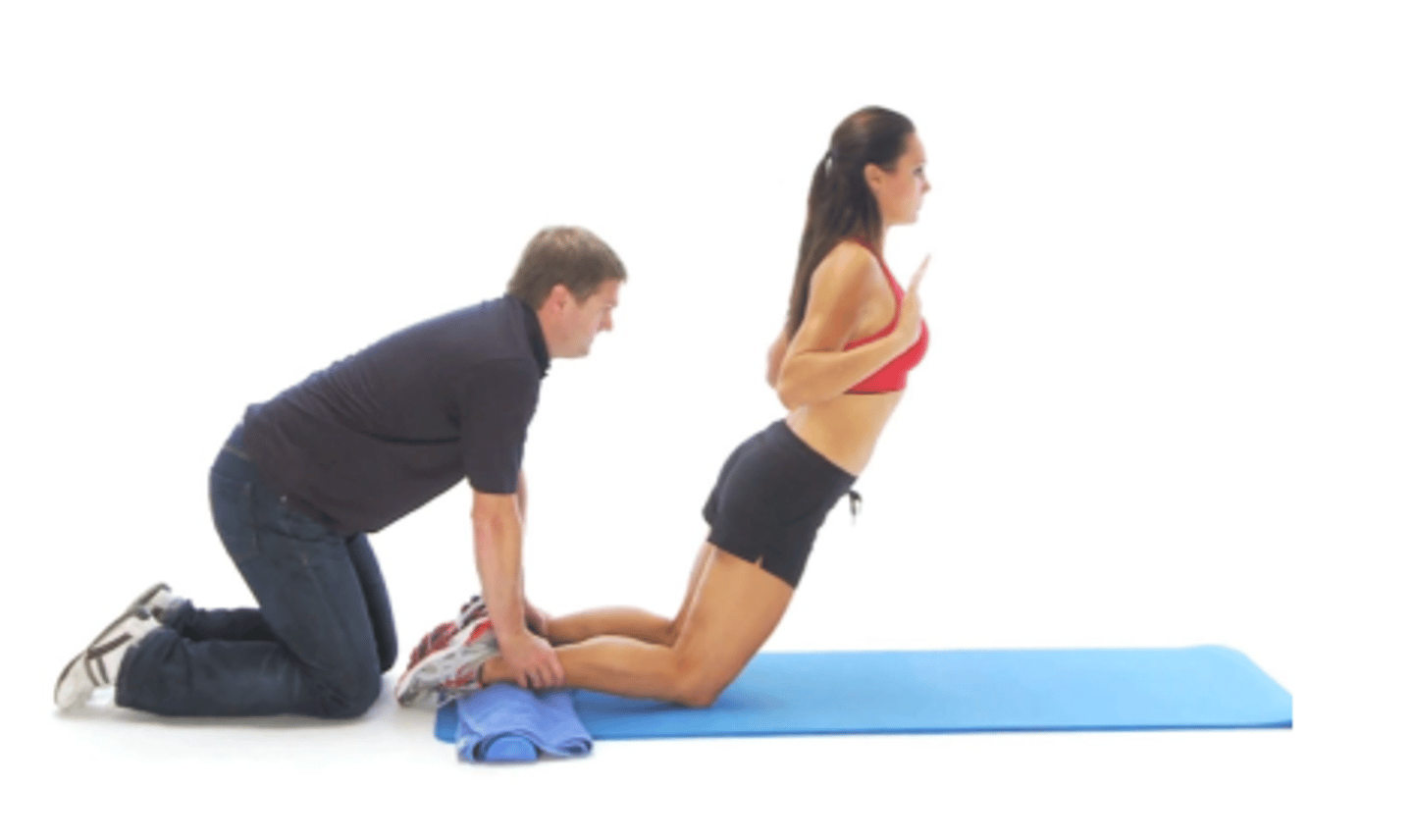
Nordic hamstring exercise
An exercise that strengthens the hamstring muscle and can reduce the likelihood of hamstring tears.
Exercises with High Gluteus Medius to Tensor Fascial Latae Muscle Recrutiment
Resisted clamshell, resisted sidestep, SL bridge with opposite hip in extension
Hip extension MET
Manually resist (sub-max isometric) hip flexion,
hold 5 sec
hip abduction MWM
1. Apply an inferior-medial glide at the greater
trochanter
2. Actively or passively abduct the hip through the pain-
free range
Hip extension MWM
1. Apply an anterior glide at the proximal femur
2. Actively or passively extend the hip through the pain-
free range
Hip flexion MWM
1. Apply an inferior glide at the proximal femur
2. Actively or passively flex the hip through the pain-free
rangeH
Hip IR/ER MWM
1. Apply a lateral distraction glide at the proximal femur
2. Actively or passively externally or internally rotate the hip through the pain-free range
Low load isometrics
4 repetitions of 45-60 seconds submaximal
traditional isometrics
10 repetitions of 6-10 seconds