NIFE Aero Ch. 2
 Call Kai
 Learn
Learn Practice Test
 Spaced Repetition
 Match
Match Flashcards
 Knowt Play
1/16

There's no tags or description
Looks like no tags are added yet.
Name | Mastery | Learn | Test | Matching | Spaced | Call with Kai | Chat |
|---|
No analytics yet
Send a link to your students to track their progress
17 Terms
DEFINE parasite drag and its components: form and friction drag
Parasite drag is not associated with the production of lift.
Form drag - results from the disruption of the streamline flow. Caused by laminar flow separation from the surface creating a low pressure wake behind an object (drag)
Friction drag - as a result of friction on the surface of the aircraft. Turbulent flow creates more friction than laminar.
Describe induced drag
Induced drag is inherent whenever a wing is producing lift and, in fact, affects the vertical lift component counteracting weight.
- created in part by wingtip vortices that makes for twice as much downwash as upwash near the wingtips. Thus average relative wind has downward slant compared to free airstream relative wind, rotating the lift vector and producing a smaller lift component and new induced drag component
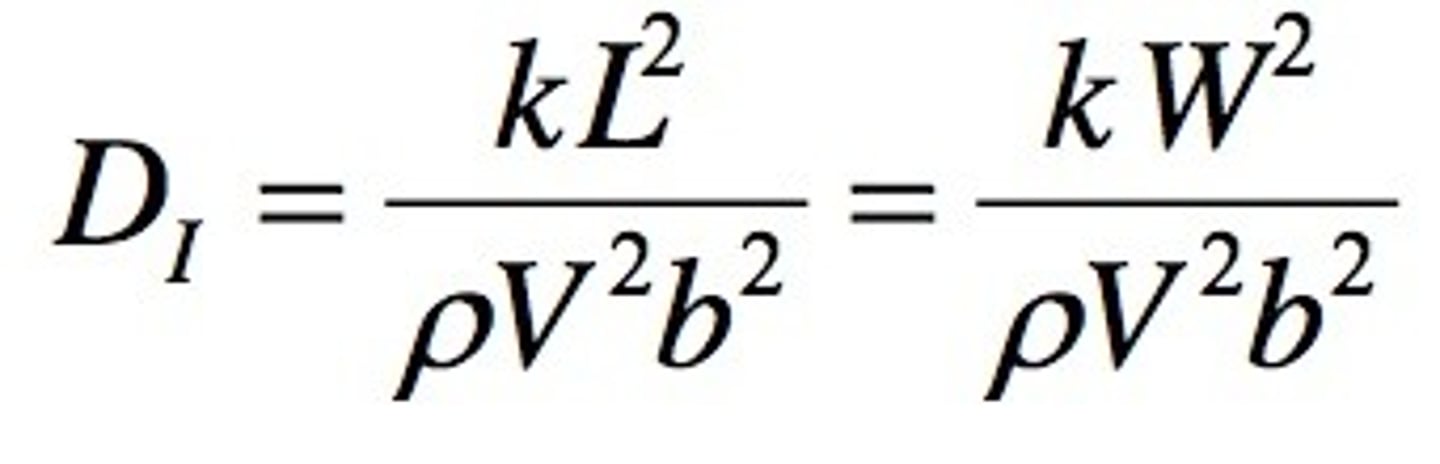
Describe the factors affecting induced drag, given the induced drag equation, and changes in lift, weight, density, velocity and wingspan
-increase in lift = increase in induced drag
-increase in weight = increase in induced drag
-increase in density = decrease in induced drag
-increase in velocity = decrease in induced drag
-increase in wingspan = decrease in induced drag
List prevention methods of induced drag in a classroom
-decrease AOA
-increase Velocity
-install winglets, wingtip tanks or missile rails to stop spanwise flow
Define total drag
Total drag is the sum of parasite and induced drag
Describe the effects of changes in velocity on total drag
As velocity increases, total drag will decrease with decreasing induced drag then hit a minimum, followed by a rise due to increasing parasite drag
Explain the importance of L/Dmax
-located at the bottom of total drag curve
-any movement away from this point will produce more drag
-most efficient AOA for wing (not engine)
-parasite drag and induced drag are equal at this point
-Greatest lift to drag ratio
-max range
Define the boundary layer
the boundary layer is that layer of airflow over a surface that demonstrates local airflow retardation due to viscosity (no more than 1 mm thick)
Describe the different types of flow within the boundary layer
Laminar flow: air that moves smoothly along in streamlines. Produces very little friction but is very easily separated from the surface.
Turbulent flow: the streamlines break up and the flow is disorganized and irregular. Produces higher friction drag than a laminar boundary layer, but adheres better to the upper surface of the airfoil and delays boundary layer separation
Describe boundary layer separation in regards to adverse pressure gradient
As the airflow moves past the point of maximum thickness, the flow goes from a low static pressure to a higher static pressure near the trailing edge (an adverse pressure gradient)
This impedes the flow of the boundary layer and if the gradient is strong enough, the boundary layer could stagnate and separate from the surface. Enough separation will lead to a stall
Define stall
a condition of flight in which an increase in AOA results in a decrease in CL
Explain the difference between true and indicated stall speed
True stall speed is the actual speed at which you are moving through a particular air mass in which you would stall (the true airspeed)
Indicated stall speed will remain constant regardless of altitude, etc
Explain the effects of gross weight, altitude, and flaps given the stall speed equation
- As weight decreases, both IASs and Vs will decrease
- As altitude increases, true stall speed will increase and indicated stall speed will remain constant
- Flaps will decrease stall speed
Explain the difference between speeds with respect to power on and power off stalls
The power-on stall is lower than a power-off stall. This is due to the fact that some of the aircraft's weight is actually supported by the vertical component of the thrust vector. Also the wing directly behind the prop produces more lift due to prop wash
Describe the factors necessary for an airplane to spin
A spin is an aggravated stall that results in an autorotation.
Conditions
1.) the aircraft must be stalled
2.) Yaw must be present
Describe the relationship between the wings during a spin
The yawing motion creates an AOA difference between the left and right wing. the down-going (inside) wing sense a different average relative wind producing a higher AOA (more stalled). while the up-going wing (outside) has a lower AOA and is less stalled
- Asymmetrically stalled wings
Describe the actions necessary to recover from a spin
Pilot must reduce AOA and use opposite rudder to correct the yaw input