UNLV KIN 224 Exam 1
 Call Kai
 Learn
Learn Practice Test
 Spaced Repetition
 Match
Match Flashcards
 Knowt Play
1/134

There's no tags or description
Looks like no tags are added yet.
Name | Mastery | Learn | Test | Matching | Spaced | Call with Kai | Chat |
|---|
No analytics yet
Send a link to your students to track their progress
135 Terms
Postganglionic axons are
A.) sometimes myelinated and sometimes unmyelinated.
B.) myelinated.
C.) unmyelinated.
C. unmyelinated.
Which of the following is correct about the autonomic nervous system (ANS)?
A. All of the choices are correct.
B. The ANS is part of both the CNS and the PNS.
C. ANS functions are involuntary.
D. ANS motor neurons innervate cardiac muscle fibers, smooth muscle fibers, and glands.
E. ANS motor pathways always include two neurons.
A. All of the choices are correct.
We lack awareness of many of our bodies' systems for maintaining homeostasis. The sensations, movements, and secretions of organs such as the heart and intestines are governed by the
A. autonomic nervous system.
B. somatic nervous system.
A. autonomic nervous system.
Which system contains short preganglionic axons that branch extensively?
A. Somatic nervous system
B. Sympathetic nervous system
C. Parasympathetic nervous system
B. Sympathetic nervous system
Which division functions to conserve energy and replenish the supply of nutrients?
A. Parasympathetic
B. Somatic
C. Sympathetic
A. Parasympathetic
The "fight-or-flight" system is the __________ nervous system.
A. sympathetic
B. somatic
C. parasympathetic
A. sympathetic
The postganglionic parasympathetic fibers that are controlled by pelvic splanchnic nerves innervate the
a: Large intestine
b: Reproductive organs
c: Salivary glands
d: Pupillary constrictor muscles
e: Urinary bladder
f: Ureters
A.) a, c
B.) a, b, e, f
C.) a, d, e
D.) b, c, e
E.) c, d, f
B.) a, b, e, f
The cranial nerve having multiple terminal and intramural ganglia is
A. CN IX.
B. CN XII.
C. CN X.
D. CN III.
E. CN VII.
C. CN X
From which part of the CNS do parasympathetic preganglionic axons of CN VII emerge?
A. Lateral horns of the T1 spinal cord segment
B. Cerebral cortex
C. Mesencephalon
D. Lateral horns of the S1 spinal cord segment
E. Pons
E. Pons
Which sympathetic pathway involves a preganglionic neuron that synapses with a ganglionic neuron in a sympathetic trunk ganglion, but the postganglionic axon does not leave the trunk via a gray ramus?
A. Splanchnic nerve pathway
B. Adrenal medulla pathway
C. Postganglionic sympathetic nerve pathway
D. Spinal nerve pathway
E. None of the choices is correct.
C. Postganglionic sympathetic nerve pathway
Gray rami from the sympathetic trunk connect to
A. alternating spinal nerves.
B. the cranial nerves.
C. all spinal nerves.
D. the sympathetic trunk.
C. all spinal nerves.
Select all that are locations where neurons in the enteric nervous system can be found.
- Submucosal plexus
- Myenteric plexus
- Cardiac plexus
- Hypogastric plexus
-Submucosal plexus
-Myenteric plexus
Which autonomic plexus innervates viscera within the pelvic region?
A. Pulmonary plexus
B. Hypogastric plexus
C. bdominal aortic plexus
D. Esophageal plexus
E. Cardiac plexus
B. Hypogastric plexus
Select all that are examples of how autonomic reflexes help maintain homeostasis.
-Decreasing blood pressure
-Emptying of the bladder
-Initiating defecation
-Preventing overstretching of skeletal muscles
-Decreasing blood pressure
-Emptying of the bladder
-Initiating defecation
Stimulation of β2 receptors in the lung causes
A. bronchodilation
B. bronchoconstriction.
A. bronchodilation
Nicotinic receptors bind
A. acetylcholine and allow sodium ions to enter the cell.
B. acetylcholine and allow chloride ions to exit the cell.
C. norepinephrine and allow potassium entry, thereby exciting the cell.
D. muscarine and increase the contractility of intestinal muscle.
E. norepinephrine and can either stimulate or inhibit the cell.
A. acetylcholine and allow sodium ions to enter the cell.
The diameter of many blood vessels is controlled exclusively by the ________ nervous system, and decreases in the activity of this system result in _________.
A. parasympathetic; vasoconstriction
B. sympathetic; vasodilation
C. parasympathetic; vasodilation
D. somatic; vasoconstriction
E. sympathetic; vasoconstriction
B. sympathetic; vasodilation
Which type of innervation causes pupil dilation?
A. Parasympathetic
B. Sympathetic
B. Sympathetic
Sweat glands and arrector pili muscles are controlled
A. only by the parasympathetic nervous system.
B. only by the sympathetic nervous system.
C. by both the autonomic and somatic nervous systems.
D. by both the sympathetic and parasympathetic nervous systems.
B. only by the sympathetic nervous system.
A rise in blood pressure causes a reflexive
A. inhibition of both the parasympathetic system and the sympathetic system.
B. activation of the sympathetic system and inhibition of the parasympathetic system.
C. activation of the parasympathetic system and inhibition of the sympathetic system.
D. activation of both the parasympathetic system and the sympathetic system.
C. activation of the parasympathetic system and inhibition of the sympathetic system.
Compared to the nervous system, the endocrine system has
A. more widespread and long-lasting effects.
B. more widespread and short-term effects.
C. more localized and short-term effects.
D. more localized and long-lasting effects.
A. more widespread and long-lasting effects.
Which is NOT characteristic of the endocrine system?
A. Response time: slow reaction time = seconds to hours
B. Effects: causes metabolic activity changes in target cells
C. Duration of response: long-lasting = minutes to weeks
D. Communication method: hormones in the bloodstream
E. Recovery time: rapid, immediate return to prestimulation level
E. Recovery time: rapid, immediate return to prestimulation level
Aldosterone release can be triggered by the presence of the blood-borne messenger angiotensin II or by low levels of sodium, and so its secretion regulation is said to be
A. purely neural.
B. both hormonal and humoral.
C. both neural and synergistic.
D. both antagonistic and synergistic.
E. purely hormonal.
B. both hormonal and humoral.
Eicosanoids are synthesized from
A. prostaglandin.
B. amino acids.
C. cholesterol.
D. arachidonic acid.
D. arachidonic acid.
Thyroid hormone is somewhat unique in that it is a
A. protein hormone that is water-soluble.
B. biogenic amine that is lipid-soluble.
C. monoamine that is water-soluble.
D. steroid hormone that is lipid-soluble.
E. steroid hormone that is water-soluble.
B. biogenic amine that is lipid-soluble.
The half-life of a hormone is
A. the time necessary to reduce the hormone concentration in the blood to half of what had been secreted.
B. one-half of the time it takes to synthesize the chemical messenger molecule.
C. half of the duration of the hormone's effects on its target cells throughout the body.
D. half the time until the hormone molecule dissolves.
A. the time necessary to reduce the hormone concentration in the blood to half of what had been secreted.
In the signal transduction pathway that results in the formation of inositol triphosphate, the G protein directly activates
A. phospholipase C.
B. calmodulin.
C. protein kinase A.
D. adenylate cyclase.
A. phospholipase C.
A G protein is
A. a receptor for a water-soluble hormone that causes arachidonic acid to be extracted from a phospholipid.
B. a molecule that binds a guanine nucleotide and helps transduce a signal inside a target cell.
C. an enzyme that catalyzes the conversion of ATP into cyclic AMP.
D. a second messenger activated by a steroid hormone.
E. a type of water-soluble hormone.
B. a molecule that binds a guanine nucleotide and helps transduce a signal inside a target cell.
When the effects of one hormone reinforce the activity of another hormone on the same target cell, the interaction is said to be
A. agonistic.
B. permissive.
C. synergistic.
D. antagonistic.
C. synergistic.
The term down-regulation refers to the process by which
A. a carrier protein increases the rate of degradation for a hormone and thereby decreases its blood concentration.
B. a carrier protein decreases the rate of degradation of the protein it ferries.
C. a cell decreases the number of receptors it has for a hormone.
D. a glandular cell decreases the amount of hormone it secretes.
E. a large amount of hormone shuts down all metabolic activity in a target cell.
C. a cell decreases the number of receptors it has for a hormone.
Where are the target cells for follicle-stimulating hormone?
A. Ovaries and testes
B. Uterus
C. Mammary glands
D. Hair follicles
E. Thyroid follicles
A. Ovaries and testes
Thyrotropin-releasing hormone is secreted by the
A. anterior pituitary and it increases release of thyroid hormone from the thyroid gland.
B. thymus and it increases release of thyroid hormone from the thyroid gland.
C. hypothalamus and it increases release of thyroid-stimulating hormone from the anterior pituitary.
D. hypothalamus and it increases release of thyroid-stimulating hormone from the posterior pituitary.
E. parathyroid hormone and it increases release of thyroid hormone from the thyroid gland.
C. hypothalamus and it increases release of thyroid-stimulating hormone from the anterior pituitary.
The thyroid gland is located
A. immediately posterior to the cricoid cartilage.
B. anterior to the atria of the heart.
C. immediately anterior to the trachea.
D. immediately superior to the larynx.
C. immediately anterior to the trachea.
The release of hormones from the adrenal medulla is stimulated by
A. thyrotropic hormone.
B. growth hormone.
C. adrenocorticotropic hormone.
D. the sympathetic division of the autonomic nervous system.
E. follicle-stimulating hormone.
D. the sympathetic division of the autonomic nervous system.
Which region of the adrenal cortex synthesizes glucocorticoids?
A. Zona papillarosa
B. Zona reticularis
C. Zona glomerulosa
D. Zona fasciculata
E. Zona glucosa
D. Zona fasciculata
Which hormone induces its target cells to take up glucose, thereby lowering blood glucose levels?
A. Somatotropin
B. Pancreatic polypeptide
C. Glucagon
D. Insulin
E. Somatostatin
D. Insulin
Insulin causes a(n) _______ in glycogenesis in the liver and a(n) _______ in lipogenesis in adipose.
A. increase, increase
B. decrease, decrease
C. increase, decrease
D. decrease, increase
A. increase, increase
Which of the following does not have an endocrine function?
A. Adipose tissue
B. Liver
C. Small intestine
D. Urinary bladder
D. Urinary bladder
Which of the following is false?
A. The pineal gland forms part of the epithalamus.
B. Melatonin makes us feel alert and awake.
C. The pineal gland is found within the diencephalon of the brain.
D. The pineal gland secretes melatonin in a cyclical fashion.
B. Melatonin makes us feel alert and awake.
Compared to young adults, the elderly usually have ______ levels of circulating growth hormone and _____ levels of circulating sex hormones.
A. lower, higher
B. lower, lower
C. higher, lower
D. higher, higher
B. lower, lower
In which sympathetic pathway does the preganglionic neuron synapse with a ganglionic neuron, and the postganglionic axon does not leave the trunk via a gray ramus, but instead projects directly to the effector?
A. Postganglionic sympathetic nerve pathway
B. Descending pathway
C. Splanchnic nerve pathway
D. Adrenal medulla pathway
A. Postganglionic sympathetic nerve pathway
Activation of parasympathetic fibers in pelvic splanchnic nerves leads to
A. decreased smooth muscle motility in the digestive tract.
B. increased smooth muscle motility in the digestive tract.
C. no effect on the digestive tract.
B. increased smooth muscle motility in the digestive tract.
What visceral sensory stimulus triggers the autonomic reflex causing the reduction of blood pressure?
A. Stretching of the urinary bladder
B. Stretching of large blood vessels
C. Increased blood CO2
D. Increased body temperature
B. Stretching of large blood vessels
The glossopharyngeal nerve innervates the
A. parotid salivary gland.
B. sublingual salivary gland.
C. lacrimal gland.
D. large intestine.
E. ciliary muscle.
A. parotid salivary gland.
Cholinergic receptors that are always excitatory in the presence of ACh are called __________ receptors.
A. muscarinic
B. nicotinic
C. beta
D. catecholamine
B. nicotinic
Which of the following is an example of a system or function only controlled by the sympathetic nervous system?
A. The digestive (GI) tract
B. Heart rate
C. The adrenal medulla
D. Pupil size
C. The adrenal medulla
The preganglionic axons of CN III extend to the _______ ganglion.
A. ciliary
B. otic
C. submandibular
D. pelvic
E. pterygopalatine
A. ciliary
The autonomic nervous system has ___________ lower motor neuron(s) in each pathway.
A. four
B. three
C. one
D. two
D. two
While most organs are innervated by parasympathetic and sympathetic divisions and express antagonistic effects, the best example of a cooperative autonomic effect is demonstrated by what function?
A. Control of pupil diameter in the iris of the eye
B. Control of heart rate
C. Sexual function of the male reproductive system (erection and ejaculation)
D. Control of muscular activity in the GI tract
C. Sexual function of the male reproductive system (erection and ejaculation)
Motor neurons of the autonomic nervous system
A. always excite effector organs.
B. always inhibit effector organs.
C. can either excite or inhibit effector organs.
D. do not excite effector organs but monitor their status of activity.
C. can either excite or inhibit effector organs.
Autonomic tone refers to
A. the degree of tension in skeletal muscles at rest.
B. whether a response is stimulatory or inhibitory.
C. whether the body's reaction is to fight or to flee.
D. the continual activity maintained by the sympathetic and parasympathetic divisions.
D. the continual activity maintained by the sympathetic and parasympathetic divisions.
There are ________ prevertebral ganglia.
A. 3
B. 2
C. 5
D. 12
E. 4
A. 3
Which may be involved in an autonomic reflex?
A. Cardiac muscle contraction
B. Smooth muscle contraction
C. Secretion by glands
D. All of the choices are correct.
E. None of the choices are correct.
D. All of the choices are correct.
Once inside the sympathetic trunk, the sympathetic preganglionic axons
A. travel superiorly.
B. follow any of the routes listed.
C. remain at the level of entry.
D. travel inferiorly.
B. follow any of the routes listed.
Match the plexus with its function.
1. Esophogeal plexus
2. Hypogastric plexus
3. Pulmonary plexus
4. Abdominal aortic plexus
- Carries signal that control swallowing
- carries signals to pelvic region
- composed of celiac and mesenteric plexuses
- passes signals to bronchi
1. Esophogeal plexus = Carries signal that control swallowing
2. Hypogastric plexus = carries signals to pelvic region
3. Pulmonary plexus = passes signals to bronchi
4. Abdominal aortic plexus = composed of celiac and mesenteric plexuses
18. Label the structures in the parasympathetic division illustration.
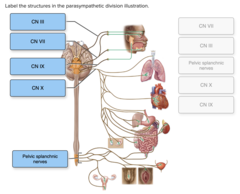
What are the names of the autonomic nerve plexuses in the body? Check all that apply.
- Hypogastric plexus
- Abdominal aortic plexus
- Esophageal plexus
- Pancreatic plexus
- Hypogastric plexus
- Abdominal aortic plexus
- Esophageal plexus
Protein hormones are
A. water-soluble
B. lipid-soluble.
C. soluble in both water and lipids.
D. soluble in neither water nor lipids.
A. water-soluble
_____________ hormones bind to nuclear receptors, usually found in the nucleus; _____________ hormones bind to membrane-bound receptors.
A. Lipid-soluble; water-soluble
B. Water-soluble; lipid-soluble
C. Lipid-soluble; lipid-soluble
D. Water-soluble; water-soluble
A. Lipid-soluble; water-soluble
Target organs regulate the pituitary through feedback loops. Most often, this takes the form of
A. direct nervous stimulation.
B. positive feedback.
C. All of the choices are correct.
D. negative feedback inhibition.
D. negative feedback inhibition.
The release of hormones from the adrenal cortex is stimulated by
A. thyroid hormone.
B. oxytocin.
C. luteinizing hormone.
D. antidiuretic hormone.
E. adrenocorticotropic hormone.
E. adrenocorticotropic hormone.
26 Within the infundibulum, the axons from neurons extending into the posterior pituitary are known as the
A. primary plexus.
B. supraoptic portal system.
C. secondary plexus.
D. hypothalamo-hypophyseal tract.
D. hypothalamo-hypophyseal tract.
The pituitary gland is located _________ to the hypothalamus and is connected by the ________.
A. inferior, epithalamus
B. posterior, infundibulum
C. inferior, infundibulum
D. superior, thalamus
C. inferior, infundibulum
Secretion of insulin causes
A. a decrease in the concentration of blood glucose.
B. a decrease in the permeability of cell membranes to glucose.
C. an increase in the breakdown of glycogen to release glucose.
D. an increase in the concentration of blood glucose.
A. a decrease in the concentration of blood glucose.
Which hormone group is not secreted by the adrenal cortex?
A. Glucocorticoids
B. No exceptions; all choices are secreted by the adrenal cortex
C. Gonadocorticoids
D. Mineralocorticoids
B. No exceptions; all choices are secreted by the adrenal cortex
Damage to the liver might impair enzymatic degradation of some hormones. The levels of such hormones in the blood would therefore be expected to
A. remain unchanged.
B. decrease.
C. increase.
C. increase.
The part of the brain that functions as a "master control center" of the endocrine system is the
A. pineal gland.
B. spinal cord.
C. cerebral cortex.
D. hypothalamus.
D. hypothalamus.
Thyroid hormone synthesis involves secretion of a glycoprotein called ___________ by the follicular cells.
A. thyroglobulin
B. tetraiodothyronine
C. thyroxine
D. triiodothyronine
A. thyroglobulin
The hypothalamo-hypophyseal portal system connects the hypothalamus to the
A. adenohypophysis.
B. thalamus.
C. neurohypophysis.
D. cerebral cortex.
A. adenohypophysis.
In response to high blood glucose, the pancreas releases insulin to enable glucose to enter body cells. When the blood glucose level returns to normal, insulin release stops. This is an example of regulation by
A. neural regulation.
B. somatic regulation.
C. endocrine dysplasia.
D. positive feedback.
E. negative feedback.
E. negative feedback.
Excessive secretion of growth hormone in adults can cause
A. acromegaly.
B. pituitary dwarfism.
C. Cushing syndrome.
D. pituitary gigantism.
E. Graves disease
A. acromegaly.
Indicate whether each statement is true or false regarding the structure and location of the parathyroid gland.
1. Embedded in the lobes of the thyroid gland
2. Secretes thyroid hormones
3. Secretes PTH
4. Organized in follicles
1. True
2. False
3. True
4. False
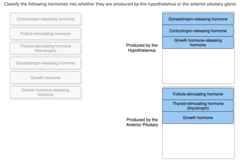
Classify the following hormones into whether they are produced by the hypothalamus or the anterior pituitary gland.
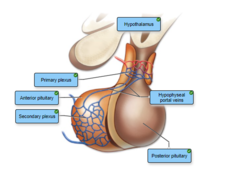
Drag and drop the labels into the appropriate location on the pituitary gland.
Match the description of the hormone interaction with the correct term.
Antagonistic effect, Synergistic effect, Permissive effect
1. Two or more hormones work together to produce a result.
2. A hormone enhances an organ's response to a second hormone, or increases the activity of the second hormone.
3. One hormone inhibits the secretion and action of another hormone, or has an opposite effect.
1. Synergistic effect
2. Permissive effect
3. Antagonistic effect
Read each description below regarding the dual innervation of the ANS. Then click and drag each into the appropriate category based on whether it is an example of antagonistic or cooperative innervation.

Label the autonomic plexuses in the figure.

Match the four pathways of sympathetic neurons with the region of the body having effector organs innervated by each pathway.
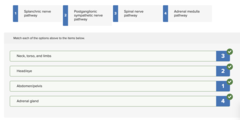
Which neurotransmitters are considered catecholamines? Check all that apply.

Which of the following are released from neurosecretory cells in the adrenal medulla as a result of sympathetic innervation? Check all that apply.

The cell bodies of the preganglionic neurons in the sympathetic division are located
A. in the brainstem.
B. in the lateral gray matter of the S2-S4 spinal cord segments.
C. in the lateral horns of the T1-L2 spinal cord segments.
D. in the lateral gray matter of the S1-S2 spinal cord segments.
C. in the lateral horns of the T1-L2 spinal cord segments.
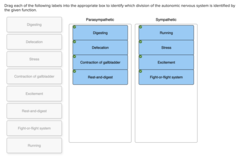
Drag each of the following labels into the appropriate box to identify which division of the autonomic nervous system is identified by the given function.
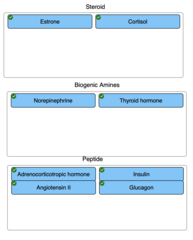
Drag each label to identify which hormones would be responsible for each description.
In Type I diabetes, blood sugar levels remain high after a meal because
A. too much insulin is released.
B. protein is converted to glucose.
C. no insulin is released.
D. the kidneys are not working.
C. no insulin is released.
The adrenal medulla secretes
A. glucocorticoids.
B. epinephrine and norepinephrine.
C. androgens.
D. aldosterone.
B. epinephrine and norepinephrine.
Which of the following statements about thyroxine is true?
A. It is water-insoluble.
B. It is lipophilic.
C. It can pass through the cell membrane.
D. All of these choices are correct.
D. All of these choices are correct.
The pancreas is
A. fused to the diaphragm.
B. located between the duodenum and spleen, just inferior to the stomach.
C. located between the lobes of the liver.
D. located superior to the kidneys.
B. located between the duodenum and spleen, just inferior to the stomach.
The suprarenal (adrenal) glands are located superior to which organ(s)?
A. Liver
B. Pancreas
C. Small intestine
D. Kidneys
D. Kidneys
The cortex of the suprarenal (adrenal) glands produces
A. epinephrine.
B. corticosteroids.
C. thyroxine.
D. insulin.
B. corticosteroids.
Correctly label the parts of the pancreas.

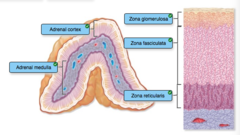
Correctly label the following parts of the adrenal gland.
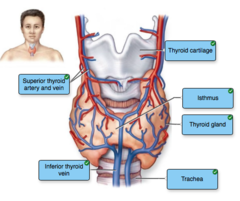
Correctly label the following gross anatomy of the thyroid gland.
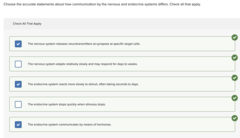
Choose the accurate statements about how communication by the nervous and endocrine systems differs. Check all that apply.
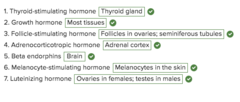
Match the target tissue with the hormone secreted by the anterior pituitary gland.
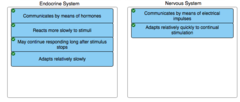
Classify the following as characteristics of the endocrine system or nervous system.
A hormone is a ______ and the target cell is __________.
A. protein that stimulates other cells; the source of hormone secretions
B. regulatory molecule that controls secretions of other cells; a cell that synthesizes hormones
C. molecule that has a metabolic effect on another cell; a cell that has receptors for specific hormones
D. None of these are correct.
C. molecule that has a metabolic effect on another cell; a cell that has receptors for specific hormones
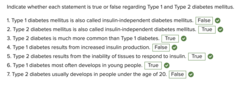
Indicate whether each statement is true or false regarding Type 1 and Type 2 diabetes mellitus.
Dual innervation by both the parasympathetic and sympathetic divisions of the ANS imparts what function to the organ?
A. Antagonistic or cooperative effects
B. Total antagonistic effect
C. Autonomic tone
D. Total cooperative effect
A. Antagonistic or cooperative effects
Many different neurons can stimulate an autonomic ganglion cell simultaneously due to
A. convergence
B. divergence.
C. reciprocity
D. reverberation.
A. convergence
The micturition autonomic reflex is associated with what organ?
A. Large intestine
B. Heart
C. Urinary bladder
D. Stomach
C. Urinary bladder