Science Guyz Chapter 1
 Call Kai
 Learn
Learn Practice Test
 Spaced Repetition
 Match
Match Flashcards
 Knowt Play
1/70

There's no tags or description
Looks like no tags are added yet.
Name | Mastery | Learn | Test | Matching | Spaced | Call with Kai | Chat |
|---|
No analytics yet
Send a link to your students to track their progress
71 Terms
Electronegativity
tendency of atom to attract electrons density towards itself causing unequal distribution in electrons
Ionic bonds
Electronegativty difference exceeds 1.7: attraction between oppositely charged ions
Covalent bonds
Electronegativity difference of 0 - 0.5: equal electron sharing
Polar covalent bond
in between 0.5 and 1.7: one atom pulls more strongly creating induction
Induction
tendancy of atoms to pull toward itself: represented by dipole arrow
Increasing electronegativity
towards right side and up
homolytic cleavage
breaks a non-polar covalent bond, with each atom retaining one electron, forming radicals
non metal + nonmetal doesn’t necessarily mean always covalent and non metal + metal doesn’t necessarily always mean ionic
Heterolytic cleavage
Breaks polar covalent bond
more electronegative atoms retains both electrons: formin an anion
curved arrows
depict electron movement
arrow shows the direction of electron flow
from source to destination

double headed arrow
shows an electron pair moving

single headed arrow
shows a single electron moving
formal charge
valence electrons - dots - lines
valence electrons of ions depend on charge
Lewis Structure Format
Sum up total valence electrons
Determine Central Atom (Usually Most Electropositive or in organic molecules always carbon)
Add valence electrons of central atom to central atom
Connect atoms via covalent bonds ( try to give each atom full octet)
Minimize formal charge
Exceptions to Octet Rule
Hyrogen only needs two e- for outer shell and still be stable with 0 e-
Boron only needs 6e- for stability
Beryllium only needs 4e- for stability
Non metals in period 3 or higher can have more than 8 electrons
formal charge can be negative
kekule structures
Like Lewis structures but omit lone pairs
Constitutional Isomers
Compounds with same molecular formula but differ in connectivity
have different physical properties
electrons are organized according to their energy level (n=1,n=2,etc) and sub-level (s,p,d,f)
atomic orbitals
atomic orbital
region of space in atoms where electrons are most likely to be found
degenerate orbitals
same energy level. Ex: 3 p orbitals
Shading of Orbitals represents phases. Shaded is + and not shaded is -
aufbau princple
lower energy Orbitals are filled first
Pauli Exclusion principle
each orbiatle can have 2 electrons. Must have opposite signs
Hunds Rule
Degenerate orbitals must be filled individually before spin-pairing
What happens when atomic orbitals combine according to molecular orbital (MO) theory?
The number of orbitals is conserved.
Two atomic orbitals combine to form two molecular orbitals:
Bonding MO: lower energy
Antibonding MO: higher energy
Antibonding MOs have misaligned phases/shading, creating a node (a region of destructive interference).
Highest Occupied Molecular Orbital (HOMO)
highest energy molecular orbital where electrons can be found
Lowest Unoccupied Molecular Orbital
Lowest energy molecular orbital where electrons can not be found
Why doesn’t helium exist as an diatomic like H2
Its anti-bonding orbital is filled
valence bond theory
covalent bond forms when:
two atoms reach an ideal bond length
orbital with one electron from each atom overlaps
sigma bonding
Same shaded region overlaps horizontally

results in single bonds
Sigma Antibonding
Opposite shaded regions overlap horizontally
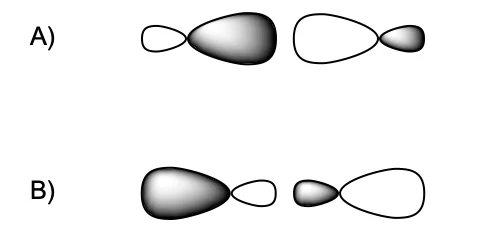
pi bonding
side to side overlap of same shaded p orbitals

anti pi bonding
side to side opposite shaded overlap of p orbitals

Hybridized orbitals
an atom ( besides hydrogen) bonds with atomic orbitals to create new ones that are more effective for bonding
sp³ Hybridization
one s orbital with 3 p to form 4 degenerate sp³ orbital
Tetrahedral
109.5 degree bond angle

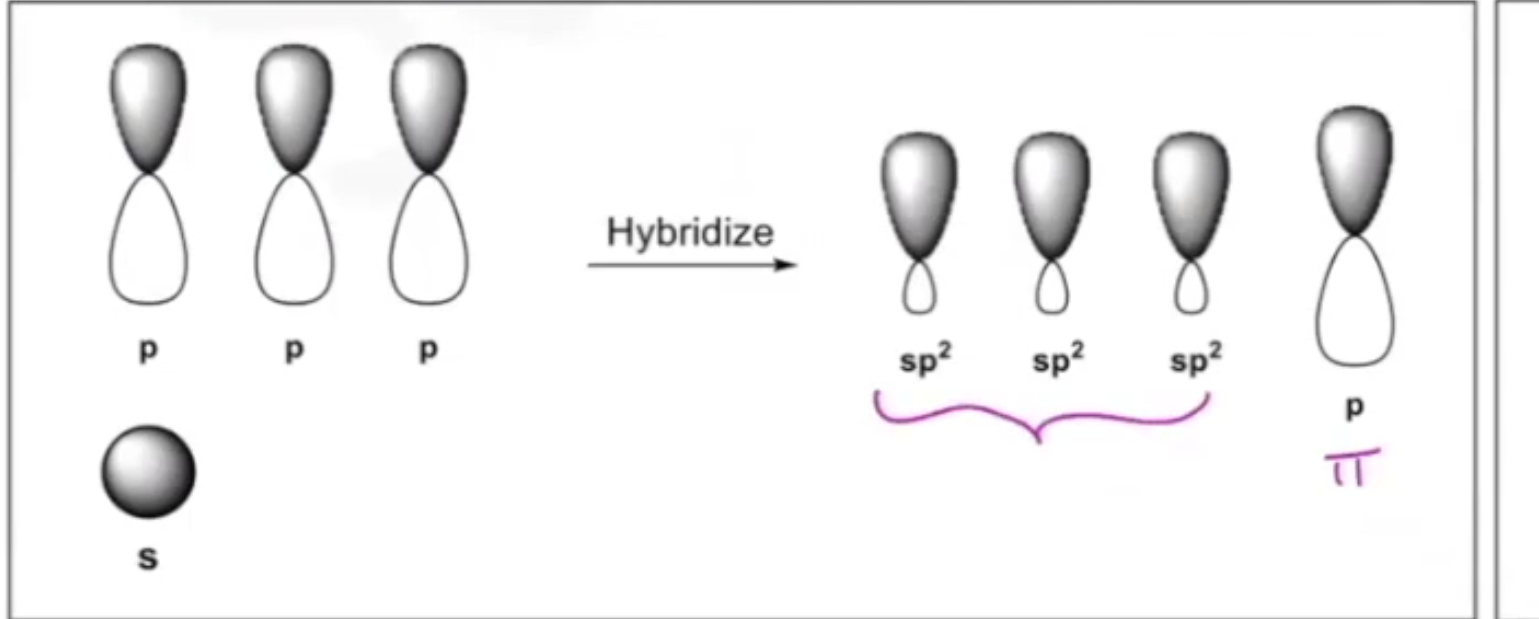
sp² Hybridization
one s orbital with 2 p to form 3 sp² and one unhybridized p orbital
trigonal planar
120 degree bond angle
sp hybridization
one s with one p to form 2 hybridized sp leaving behind 2 u hybridized p orbitals
linear
180 degree bond angle

Hybridization and Electron Density
2 regions of electron density = sp
3 regions of electron density = sp²
4 regions of electron density = sp³
Electron density exception
radicals are not counted
sigma bonding in Kekule structures
Number of Bonding Regions + number of hydrogens
Ex: This has 28
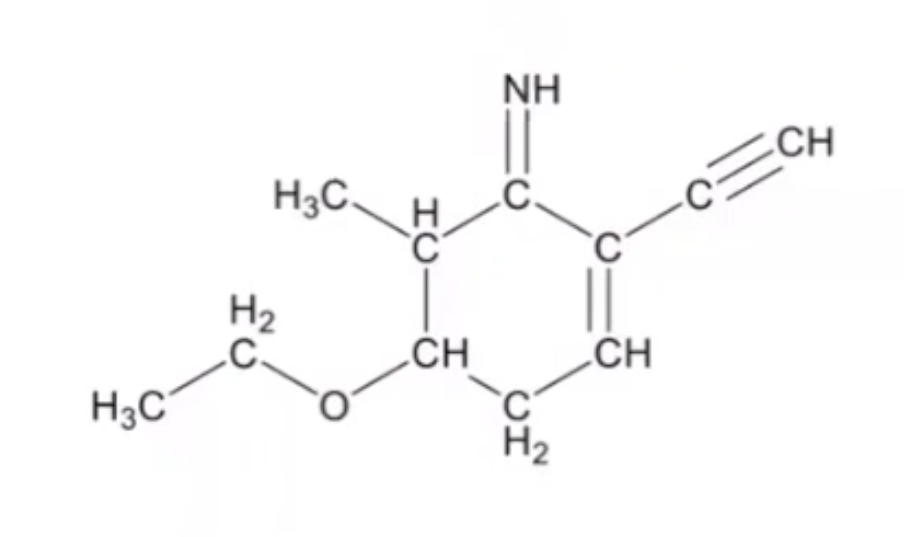
pi bonding in kekule structures
Extra lines in the bonding regions
Ex: this has 4

Linear (sp) = 2 pi bonds
4 example if there are 4 pi bonds then there are 2 sp
Trigonal Planar (sp²) = 1 pi bond
4 example if there are 4 pi bonds then there are 4 sp²
Tetralhedral = 0 pi bonds
find this by finding number of bonding regions then subtraction number is sp² and sp
VESPR Theory
Builds upon hybridization
influence of lone pairs on molecular geometry
Molecular Geometry takes into consideration lone pairs while Electronic does not
Trigonal Planar Electronic Geometry that includes one lone pair
Bent Molecular Geometry
Less than 120 degrees bond angle
Tetrahedral electron geometry that includes one lone pair
Trigonal Pyramidal Molecular Geometry
107 degree bond angle
Tetrahedral Molecular Geometry that includes 2 lone pairs
Bent Molecular Geometry
105 degree Bond angle
shorter bonds are stronger
Higher Bond Order
More shorter
Increase S character
Increased bond strength and decreased length
% s character = (number of s orbitals/ number s orbitals + number of p orbitals) * 100
Hydrogen Halides
The Bigger the Halogen, The longer the bond

indicator of polarity

=

Molecular with polar bonds can still be non polar if the polar bonds cancel each other out
Molecular Dipole Moment
Represents Sum of all dipole moment in a molecule
Dispersion Forces (LDF)
weakest type of IMF
When comparing Constitutional Isomers
More branched structures have weaker LDF
Larger atoms have stronger dispersion forces
Dipole-Dipole Interaction
Next strongest IMF
More polar bonds makes it stronger
H Bond (Strongest IMF)
When Bonded to O,N, or F
Similiar IMF =
Better solubility
To be an Hydrogen donor
hydrogen needs to be connected to O,N, or F
Hydrogen Acceptor
O,N,or F needs a lone pair
methine group
CH
methylene group
CH2
Methyl group
CH3