y5 bio: cluster 1 (carbs and lipids)
 Call Kai
 Learn
Learn Practice Test
 Spaced Repetition
 Match
Match Flashcards
 Knowt Play
1/25

There's no tags or description
Looks like no tags are added yet.
Name | Mastery | Learn | Test | Matching | Spaced | Call with Kai | Chat |
|---|
No analytics yet
Send a link to your students to track their progress
26 Terms
carbon has 4 valence electrons and is super versatile, what structures can it form?
chains, rings, branched, unbranched
NOTABLE UNIT CONVERSIONS (mega, mili, micro and nano)
mega (
what is the condensation reaction equation (reactants: monomers, products: polymers)?
monomers -> polymers + h2O
draw the diagram of 2 glucose monomers forming one maltose polymer
great job soldier (remember the BONDS)
macromolecules and monomers for starch, proteins, DNA
starch - polysaccharides, glucose
proteins - polypeptides, amino acids
DNA/RNA - nucleotides
glucose vs galactose (when drawing structure)
for glucose, at carbon 4, the -OH group points upwards, but for galactose, -OH group points downwards.

disaccharides breakdown (small little mice)
sucrose - glucose and fructose, lactose - glucose and galactose, maltose - glucose and glucose
polysaccharides examples
starch, glycogen, cellulose
glycogen definition
the storage form of glucose in animals (in plants, it’s starch!), and is present in liver and muscles
monosaccharides can be grouped into 2 groups, based on the number of carbons. what are these 2 groups?
pentose sugars - 5 carbons, C5H10O6 (e.g. d-ribose) AND hexose (these include GGF)- 6 carbons , C6H12O6 (alpha and beta glucose)
what are the 3 key properties and functions of glucose (solubility, oxidised, chemical stability)
soluble in water - transport of carbs in blood, where glucose is dissolved in plasma
can be oxidised - act as energy source in respiration (where aerobic gives high energy yield and anaerobic gives low energy yield)
chemically stable - act as energy storages as polysaccharides
2 types of starch
amylose and amylopectin
characteristics of amylose (bonds, linkages, structure, branching, starch %)
has only glycosidic bonds 1-4 linkages, linear linkages, helical coiled structure, unbranched, ~25% starch
characteristics of amylopectin (bonds, linkages, structure, branching, starch %)
has both glycosidic bonds 1-4 and 1-6 linkages, has moderate branching for efficient storage, ~75% starch
characteristics of glycogen (bonds, linkages, structure, branching)
has both glycosidic bonds 1-4 and 1-6 linkages, more branched than amylopectin, highly branched, allowing rapid glucose release when needed (fast energy storage in animals)
3 features of polysaccharides that make it good energy storage molecules (compactability, solubility, ease of adding/removing glucose)
compact due to coiling (amylose) and branching (amylopectin and glycogen)
relatively insoluble, so will have no osmotic problems
easy addition/removal of glucose monomers
formation of glucose in cellulose use beta glucoses, how is it orientated?
alternate units of beta-glucose monomers have to be oriented 180 degree celsius to one another to form beta (1,4) glycosidic bonds
purpose of oligosaccharides projecting from membrane?
enables cell cell recognition, and they help to bind cells to tissues and recognise if the cell is foreign or infected
3 types of lipids
triglycerides (made from normal glycerol + 3 fatty acid tails) to store energy + provide thermal insulation
phospholipids to regulate membrane permeability
steroids - regulate body processes (growth, metabolism)
example of steroid, its composition and function
steroid is a cholesterol, has 4 carbon rings and O-H group, function is to regulate the fluidity of the membrane
2 types of fatty acids
saturated and unsaturated
saturated VS unsaturated (bonding aspect)
saturated has NO double bonds, and only has C-C single bonds. unsaturated has 2 types of C=C double bonds (trans - H atoms opposite, cis - H atoms on same side)
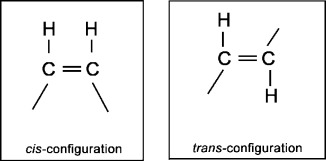
which fatty acid is the one that can pack closely tgt?
saturated fatty acid! unsaturated (specifically, cis) has a point of weakness, causing the tail to be kinked. so, it cannot be packed neatly and tends to be more liquid
unsaturated vs polyunsaturated fatty acids
poly has MULTIPLE C=C double bonds, create more kinks, has a lower melting point
storage efficiency of carbs VS lipids
carbs - 4 kcal/g, lipids - 9 kcal/g
how are triglycerides well-suited for their roles in long term energy storage + thermal insulation in ADIPOSE tissues?
triglycerides store more than twice the energy per unit mass than carbs. they remain in adipose tissues due to their hydrophobic nature. they also havelow thermal conductivity and are effective thermal insulators