Homeostasis
 Call Kai
 Learn
Learn Practice Test
 Spaced Repetition
 Match
Match Flashcards
 Knowt Play
1/57

There's no tags or description
Looks like no tags are added yet.
Name | Mastery | Learn | Test | Matching | Spaced | Call with Kai |
|---|
No analytics yet
Send a link to your students to track their progress
58 Terms
Homeostasis
The maintaining of internal conditions and concentrations
Homeostatic mechanisms involve detecting a change (stimuli) and initiating a response to the stimuli. This is done by the stimulus response model that had a series of similar steps with a response either reinforcing (positive) or counteracting (negative)
Receptors
Specialised sensory neurons that detect stimuli. Defined by what stimuli they detect
Can be internal or external
Types of Receptors
Thermoreceptors (temp)
Mechanoreceptors (touch)
Photoreceptor (light)
Chemoreceptor
Pain receptor
Osmo receptor
Responding system - Nervous system
Made up of the central and peripheral nervous system
CNS is brain and spinal cord whilst PNS is every other nerve
3 neurons make up this system
Sensory neuron (detect)
Interneuron (transmit)
Motor neuron (move)
Transimts messages as electrocal impulses, and occur quickly along neuron pathways
Area of impact is localised and specific with short response times.
Endocrine: ADH + Thyroxine
Endocrine system depends on chemical messages (hormones) being produced by glands and moving to target sites via the bloodstream
Slower and not as immediate
Large target sites and longer duration of effect
each hormone causes a different response
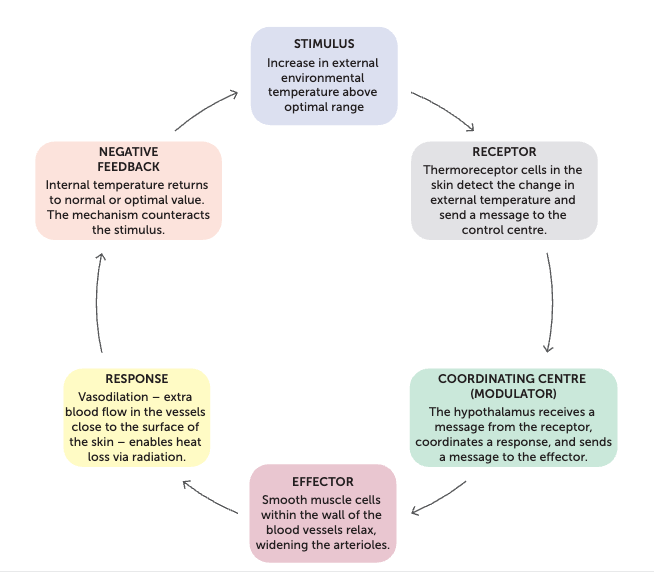
Feedback loop components
Stimuli
Receptor
Modulator
Effecter
Response
Feedback loop components - Stimuli
A detectable change in conditions
A deviation from the normal
Conditions/concentrations that are moving away from optimal range
Feedback loop components - Receptors
Sensory cells or tissues that detect a stimulus/change
Feedback loop components - Modulator
(Often the hypothalamus in the brain) reduces the message from the receptor and initiates a response by communicating with an effector
Feedback loop components - Effector
A part of the body/organism that carries out the response
Feedback loop components - Response
The action of the effector in response to the stimuli
If reinforcing (positive)
If counteracting (negative)
Tolerance Ranges
All organisms have set ranges of conditions/factors that they can exist within. The optimal range is where metabolism will occur at its best/most efficient rate; it is also the range where population numbers will be at their highest
Deviations from the optimal is where homeostatic responses take over and attempt to bring the factor back within the optimal zone
Tolerance Ranges - Internal factors
Temperature
Nitrogenous waste
Water
Gases
Tolerance Ranges: Internal factors - Temperature
An increase:
Enzymes denaturing, leading to critically slow cell metabolism
Cells can die
Membranes such as cell membranes become too fluid allowing some unwanted substances into or wanted substances out of cells
Rate of photosynthesis slows
A decrease:
Decrease in the activity rate of enzymes, which results in a decrease in metabolic rate
The activity of some other proteins decreases
Membranes such as cell membranes become rigid, slowing cell membrane transport
Mammals can suffer hypothermia, may lose limbs and cannot reproduces
Tolerance Ranges: Internal factors - Nitrogenous waste
An increase:
As nitrogenous waste builds up, they increased in concentration and become more toxic.
An increase in ammonia in the blood can lead to an increase in pH
Enzyme activity can decrease; enzymes will denature if pH gets too high.
High levels of nitrogenous waste can affect water balance. Cells may lose water to dilute the waste, affecting water homeostasis
A decrease:
Not applicable
Tolerance Ranges: Internal factors - Water
An increase:
Too much water results in the inability to regulate salt and other solute concentrations
An increase in water concentration leads to a decrease in the collision rates of reactants involved in biochemical pathways, slowing metabolism
An increase in water above the tolerance range leads to a hypotonic solution. ANimal cells can swell and burst (lysis), plant cells can swell.
Solute concentrations can be too low, leading to a decrease in collisions of reactant particles, slowing the rate of reactions, as in the coase of excess water concentration
A decrease:
Too little water results in the inability to regulate salt and other solute concentrations
A hypertonic solution can surround the cells, leading to movement of water out of the cells by osmosis
Dehydration - cells can shrink, and plant cells can undergo plasmolysis
Ions are unable to move to their reaction sites fast enough; metabolic rates slow down
Toxic waste cannot be excreted effectively, leading to increased pH, which affects enzyme activity
Blood plasma is 90% water in animals. A decrease in water content can slow the rate of transportation of nutrients and waste
Tolerance Ranges: Internal factors - Salts
An increase:
Salt ions such as Na+ and Ca+ are required within fairly narrow limits for normal activity of muscles, neurons and other body cells
As salt concentrations increases, water may be transported out of the cells by osmosis. This leads to cell shrinkage and dehydration
High levels of Na+ disenables regulation of salt concentrations and therefore water balance
Higher than normal levels of potassium (K+) can impair the function of skeletal muscles, the nervous system and the heart. High levels can cause excitation of muscle and nerve cells and cause muscle cells to lose the ability to relax
A decrease:
Low Ca+ levels can lead to muscle cramping in the legs and back
Low blood Na+ levels affect water balance, blood pressure and the nervous system
If the Na+ concentration outside cells is lower than inside, water moves into cells. Cells can swell with too much water. Swollen red blood cells can lose their oxygen carrying efficiency. This can lead to weakness, fatigue and confusion.
Tolerance Ranges: Internal factors - Gases
An increase:
High levels of CO2 can lead to a high concentration of H+ ions in solution which lowers the pH
Lowering of pH affects homeostasis and can reduce enzyme activity rate or denature enzymes
When the O2 level increases above the tolerance range in animals, this can be toxic. It can cause cell damage, nausea, dizziness and breathing problems
A decrease:
A reduction in O2 leads to a reduction in the respiration rate of ATP (energy) production
Low CO2 leads to lowered ventilation (breathing) rate in animals and a lower photosynthesis rate in plants
Basic Adaptations
Features organisms have to aid them in surviving particular conditions/environments
Adaptations aim to keep conditions within tolerance ranges
Broken up into three types
Physiological: A functional process
An increase in metabolism
Structural: A specialized shape, size and feature
Large SA:V ratio in ears
Behavioural: How organisms act
Huddling or seeking shade
Some adaptations overlap and may be linked or they depend on each other to be effective
Basic Adaptations - Thermoregulation
This refers to how organisms maintain temperature within tolerance ranges
To be able to know how organisms gain, lose and regulate we must know how heat energy moves
Thermoregulation: Heat movement
Moves down a gradient: goes from areas it is high to area where it is low
Conduction
Movement of heat through direct contact. Objects must be physically in contact with each other
Convection
Movement of liquids or gases due to difference in heat and therefore different densities. Also known as convection current.
Radiation
Movement of heat energy without the need for particles or a medium to travel through
A biological movement for thermoregulation is:
Evaporation
This is the movement of heat from an area due to a liquid evaporating into a gas. This results in heat moving from the source into the liquid and moves away as gases are produced
Basic Adaptations - Endotherms + Ectotherms
Ectotherms:
These are organisms whose internal temperature is dependent on the external temperature. As a result their metabolism increases and decreases with environmental temperature changes. Eg, Reptiles
Endotherms:
These organisms maintain an internal temperature independent to the environmental temperature. This means they have a base metabolic rate to ensure internal temperature can be maintained
Endotherms + Ectotherms Cost
Endotherms:
To maintain a stable internal temperature they may have a higher metabolic rate.
They need to spend more energy to maintain a higher metabolic rate.
This results in higher food requirements and more time spent finding food
Ectotherms:
Body temperature is dependent on the external environment.
These animals are limited to living in environments with less extreme temperatures.
They cannot tolerate very high or very low external temperatures
Endotherms + Ectotherms Benefit
Endotherms:
Body temperature is independent of external temperature.
This enables endotherms to live in more extreme environments.
They can be active at night (when some ectotherms are not) or move often during the day and in cold weather.
Being more active may reduce the chance of predation
Ectotherms:
Their heat source is mainly the environment, so there are lower energy requirements for these animals.
Therefore, they need to consume less food.
They can spend less time hunting for food.
They can tolerate larger fluctuations in their internal body temperature compared with endotherms
Thermoregulation in Hot Environments
Organisms that live in hot environments have to reduce heat gain and increase heat loss
Large SA:V ratio
Large vascularised ears
Licking of forearms
Vasodilation*
Sweating*
Panting
Pilorelaxation
Pale colouration
Burrowing
Mud coverings
Excessive skin
Reducing contact with hot surfaces
Thermoregulation in Hot Environments - Large SA:V Ratio
Organisms in hot climates typically have a large SA:V ratio as this increases the efficiency of heat being lost to the environment
Thermoregulation in Hot Environments - Large Vascularised Ears
A common structural adaptation is large, think and highly vascularised ears. This increases the amount of heat that can be lost due to its high SA:V ratio and being highly vascularised (vasodilation). Flapping ears increases the movement of air over the surface, increasing the amount of heat loss.
Thermoregulation in Hot Environments - Licking of Forearms
Kangaroos have a behavioural response to lick the forearm as it is high in blood vessels and the addition of moisture increases evaporation, therefore lowering body temp
Thermoregulation in Hot Environments - Vasodilation
The expanding of blood vessels near the surface of the skin to increase blood flow to the area and increasing heat loss from the body
Thermoregulation in Hot Environments - Sweating
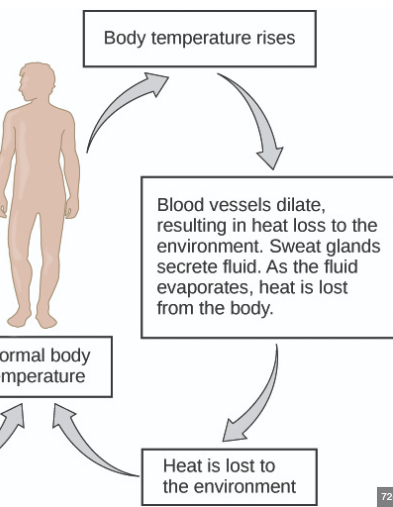
The production of swear from sweat glands that add moisture on an organism to allow evaporation to occur. This increases heat loss as water vapour takes energy/heat away from the organism.
The issue is that this means there is an increase in water loss, but conserves energy
Thermoregulation in Hot Environments - Panting
With an increase in breathing rate organisms increase the air moving over moist respiratory tracts and increase the amount of evaporation occurring to cool down.
Thermoregulation in Hot Environments - Pilorelaxation
When fur and feathers relax and reduce the amount of air trapped close to the body it allows excessive heat to escape
Thermoregulation in Hot Environments - Pale colouration
Thermoregulation in Hot Environments - reduces the amount of heat gained via radiation
Thermoregulation in Hot Environments - Burrowing
Organisms burrow underground to avoid being exposed to warm conditions on the surface. This reduces heat gain. This often occurs with organisms that are nocturnal. Being nocturnal means organisms avoid warmer day conditions and are active during the cooler night periods.
Thermoregulation in Hot Environments - Mud coverings
Organisms can cover themselves in mud to act as a thermal covering and reduce heat gain
Thermoregulation in Hot Environments - Excessive skin
Increases the SA that heat can be lost from
Thermoregulation in Hot Environments - Reducing contact with hot surfaces
Lizard and rock
Vasodilation Feedback Loop
Sweating Feedback Loop
Thermoregulation in Cold Environments
Organisms that experience cold environments or conditions need to increase heat gain or reduce heat loss.
Naturally these organisms lose energy to the environment as heat moves from areas of high to areas that are low
Countercurrent exchange
Vasoconstriction
SA:V ratio
Torpor
Hibernation
Shivering
Increased metabolism
Piloerection
Blubber (fur/feathers)
Huddling
Thermoregulation in Cold Environments - Countercurrent Exchange
Some organisms use countercurrent exchange between arterial and veinous blood as it moves to and from an extremity
The warm arterial blood warms the cooler veinous blood as it returns. This reduces the arterial blood gradient with the environment and reduces heat loss. The veinous blood being warmed returns at a higher temperature, meaning the organism has to spend less energy in recovering the lost energy. Often done with vasoconstriction.
Thermoregulation in Cold Environments - Vasoconstriction
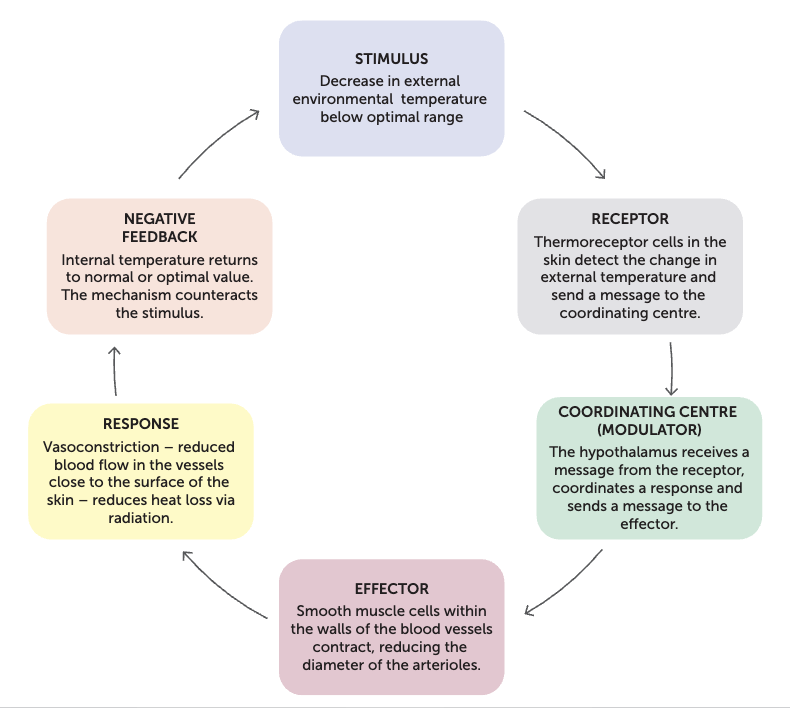
Blood vessels at the surface constrict and reduce the amount of blood flow at the surface, reducing heat being lost to the environment.
Thermoregulation in Cold Environments - SA:V
organisms in cooler environments have a lower SA:V ratio in general shape or at specific locations (ears). This makes exchanging with the environment inefficient and conserves heat.
Thermoregulation in Cold Environments - Torpor
Torpor is an adaptation where organisms enter into a short period of dormancy. In this period of dormancy they drop their metabolic rate significantly, this reduces the demands for O2 and glucose, and it also drops their internal temp.
The dropping of internal temp reduces the gradient between the organism and the environment, conserving energy
Torpor is done when conditions are unfavourable and being active would cost too much energy and create too much stress on the organism
When organisms come out of torpor they increase their metabolism above normal rates, period of arousal, to recover from the period of lower internal temperatures
Thermoregulation in Cold Environments - Hibernation
This is extended periods of dormancy where organisms avoid entire seasons as conditions re unfavourable and existing is too difficult
Thermoregulation in Cold Environments - Shivering
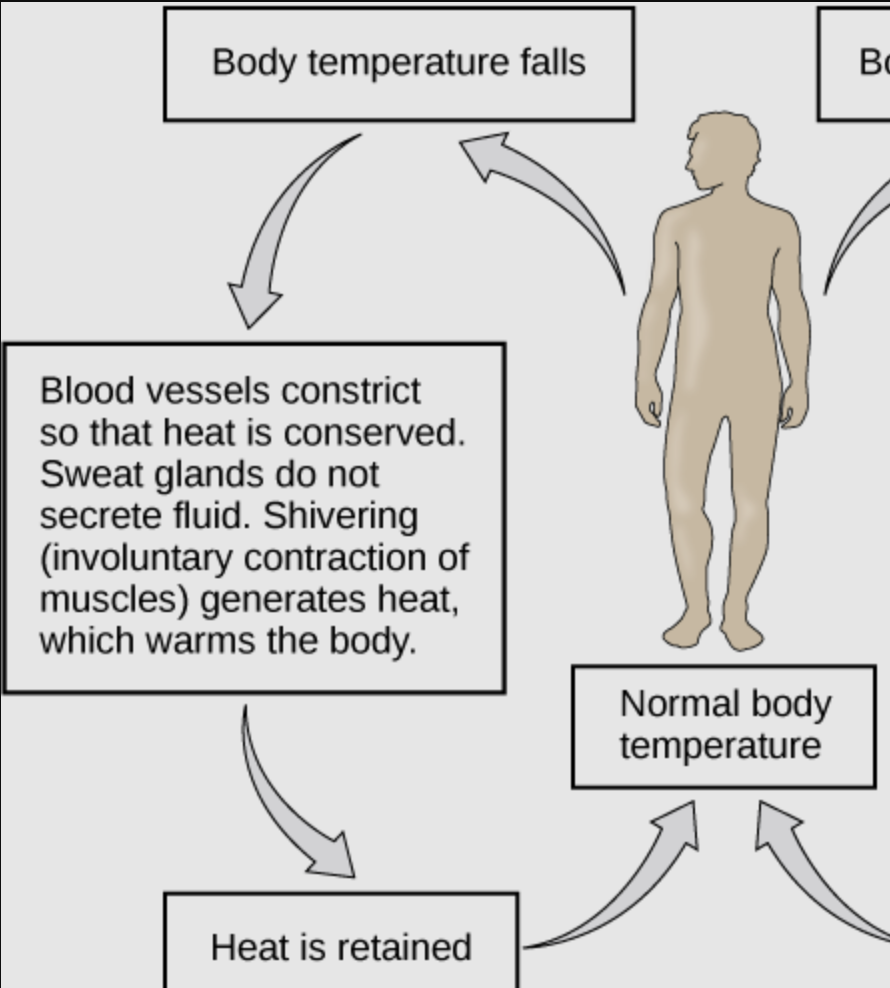
Shivering is the uncontrollable muscle contractions that increase the rate of CR and therefore increase heat productions
Thermoregulation in Cold Environments - Increased metabolism
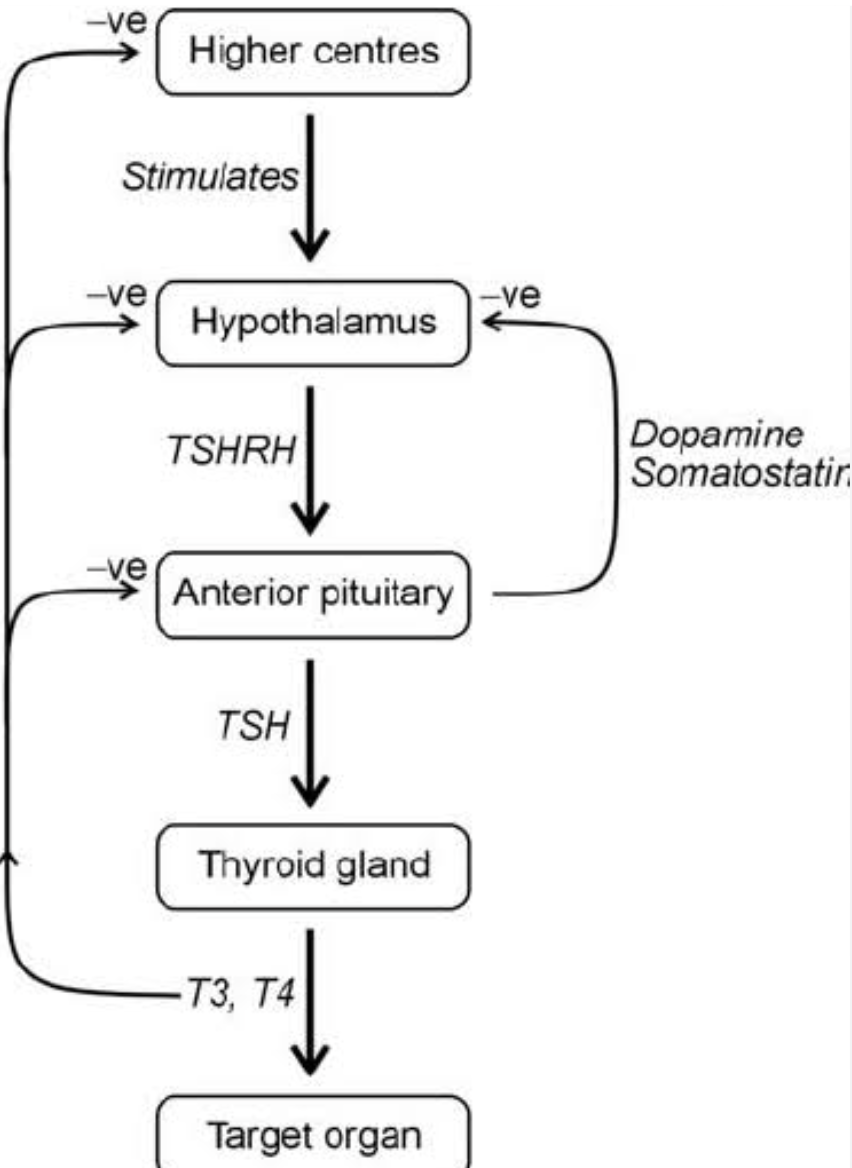
Organisms can increase their metabolic rate to increase heat production. This is done by a hormone release and response (thyroxine)
Thermoregulation in Cold Environments - Piloerection
This is when hair, feathers or fur stands up and traps a layer of heat next to its skin. This trapped layer reduces the gradient between the internal and external environment.
Thermoregulation in Cold Environments - Blubber (fur/feathers)
Blubber acts as insulation and prevents heat loss to the environment. Blubber is a poor conductor of heat and reduces the heat from leaving the organisms core.
Fur and feathers act in a similar way. They are layers of insulation but not as effective.
Thermoregulation in Cold Environments - Huddling
Organisms can group together to reduce the surface area exposed to the environment and reduce heat loss. It also works by sharing any lost heat with organisms nearby.
Shivering Feedback Loop
Vasoconstriction Feedback Loop
Thyroxine Feedback Loop
Hypothalamus = modulator
Anterior pituitary + Thyroid gland = effector