Ch. 3 Kinematics
 Call Kai
 Learn
Learn Practice Test
 Spaced Repetition
 Match
Match Flashcards
 Knowt Play
1/7

There's no tags or description
Looks like no tags are added yet.
Name | Mastery | Learn | Test | Matching | Spaced | Call with Kai | Chat |
|---|
No analytics yet
Send a link to your students to track their progress
8 Terms
Kinematics: mechanics concerned with the motion of objects without reference to the forces that cause the motion.
-displacement
Displacement
The displacement of an object is its change in position.
Formula
Displacement= positionfinal - positioninitial
Example
Let’s say we were measuring an object moving along in a straight line by laying a meter stick along the object’s line of motion. If the object starts at, say, the 10cm mark on the meter stick and moves to the 70cm mark, then its position changed by 70-10=60cm, so we’d say its displacement is 60cm.
Another example
Now, what if the object (same object) moved from the 70cm mark on the meter stick to the 10cm mark? Then its displacement would be 10cm-70cm= -60cm
In both cases, the object moved a distance of 60 cm, but in the first case it moved to the right, and in the second case, it moved to the left. Displacement is a vector, so it takes direction into account. If we call the right the positive direction (hence to the left automatically becomes the negative direction) then in the first case we’d say the displacement is +60cm, and the in the second case, it’s -60cm.
Another example
The motion of an object can be more complicated. For example, what if the object started at the 10cm mark, moved to the 50cm mark, back to the 40cm mark, and then over to the 70cm mark?
This example brings up a crucial point about displacement. The total distance that the object travels is (40cm) + (10cm) + (30cm) = 80cm, but the object’s displacement is still
Displacement: positionfinal- positioninitial
70cm-10cm= +60cm
come back to this later, it was in the middle of page 43.
Velocity
Displacement tells us how much an object’s position changes.
Velocity tells us how fast an object’s position changes.
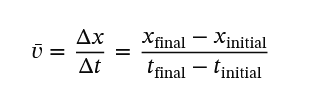
If you’re in a car traveling at 60 miles per hour along a long, straight highway, then this means your position changes by 60 miles ever hour. To calculate velocity, simply divide how much the position has changed by how much time it took for it to change; in other words, divide the displacement by time.
Formula for average velocity
average velocity: displacement/time
v̄: Δx/Δt=d/Δt
This is the definition of average velocity, and we place a bar above the v to signify that it’s an average. So, v is velocity, and v̄ is the average velocity.
stopped on page 44
Acceleration
displacement tells us how much an object’s position changes
velocity tells us how fast an object’s position changes
acceleration tells us how fast an object’s velocity changes.
average acceleration
average acceleration: change in velocity/time
ā: Δv/Δt
Acceleration is a little trickier than velocity. Even though both involve how fast something changes, acceleration is how fast velocity changes, and an object’s velocity changes if the 1. speed or the 2. direction changes (because velocity is a vector). So, for example, an object can be accelerating even if its speed is constant.
stopped on page 46.
Uniformly accelerated motion
In the last section, we defined the principle quantities of kinematics: displacement, velocity, and acceleration. In this section, we’ll summarize the mathematical relationships between them in the special but important case of uniformly accelerated motion. This is motion in which the object’s acceleration, a, is constant.
The Big Five
d= ½ (v0+v)t, missing a
v=v0+ at, missing d
d=v0t+1/2at2, missing v
d=vt-1/2at2, missing v0
v2= v02+2ad, missing t
These are the equations to use in the case of uniformly accelerated motion.
Note that these cases involve five quantities, d,v0, v, a, and t- and there are five equations. Each equation has exactly one of those quantities missing, and this is how you decide which equation to use in a particular problem. A quantity is missing from the problem if it’s not given or asked for. For example, if a question does not give or ask for v, then use Big Five #3; if a question does not give or ask for t, then use Big Five #5. On the MCAT, the Big Five Equations that are used most frequently is #2, #3, and #5.
stopped on page 52.
Kinematics With Graphs
The MCAT expects you to be able to interpret graphs as well as to be able to apply equations. In general, you will need to extract three forms of information from graphs:
individual points
slopes
areas
Below we consider these in two types of graphs, the position vs. time graph and the velocity vs time graph.
look at the picture of the graph on page 53. The graph is a position vs time graph (in other words, the graph is a displacement vs time graph).
The object starts at x=0, then moves x=6m at t=2s. From t=2s to t=5s, it remains at position x=6m. Then, from t=5s to t=8s, the object moves from x=6 m back to x=0.
Let’s figure out the velocity during these time intervals. From t=0 to t=2s, its veloctiy is
v=Δx/Δt= x-x0/ tf-ti= (6m)-(0)/2s=3m/s
Note that Δx is the vertical change in this graph and Δt is the horizontal change, from t=0 to t=2s. Dividing a vertical change by the corresponding horizontal change gives the slope of a graph. So, we have this rule: The slope of a position vs time graph gives velocity.
the graph is displacement vs. time
velocity= displacement/ time
Therefore, you can use the individual points to figure out a velocity.
There is still pages 54-57 to go
Free Fall
The Big Five Equations are only used in situations where acceleration is constant. The most important “real life” situation in which motion takes place under constant acceleration is free fall, which describes an object moving only under the influence of gravity (ignoring any effects due to the air, such as air resistance and buoyancy).
Near the surface of the earth, the magnitude of g, the gravitational acceleration, is approximately equal to 9.8m/s2. For the MCAT, we can use the simpler approximation of 10 m/s2. The term “free fall” might make you think that The Big Five apply only to objects that are actually falling, but if we throw a baseball up into the air (and ignore the effects due to the air), then the ball is still experiencing the downward acceleration due to gravity, so it, too, would be considered in free fall. So, think of free fall not as a description of a downward velocity but as a description of a downward acceleration
stopped at the middle of page 58.
Projectile Motion
page 60 come back to this