COSI 305 Exam 2: Brainstem
 Call Kai
 Learn
Learn Practice Test
 Spaced Repetition
 Match
Match Flashcards
 Knowt Play
1/217

There's no tags or description
Looks like no tags are added yet.
Name | Mastery | Learn | Test | Matching | Spaced | Call with Kai | Chat |
|---|
No analytics yet
Send a link to your students to track their progress
218 Terms
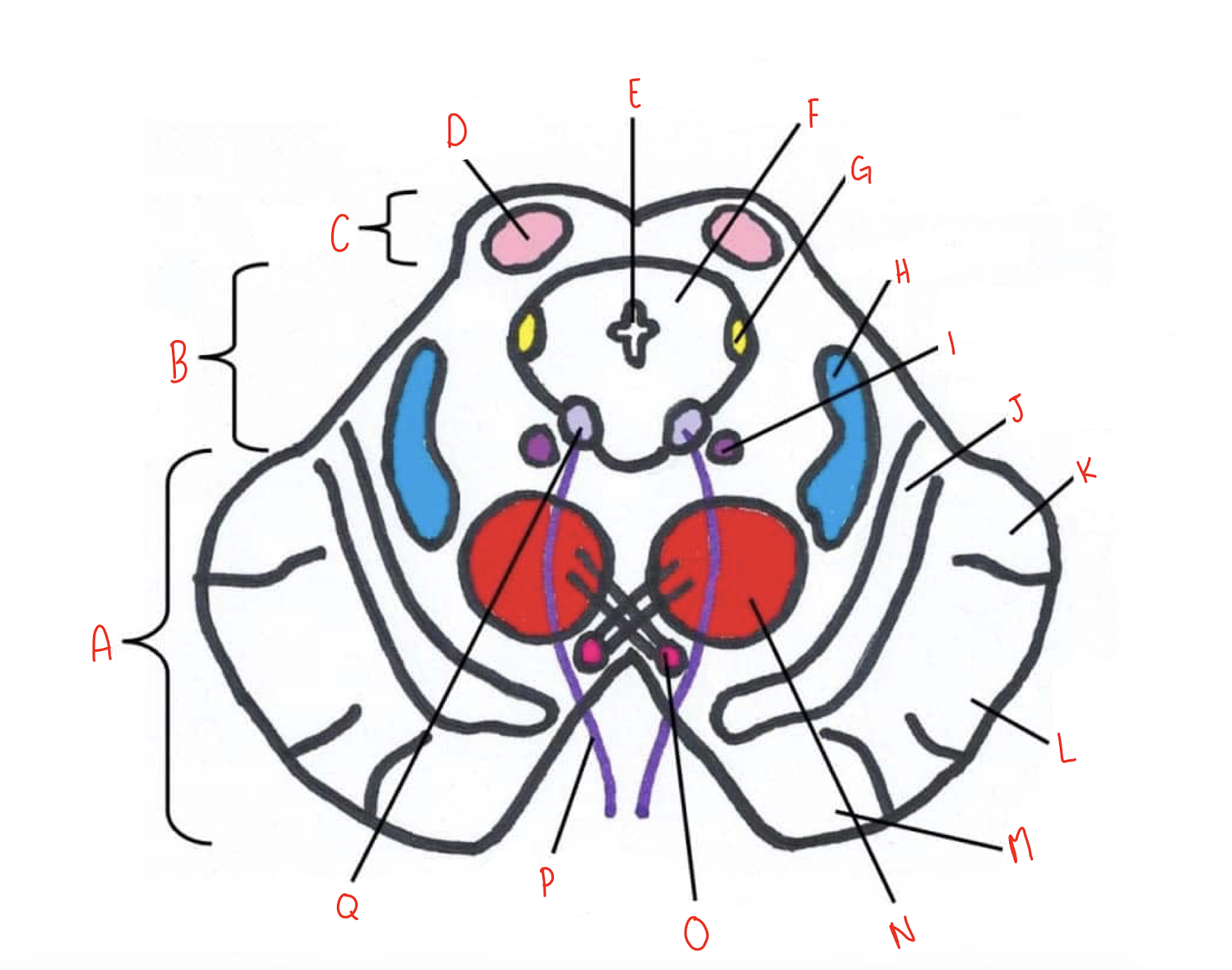
What structure of the sliced superior colliculus section of the midbrain is labeled A?
Crus Cerebri
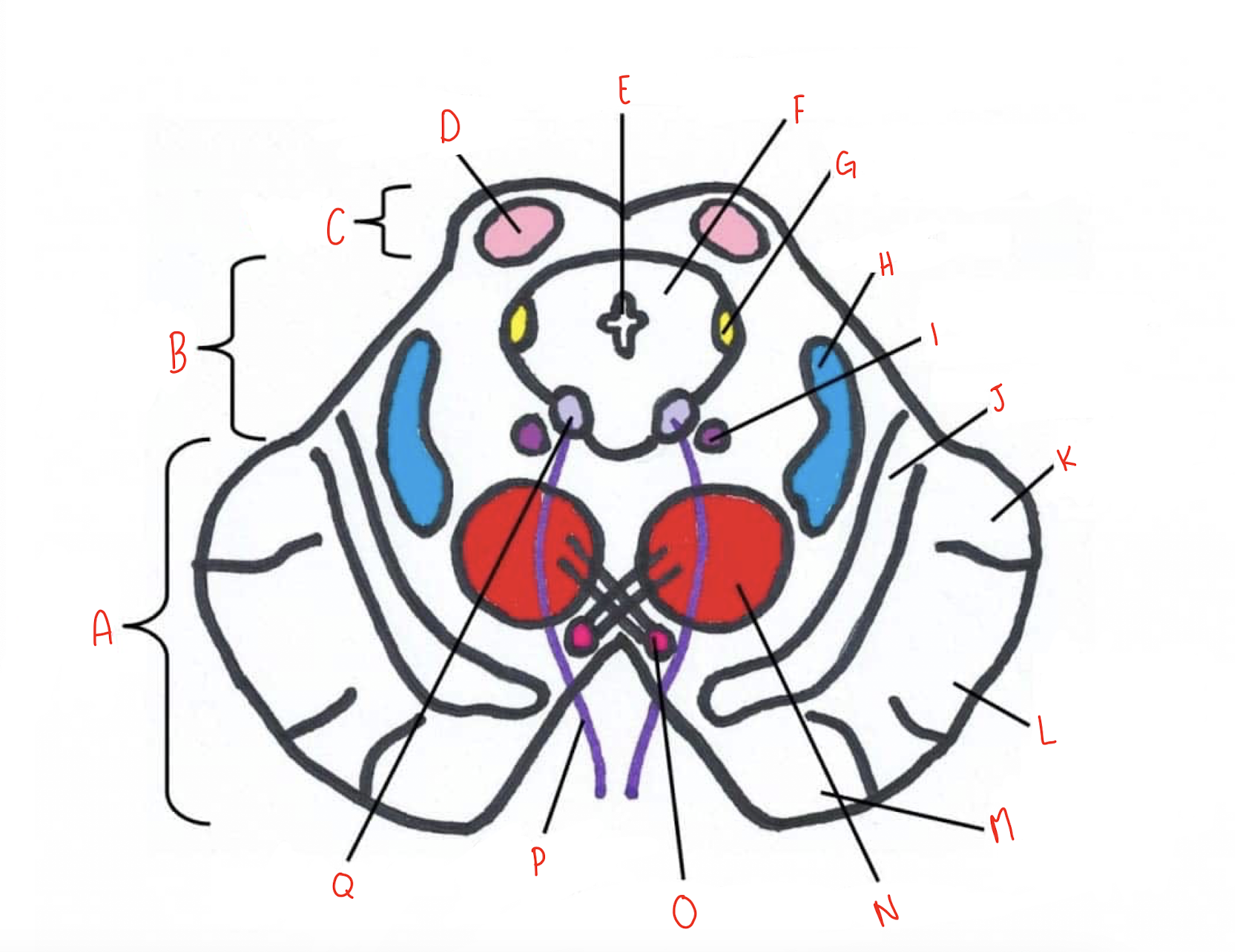
What structure of the sliced superior colliculus section of the midbrain is labeled B?
Tegmentum
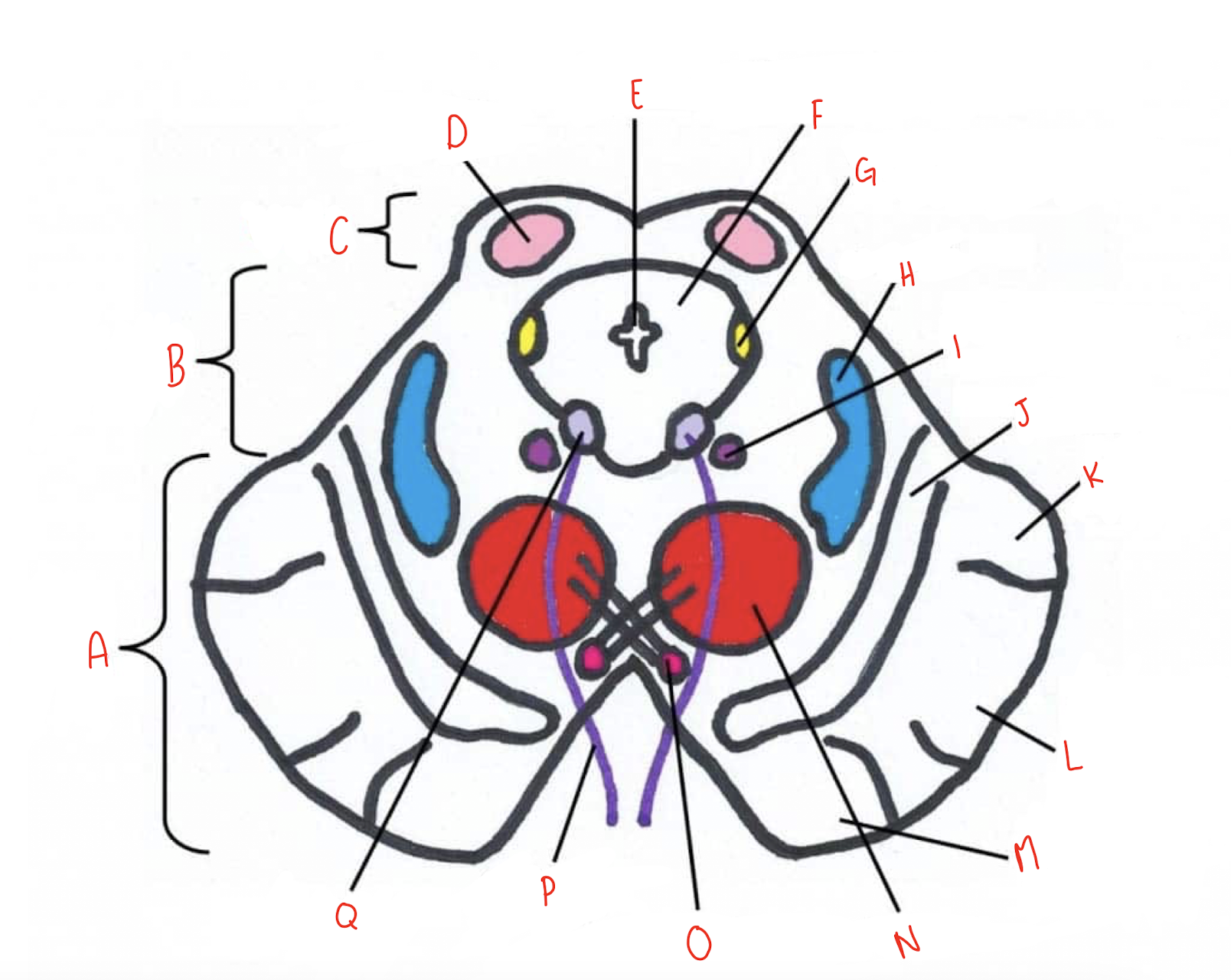
What structure of the sliced superior colliculus section of the midbrain is labeled C?
Tectum
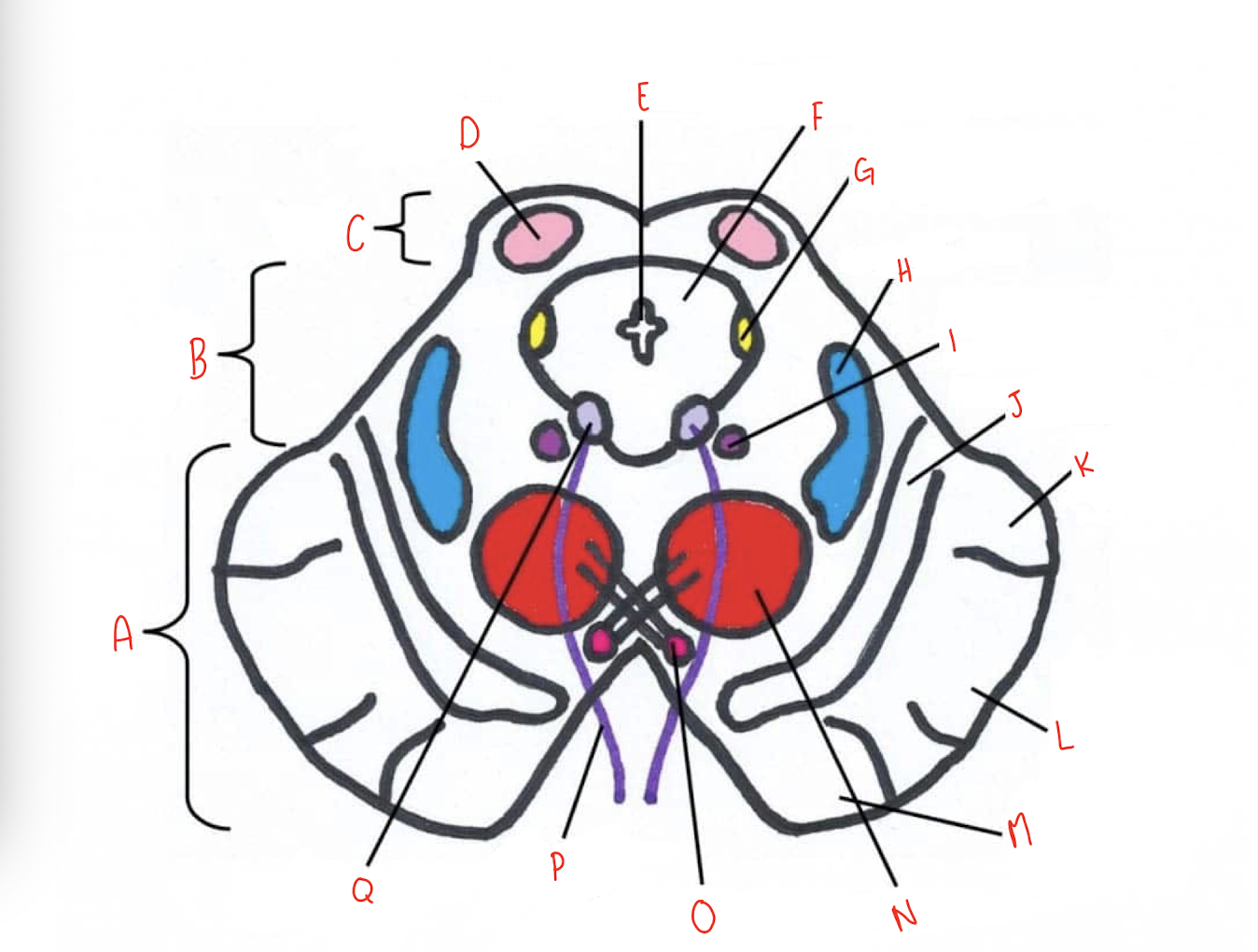
What structure of the sliced superior colliculus section of the midbrain is labeled D?
Superior Colliculus
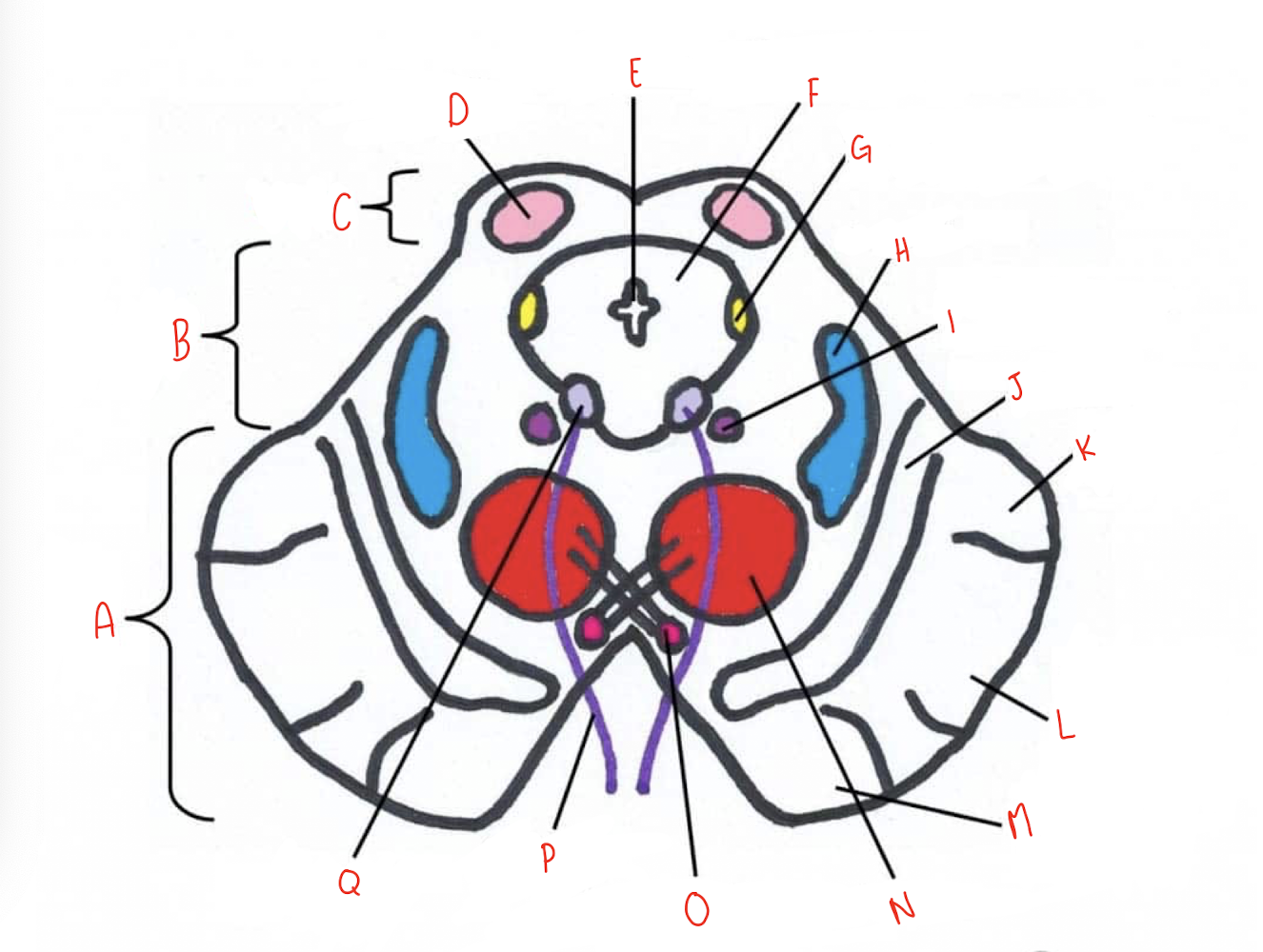
What structure of the sliced superior colliculus section of the midbrain is labeled E?
Cerebral Aqueduct
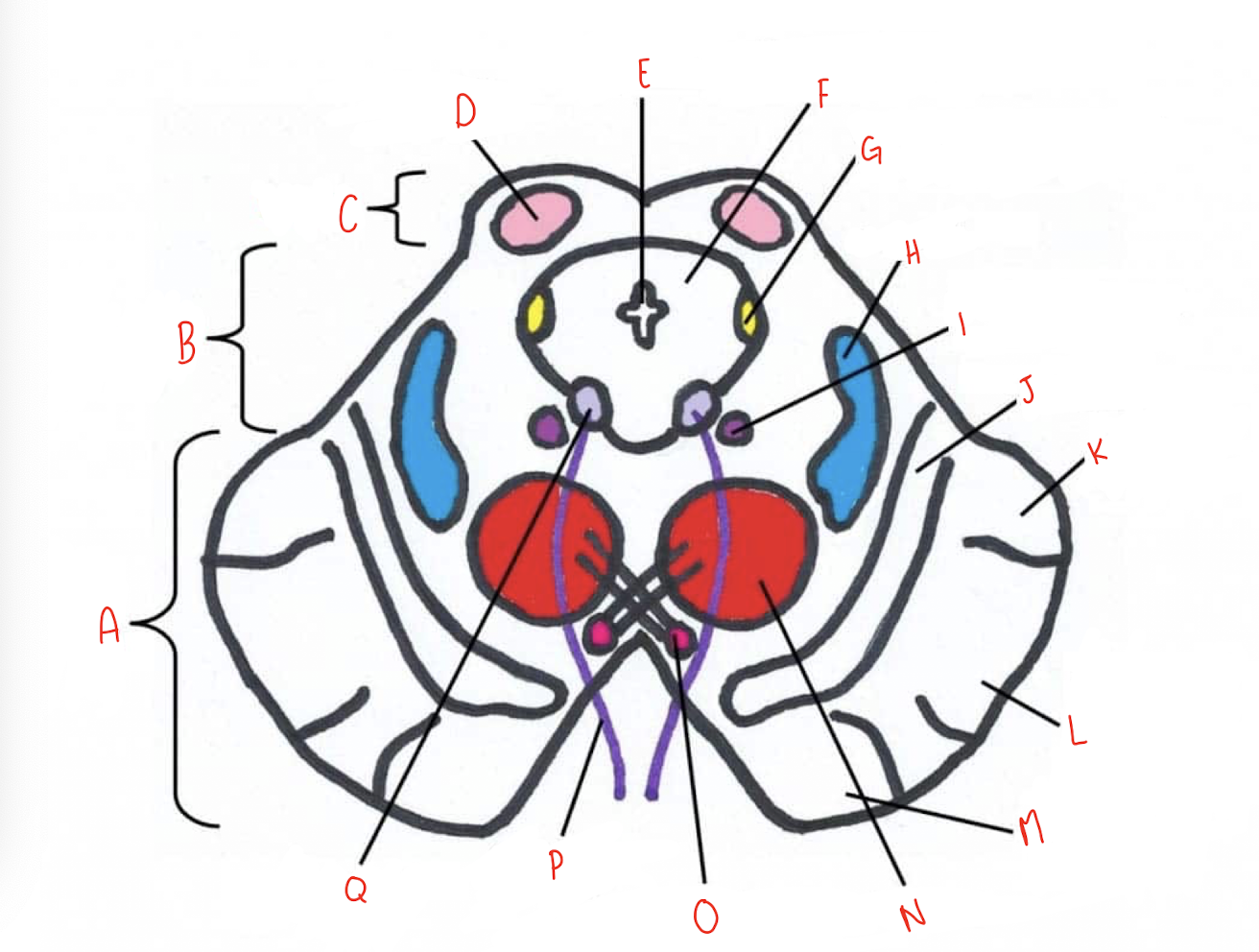
What structure of the sliced superior colliculus section of the midbrain is labeled F?
Periaqueductal Gray Matter
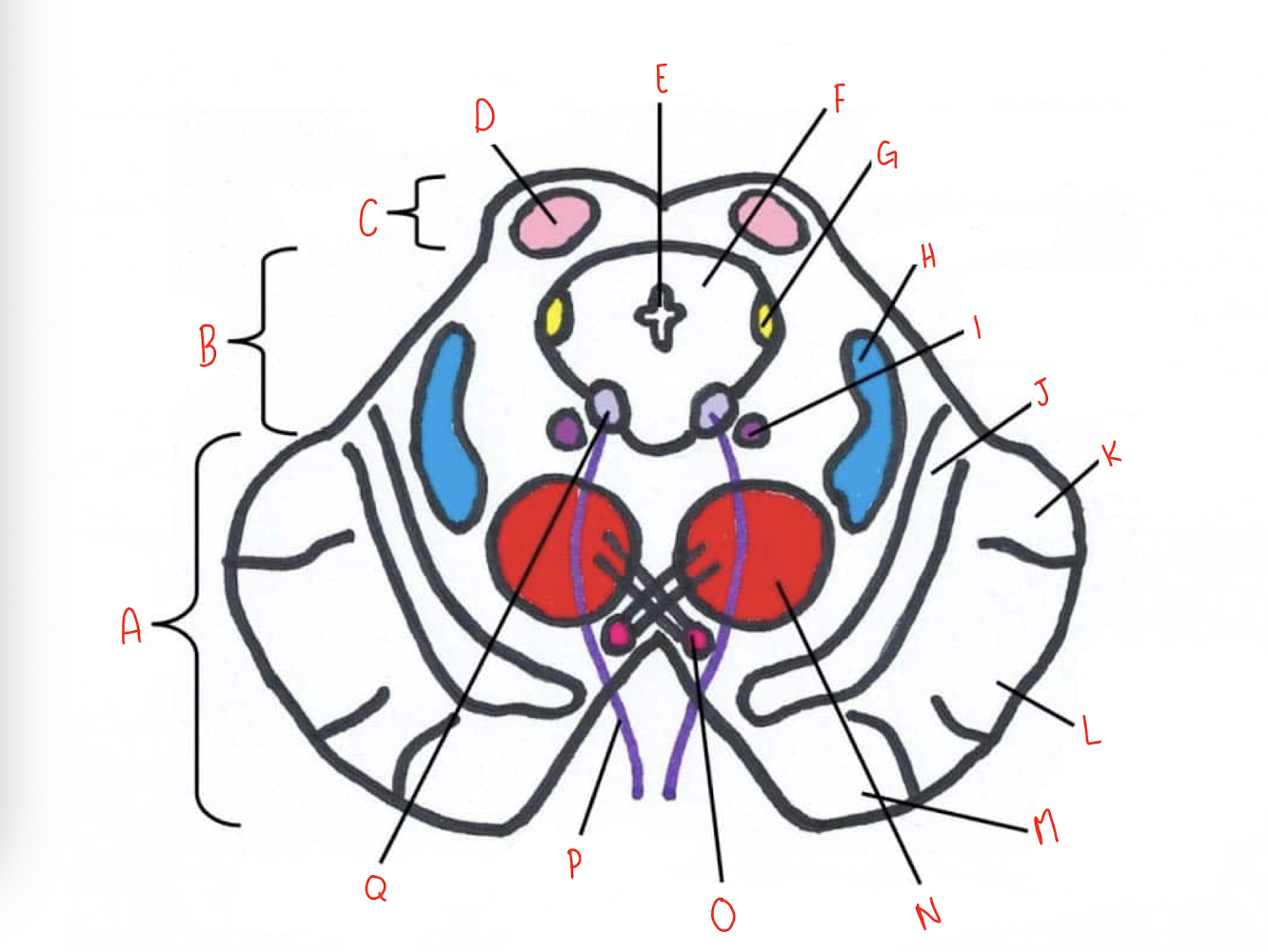
What structure of the sliced superior colliculus section of the midbrain is labeled G?
Mesencephalic Nucleus of Trigeminal Nerve
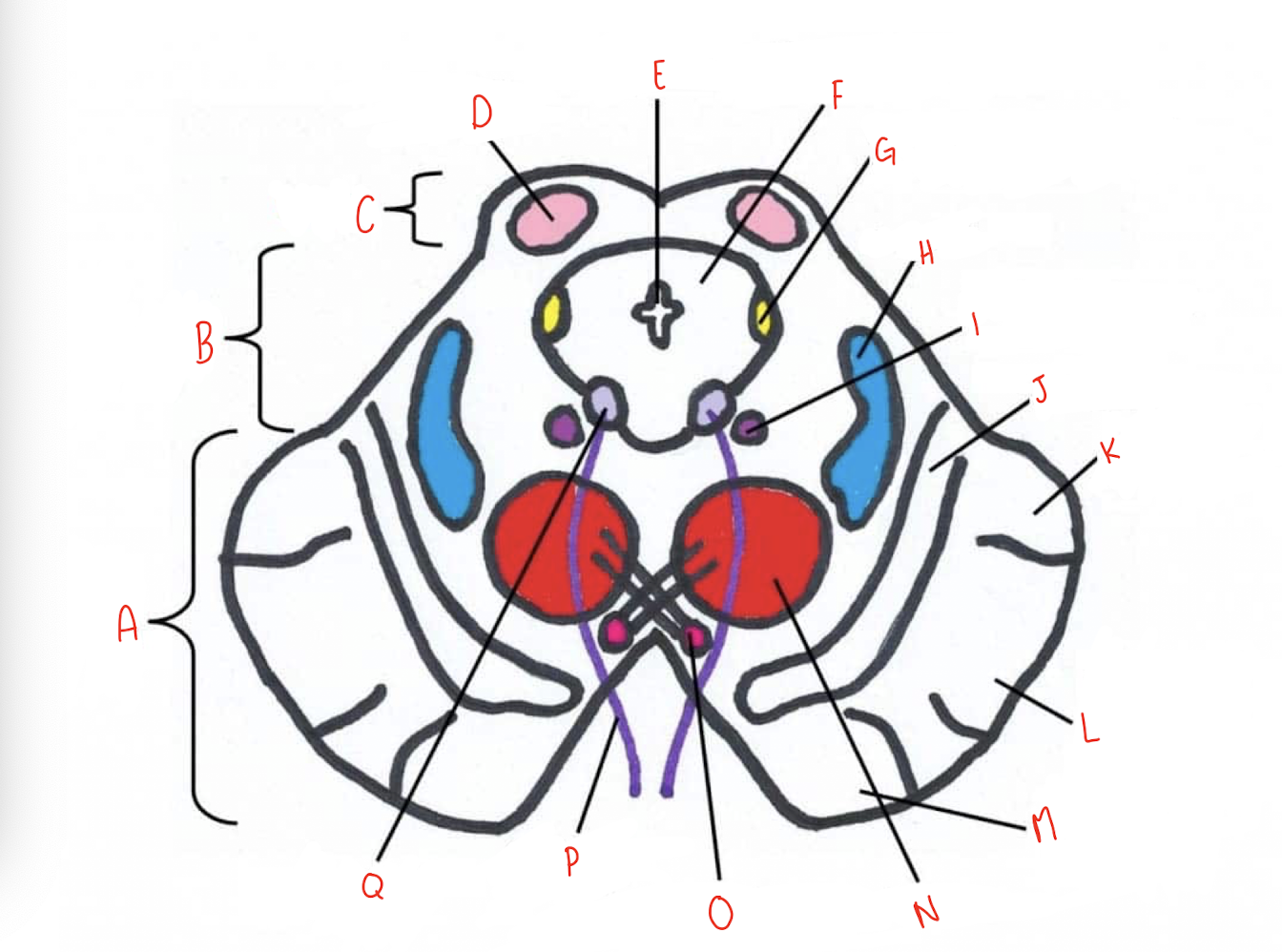
What structure of the sliced superior colliculus section of the midbrain is labeled H?
Spinal, Trigeminal, and medial —> no lateral in this section
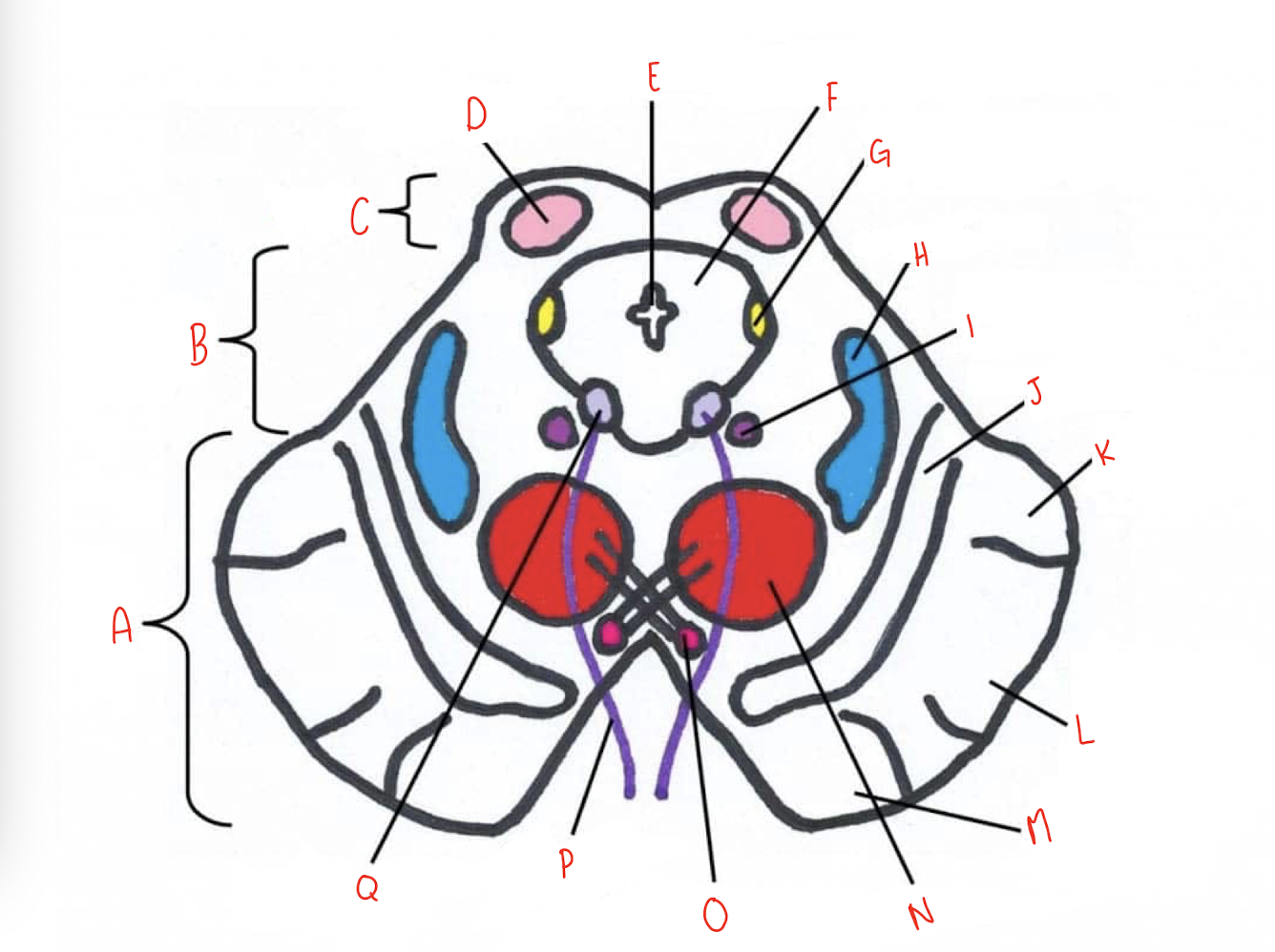
What structure of the sliced superior colliculus section of the midbrain is labeled I?
Medial Longitudinal Fasciculus
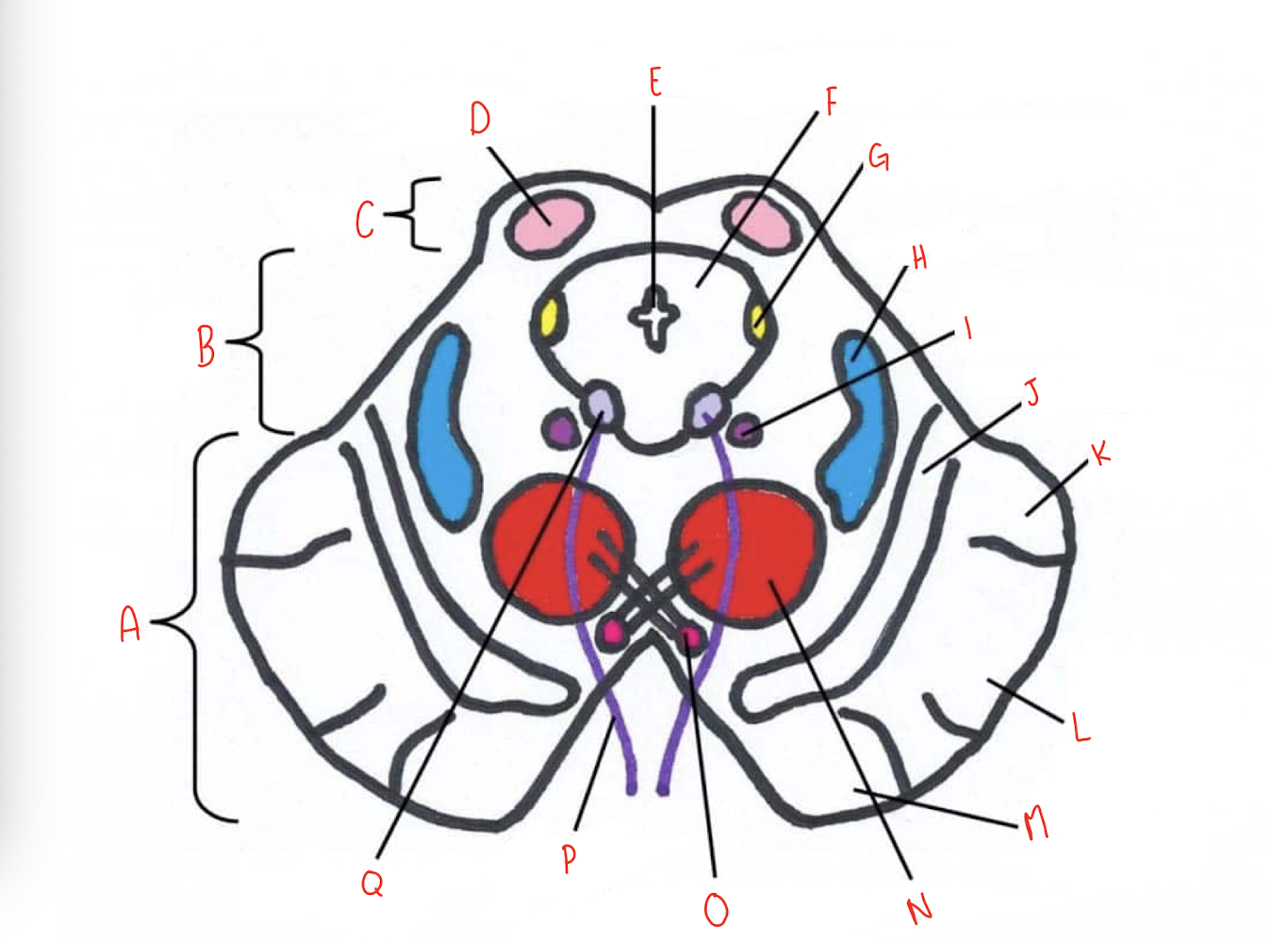
What structure of the sliced superior colliculus section of the midbrain is labeled J?
Substantia Nigra
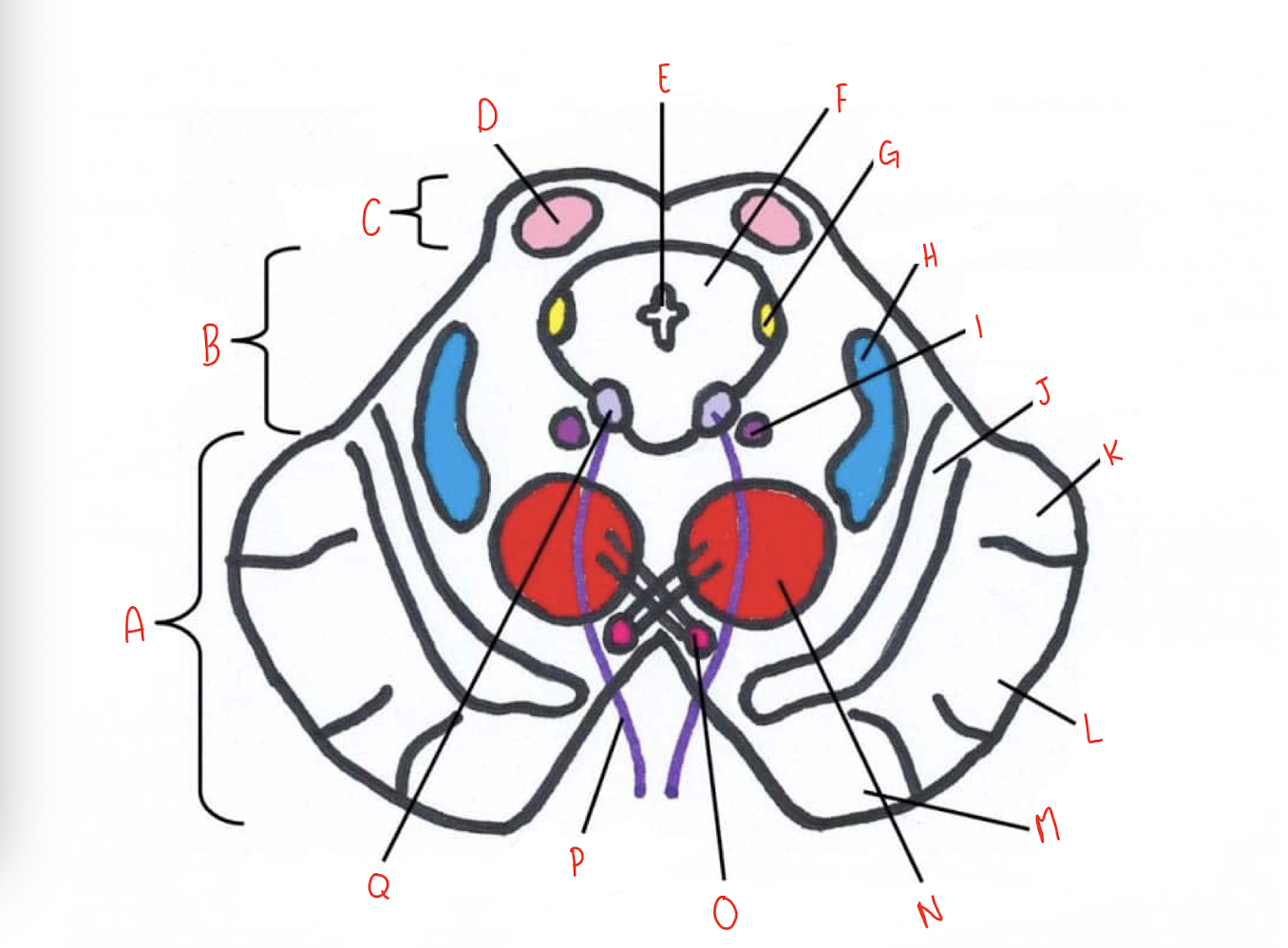
What structure of the sliced superior colliculus section of the midbrain is labeled K?
Temporo-pontine Fibers
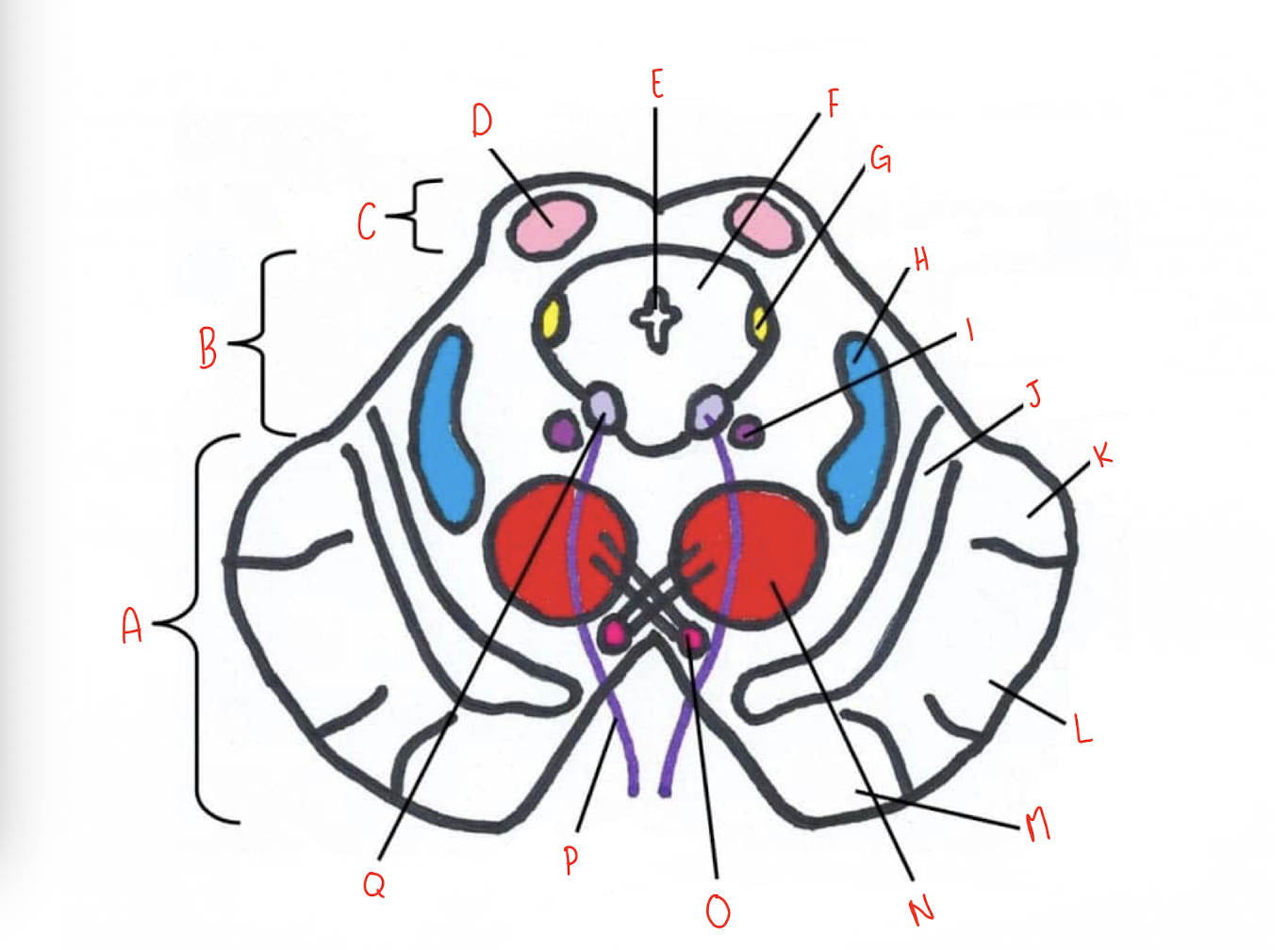
What structure of the sliced superior colliculus section of the midbrain is labeled L?
corticospinal and corticonuclear fibers
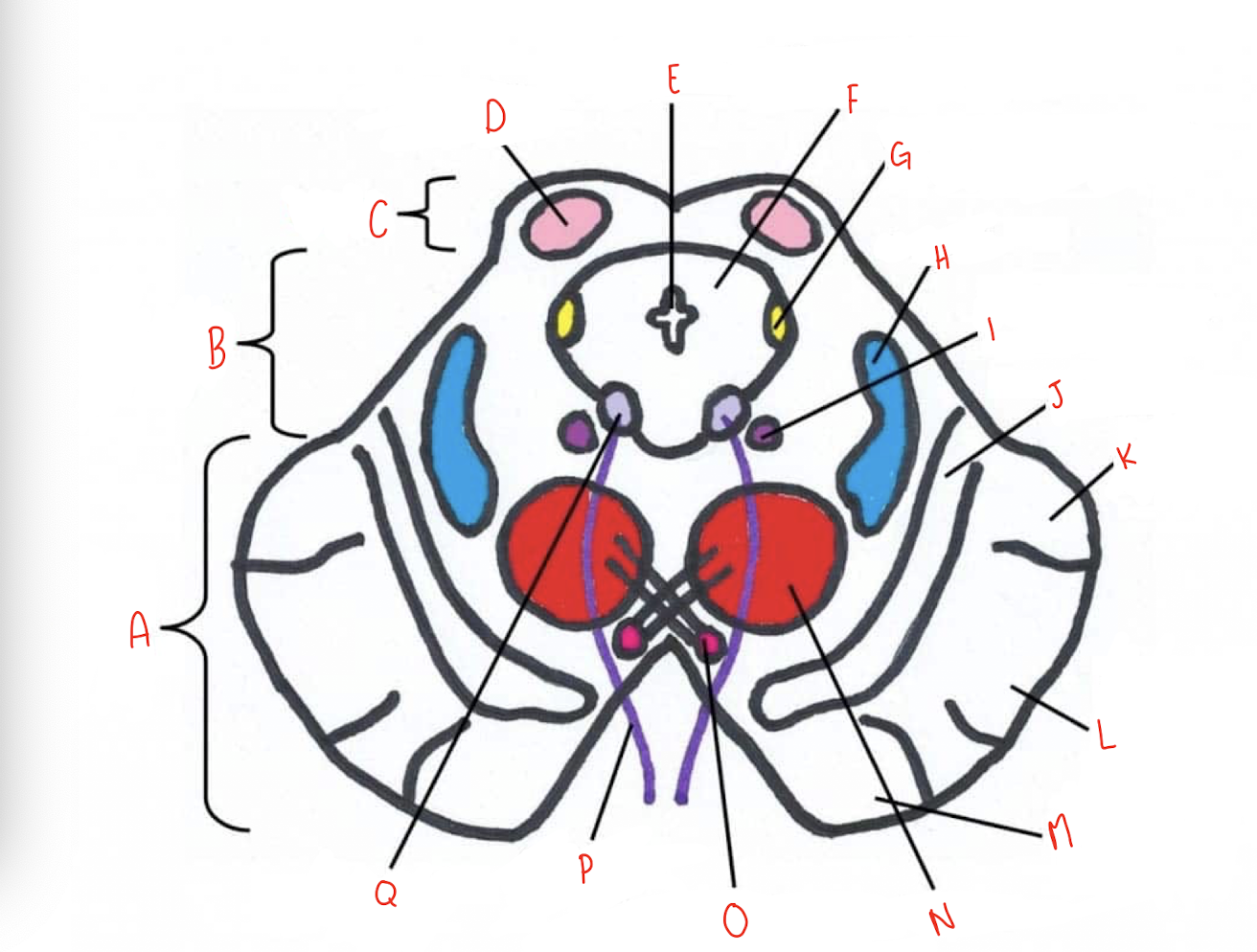
What structure of the sliced superior colliculus section of the midbrain is labeled M?
frontopontine fibers
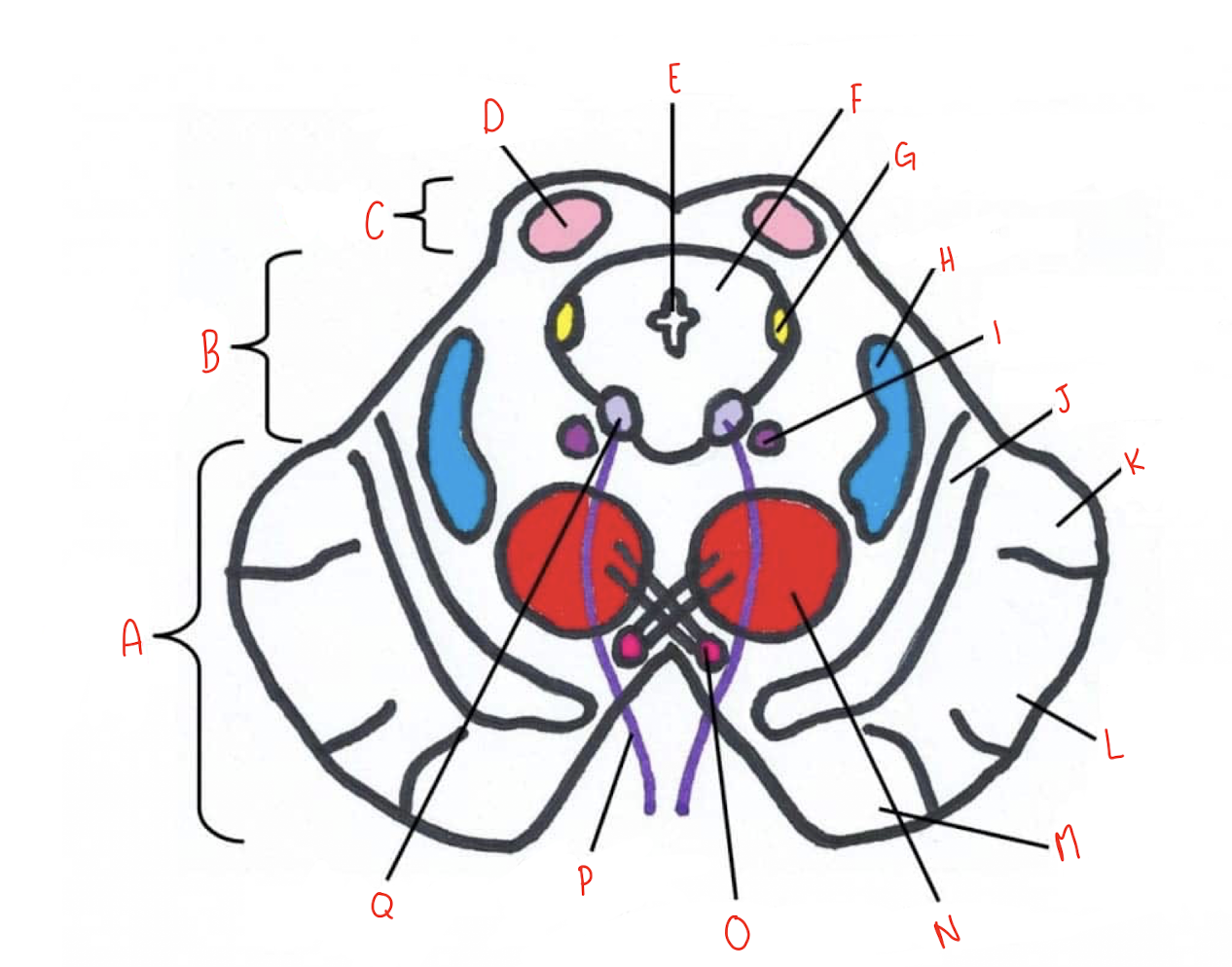
What structure of the sliced superior colliculus section of the midbrain is labeled N?
red nucleus
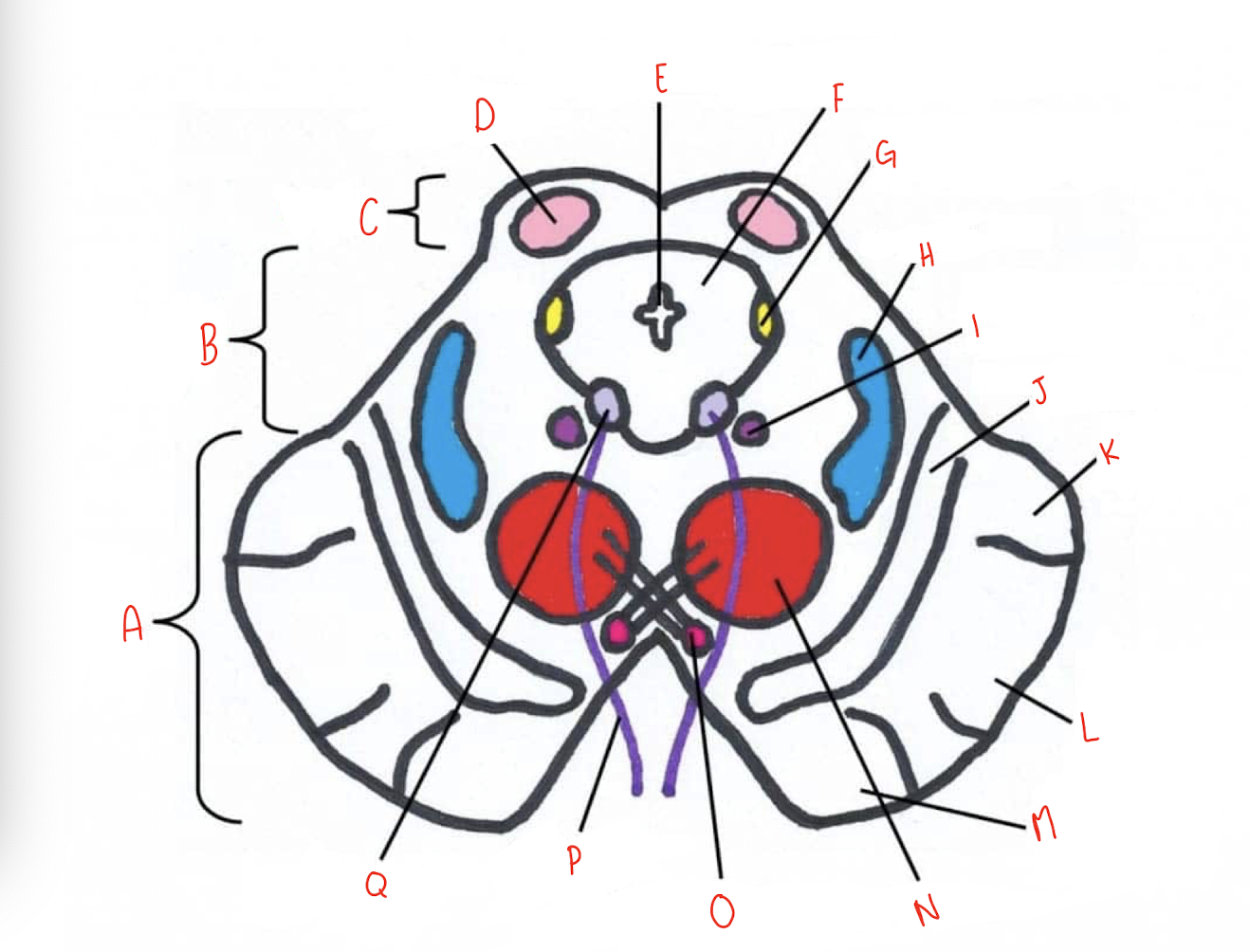
What structure of the sliced superior colliculus section of the midbrain is labeled O?
Decussation of Rubrospinal Tract
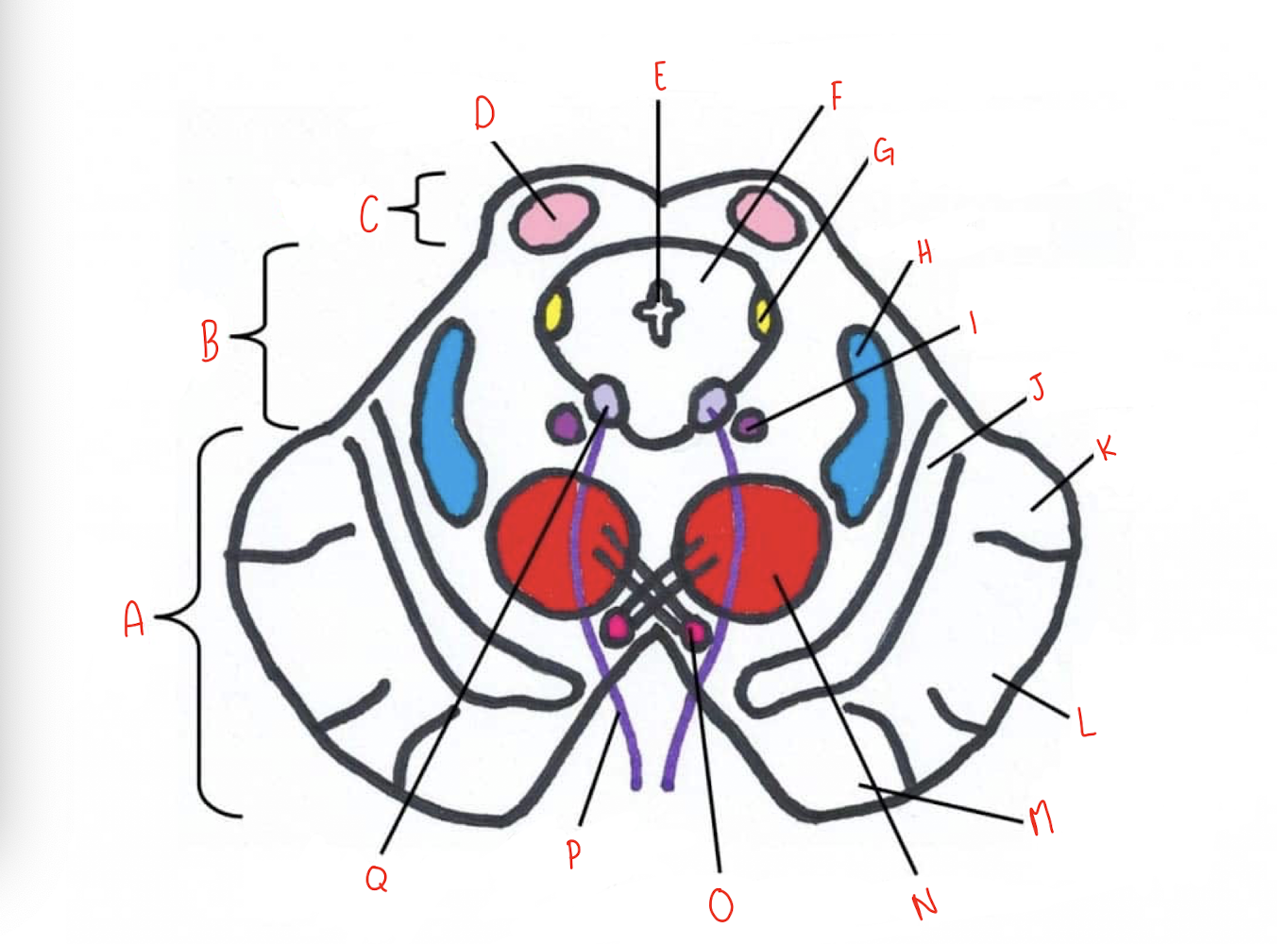
What structure of the sliced superior colliculus section of the midbrain is labeled P?
Oculormotor nerve
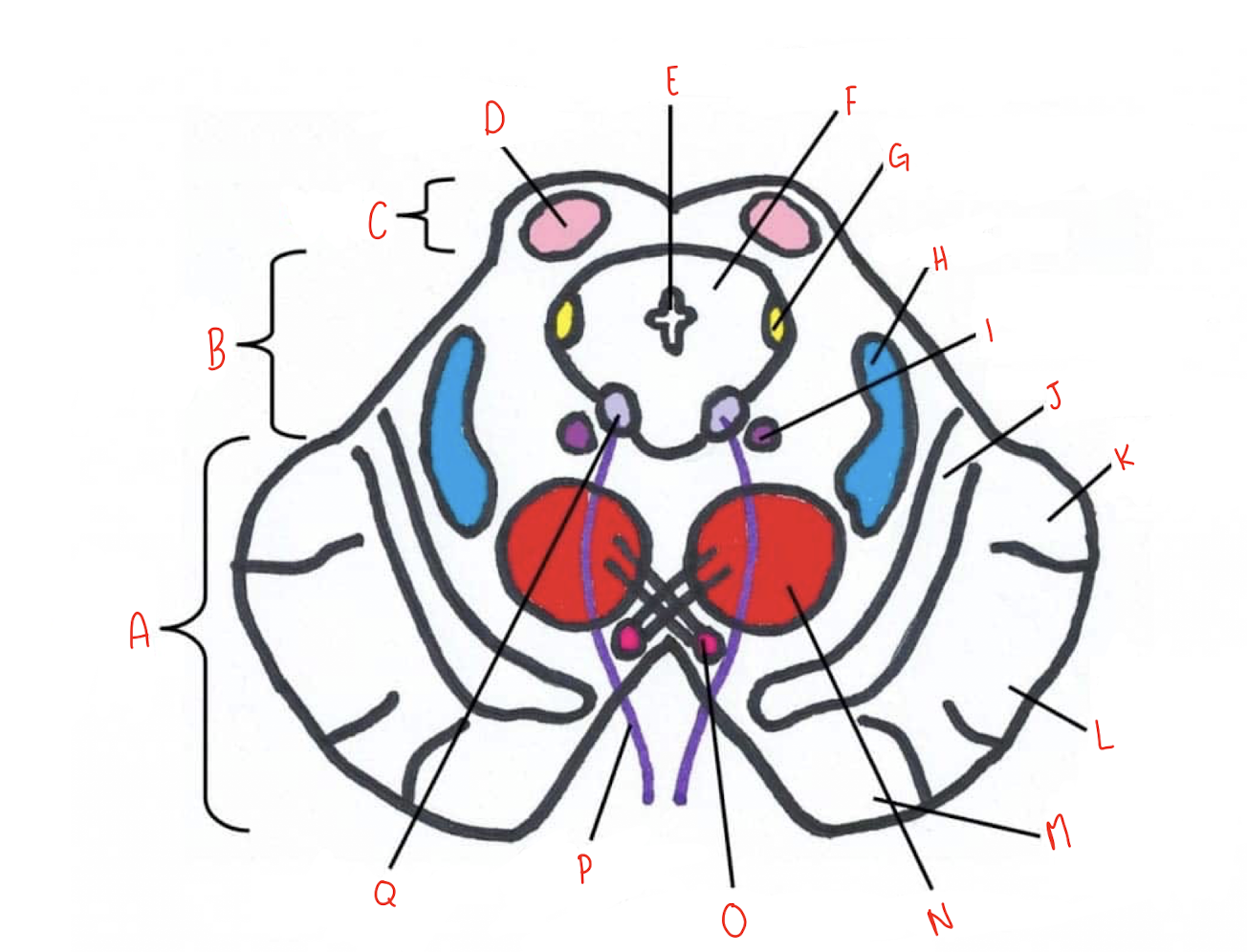
What structure of the sliced superior colliculus section of the midbrain is labeled Q?
oculomotor nucleus
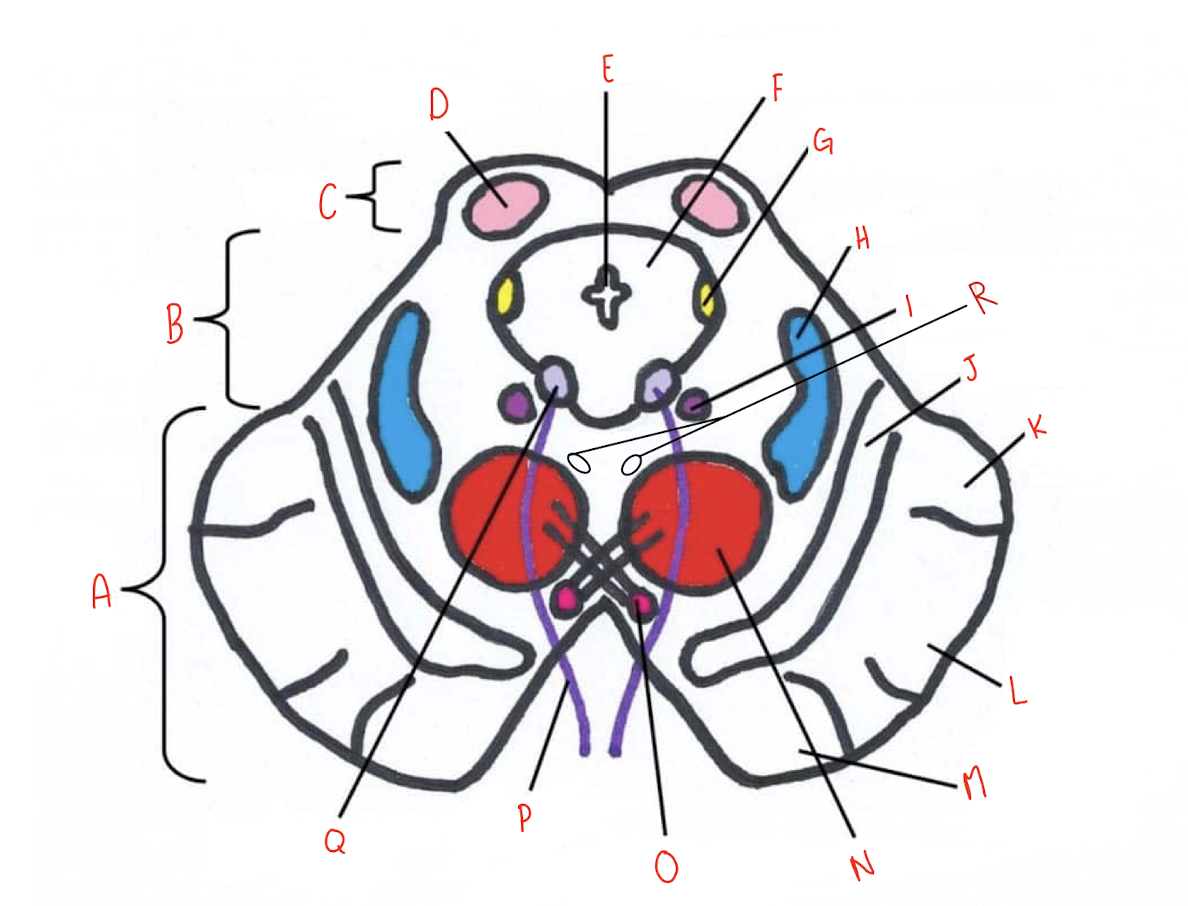
What structure of the sliced superior colliculus section of the midbrain is labeled R?
Pretectal Nucleus
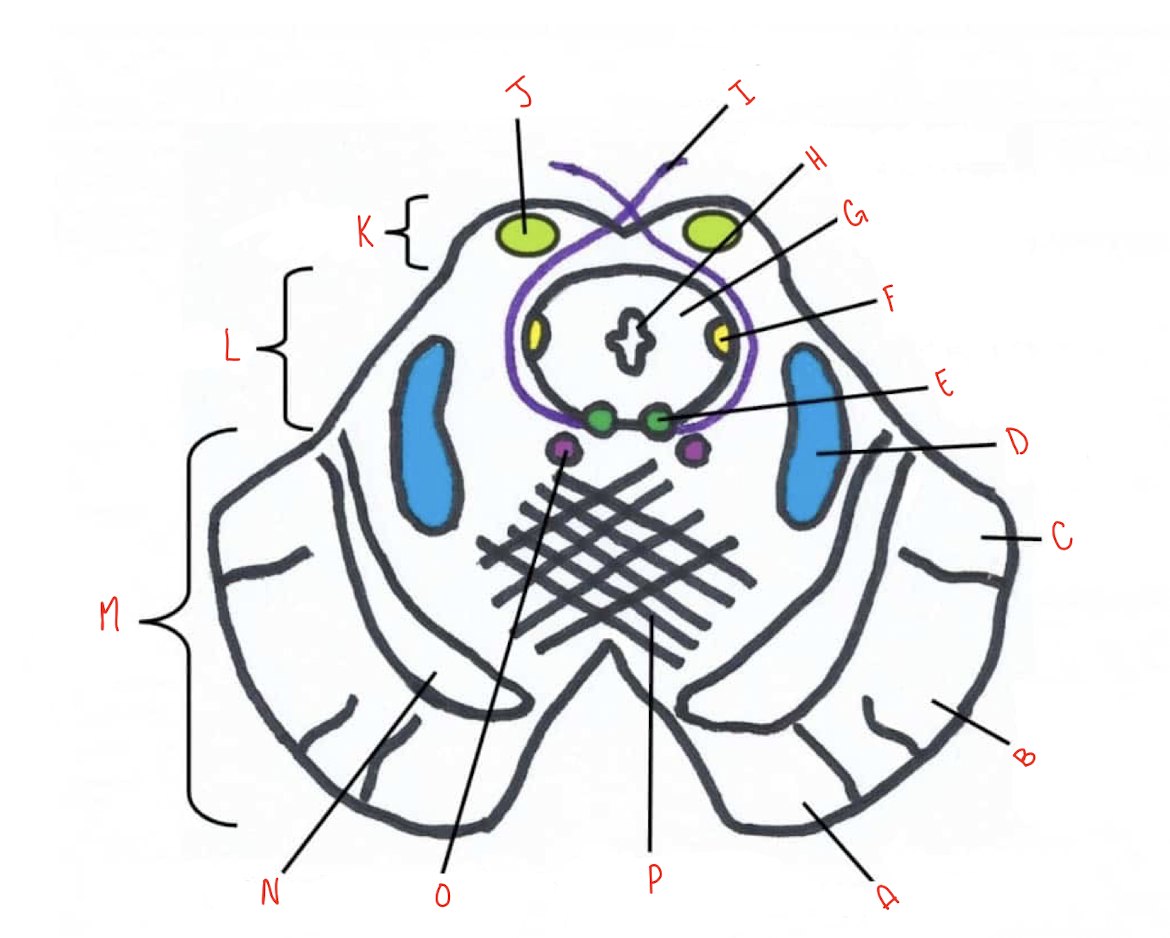
What structure of the sliced inferior colliculus section of the midbrain is labeled A?
Frontopontine Fibers
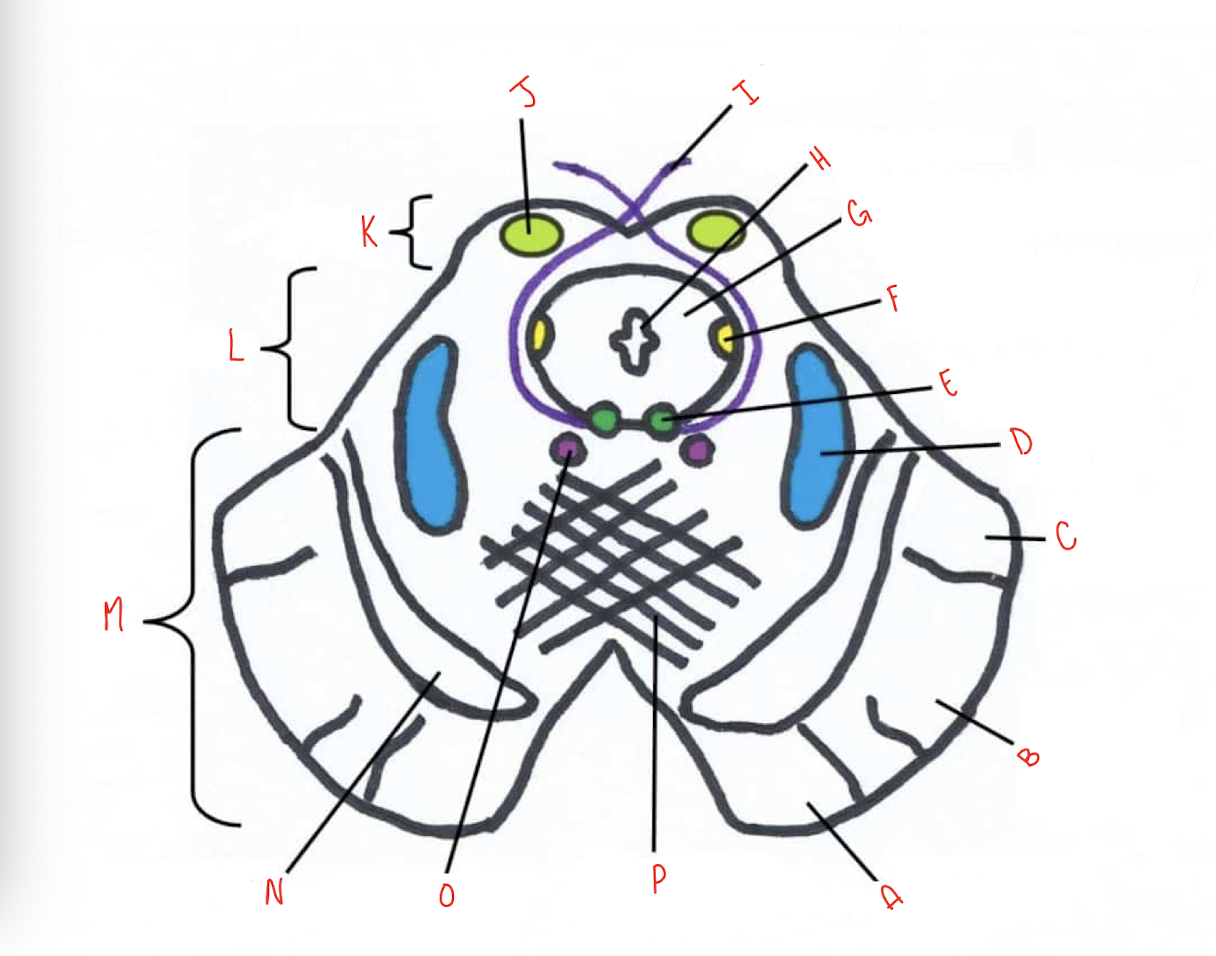
What structure of the sliced inferior colliculus section of the midbrain is labeled B?
Corticospinal and corticonuclear fibers
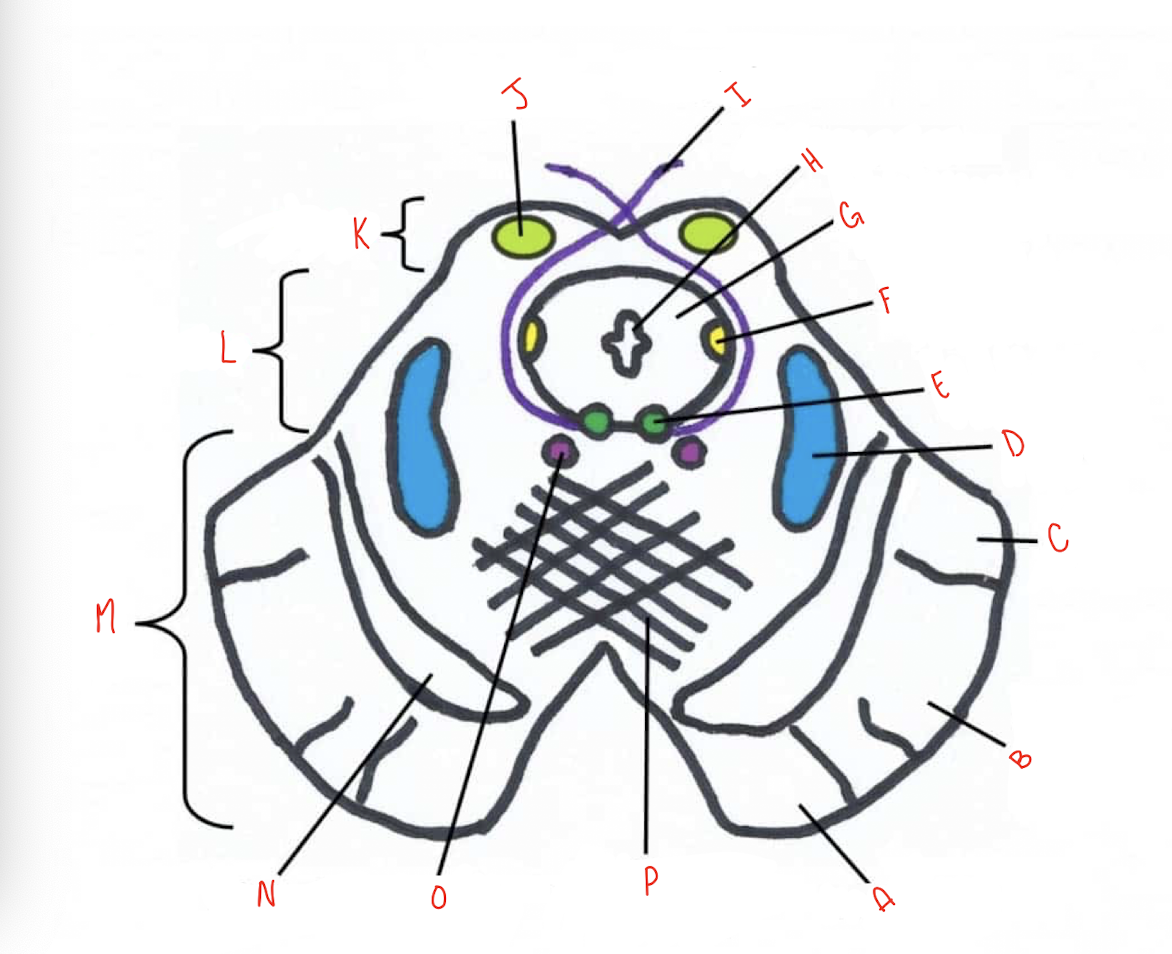
What structure of the sliced inferior colliculus section of the midbrain is labeled C?
temporopontine fibers
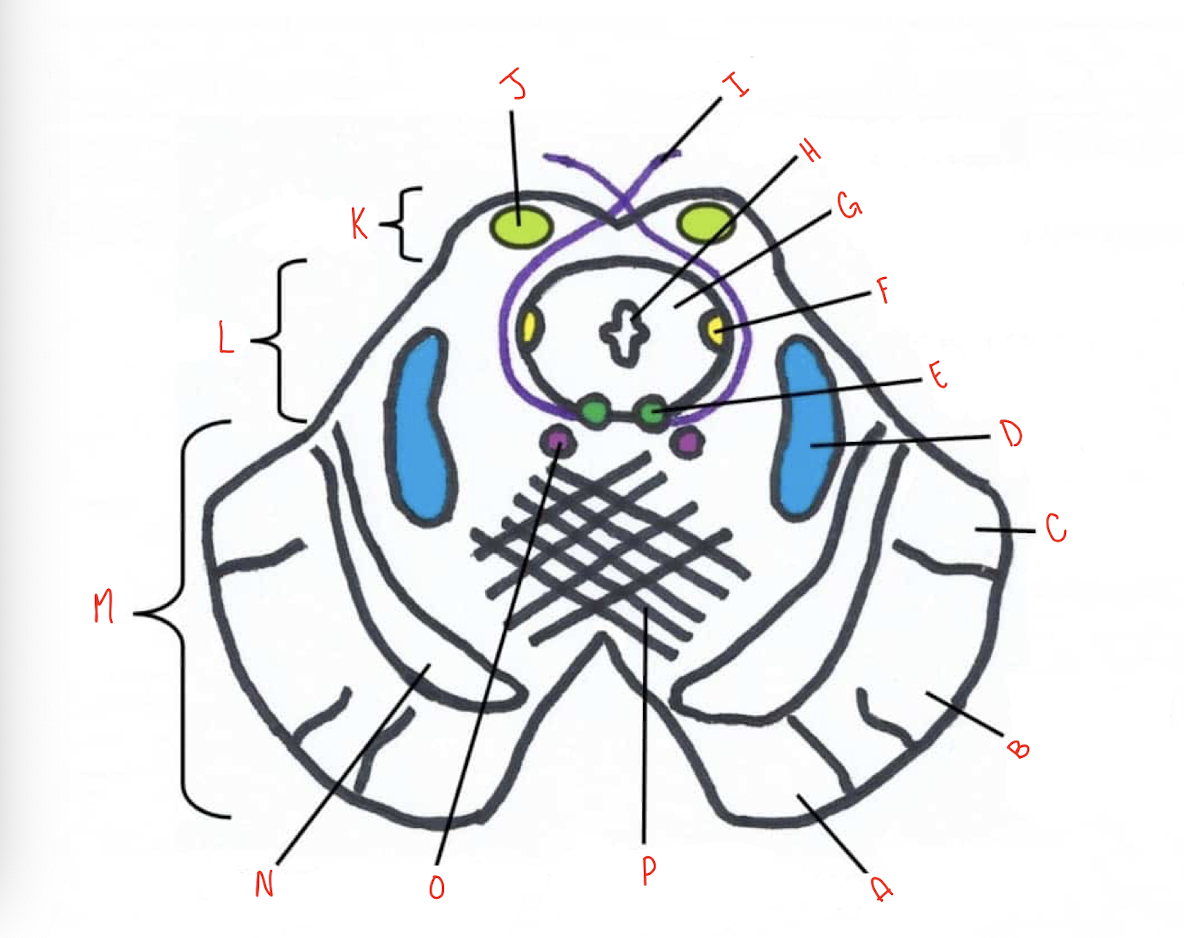
What structure of the sliced inferior colliculus section of the midbrain is labeled D?
Lemnisci ( lateral, spinal, trigeminal, medial)
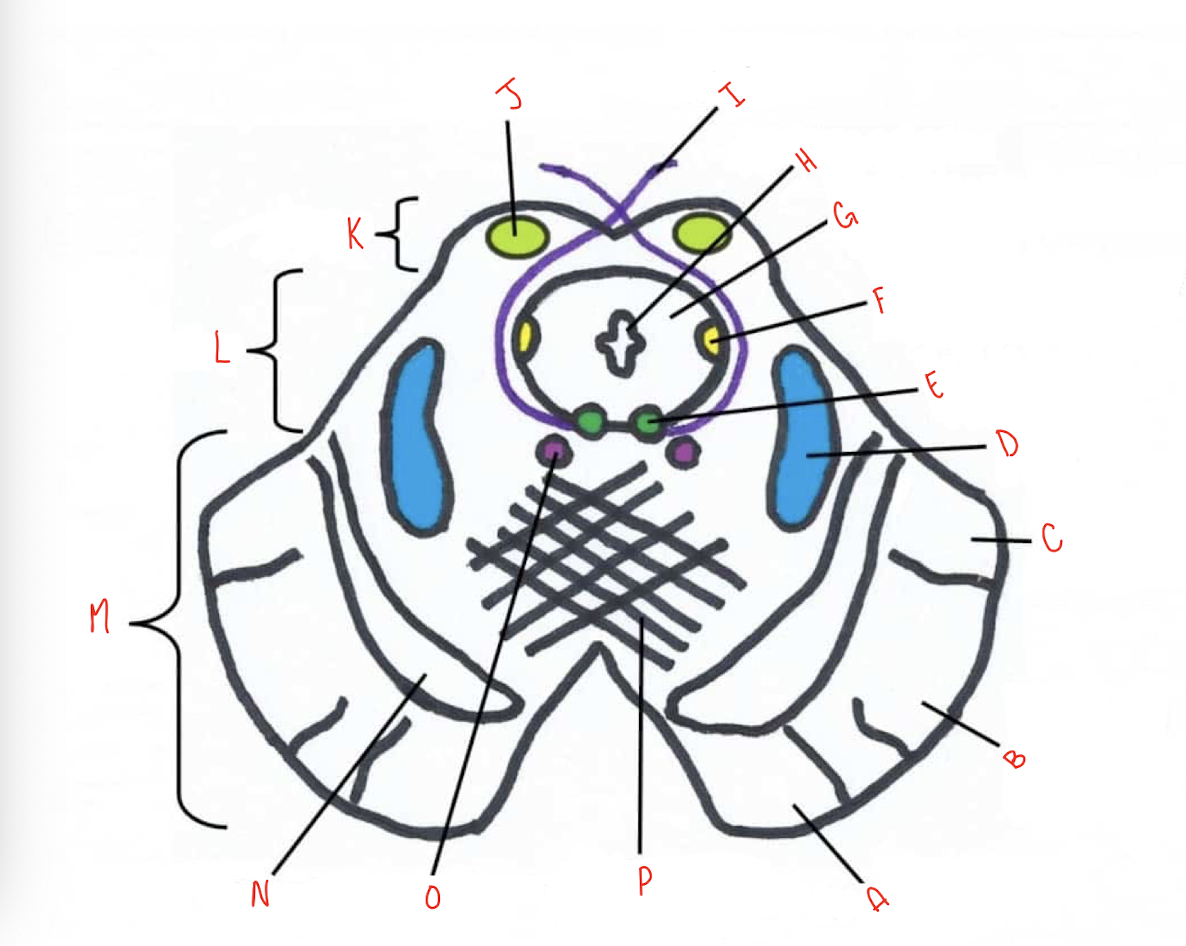
What structure of the sliced inferior colliculus section of the midbrain is labeled E?
Trochlear Nucleus
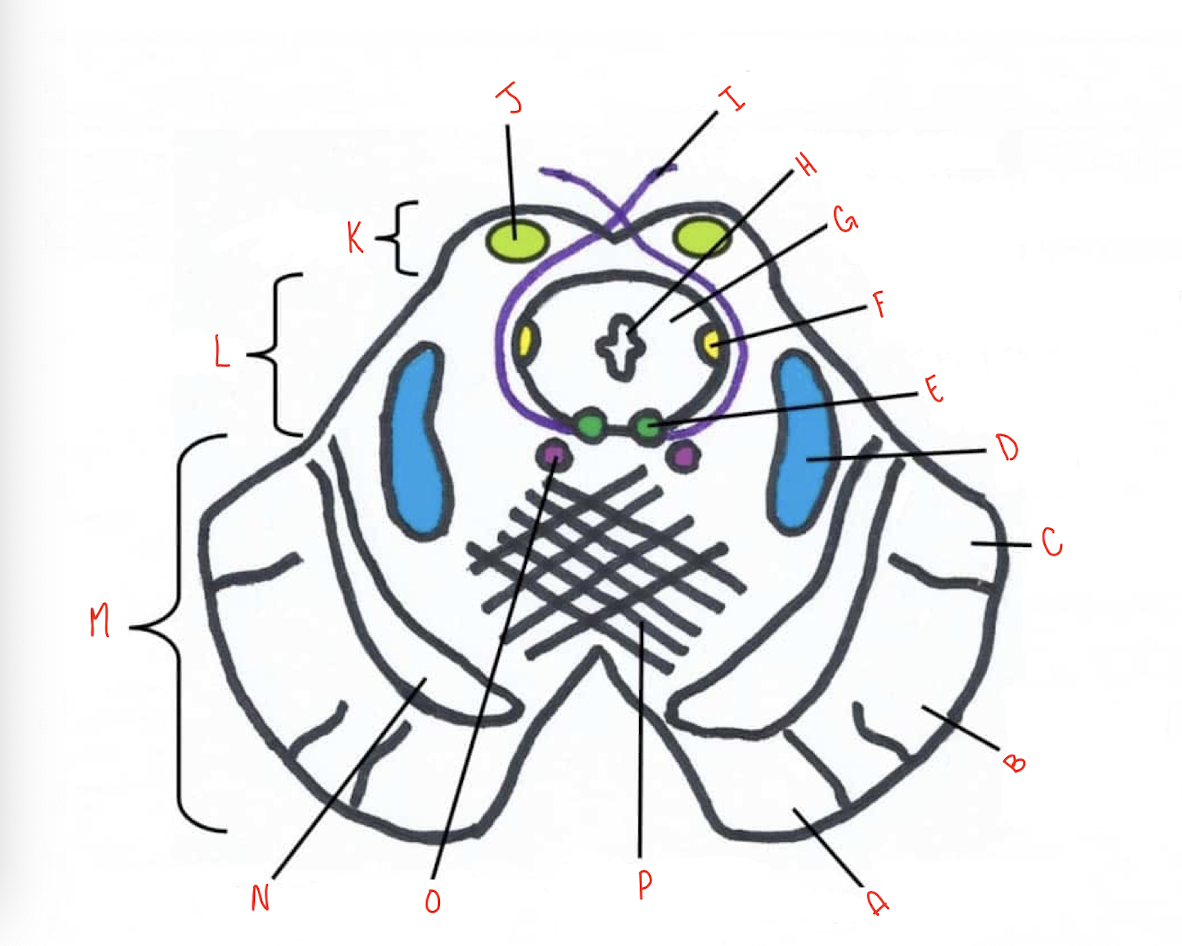
What structure of the sliced inferior colliculus section of the midbrain is labeled F?
Mesencephalic Nucleus of Trigeminal Nerve
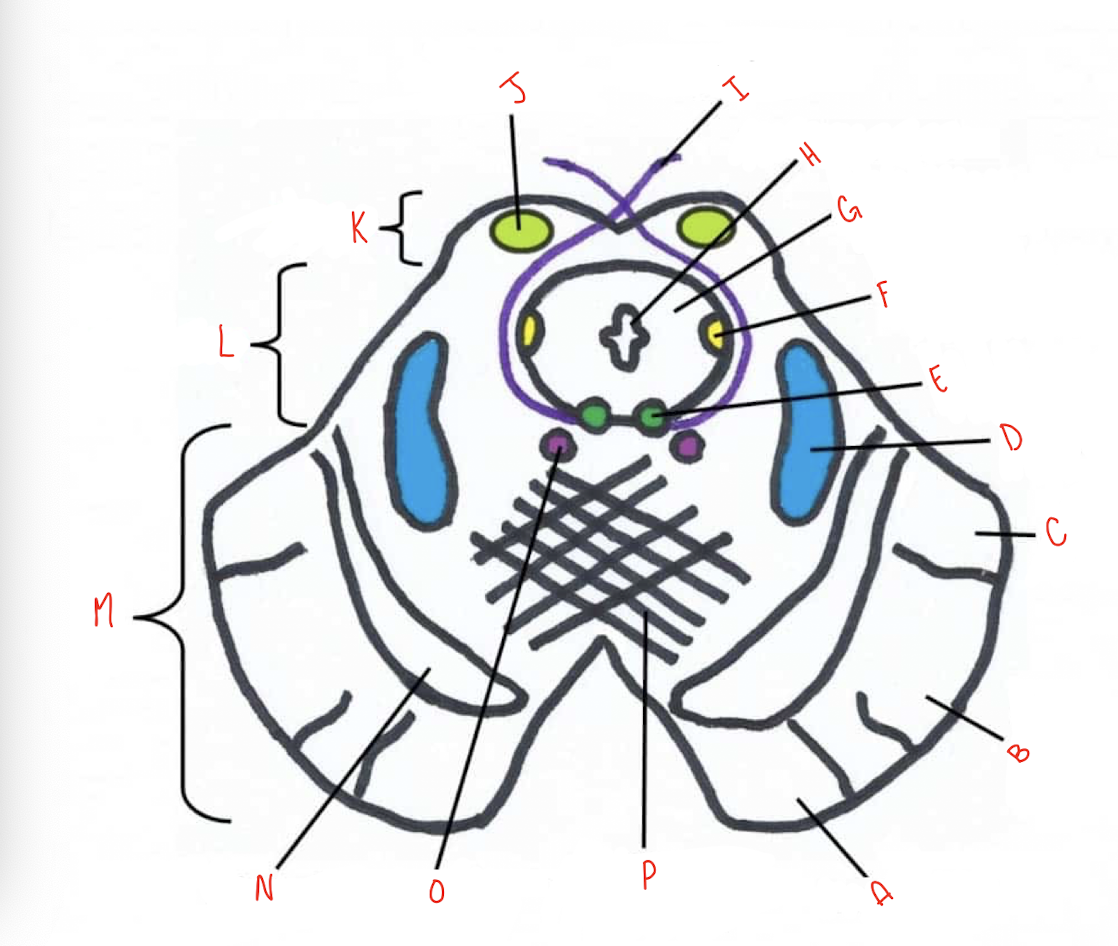
What structure of the sliced inferior colliculus section of the midbrain is labeled G?
Periaqueductal gray matter
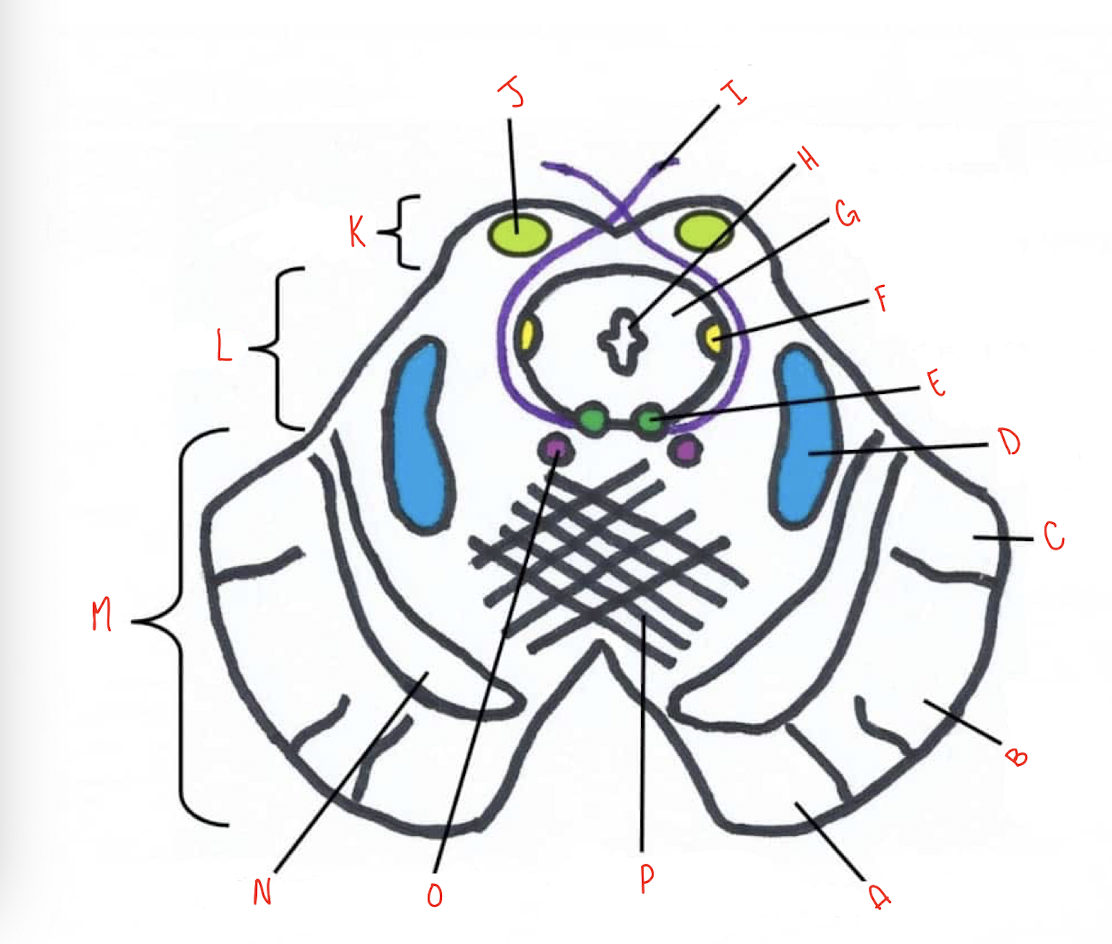
What structure of the sliced inferior colliculus section of the midbrain is labeled H?
cerebral aqueduct
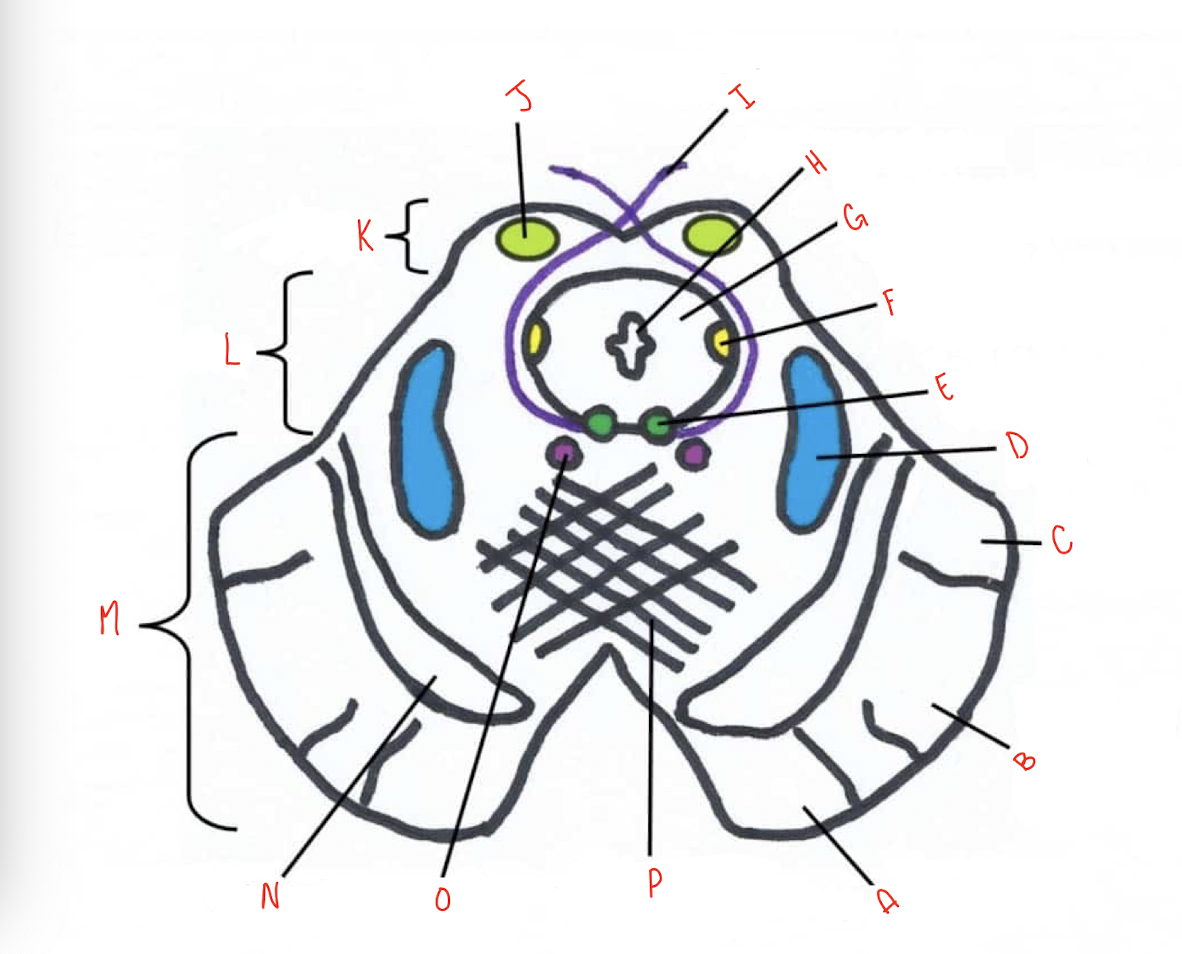
What structure of the sliced inferior colliculus section of the midbrain is labeled I?
Trochlear Nerve
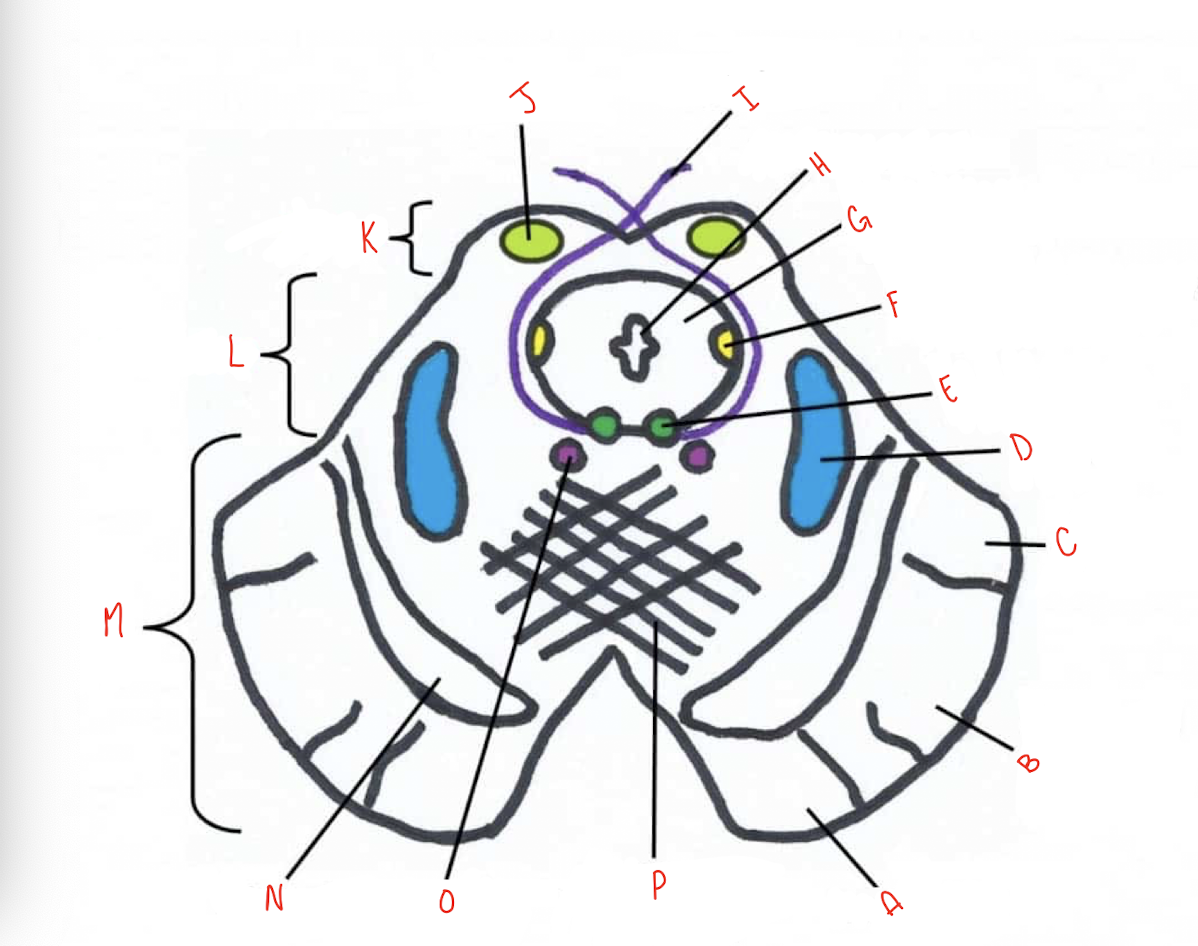
What structure of the sliced inferior colliculus section of the midbrain is labeled J?
Inferior Colliculus
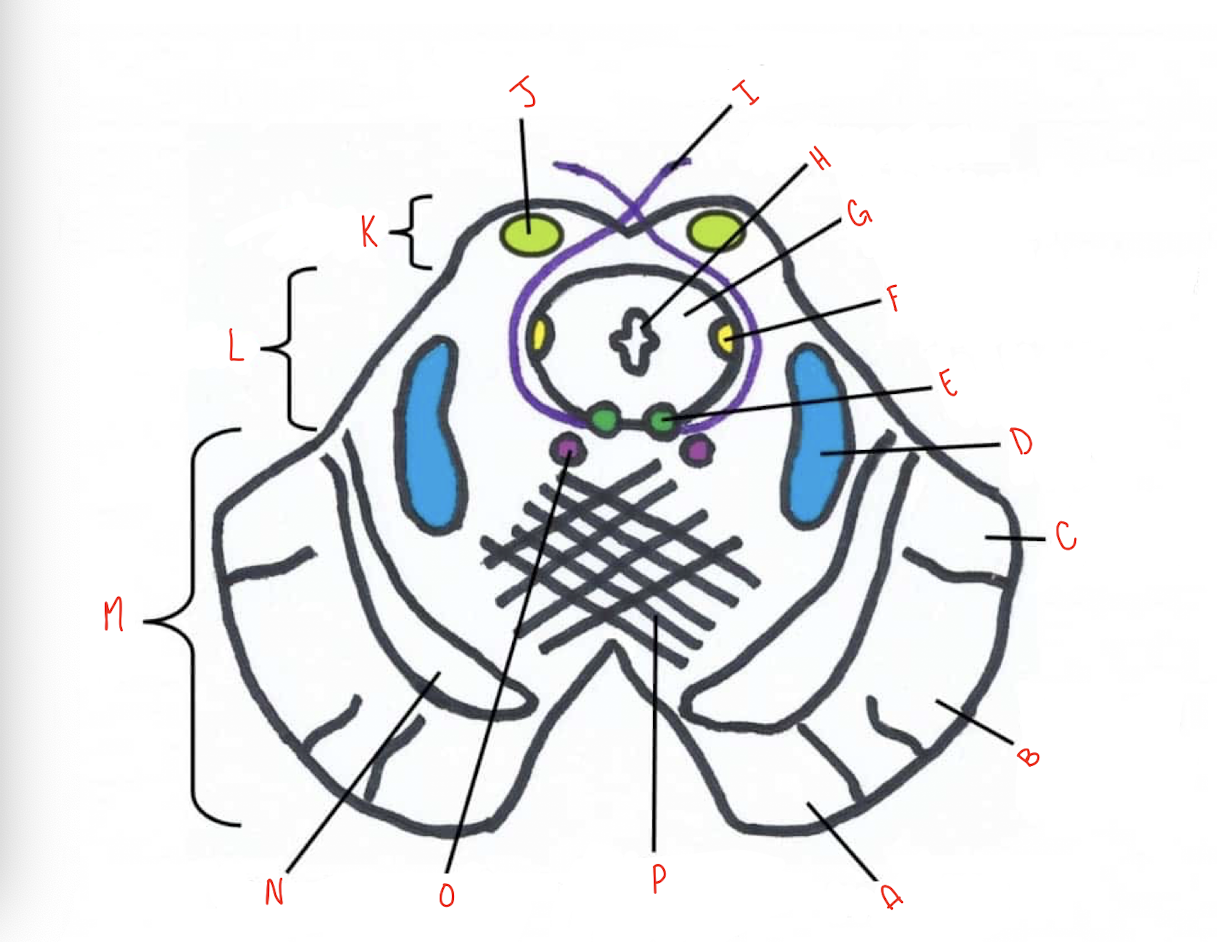
What structure of the sliced inferior colliculus section of the midbrain is labeled K?
Tectum
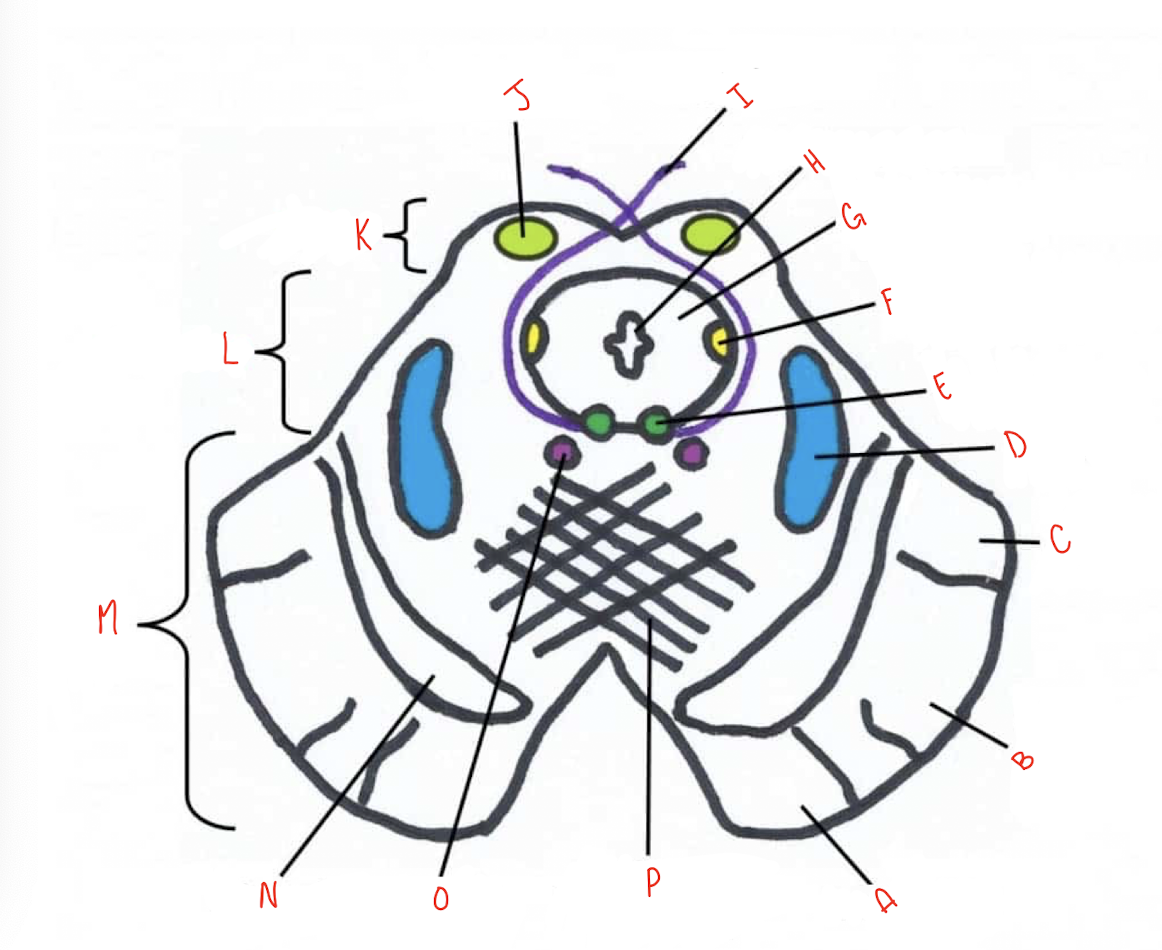
What structure of the sliced inferior colliculus section of the midbrain is labeled L?
tegmentum
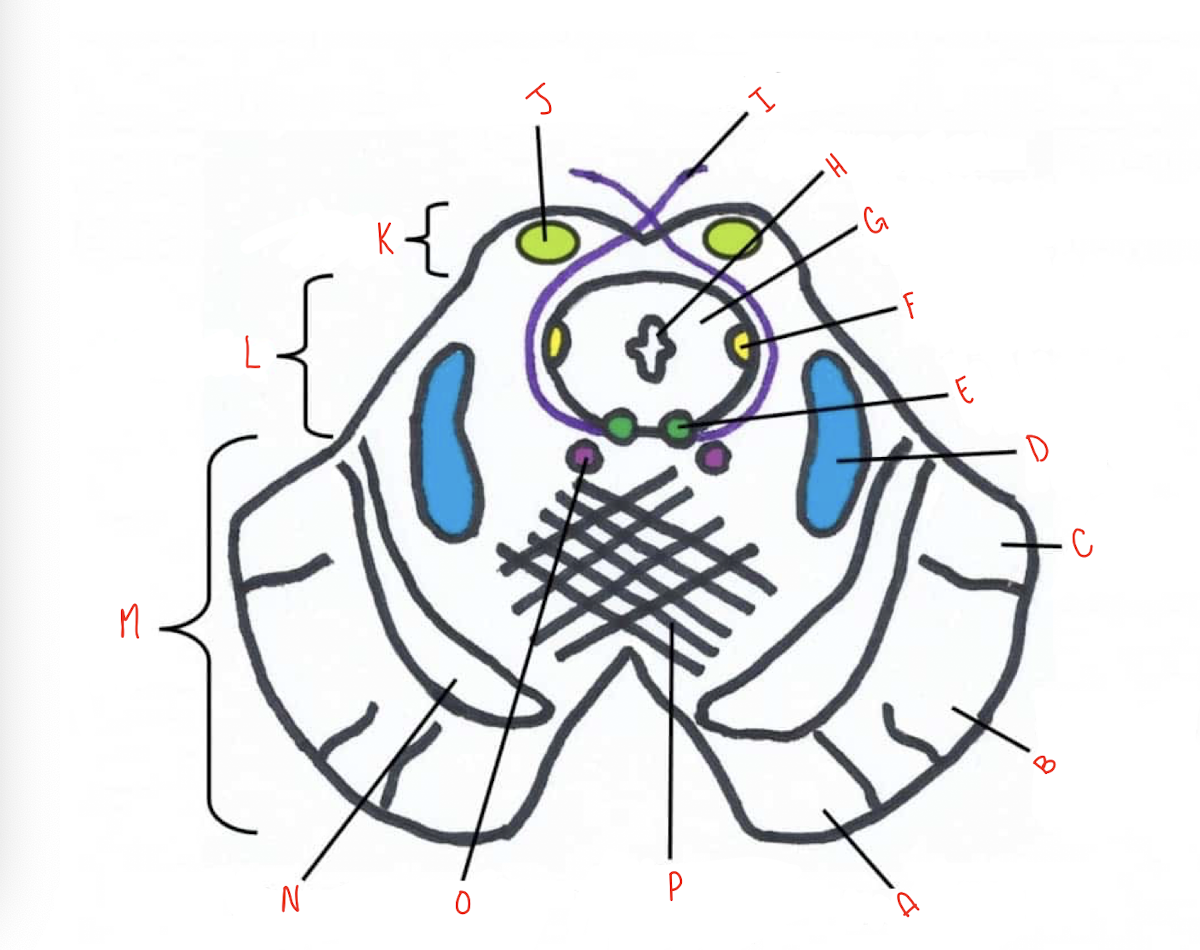
What structure of the sliced inferior colliculus section of the midbrain is labeled M?
crus cerebri
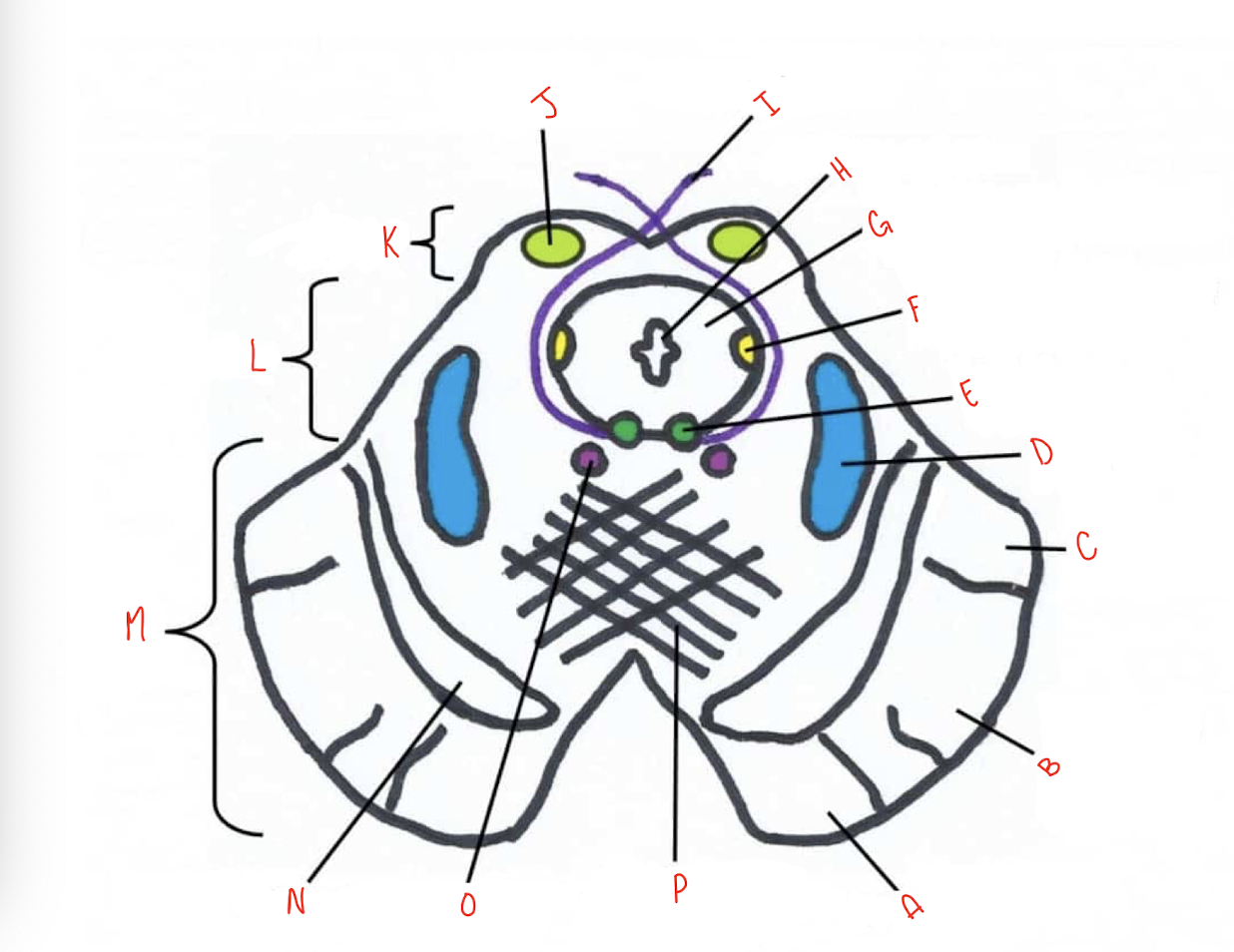
What structure of the sliced inferior colliculus section of the midbrain is labeled N?
Substantia Nigra
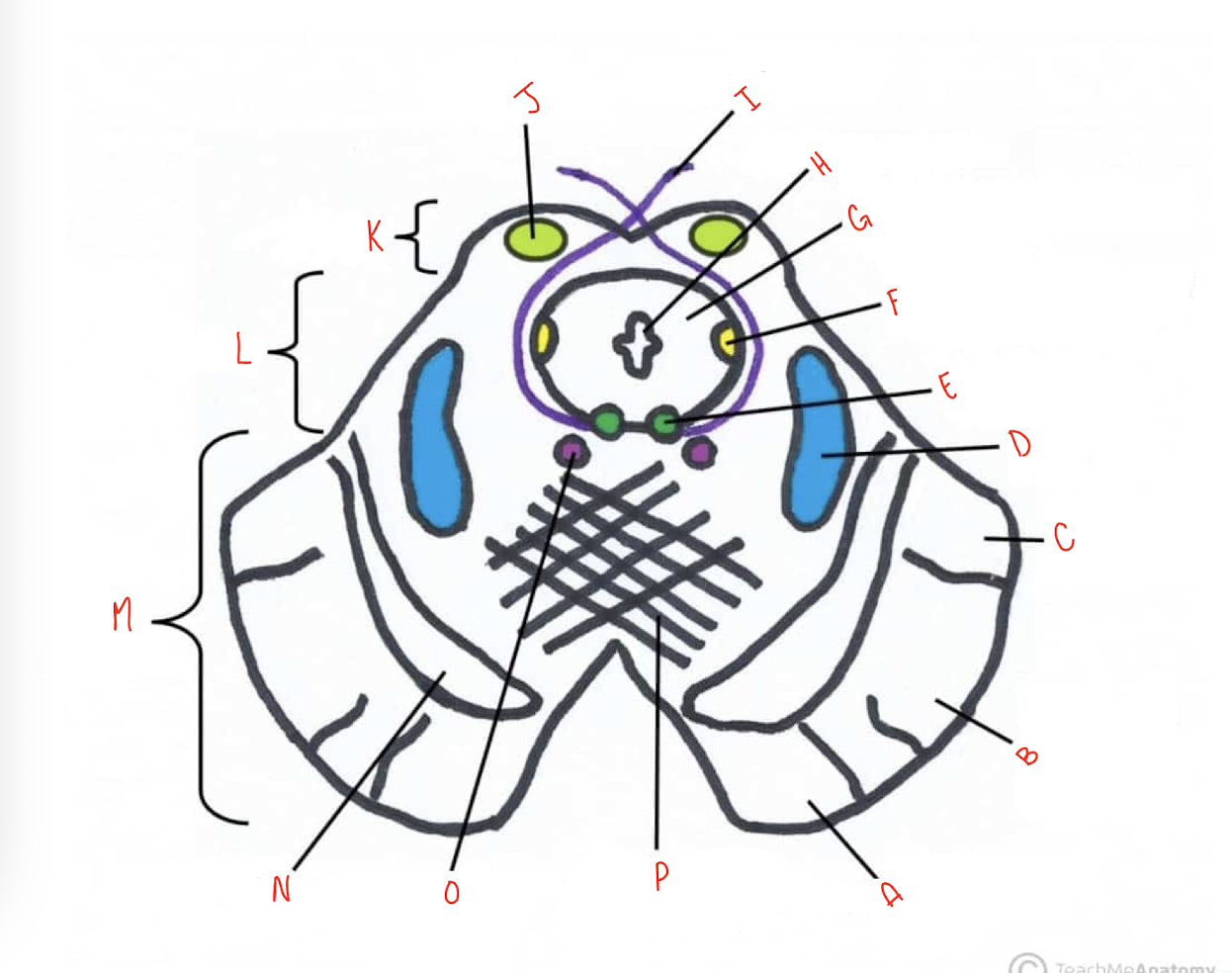
What structure of the sliced inferior colliculus section of the midbrain is labeled O?
Medial longitudinal fasciculus
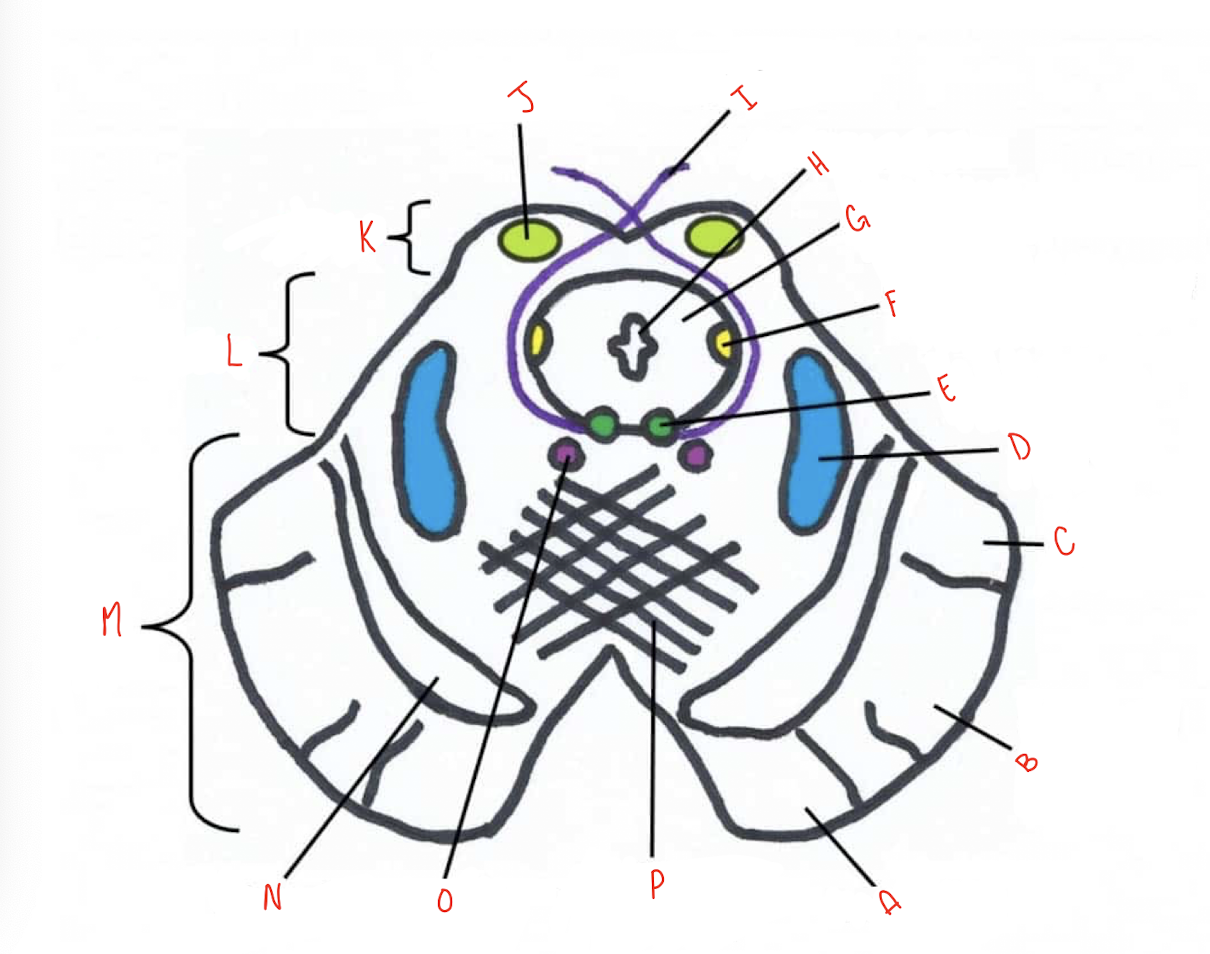
What structure of the sliced inferior colliculus section of the midbrain is labeled P?
Decussation of superior cerebellar peduncles
What are the three main functions of the brainstem?
conduit for information —> information can be sensory or motor or both!
Houses Cranial Nerve Nuclei (all except 1 and 2)
Most primitive part of our brain meaning it is responsible for essential functions such as respiration, consciousness, modulating pain, motor patterns, BP, Temp modulation
If you hear someone has a brain stem stroke what would that mean?
Even if the infact is the tip of a pin, if it occurs in the brainstem, depending on where it is it can instantly kill someone
What is a common issue associated with brain stem strokes?
Ability to swallow. Stroke to the midbrain causes dysphagia. Can lead to silent aspiration.
What is silent aspiration?
when food or liquid go into the lungs without the body reacting
happens a lot with brainstem stroke
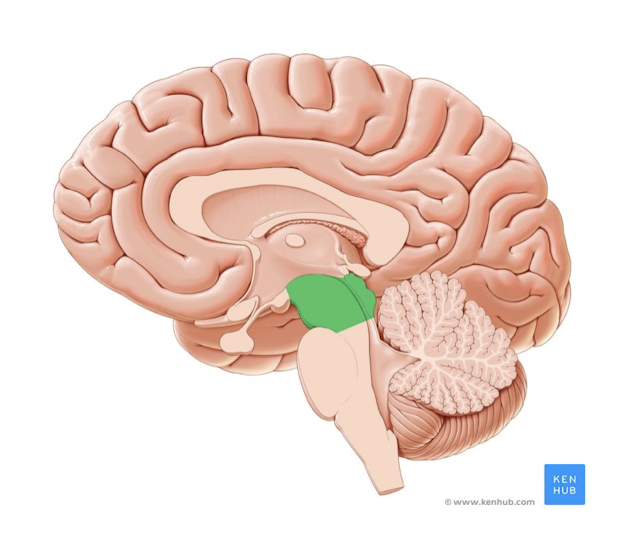
What structure of the brain is this?
Midbrain
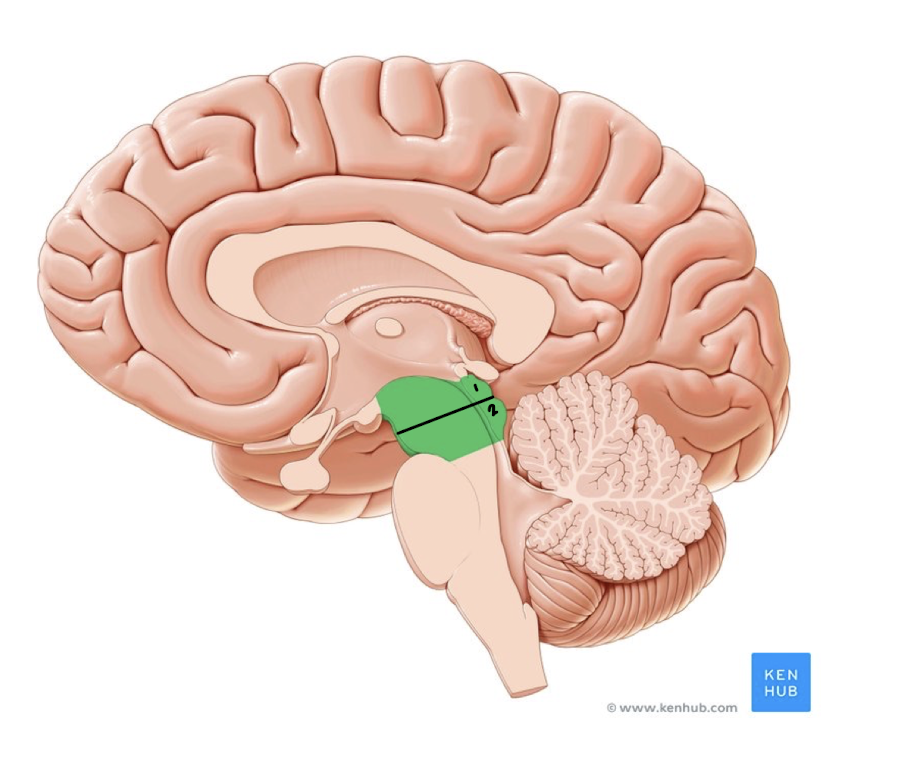
What part of the midbrain is labeled 1?
superior colliculus
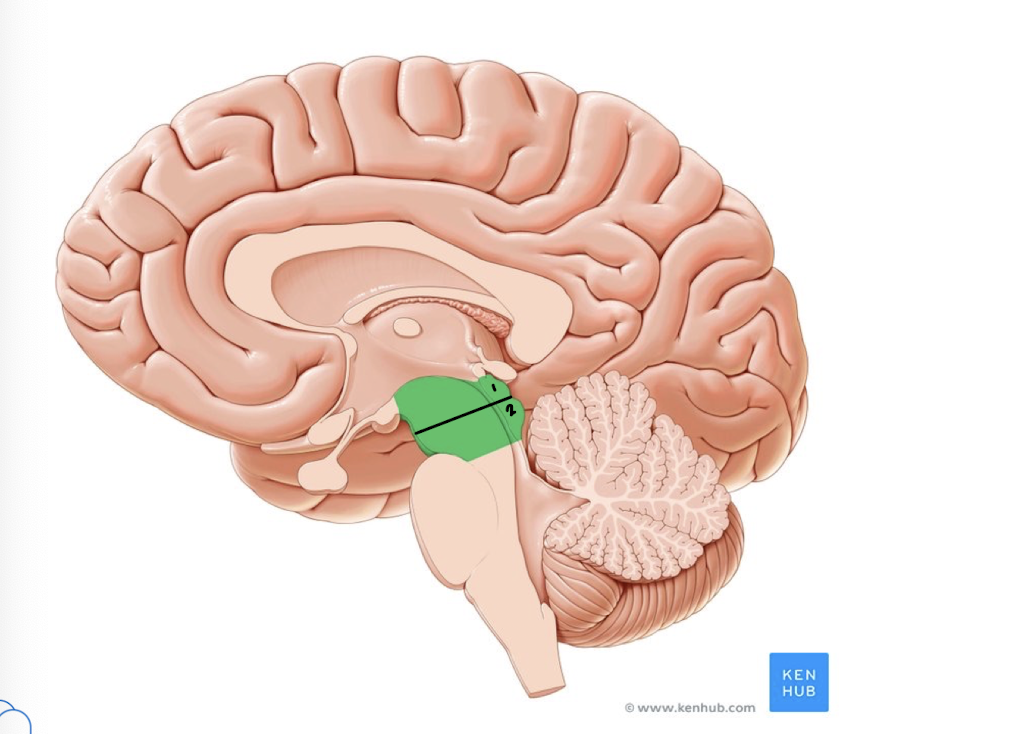
What part of the midbrain is labeled 2?
Inferior colliculus
What are the three main sections of the midbrain?
Crus Cerebri
Tegmentum
Tectum
In which part of the midbrain is the substantia nigra located?
tegmentum
How many fibers go through the crus cerebri in the midbrain? List them.
in the crus cerebri we have three types of fibers that are going to go through it
Frontopontine Fibers
Corticospinal and Corticonuclear Fibers
Temporopontine Fibers
What are frontopontine fibers?
Frontopontine Fibers
Most Medial Fibers
corticopintine fibers → start at cortex (specifically the frontal lobe) and go down to the pons
What are the corticospinal and corticonuclear fibers?
Corticospinal and Corticonuclear Fibers
Corticonuclear is the same as our corticobulbar tract
Corticobulbar will send information from the cortex to cranial nerve nuclei
brocas area
Corticospinal tract will send information from the cortex to the spinal cord and then out to muscles for voluntary motor movement
What are Temporopontine Fibers?
Temporopontine Fibers
Corticopontine fiber
send information from the temporal, parietal, and occipital lobes to the pons
Describe the midbrain homonculus.
More medially —> face and upper extremities
More Lateral —> lower extremities
Where is the midbrain homonculus located?
In the corticospinal and corticonucleus area of the crus cerebri
What are the two parts of the substantia nigra?
1) Pars Compacta → most superior
2) Pars Reticularis → most inferior
What does the Pars Compacta produce?
the pars compacta produces dopamine
What does dopamine do?
dopamine helps with motivation, feelings of reward
dopamine goes to the basal ganglia which is closely related to the cerebellum → going to be responsible with assisting with smooth movement and initiation of movement
What happens if there is not a lot of dopamine?
if there is not enough dopamine, we associate that with parkinsons disease
dopamine is not able to be sent to the basal ganglia because there is not enough
some medications for parkinsons will work on the pars compact to try and modulate the production of dopamine
Not enough dopamine can also be associated with:
Schizophrenia, bipolar disorder, addiction
What happens if there is too much dopamine?
delusions and hallucinations
What does our pars reticularis do?
Produces GABA
What does GABA do?
Inhibitory Neurotransmitters
lessens certain excitatory things
reduces stress and increases sleep
If there is a problem with GABA production what is going to happen?
increased stress
anxiety
sleep deprivation
Where does GABA get sent?
GABA gets sent to the thalamus and also to the superior colliculus
How many leminisci are there at the inferior colliculus level?
There are 4
lateral
spinal
trigeminal
medial
What is the decussation of the superior cerebellar peduncles?
This is cerebellar fibers and they are going to cross and move to red nucleus of the superior colliculus section of the midbrain
What is the medial longitudinal fasiculus?
connects the vestibulo part of the vestibulocochlear CN to CNs III, IV, VI to accomodate eye movement
this is going to be responsible for knowing where our body is in terms of our balance
The medial longitudinal fasiculus is going to connect the vestibular system to our CNs for eye movement so that if we need to turn our head, rotate our head to look at certain places we are not going to get all dizzy —> we will be able to compensate for all that
ultimately, it is the connections between our vestibular and vision systems
What is the trochlear nucleus?
CN IV → trochlear
going to send motor information to the superior oblique
inferior eye movement and rotating the eyes in medially (looking down and in)
What is the mesencephalic nucleus?
trigeminal nerve
proprioception from face
What is the paraqueductal gray mater?
gray mater
inside of it is this the cerebral aqueduct which connects the third and fourth ventricle
pain modulation
What is located in the tectum of the midbrain?
only the superior and inferior colliculi are located in the tectum
What type of information is the inferior colliculus responsible for?
auditory information
T/F: all of the fibers in the crus cerebri are all motor?
TRUE
Are the leminsci in the tegmentum sensory or motor?
all of them are sensory
How many leminisci does the level of the superior colliculus have?
3
spinal
trigeminal
medial
NO LATERAL HERE
What is the superior colliculus responsible for?
vision, eye tracking
What is the red nucleus going to do?
the red nucleus is the place where those superior cerebellar fibers from the inferior section of the midbrain are going to cross and then turn into rubrospinal fibers
we then have this decussation of the rubrospinal tract
What is the oculormotor nucleus?
Edinger Westfall Nucleus
parasympathetic and sympathetic fibers
resp for pupil dilation (sympathetic) and constriction (parasympathetic)
What is oculomotor nerve?
responsible for general somatic motor fibers
What are the pretectal nuclei?
responsible for pupillary light reflex
receives info to the eye and send it to the edinger westfall nucleus
Bilateral information → sent to the EWN bilaterally
shine a light in right eye → eye will constrict and so will left eye event if the light is not shone directly in left eye
if it is not bilateral, this means that the EWN is not getting that bilateral information → could mean a problem in the brainstem
In the pons what are the four leminisci?
lateral, spinal, trigeminal, and medial leminisci
In the pons, What is the lateral leminiscus responsible for?
receiving information from cochlear for hearing
In the pons, What is the spinal leminiscus responsible for?
responsible receiving information about pain, temperature, and crude touch from the neck down
In the pons, What is the trigeminal leminiscus responsible for?
receiving sensory information from face
In the pons, What is the medial leminiscus responsible for?
receiving information about proprioception
In the pons, What does the middle cerebellar peduncle do?
part of base
connects pontocerebellar fibers to the contralateral side of the cerebellum
In the pons, What will descending fibers do with the pontine nuclei?
descending fibers come and synapse on the pontine nuclei and then they are going to cross
In the pons, after synapsing on the pontine nuclei descending fibers are going to cross and become what?
pontocerebellar fibers
In the pons, what is the trapezoid body?
where the fibers we receive from our cochlea that give us information about our hearing are going to move into our lateral leminisci
info from cochlea is going to come in to this trapezoid body and it is going to cross in order to get to the lateral leminiscuc
this criss-cross is our trapezoid body and this is where our cochlear fibers cross and move into the lateral leminiscus
In the pons, what is the red nucleus?
the motor branch of CN V (trigeminal)
responsible for moving the muscles of mastication
in the pons, what is the green nucleus?
the sensory branch of CN V (trigeminal)
responsible for sensations of face
In the pons what does the superior cerebellar peduncle do?
too small so they dont do much compared to the middle cerebellar peduncle
What is the medial longitudinal fasiculus responsible for?
motor tract that connects cranial nerves 3, 4, and 6 to assist with eye movement
connects these to our CN VIII (vestibular system) → allows for us to move our eyes and head without getting dizzy
The purpose of the medial longitudinal fasciculus is to integrate movement of the eyes and head movements.
What does the tectospinal tract do?
moves our head in the response to certain visual stimuli
works closely with superior colliculus in the midbrain (resp for vision)
takes motor info and it innervates the muscles of the head and neck to move in response to whatever you are seeing
What does our rubrospinal tract in the pons do?
motor tract that innervates the flexor muscles of the upper extremities
At abducent/facial level of the pons what tracts are also going to be present?
corticospinal (voluntrary muscle movement) and corticobulbar tract (brocas area)
At abducent/facial level of the pons which leminisci are present?
only the medial and spinal leminisci are present at this level
What is the ventral spinocerebellar tract?
this is a sensory tract that is responsible for picking up proprioception information
What is the superior olivary nucleus?
responsible for picking up on the intensity, velocity, and timing of auditory sensation
part of the auditory pathway
What are the ventral cochlear nuclei and dorsal cochlear nuclei responsible for?
resp for auditory pathway
What is the role of the inferior cerebellar peduncle?
separates the ventral cochlear nuclei from the dorsal cochlear nuclei
What is our vestibular nuclear complex?
has a superior, lateral, and a medial part
resp for our vestibular system → making sure we have good balance and are maintaining equilibrium
What is the nucleus of tractus of solitarius?
sensory info from the anterior 2/3 of the tongue
What is the superior salivary nucleus of CN VII?
resp for salivation
what is the motor nucleus of CN VII?
resp for muscles of facial expression
What is the abducens?
CN VI
only motor
resp for moving a muscle called the lateral rectus
allows for eyes to abduct
allows for eye movement to move laterally