Lect 4: Membrane Transport cont.
 Call Kai
 Learn
Learn Practice Test
 Spaced Repetition
 Match
Match Flashcards
 Knowt Play
1/17

There's no tags or description
Looks like no tags are added yet.
Name | Mastery | Learn | Test | Matching | Spaced | Call with Kai | Chat |
|---|
No analytics yet
Send a link to your students to track their progress
18 Terms
4 Types of ATPases
P-class = moves _____
V-class = moves _____, uses/makes ATP
F-class = moves _____, uses/makes ATP
ABC Transporter = moves _____
4 Types of ATPases
P-class = moves small ions
V-class = moves H+, uses ATP
F-class = moves H+, uses OR makes ATP (both directions)
ABC Transporter = moves substances (nutrients, drugs, etc.)

P-Class 2 main examples:
__________
__________
P-Class 2 main examples:
Ca2+ ATPase
Na+/K+ Pump
P-class examples:
Ca2+ ATPase = moves Ca2+ with/against concentration gradient
in ________ cells
SR lumen/cytosol to SR lumen/cytosol
contains ___ Ca2+-binding sites
P-class examples:
Ca2+ ATPase = moves Ca2+ against concentration gradient
in muscle cells
cytosol to SR lumen
contains 2 Ca2+-binding sites
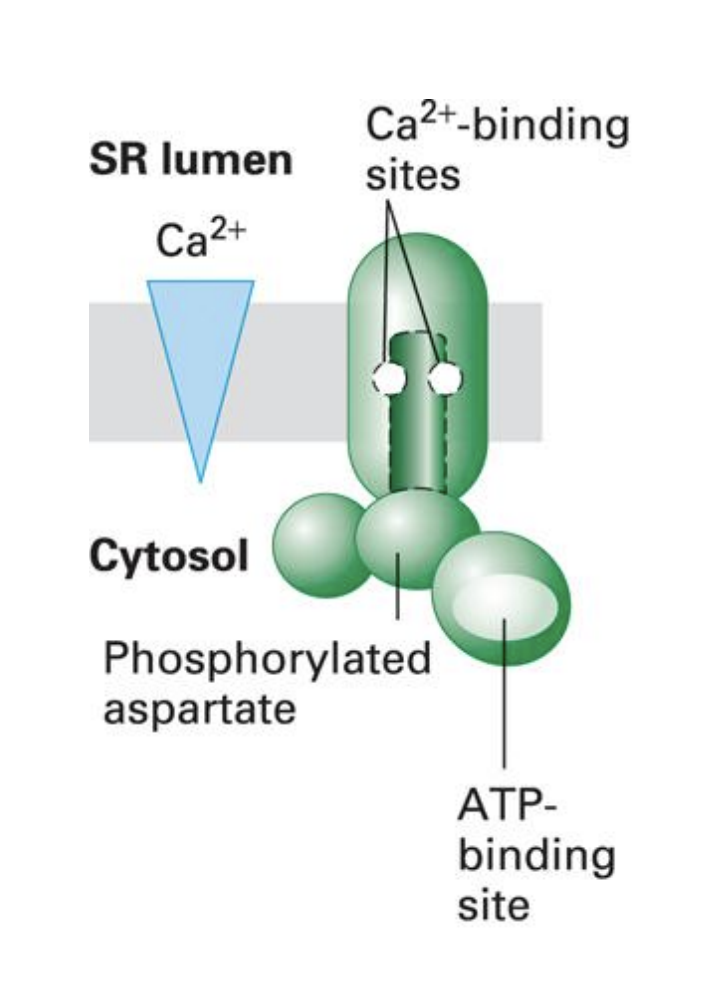
Ca2+ ATPase Mechanism
E1/E2 is more stable than E1/E2
-
____ and ____ bind to transporter
____________ = energy is released (and Pi added)
Conformational change (E1/E2 → E1/E2)
now has low affinity for Ca2+
____ is released
____ is released
Conformational change (E1/E2 → E1/E2)
now has high affinity for Ca2+
Ca2+ ATPase Mechanism
E1 is more stable than E2
-
ATP and Ca2+ bind to transporter
ATP hydrolysis = energy is released (and Pi added)
Conformational change (E1 → E2)
now has low affinity for Ca2+
Ca2+ is released
Pi is released
Conformational change (E2 → E1)
now has high affinity for Ca2+

P-class examples:
Na+/K+ Pump = moves Na+ with/against gradient, and moves K+ with/against gradient
maintains ___________
Na+/K+ move in same/opposite directions
contains ___ Na+-binding sites and ___ K+-binding sites
P-class examples:
Na+/K+ Pump = moves Na+ against gradient, and moves K+ against gradient
maintains membrane potential
Na+/K+ move in opposite directions
contains 3 Na+-binding sites and 2 K+-binding sites
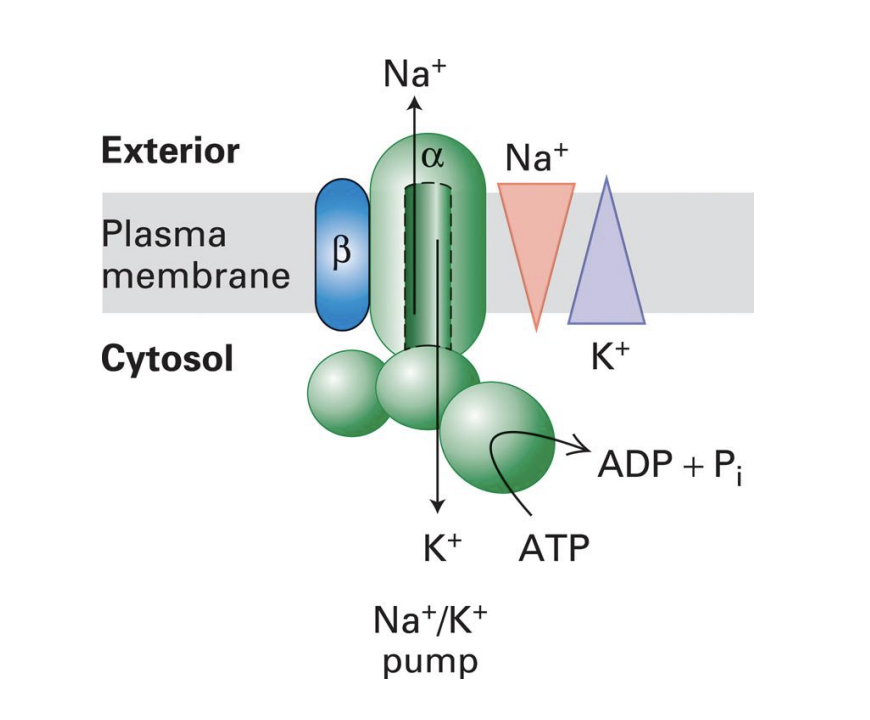
Na+/K+ Pump Mechanism
____ and ____ bind to transporter
____________ = energy is released (and Pi added)
Conformational change (E1/E2 → E1/E2)
now has low affinity for ____ and high affinity for ____
____ is released and ____ binds
____ is released
Conformational change (E1/E2 → E1/E2)
now has high affinity for ____ and low affinity for ____
____ is released
Na+/K+ Pump Mechanism
Na+ and ATP bind to transporter
ATP hydrolysis = energy is released (and Pi added)
Conformational change (E1 → E2)
now has low affinity for Na+ and high affinity for K+
Na+ is released and K+ binds
Pi is released
Conformational change (E2 → E1)
now has high affinity for Na+ and low affinity for K+
K+ is released

V-Class Pump
uses/makes energy (via _____________) to move H+ with/against concentration gradient
critical in (disease)
help move H+ into ________
V Pump issue → ?
V-Class Pump
uses energy (via ATP hydrolysis) to move H+ against concentration gradient
critical in osteopetrosis
help move H+ into resorption lacuna
V Pump issue → low H+ in lacuna → osteopetrosis

F-Class Pump
uses/makes energy (via _____________) to move H+ with/against concentration gradient
aka __________
F-Class Pump
uses energy (via PE gradient of H+) to move H+ against concentration gradient
AND makes energy by moving H+ with concentration gradient
aka ATP synthase

ABC Transporter = moves different substrates across membrane
___ specific aa sequences bind and hydrolyzes ATP
ABC Transporter = moves different substrates across membrane
2 specific aa sequences bind and hydrolyzes ATP
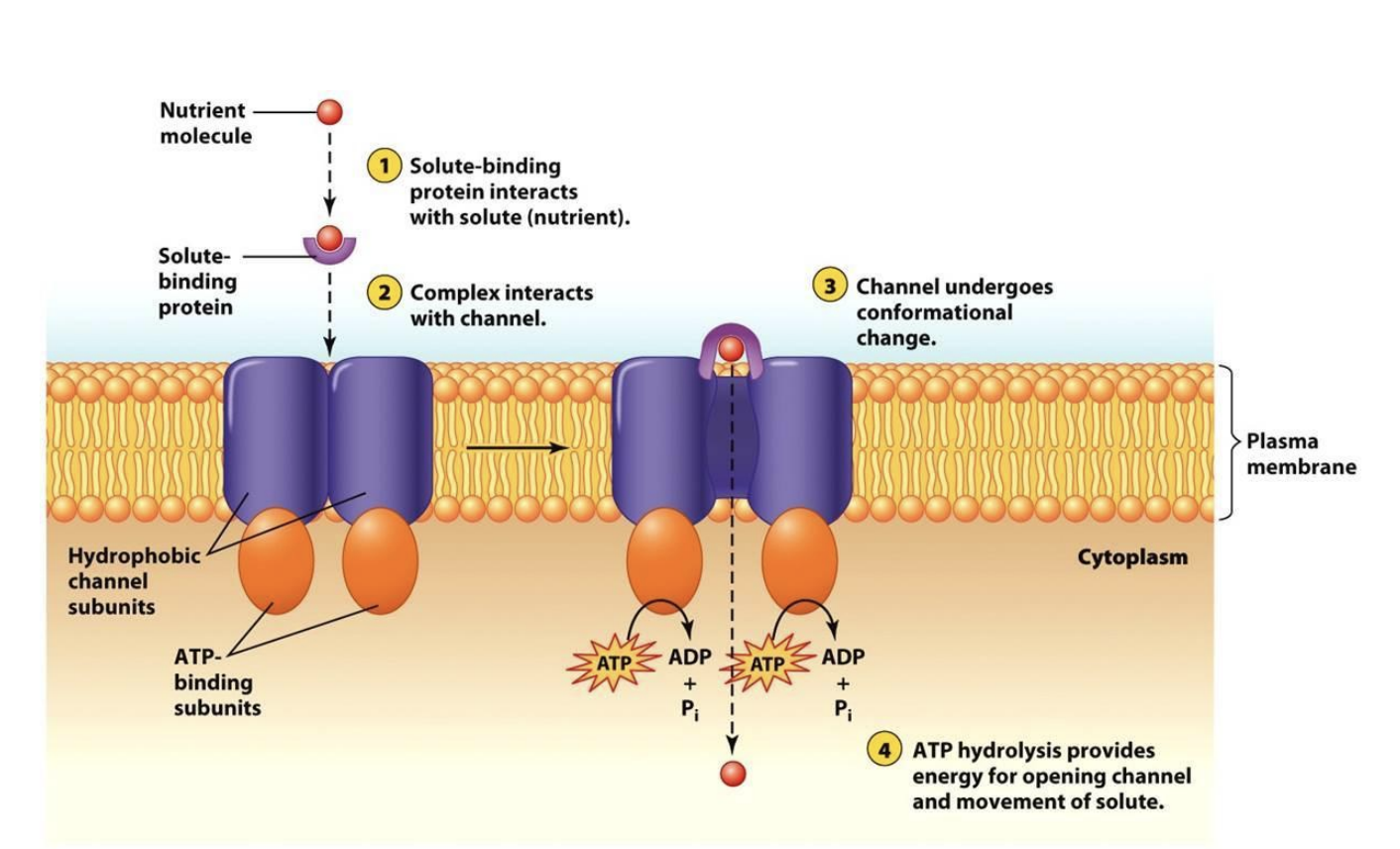
ABC Transporter Mechanism
__________ interacts with __________ → complex
complex interacts with (open/closed) channel
conformational change
__________ provides energy → channel opens/closes + solute moves inside
ABC Transporter Mechanism
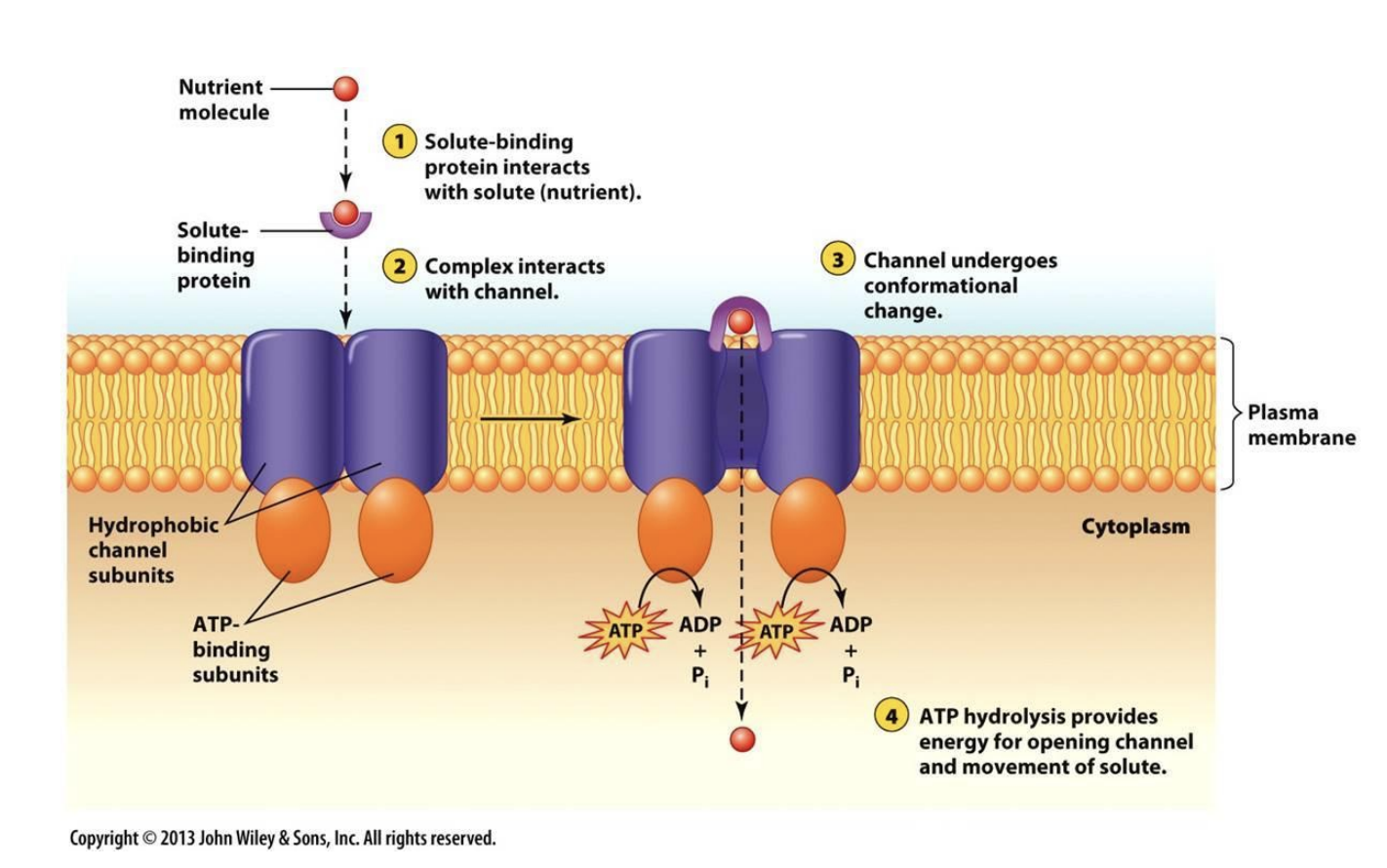
solute/nutrient interacts with solute-binding protein → complex
complex interacts with (closed) channel
conformational change
ATP hydrolysis provides energy → channel opens + solute moves inside
Channels and Transporters examples:
Channels
_________
Transporters
_________ = uniporter
_________ = symporter
Channels and Transporters examples:
Channels
Aquaporin
Transporters
GLUT1 = uniporter
Na+/Glucose Transporter = symporter
Channels
___________ = transport H2O down conc. gradient
gated/non-gated
conformational change?
water forms _________ with hydrophilic aa
Channels
Channels
Aquaporin = transport H2O down conc. gradient
non-gated
NO conformational change
water forms H-bond with hydrophilic aa

Transporter
ex: ___________ = uniporter, brings glucose into brain
located on ___________
ex: ___________ = symporter, Na+ with/against gradient and glucose with/against gradient
Transporter
ex: GLUT1 = uniporter, brings glucose into brain
located on endothelium (blood vessel lining)
ex: Na+/Glucose Transporter = symporter, Na+ with gradient and glucose against gradient

GLUT1 vs GLUT4
GLUT1/GLUT4 brings glucose into brain, GLUT1/GLUT4 brings glucose into muscle/fat cells
GLUT1/GLUT4 is a uniporter, GLUT1/GLUT4 is a uniporter
GLUT1/GLUT4 is insulin-dependent, GLUT1/GLUT4 is insulin-independent
GLUT1/GLUT4 deficiency → diabetes, GLUT1/GLUT4 deficiency → neuro issues
GLUT1 vs GLUT4
GLUT1 brings glucose into brain, GLUT4 brings glucose into muscle/fat cells
GLUT1 is a uniporter, GLUT4 is a uniporter
GLUT4 is insulin-dependent, GLUT1 is insulin-independent
GLUT4 deficiency → diabetes, GLUT1 deficiency → neuro issues
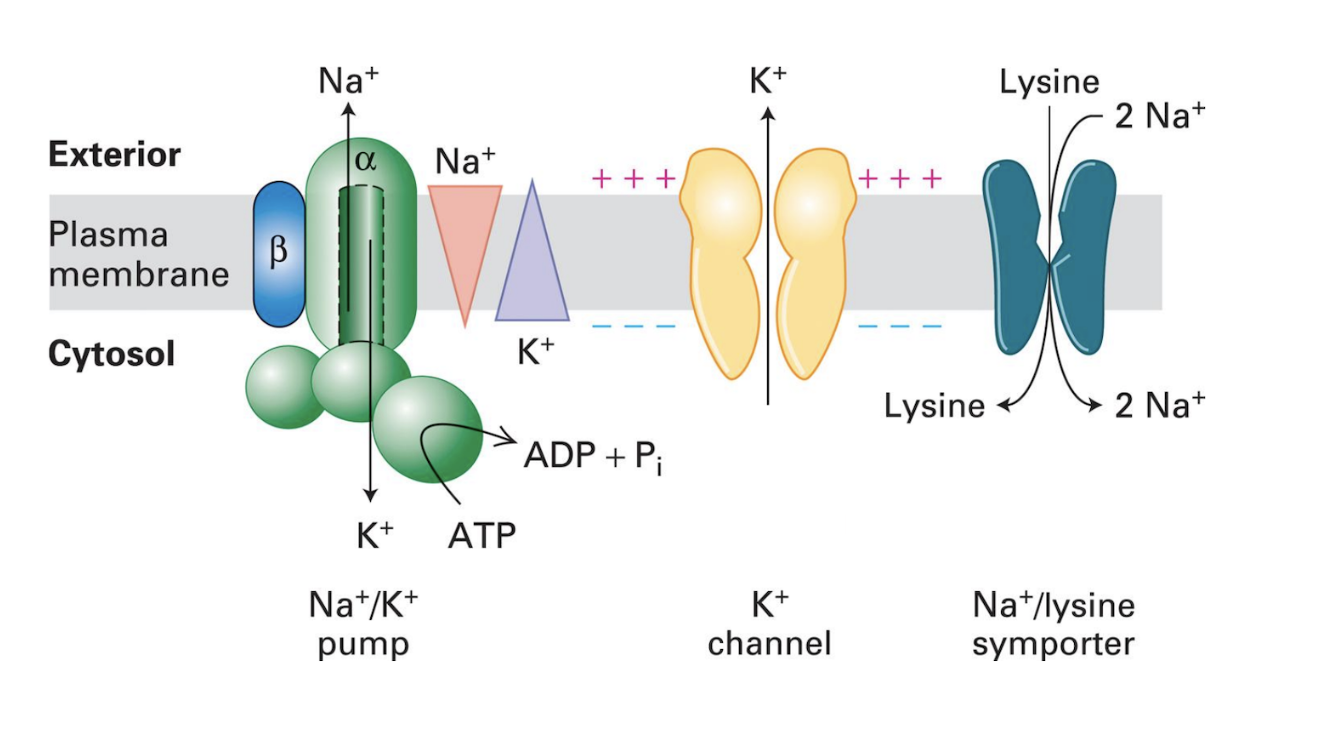
All 3 Together (Amino Acid Import)
All 3 Together (Amino Acid Import)
Pump: Na+/K+ ATPase Pump = creates Na+/K+ concentration gradient
Channel: K+ channel = K+ flow down concentration gradient
Transporter: Na+/Lysine symporter = Na+ flows down electrochemical gradient → powers uphill transport of Lysine
Click Questions
What is a major difference between V-ATPase and F-ATPase?
Why can’t H3O+ flow through an aquaporin channel?
How would the F-ATPase be affected if H3O+ could flow through aquaporins?
What is a major difference between V-ATPase and F-ATPase?
V-ATPase = against gradient, need ATP
F = uses gradient to create ATP, can work in reverse direction (so also can use ATP to move H+)
Why can’t H3O+ flow through an aquaporin channel?
charge - aquaporins contain positive residues → repel protons
How would the F-ATPase be affected if H3O+ could flow through aquaporins?
H+ gradient would disappear → F+ ATPase would have no force → ATP production would stop
Click Questions
How does secondary active transport differ from active transport?
What transport proteins use active transport & what transport protein use secondary active transport?
Do channels and uniporters require energy input? Why?
Click Questions
How does secondary active transport differ from active transport?
secondary active = energy is from ion gradient PE
active = energy is from ATP
What transport proteins use active transport & what transport protein use secondary active transport?
symporters and antiporters = secondary active
atpase (abc transporters, etc.) = active
F = depends on direction, can be active or facilitated
Do channels and uniporters require energy input? Why?
channels + uniporters do not require energy input
things flow down conc. gradient
Click Questions
GLUT1 vs GLUT4?
Click Questions
GLUT1 vs GLUT4?
brain vs muscle
already in plasma membrane vs stored inside cell, later moved to plasma membrane in response to insulin
glut1 deficiency ⇒ brain issues
glut4 deficiency ⇒ diabetes