NUR 255: Exam 1 Study Guide (Edited)
 Call Kai
 Learn
Learn Practice Test
 Spaced Repetition
 Match
Match Flashcards
 Knowt Play
1/139

There's no tags or description
Looks like no tags are added yet.
Name | Mastery | Learn | Test | Matching | Spaced | Call with Kai | Chat |
|---|
No analytics yet
Send a link to your students to track their progress
140 Terms
Preoperative Phase
NPO status
- Patients must remain NPO for at least 6 hours prior to surgery due to aspiration risk
- If a patient eats, surgery must be delayed at least 6 hours
- Pt can become easily dehydrated
Medication Check
- Review all current medications and allergies of the pt
- Hold before surgery: blood thinners, ED drugs, ACEs / ARBs, and GLP-1 meds
When to Hold Each Medication
Heparin: Day before/morning of
GLP-1s (Ozempic): 1 week
Enoxaparin: 24 hours
Warfarin: 5 days
Aspirin: 7-10 days
ACEs/ARBs: Day before/morning of
Herbal Supplements: 2 weeks
Medications to Continue
Continue essential meds: cardiac stent maintenance, renal support, beta blockers, and thyroid meds
Consent Requirements
- Verify signed, written consent
- Must be in the patient's first language; translator would be present if it is needed
- Patients whos mental status are altered cannot consent
- Consent must include: right patient, procedure, laterality, and site
Who can consent
- Adults or emancipated minors
- POA
- If no POA can be reached for an incompetent patient, surgery must be canceled unless emergent
Emergency Situations of Consent
- Implied consent applies for lifesaving procedures
- Patients can revoke consent at any time
Assessment
- Perform a focused assessment: neurological, cardiac, pulmonary, and skin
- Know Baselines
- Obtain history: medical, surgical, medications, allergies, anesthesia reactions
Diagnostics
- CBC, Chem-7, Hemoglobin A1C (If diabetic) within 30 days
- Perform type and screen for blood typing and antibody compatibility
What substance use disorder risk factor is noted for complications before surgery?
None used
What are significant comorbidities that increase risk for complications?
Cardiac disease, hypertension, BMI > 40, diabetes, pulmonary disease
How can positioning concerns affect patients with COPD during surgery?
- Trendelenburg and supine may worsen COPD complications
- These can increase pressure too much on heart and lungs
What should be reviewed with a patient regarding surgery?
- Risks
- Benefits
- Alternatives
- Procedure (anesthesia & plan)
- Surgeon first, then RN reiterates and answers questions
What should be explained to a patient about post-surgery discomfort?
Expected discomfort and pain management plan
What should patients be educated about if opioids are part of their pain management?
Use of stool softeners
What should patients be taught for post-operative care about lung complications? (if required)
- Airway clearance techniques for coughing and secretion
- Deep breathing
- Incentive spirometry
How often should a patient use an incentive spirometer post-surgery?
10 times per hour
Why is early mobility important for post-surgery patients?
- Prevent clots
- Prevent pneumonia
- Muscle loss
- Decreased ROM
What should the patient know about post-surgical ambulation?
Postoperative ambulation devices such as walkers may be needed
What topics should be covered regarding wound care after surgery?
- Nutrition
- Routine wound tx (ex. dressing changes)
- Positioning
- Limitations
- Medications
- Signs of complications
Positioning
- Patient will likely be in supine position
- Pad bony prominences (coccyx, scapula, heels, etc)
- Arm boards
Overarching pre-op goal
SAFETY
Nurse's Role
- Act as patient's advocate: support safety, comfort, and privacy
- Serve as the eyes and ears of the patient during pre-op and preparation
What is elective surgery?
Planned in advance, non-emergent; patient should have the surgery (e.g. hernia repair)
What is urgent surgery?
Requires prompt attention but not immediate (e.g. appendectomy without rupture)
What is emergent surgery?
Lifesaving, requires immediate intervention (e.g. ruptured aneurysm)
What is diagnostic surgery?
Intended to identify the pathology (e.g. biopsy)
What is cosmetic surgery?
To repair a physical defect
What is exploratory surgery?
Done to find an existing problem that other testing has not identified
What is curative surgery?
Resolve the problem through surgical techniques
What is palliative surgery?
Performed to provide temporary relief of symptoms
What is preventive surgery?
Performed to prevent a problem
What is ambulatory surgery?
Includes outpatient, same-day, or short-stay surgery that does not require an overnight hospital stay
What is minimally invasive surgery?
Surgical procedures that use specialized instruments inserted into the body either through natural orifices or through small incisions
Intraoperative Phase
Who is legally responsible for documenting all surgical counts?
The circulating nurse
When are surgical counts performed?
Before surgery begins, before closing the inner layer, and before closing the outer layer
What happens if something is missing during a surgical count?
The surgeon is notified and will order an intraoperative X-ray
Patient Positioning Details
- Patient is typically in the supine position with a safety strap placed 2 inches above knees on the thighs
- RN ensures patient is maintained in proper functional alignment throughout the procedure
- Arms must remain secured on the arm boards
- The top priorities of the nurse in the OR are safety, comfort, privacy, and confidentiality
What is the role of the circulating nurse in the operating room?
Manages the counts, monitors EBL, documents, distributes sterile items, and ensures all medications on the sterile field are labeled.
What is the role of the scrub nurse in the operating room?
Works within the sterile field.
What are the responsibilities of the anesthesiologist or CRNA during surgery?
Monitors vital signs, manages anesthesia, and makes anesthesia-related decisions.
What is confirmed during the first time-out (pre-anesthesia) in surgery?
- Right patient
- Right site
- Right laterality
- Right procdeure
What occurs during the second time-out before incision?
Everyone introduces themselves and confirms patient consent. Recheck the right patient, site, and laterality.
Surgical Asepsis Principles
- Sterilize all equipment and maintain sterile technique
- Back of the gown and anything below waist are not sterile
- Drop sterile items 5 inches away
- Sterile area is 1 foot from sterile field
- Work clean to dirty
- Disinfect = clean; Asepsis = sterile
Patient Specific Concerns
- Post-menopausal women are more sensitive to high temperatures
- Diabetic patients are at risk for hyperglycemia (stress response can raise glucose levels and trigger DKA), as well as hypoglycemia due to NPO status
- Patients with COPD can have complications such as chest collapse from lying supine or the Trendelenburg position
- Bariatric patients may struggle with gas exchange
- Elderly patients may experience hypothermia due to decreased subcutaneous fat
What is the Trendelenburg position used for?
Lower abdominal procedures
What is the dorsal recumbent position used for?
Perineal access
What is the most common surgical position?
Supine
What is lateral position used for?
Lying on the unaffected side (ex. kidney surgery)
What is the lithotomy position used for?
Surgeries and examination of the pelvic region, such as childbirth
What factors influence the choice of anesthesia?
The choice depends on the procedure, patient tolerance, and anesthesiologist judgment.
How are anesthetic gases eliminated from the body?
Gases are eliminated through exhalation.
What are the potential risks associated with anesthesia?
- Aspiration
- Glossopharyngeal obstrcution
- Malignant hypothemia
- Medullary depression
- Death
What is malignant hyperthermia?
- Malignant hyperthermia is a life-threatening hypermetabolic state that is genetic and requires chart flagging for higher risk.
- 104-110F
- Tachycardia then muscle rigidity are the first signs
What often causes complications of anesthesia?
Complications of anesthesia often stem from comorbidities or medications.
What are the characteristics of Stage 1 of anesthesia?
Dizziness, can't move limbs easily, agitation
What are the characteristics of Stage 2 of anesthesia?
Excitement, struggling, shouting, laughing, pupils dilate, irregular pulse and respiratory rate
What defines Stage 3 of anesthesia?
Surgical anesthesia with vapor/gas and IV, the patient is stable
What are the signs of Stage 4 of anesthesia?
Medullary depression, shallow respirations, weak pulse, dilated pupils, cyanosis, potential for death
Postoperative Phase
Phases of post-op (PACU)
- Phase 1
- Phase 2
- Phase 3
Main priotrity of PACU
Maintain ABCs
Phase 1 PACU
- Used during the immediate recovery phase
- Intensive one on one nursing care
- ABCs
Who needs Phase 1
General anesthesia, epidural, spinal (neuraxial), and/or complications during the procedure
Phase 2 PACU
- Patient is preparing for transfer to inpatient nursing unit or extended care setting/discharge
- Pt is walkie talkie
- Step-down
Who needs Phase 2
- Minor-moderate surgery
- MAC
Phase 3 PACU
- Ongoing care for patients who need extended observation if they don't meet phase 2 discharge requirements
- Can be at home with follow-up instructions or at an extended facility
CRNA/Anesthesiologist role
Transfers pt to PACU
Circulating nurse role
Gives report to PACU nurse
PACU nurse pre-arrival role
Set up oxygen, suctioning, IV fluids (fixes ABC complications)
Recovery in older adults
Meds leave body slower (longer recovery)
OPA (oral pharyngeal airway)
- Tx to prevent the tongue from blocking the throat (glossopharyngeal obstruction) if lowering jaw doesn't work
- Holds open airway
- Removed when pt is awoken
Dehiscience
Wound reopens
Evisceration
Protrusion of organs through wound openings
First-intention Healing
- Minimal scar tissue formation
- Rapid healing
- Bring together with sutures
Second-intention Healing
Leave wound open to heal itself through granulation from bottom up
- Complex wounds, significant tissue loss
- Higher risk of infections and longer healing time
Aldrete Score
Evaluated for readiness of discharge from PACU (Need to be 7-10)
General anesthesia destination
Phase 1 PACU
MAC destination
Phase 2 PACU
Local anesthesia destination
Phase 3 or home
MAC vs Conscious Sedation
MAC: Deep sedation that allows the patient to remain unresponsive to verbal commands but retain spontaneous breathing. Pt can slip far under and may not be able to maintain own airway
Conscious sedation: Moderate sedation that allows the patient to respond to verbal commands and maintain their own airway. Pt can be aroused
Circulating needs to tell PACU Nurse what
- Baseline H&H
- EBL
- VS (pre, intra, and post)
- Type and amount of anesthesia
- ABCs (ex. airway management interventions for pt)
- Complications
Hypovolemia Measurement Post-Op
- Loss of 750-1500cc of fluids
Monitoring Complications
Monitor for complications like hemorrhage, infection, DVT, pneumonia, urinary retention, edema
Bolus Fluids
- Fluids given quickly ~500cc
- Given when significant change in BP/HR
Naloxone half-life
Less than opioids
Shock
What is Shock?
A state hemodynamic instability leading to perfusion issues and hypoxemia
Who is most at risk of developing
shock?
- Post-op pts
- Very young pts
- Very old pts
- Pts w/ comorbidities, especially anemia, kidney issues, and heart failure
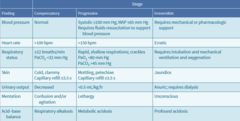
Stages of Shock
Initial, Compensatory, Progressive, Irreversible (AKA Early, Going, Going, Gone)
Initial Stage S/S
May not see many changes in VS (very subtle changes occur to maintain homeostasis)
Compensatory Stage S/S
Changes in VS, including: tachycardia, normal blood pressure (presents with brief sudden increase in BP and HR then BP returns to normal *warning sign*), changes in LOC with confusion and agitation
Progressive Stage S/S
- Significant signs of decline in BP while HR goes faster (>150bpm) to compensate and RR is tachypneic and shallow
- Mottling of extremeties and prolonged capillary refill occur due to poor perfusion
- Changes in LOC are more profound (lethargy)
Progressive Stage Tx
- Give fluids (0.9% Sodium Chloride or LR)
- If they are bleeding, anemic, or dropping BP dramatically, then give blood
- Pt can be put in Modified Trendelenburg (legs 4 inches above the heart) to promote venous return
Why not normal Trendelenburg?
Normal Trendelenburg causes too much strain on the already overworked heart because it will be working against gravity
Irreversible Stage S/S
- Extreme hypotension, often unmeasurable
- Looks "shocky" (pale, mottled, cyanotic, cool/clammy)
- Unresponsive
- Extreme decrease in HR and RR (agonal breaths)
- Most vital organs aren't receiving blood (jaundice)
Textbook Shock Stages
MODS
Multiple Organ Dysfunction Syndrome