Lipids: Structure, Absorption, and Metabolism
 Call Kai
 Learn
Learn Practice Test
 Spaced Repetition
 Match
Match Flashcards
 Knowt Play
1/101

There's no tags or description
Looks like no tags are added yet.
Name | Mastery | Learn | Test | Matching | Spaced | Call with Kai | Chat |
|---|
No analytics yet
Send a link to your students to track their progress
102 Terms
saturated
fatty acids that do not contain any double bonds

unsaturated
fatty acids that contain one or more double bonds, giving them a bent shape

solid
saturated fatty acids are __________ at room temperature
liquid
unsaturated fatty acids are _____________ at room temperature
omega-3
______________ fatty acids are good for the cardiovascular system; double bond is at the third carbon from the omega carbon
Ex: eicosapentaenoic acid (EPA); docosahexaenoic acid (DHA)

base
add ___________ to the fatty acids to enhance solubility by ionizing them
amphipathic
the majority of lipids, including fatty acids, are ___________________, meaning they have a polar (carboxylic acid) and nonpolar (hydrocarbon) componants
energy
fatty acids are a principle ____________ source in mammals; produce more than carbohydrates when undergoing combustion to carbon dioxide and water because of their highly reduced nature
chain length, unsaturation
fatty acids vary in ___________ ___________ and degree of ______________
higher
the __________ the degree of unsaturation, the lower the melting point of the fatty acid will be
shorter
the ___________ the chain of the fatty acid (lower MW), the lower the melting point will be
cis, trans
_________ unsaturation is healthy and easier to digest and metabolize; _________ unsaturation is not healthy
cell membranes
melting point of fatty acids are key to maintaining the fluidity and functionality of __________________________
TAGs (Triacylglycerols)
the storage form of fatty acids; store energy more efficiently than carbohydrates
carboxylic acid
high concentration of free fatty acids can damage cells, so TAGs "hide" the reactive _____________________ component by forming an ester bond with a glycerol molecule, making it stable and neutral
40
triacylglycerols provide ______% of daily energy requirements for humans
100
triacylglycerols provide ________% of daily energy requirements for hibernating animals and migrating birds
adipose tissue
the major site of accumulation of TAGs in mammals - under the skin and around visceral tissue
membrane lipids
phospholipids, sphingolipids, glycolipids, and steroids are all types of ______________ ____________
phospholipids
common alcohol moieties of __________________: serine, ethanolamine, choline, glycerol, and inositol
sphingolipids
common alcohol moieties of _________________: choline and ethanolamine
nerve
sphingolipids are abundant in __________ cell membranes
phospholipids (examples)
ex: phosphatidylserine; phosphatidylethanolamine
sphingolipids (examples)
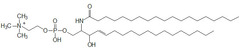
ex: sphingosine, sphingomyelin
phosphatidylserine

phosphatidylethanolamine

sphingosine

sphingomyelin
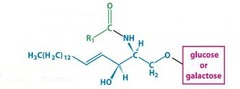
glycolipids
present in all membranes; have sugar molecules (glucose or galactose) instead of phosphorylcholine (in sphingolipids) - sphingosine attached to glucose or galactose
Ex: cerebroside, gangliosides
cerebrosides
steroids
contain a cyclopentanoperhydrophenanthrene nucleus; are membrane constituents, and precursors for hormones and bile acids
cholesterol

micelles
ingested lipids are first emulsified in the stomach by forming _________________
bile salts
in the small intestine, secreded _________________ (ex: glycocholate) further enhance emulsification of lipids
lipase
lipids are hydrolyzed to fatty acids and glycerol by pancreatic ____________; hydrolyze and break the ester bonds by adding water molecule, chopping off one fatty acid at a time
chylomicrons
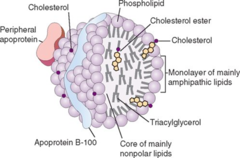
after being hydrolyzed in the intestinal lumen, the free fatty acids get absorbed through the GI membrane and are reassembled into TAGs and then into ____________________ to travel to the lymph system
catabolism
___________ of triacylglycerols involves
1) mobilization
2) transportation
3) breakdown
glucagon
binds to 7TM receptor on adipocyte which ultimately results in the activation of triacylglycerol lipase via phosphorylation
glycerol
goes to the liver for biotransformation once the TAG is broken down
albumin
plasma protein that carries the free fatty acids from TAG breakdown to a cell in the tissues to be broken down
fatty acyl CoA
the free fatty acid gets activated into ________________ by ATP in the cytosol of the target cell
glyceraldehyde 3-phosphate
glycerol ultimately ends up being metabolized into _______________________ which can enter either glycolysis or gluconeogenesis depending on the needs of the cell
requires ATP and NAD+
5%
____% of energy supply is provided by TAGs - glycerol enters glycolysis or gluconeogenesis
mitochondrial matrix
after the free fatty acids enter their target cell, they undergo activation, conjugation, and transportation into the ______________________
carnitine
the ___________ carrier system brings fatty acyl CoA (activated fatty acids) into the mitochondrial matrix
carnitine acetyltransferase
enzyme that adds and removes carnitine from acyl CoA
acyl carnitine
form of acyl CoA (activated fatty acid) that can cross the inner mitochondrial membrane
beta oxidation
the four-step sequence to degrade saturated fatty acids:
1) oxidation
2) hydration
3) oxidation
4) lysis
oxidation
step one of beta oxidation in which acyl CoA dehydrogenase makes a double bond between carbons 2 and 3, reducing FAD
hydration
second step of beta oxidation in which enoyl hydratase adds water across the double bond
oxidation
third step of beta oxidation in which L-3-hydroxyaceyl CoA dehydrogenase oxidizes the alcohol into a ketone by reducing NADH
thiolysis
fourth step in beta oxidation in which B-ketothiolase breaks the bond between carbons 2 and three, releasing one acetyl CoA molecule
palmitate
16-carbon fatty acid; breakdown generates 106 ATP
10
number of ATP produced for each Acetyl CoA molecule
1.5
number of ATP produced for each NADH molecule
2.5
number of ATP produced for each FADH2 molecule
(#C x 7) - 6
formula for determining how much ATP a fatty acid will generate
isomerase
extra enzyme required for the degredation of mono-unsaturated fatty acids; moves the double bond from C4=C3 to C3=C2
reductase
extra enzyme required for the degredation of multiply-unsaturated fatty acids; first isomerase will move the double bond, and then all other double bonds will be eliminated
propionyl CoA
in the degredation of odd-numbered fatty acids, the final step yields acetyl CoA and ____________________
succinyl CoA
propionyl CoA produced in the degredation of odd-numbered fatty acids gets converted by propionyl-CoA carboxylase (+ biotin carrier) into _________________, which enters the citric acid cycle
FADH2
unsaturated fatty acids do not generate exactly the same amount of ATP as saturated fatty acids because they skip the step of _____________ production (off by about 2.5 ATP)
ketone bodies
C-4 and C-3 compounds that are synthesized in the liver and released to the blood for extrahepatic tissues to use as fuels
citric acid cycle
most acetyl CoA produced by fatty acid degradation enters the _________________________
acetoacetate
formed by the condensation of two acetyl CoA molecules - forms a ketone body
3-hydroxybuterate
acetoacetate can be reduced to form ____________________ (ketone body)
acetone
acetoacetate can emit carbon dioxide to form ______________ (ketone body)
gluconeogenesis
diabetes and fasting are conditions that increase __________________
phosphoenolpyruvate carboxykinase
in type II DM, _________________________ is not suppressed when insulin is secreted so gluconeogenesis continues to generate glucose
oxaloacetate
in type II DM, _____________________ from the citric acid cycle is channeled to gluconeogenesis instead, slowing down the citric acid cycle
acetyl CoA
in type II DM, __________________ is channeled to ketone body formation instead of entering the citric acid cycle because oxaloacetate is being used for gluconeogenesis
ketoacetosis
accumulation of ketone bodies in our system leads to __________________ which may result in coma and death
citrate
in the fed state when there is an excess of Acetyl CoA, it travels from the mitochondria into the cytoplasm by being converted into ______________
pyruvate
when citrate enters the cytoplasm and releases Acetyl CoA for fatty acid synthesis, it becomes oxaloacetate which gets reduced into malate, which then enters back into the mitochondria as _________________
ATP-citrate lyase
enzyme that uses ATP to break citrate back into acetyl CoA and oxaloacetate
8, palmitic acid
the stage I of fatty acid synthesis repeats _____ times to provide the 16C atoms to build one ____________________ molecule
citrate
stage 1 of fatty acid synthesis is the transfer of acetyl CoA from the mitochondria to the cytoplasm as ______________
acetyl CoA
stage II of fatty acid synthesis is the activation of _______________ once in the cytoplasm
acetyl CoA carboxylase (ACC)
key regulatory enzyme in fatty acid synthesis that activates acetyl CoA by converting it to malonyl CoA
malonyl CoA
in fatty acid synthesis (stage II) acetyl CoA gets activated by acetyl CoA carboxylase by converting it into _________________
carnitine shuttle
malonyl CoA is an inhibitor of the __________________________
activators
__________________ of Acetyl CoA Carboxylase are the fed state and high levels of ATP
deactivators
_____________________ of Acetyl CoA Carboxylase are starving/fasting states and a need for energy (low ATP)
fatty acid synthase
Stage III of fatty acid synthesis is the construction of the fatty acid chain, which is catalyzed by the enzyme system collectively known as ___________________________
synthesis
the four reactions of fatty acid _________________:
1) condensation
2) reduction
3) dehydration
4) reduction
repeated until fatty acid is fully assembled
NADP+
fatty acid biosynthesis produces _______________ which goes into the pentose phosphate pathway
7, palmitic acid
repetition of a four-round sequence of fatty acid biosynthesis for _______ rounds generates one molecule of _____________________
Acyl carrier protein (ACP)
part of fatty acid synthase; continuously receives and acetyl group, activates it, and adds it to the growing fatty acid chain
KS
holds the incoming activated acetyl CoA in fatty acid synthesis
beta-ketoacyl-ACP synthase
in fatty acid synthase, condensation occurs at ____________________________ while the remaining 3 reactions occur at ACP after the chain moves back to ACP. The growing chain is then moved back to this enzyme for another round of elongation
thioesterase, palmitate
as soon as the growing fatty acid chain is C16-acyl ACP, the enzyme ______________ cleaves the thioester bond to release free ______________
palmitate
the major product of fatty acid synthase
8, 7, 14, 7
net cost of intermediates involved in synthesis of palmitate:
_____ acetyl CoA
_____ ATP
_____ NADPH
_____ H+
7
synthesis of palmitate requires _____ ATP
1
____ NADPH is generated for each acetyl CoA transferred as citrate
6
____ NADPH are generated by the PPP
longer-chain fatty acids
___________________ are synthesized by addition of more malonyl CoA to units of C-16 chains
ER (endoplasmic reticulum)
enzymes on the surface of the _____________________ catalyze the reactions of introducing double bonds in saturated fatty acids
linoleate and linolenate
essential fatty acids because mammals cannot introduce double bonds in fatty acids beyond C-9; therefore they must be supplied by the diet
eicosanoids
C-20 unsaturated fatty acids derived from the cell membrane component arachidonic acid (20:4); short-lived local hormones that play a pivotal role in inflammation, blood flow, ion transport, and allergy
Ex: prostaglandins and leukotrienes