Culture
 Call Kai
 Learn
Learn Practice Test
 Spaced Repetition
 Match
Match Flashcards
 Knowt Play
1/34

There's no tags or description
Looks like no tags are added yet.
Name | Mastery | Learn | Test | Matching | Spaced | Call with Kai | Chat |
|---|
No analytics yet
Send a link to your students to track their progress
35 Terms
Culture
the set of beliefs, traditions, and practices that organize a society; relatively stable (evolves over time but does not change much) and interconnected; what we don’t notice at home but spot in a foreign context; any widespread pattern of behavior we don’t biologically need to do (what/how we eat not that we do eat)
Interconnected - Culture
how certain things relate to each other in a culture; ex. food ways and technology and how they effect each other
Body Rituals (Nacirema) - Culture
a lot of self-loathing especially of body; sociological imagination exercise → rying to see things from outside perspective like you’ve never seen it before; it tends to be difficult to explain our own culture
Structural Functionalism Culture Example
Culture provides society a sense of solidarity and shared values, so that we can all work together more harmoniously. It is generated through interconnected institutions, like the entertainment media, the family, and schools. (IF SEE INSTITUITIONS IT IS THIS)
Cheerfulness promotes harmoney, so it is socialized through numerous institutions that emphasize its importance from an early age. The Boy Scouts urge cheerfulness in their official pledge, and schools hold pep rallies, encourage “school spirit”, and fill their walls with motivational posters/
Conflict Theory Culture Example
Culture is generated by the powerful, and generates values and practices (e.g. consumerism; “hustle culture”) that benefit the ruling class.
Corporations sell perpetual optimism to the American public, so we won’t reflect on how unjust society is, and revolt.
Symbolic Interactionalism Culture Example
Culture emerges from everyday interactions where people seek to create, negotiate, and modify shared meanings about the social world around them. A shared cultire reduces ambiguity by helping individual people know what to expect from each other.
Cheerfulness is a performance, which has evolved as a way to quickly signal approachability and trustworthiness to the strangers we meet, in order to make social interactions easier.
Social Identity Theory (SIT) Culture Example
Our engagement with culture - particularly the groups we belong to, like a frat or the PTA - help us define who we are as individuals.
Elements of Culture
institutions, ideolofies (norms/values), rituals, symbolic culture/language, and material culture
Institutions
an element of culture; organs of social body; complex, enduring social endeavor that serves a specific indentifiable purpose for society (myraid and latent vs manifest); has a stable structure of roles, norms, statuses, and practices; guides and constrains behaviors; ex. banks, courts, markets, religions, sports teams, schools, etc.
Purposes in Institutions
can be myraid and different than what they actually are (latent vs manifest)
Manifest vs Latent In Colleges as an Institutions - Elements of Culture
manifest (career readiness and well-rounding)
latent (broadening perspectives and making life-long relationships)
are enduring and complex
has a stable structure of roles (dean, profs, students), w/ statuses/hierarchy
has standard norms/practices (getting work done on time and getting to class on time)
guides/constrains behavior (policies/rules, influences an entire area aka college town that have certain types of stores and also recreationally (sports games))
Ideology
an element of culture; shared beliefs about the nature of reality and how we should behave within it; ex. norms and values
Ideology Examples
style (clothing) - what are the consequences
murder/robbing a bank (taboo)
taboos - age-gap relationships, insest, beastality, etc.
sanctions (+ and -) - incentive to do things: side eye, compliment, making deans list, getting a good grade
Sanctions - Ideology
can be positive or negativel incentive to do things
Values
widely-shared beliefs about what is good, right, or important in society; can be terminal or instrumental
Terminal Values
end goals that should be pursued like financial self-sufficiency, personal liberty, spritiual enlightenment, etc.; ex. wealth, amrriage, children/family
Instrumental Values
the proper traits for achievement like optimism, hard work, and empathy; ex. altrusim and hard-working
Norms
the shared rules and expectations that govern how people behave in a social setting; can be formal or informal (laws vs customs), range in seriousness (manners vs taboo), and enforced by sanctions; are socialized (we learn them from each other)
Norms vs. Values Picture

Rituals
an element of culture; recurring synchronized activities which have a shared symbolic meaning for participants (aka rites); not a 1 time thing (embedded in everyday life or enacted at specific times/places); do not have a direct, observable benefit; ex. solidarity, passage, demarcation, memorial, communion, and cleansing/atonement
Solidarity - Rituals
create a sense of belonging and togetherness
Passage - Rituals
one life stage to another; ex. sweet 16 bdays
Demarcation - Rituals
mark or recognize something as special or sacred
Memorial - Rituals
honor the dead/greiving
Communion - Rituals
actually communicate or have feeling that you do with (a) diety(s)
Cleansing/Atonement - Rituals
serve to symbolically or ceremonially remove impurity, guilt, or negative energy to restore spiritual harmony and relationship with the divine
Examples of American Rituals
rite of passage: sweet 16 bdays (childhood → young adult), bar/bat mitzvah, hs graduation
hazing
bar crawls at 21
Symbolic Culture and Language
an element of culture; symbols convey suttle messages and must cultures have a primary language
ex. Nike (Just Do It) → perserveance, grit, etc.)
Mcdonalds → childhood/nostalgia, sense of good value (lowest price possible)
Material Culture
an element of culture; objects that take on culture; ex. (American ones) barbies, smart phones, artitechure, shoes (sneakers = causalness), bseball cards, etx.
Categories within a Society
dominant culture/hegemony, subculture, and counterculture
Dominant Culure/Hegemony
the values and practices that are most widespread and formalized (societies defaults); these are informed by ideologies: interconnected/shared beliefs, opinions, and values; the stories we tell ourselves about ourselves
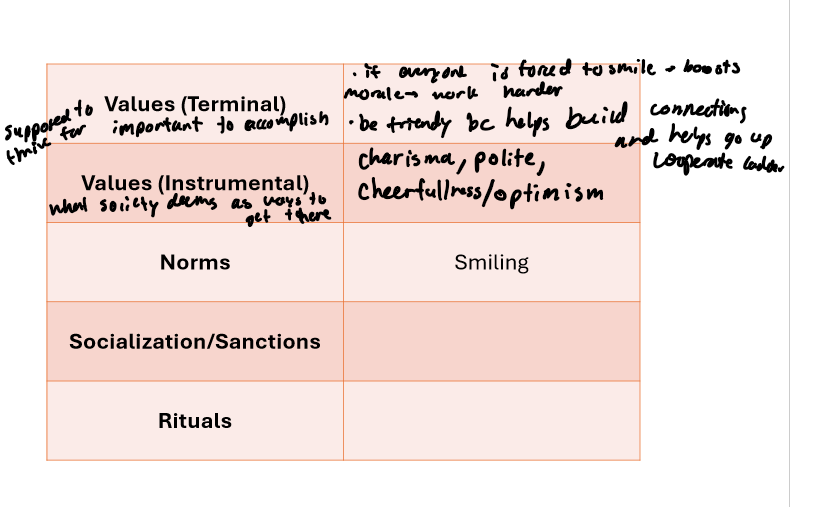
Values, Norms, Socialization/Sanctions, and Rituals Pictures
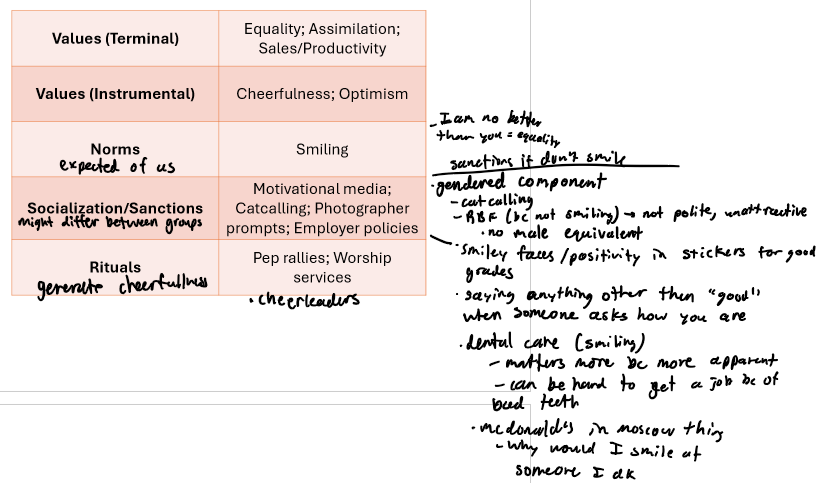
Discussion Question - Are there other cultural “feeling rules” that dictate how we feel and express emotion?
essential if don’t appear to be feeling the proper way then punished by sanctions; ex. mh struggles in people w/ “good” lives (why are they acting like that), expectations to have performative patriotism (sanctions to get you to do so or make you feel bad → pledge of allegiance, national anthemn), breakups (expected to hate other person and express certain feelings an if not then it is weird), sports teams/poltiical parties like rivalies (if you don’t have that “hate” for the other side then your loyalities are questioned), and grief
Subcultures
organized around shared interests/traits; values/practices are distinct from, but mostly consistent with, the dominant culture; specialized terms and symbols; ex. hip-hop, gamer, geek, amish culture, and athlete (clothes and terminlogy) culture
can be in specific places like a kitchen worker “heard” and cigrette breaks)
Countercultures
shared interests also w/ specialized terms/symbology; values contradict dominant cultures’; ex. white nationalists, hippies in 1960s (causal drug use and sex and clothes), LGBTQ community in 1970s; can become subcultures or even the dominant one