astronomy: unit 7; chapters 2-3
 Studied by 0 people
 Call with Kai
 Learn
Learn Practice Test
 Spaced Repetition
 Match
Match Flashcards
 Knowt Play
1/96

Earn XP
Name | Mastery | Learn | Test | Matching | Spaced | Call with Kai |
|---|
No study sessions yet.
97 Terms
how is the term “radiation” used in astronomy?
any way in which energy is transmitted through space from one point to another without the need for any physical connection between those two locations
visible light is one particular type of electromagnetic radiation. what are the others mentioned?
gamma rays, x-rays, UV, infrared, microwaves, and radio waves
what do wavelength and frequency of a wave measure?
wavelength: distance from one wave crest to the next; frequency: number of wave crests passing any given point per unit time
what is the speed of light?
a universal physical constant exactly equal to 299,792,458 metres per second, otherwise the fastest speed possible
does all electromagnetic radiation travel at the speed of light?
yes
can anything travel faster than the speed of light?
no, according to the current laws of physics, the speed of light is the fastest speed achievable
light travels in little pieces or bursts of energy. what are they called?
photons
what is a “light year”? what does it measure?
a light year (ly) is the distance light travels in one Earth year. it is 9.4607×10 15 meters or 5.8786×10 12 miles, about 63 astronomical units or about 0.3 parsecs
what is a spectrum?
separating a beam of white light into a rainbow of these basic colors
what does temperature measure?
measures the amount of heat in an object, and an indication of the speed of the particles that comprise it
most life on earth exists at temperatures near the freezing point of water. what kelvin temperature is the freezing point of water? what would you estimate is a “livable” range of temperatures in the kelvin scale?
273.15 K; ~294.261
what does wien’s law tell us about the radiation coming from an object? does a hotter object put more or less energetic radiation?
the wavelength at which an object radiates most intensely is inversely proportional to its temperature (λmax∝1/T); more energetic radiation
how do astronomers apply the idea of a blackbody curve to determine the temperature of celestial objects?
astronomers measure the intensity of light emitted by a celestial object at different wavelengths to plot its blackbody curve; by identifying the peak wavelength (λmax) of this curve, they can use Wien's law to calculate the object's surface temperature
what is a spectroscope?
instrument used to view a light source so that it is split into its component colors
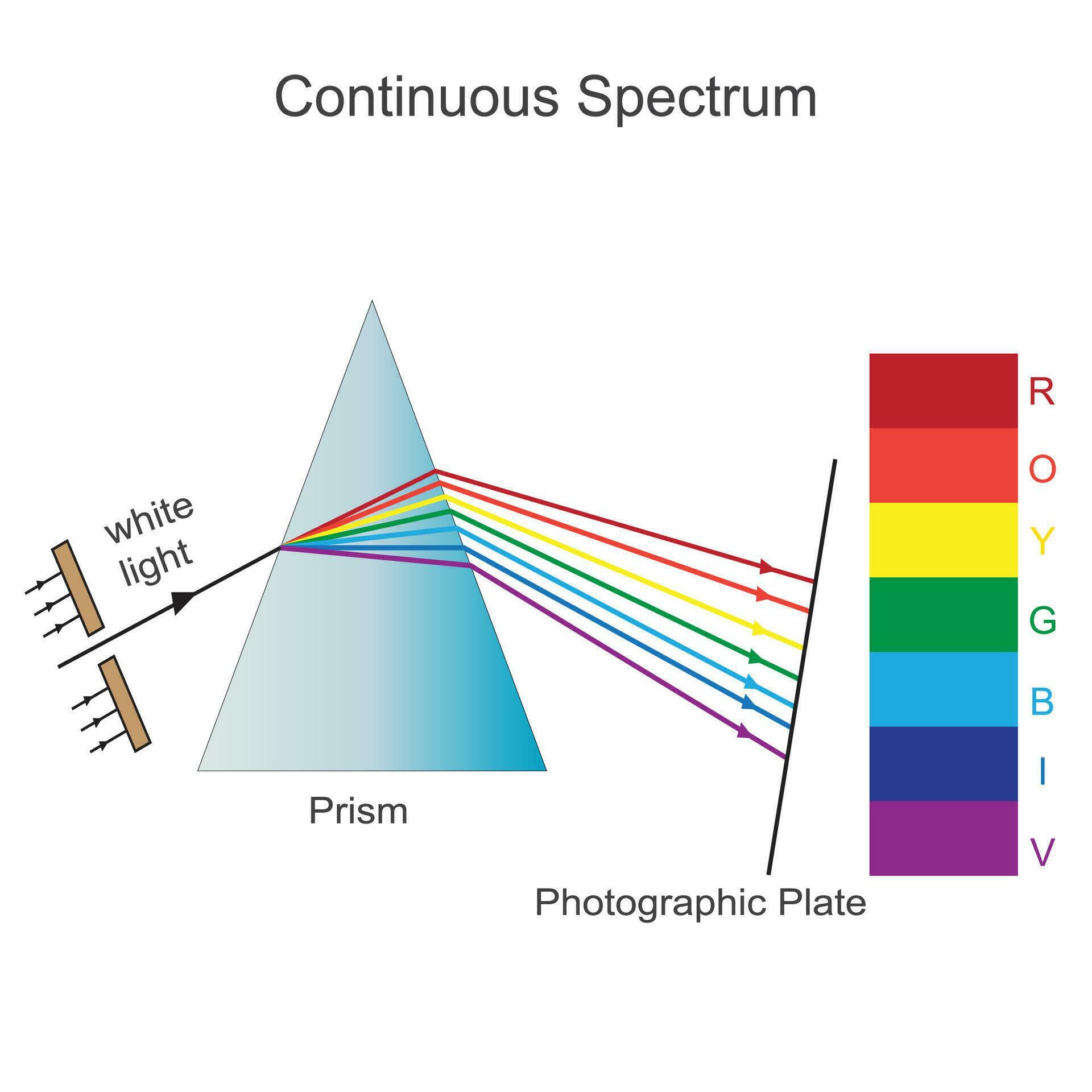
what is the name for the type of spectrum emitted by a blackbody? what does a visible light view of this kind of spectrum look like?
a continuous spectrum; in visible light, it looks like a complete, unbroken rainbow of colors transitioning smoothly from one to the other without any dark gaps or lines
if you excite hydrogen gas with an electric discharge (or other means), what kind of spectrum would you see? describe what this would look like in the visible band
an emission spectrum; in the visible band, it looks like a series of specific, narrow, bright colored lines at fixed wavelengths against a completely dark background
what is an emission spectrum also known as?
discrete or the line spectrum
do all elements have the same emission spectrum? what information do astronomers get from an emission spectrum?
no, each element has its own unique set of spectral lines, thus creating its own emission spectrum, similar to a fingerprint; astronomers use these lines to identify the chemical composition of distant stars and gas clouds
what kind of spectrum consists of a continuous spectrum with “gaps” (black lines) in it?
absorption spectrum
what must be true about the absorption and emission lines coming from hydrogen gas?
absorption lines associated with a given gas occur at precisely the same wavelengths as the emission lines produced when the gas is heated. both sets of lines therefore contain the same information about the composition of the gas
could you see an absorption spectrum if there is no continuous spectrum behind the cool gas?
no, because absorption lines are dark drips in a full spectrum; if there’s no background light to absorb, you’d see only emission lines from the excited gas itself, or close to nothing at all
what do each of kirchoff’s laws tell us?
A luminous solid or liquid, or a sufficiently dense gas, emits light of all wavelengths and so produces a continuous spectrum of radiation
A low-density hot gas emits light whose spectrum consists of a series of bright emission lines. These lines are characteristic of the chemical composition of the gas
A low-density cool gas absorbs certain wavelengths from a continuous spectrum, leaving dark absorption lines in their place, superimposed on the continuous spectrum. These lines are characteristic of the composition of the intervening gas. They occur at precisely the same wavelengths as the emission lines produced by the gas at higher temperatures
the doppler effect is seen in objects that are doing something specific—what is it?
any motion-induced change in the observed wavelength (or frequency) of a wave
if the spectrum of an object is blueshifted, what information can we determine about the object?
the object is moving towards you (any shift toward shorter wavelengths)
if the spectrum of an object is redshifted, what information can we determine about the object?
the object is moving away from you (any shift toward longer wavelengths)
if the spectrum of an object is neither blueshifted or redshifted, could the object be moving?
yes, it could be moving across your line of sight (perpendicular) OR it could be stationary
what six things can an astronomer determine by looking at the spectrum of a celestial object?
The composition of an object is determined by matching its spectral lines with the laboratory spectra of known atoms and molecules.
The temperature of an object emitting a continuous spectrum can be measured by matching the overall distribution of radiation with a blackbody curve. Temperature may also be determined from detailed studies of spectral lines.
The (line-of-sight) velocity of an object is measured by determining the Doppler shift of its spectral lines.
An object’s rotation rate can be determined by measuring the broadening (smearing out over a range of wavelengths) produced by the Doppler effect in emitted or reflected spectral lines.
The pressure of the gas in the emitting region of an object can be measured by its tendency to broaden spectral lines. The greater the pressure, the broader the line.
The magnetic field of an object can be inferred from a characteristic splitting it produces in many spectral lines, when a single line divides into two. (This is known as the Zeeman effect.)
what does it mean to say that a telescope is a “light bucket”?
a device whose primary function is to capture as much radiation as possible from a given region of the sky and concentrate it into a focused beam for analysis
whether light passes through a lens or bounces off a curved mirror, all of the light entering the telescope passes through a point called the _____
focus (focal point)
what type of design are all modern telescopes? does that mean that they use lenses or mirrors?
all large modern optical telescopes are reflectors, meaning they use mirrors to gather and focus light, not lenses
why are mirrors preferred on telescopes?
they are supported from the back, can be made enormous so that they gather more light, reflect all wavelengths of light equally, prevent color fringing (sharper images), easier to shape, and easier to polish
light gathering power is controlled by the amount of time of an exposure, which can change from observation to observation. what property that comes from the design of the telescope is equally important in light gathering power?
collecting area
what does “resolving power” mean? what would i be referring to if i talked about the “resolution” of an image?
the ability to distinguish fine detail between two closely spaced points as separate; the level of detail it shows and how that detail is displayed
why does the atmosphere make images of stars blurry?
light from stars gets randomly bent and distorted as it passes through turbulent layers of air with varying temperatures, densities, and pressures
what causes the twinkling of stars?
light from the star is refracted slightly, again and again, and the stellar image dances around on the detector (or retina)
what would it mean if an astronomer said that it was a night with “good seeing”?
the earth’s atmosphere is stable, calm, and clear, allowing for minimal distortion/distraction of light from celestial objects
why do some telescopes have to be in outer space to work properly?
the atmosphere blocks certain light (x-ray, UV, infrared) which prevents clear and full-spectrum views
a telescope that uses visible light works fine from the ground. why might you want to put a visible light telescope (like the hubble) in space?
to get above earth’s blurring atmosphere for sharper images and to see UV and some infrared light that is blocked, which allows access to wavelengths and clarity that is impossible from the ground
active optics
dark line in an otherwise continuous spectrum, where light within one narrow frequency range has been removed
amplitude
maximum deviation of a wave above/below zero point
atom
building block of matter, composed of positively charged protons and neutrally charged neutrons in the nucleus surrounded by negatively charged electrons
blackbody curve
characteristic way in which the intensity of radiation emitted by a hot object depends on frequency. frequency at which the emitted intensity is highest is an indication of the temperature of the radiating object
bohr model
first theory of the hydrogen atom to explain spectral lines. this model rests on three ideas: 1. there is a state of lowest energy for the electron; 2. there is a maximum energy beyond which the electron is no longer bound to the nucleus; 3. within these two energies, the electron can only exist in certain energy levels
continuous spectra
spectra in which the radiation is distributed over all frequencies, not just over a few specific frequency ranges. ex: blackbody radiation emission by a hot, dense body
diffraction
ability of waves to bend around corners. the diffraction of light establishes its wave nature
electric field
field extending outward in all directions from a charged particle, such as a proton or an electron. the electric field determines the electric force exerted by the particle on all other charged particles in the universe; the strength of the electric field decreases with increasing distance from the charge according to an inverse-square law
electromagnetic radiation
another term for light, electromagnetic radiation transfers energy and information from one place to another
electromagnetic spectrum
complete range of electromagnetic radiation, from radio waves to gamma rays, including the visible spectrum. all types of electromagnetic radiation are basically the same phenomenon, differing only be wavelength and all move at the speed of light
electromagnetisim
union of electricity and magnetism, which do not exist as independent quantities but are in reality two aspects of a single physical phenomenon
emission line
bright line in a specific location of the spectrum of radiating material, corresponding to emission of light at a certain frequency. a heated gas in a glass container produces emission lines in its spectrum
emission spectrum
pattern of spectral emission lines produced by an element; each element has its own unique emission spectrum
excited state
state of an atom when one of its electrons is in a higher energy orbital than the ground state. atoms can become excited by absorbing a photon of a specific energy or by colliding with a nearby atom
gamma ray
region of the electromagnetic spectrum, far beyond the visible spectrum, corresponding to radiation of very high frequency and very short wavelength
ground state
lowest energy state that an electron can have within an atom
infrared
region of the electromagnetic spectrum just outside the visible range, corresponding to light of a slightly longer wavelength than red light
intensity
basic property of electromagnetic radiation that specifies the amount or strength of the radiation
interferenece
ability of two or more waves to interact in such a way that they either reinforce or cancel each other
kirchoff’s law-
three rules governing the formation of different types of spectra
magnetic field
field that accompanies any changing electric field and governs the influence of magnetized objects on one another
protons and neutrons have roughly the same ____
mass
opacity
quantity that measures a materials ability to block electromagnetic radiation. opacity is the opposite of transparency
photon
individual packet of electromagnetic energy that makes up electromagnetic radiation
what determines the type of atom?
the number of protons
radio
region of the electromagnetic spectrum corresponding to radiation of the longest wavelengths
spectroscopy
study of the way in which atoms absorb and emit electromagnetic radiation; allows astronomers to determine the chemical composition of stars
stefan’s law
relation that gives the total energy emitted per square centimeter of its surface per second by an object of a given temperature; shows that the energy emitted increases rapidly with an increase in temperature, proportional to the temperature raised to the fourth power
ultraviolet
region of the electromagnetic spectrum, just beyond the visible range, corresponding to wavelengths slightly shorter than blue light
visible light
small range of the electromagnetic spectrum that human eyes perceive as light. the visible spectrum ranges from about 400 to 700nm, corresponding to blue through red light
wave
pattern that repeats itself cyclically in both time and space. waves are characterized by the speed at which they move, their frequency, and their wavelength
wave period
amount of time required for a wave to repeat itself at a specific point in space
x-ray
region of the electromagnetic spectrum corresponding to radiation of high frequency and short wavelength, far beyond the visible spectrum
can light exist without air?
no. if we were to remove all the air from a room, conversation would be impossible because sound waves cannot exist without air or some other physical medium to support them
active optics
collection of techniques used to increase the resolution of ground-based telescopes. minute modifications are made to the overall configuration of an instrument as its temperature and orientation change; used to maintain the best possible focus at all times
adaptive optics
technique used to increase the resolution of a telescope by deforming the shape of the mirrors surface under computer control while a measurement is being taken'; used to undo the effects of atmospheric turbulence
angular resolution
ability of a telescope to distinguish between adjacent objects in the sky
cassegrain telescope
type of reflecting telescope in which incoming light hits the primary mirror and is then reflected upward toward the prime focus where a secondary mirror reflects the light back down through a small hole in the main mirror into a detector or eyepiece
charge coupled device (CCD)
electronic device used for data acquisition, composed of many tiny pixels, each of which records a buildup of charge to measure the amount of light striking it
what is collecting area?
total area of a telescope of capturing incoming radiation. the larger the telescope, the greater its collecting area and the fainter the objects it can detect
diffraction-limited resolution
theoretical resolution that a telescope can have due to diffraction of light at the telescopes aperture. depends on the wavelength of radiation and the diameter of the telescopes mirror
exposure time
time spent gathering light from a source
false color
representation of an image in which color does not represent true visual color, but rather an invisible wavelength of radiation, or some other property, such as temperature
high-energy telescope
telescope designed to detect x and gamma ray radiation
image
the optical representation of an object produced when the object is reflected or refracted by a mirror or lens
infrared telescope
telescope designed to detect infrared radiation. many such telescopes are designed to be lightweight so that they can be carried above (most of) earths atmosphere by balloons, airplanes, or satellites
interferometer
collection of two or more telescopes working together as a team observing the same object at the same time and at the same wavelength. the effective diameter of an interferometer is equal to the distance between its outermost telescopes
interferometry
technique in widespread use to dramatically improve the resolution of radio and infrared maps. several telescopes observe the object simultaneously, and a computer analyzes how the signals interfere with each other
newtonian telescope
reflecting telescope in which incoming light is intercepted before it reaches the prime focus and is deflected into an eyepiece at the side of the instrument
prime focus
point in a reflecting telescope where the mirror focuses incoming light to a point
radio telescope
large instrument designed to detect radiation from space at radio wavelengths
reflecting telescope
telescope that uses a mirror to gather and focus light from a distant object
refraction
tendency of a wave to bend as it passes from one transparent medium to another
seeing
term used to describe the ease with which good telescopic observations can be made from earths surface, given the blurring effects of atmospheric turbulence
seeing disk
roughly circular region on a detector over which a stars point-like images spread, due to atmospheric turbulence
ultraviolet telescope
telescope that is designed to collect radiation in the ultraviolet part of the spectrum. earths atmosphere is partially opaque to these wavelengths, so UV telescopes are put on rockets, balloons, and satellites to get high above most or all of the atmosphere
refracting telescope
type of optical telescope that uses lenses to gather and focus light
very-long-baseline interferometry (VLBI)
type of interferometry that uses radio telescopes separated by thousands of kilometers to achieve very high angular resolution
radio galaxy
a galaxy that emits more energy in the form of radio waves than visible light