essay 28 - hemostatic abnormalities - hemorrhagic diathesis
 Call Kai
 Learn
Learn Practice Test
 Spaced Repetition
 Match
Match Flashcards
 Knowt Play
1/8

There's no tags or description
Looks like no tags are added yet.
Name | Mastery | Learn | Test | Matching | Spaced | Call with Kai | Chat |
|---|
No analytics yet
Send a link to your students to track their progress
9 Terms
what is hemorrhagic diathesis
an increased tendency to bleed due to defects in one or more components of the hemostatic system:
vascular wall (blood vessel integrity)
platelets (number or function)
coagulation cascade (clotting factors)
describe coagulation abnormalities
cause = deficiencies or dysfunctions of clotting factors → defective fibrin clot formation → prolonged bleeding
such disorders = acquired coagulation abnormality and haemophilia (inherited coagulation abnormality)
describe acquired coagulation abnromality (type of coagulation abnormality)
vit k deficiency = e.g malnutrition = vitamin k is required for synthesis of factors II, VII, IX, X
liver damage = e.g cirrhosis = most clotting factors are made in the liver
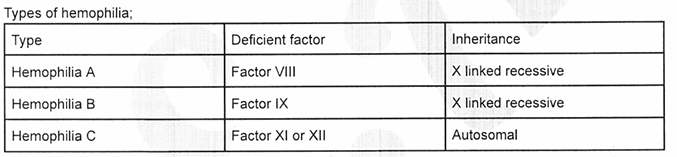
describe hemophilia (type of coagulation abnormality)
genetic bleeding disorder where specific clotting factors are missing or dysfunctional → weak/slow clot formation → recurrent and prolonged bleeding
inheritance = most are x-linked recessive
- men (XY) with the gene develop disease
- women (XX) are usually carriers, sometimes with mild symptomscomplications= recurrent joint bleeding → hemophilic athropathy (fibrosis, cartilage destruction)
types of hemophilia
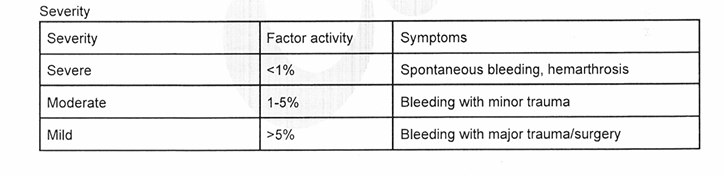
severities of hemophilia
describe platelet abnormalities
causes =
decreased production = bone marrow suppression (chemotherapy, HIV viral infection, vitamin B12 deficiency)
increased destruction = immune thrombocytopenic purpura (ITP), disseminated intravascular coagulation (DIC), thrombotic thrombocytopenic purpura (TTP)
splenic sequestration (hypersplenism)
pseudothromocytopenia (artifact in vitro → clumped platelets)
qualitative plateles fucntion disorders
hereditary = glanzmann thrombasthenia (defective aggregation, glycoprotein IIb/IIIa defect)
acquired = drugs (asprin, NSAIDs → inhibit platelet cyclooxygenase)
vascular wall abnormalities
causes = structural or functional defects in blood vessel walls → increased fragilities
Types:
hereditary =
Rendu-Osler-Weber disease = a rare genetic disorder causing malformations of blood vessels, particularly arteriovenous malformations (AVMs), which leads to excessive bleeding, especially nosebleeds, red spots on skin and anemia
acquired:
Henoch-Scholein Purpura (HSP)
- small vessel IgA-mediated vasculitis
- common in children (2-8 years), often after upper respiratory infection
symptoms + palpable purpura (legs), arthritis (knees, ankles), abdominal pain, GI bleeding, renal involvement (haematuria, proteinuria)vitamin C deficiency (scurvy → defective collagen in vessel walls → fragile capillaries)