biopsychology - drug action
 Studied by 0 people
 Call Kai
 Learn
Learn Practice Test
 Spaced Repetition
 Match
Match Flashcards
 Knowt Play
1/41

There's no tags or description
Looks like no tags are added yet.
Name | Mastery | Learn | Test | Matching | Spaced |
|---|
No study sessions yet.
42 Terms
How does DSM‑5 (2013) define mental disorder?
Clinically significant disturbance in cognition, emotion regulation, or behaviour due to dysfunction in psychological, biological, or developmental processes, causing distress or impairment
What does “disturbance in function” mean in DSM‑5?
Disruption in thinking, feeling, or behaving
What is the biological approach to mental disorder?
The medical model, which explains psychological disorders similarly to physical illnesses with biological causes
Who believed the brain was the centre of thought and emotion?
Hippocrates and Plato
What did Aristotle believe about thought and emotion?
He argued that the heart, not the brain, was responsible for thought and emotion
What is the anti‑psychiatry perspective?
A critique of the medical model, arguing mental illness is either a social construct or purely psychological without brain pathology
What is organic pathology? - how we know something is wrong from tissue pathology
Structural abnormalities in tissues or organs, such as enlarged ventricles in schizophrenia or temporal lobe atrophy in depression
What is functional pathology?
Physiological dysfunction detectable only with biochemical or pharmacological methods, e.g., underactive GABA in anxiety
What is the nature vs. nurture debate in biopsychology?
Biological determinism (nature) versus environmental determinism (nurture), with biopsychology supporting an interactionist view

What does the vulnerability‑stress model propose?
Biological vulnerability interacts with environmental stress to produce mental disorders
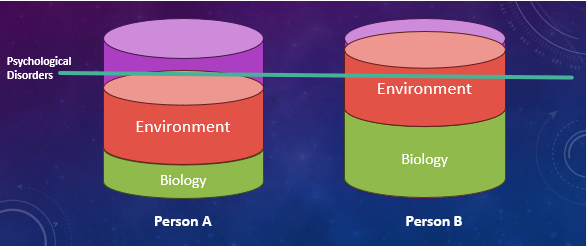
What is differential susceptibility?
Some individuals are more or less sensitive to environmental risks or supports, affecting outcomes
What does the hierarchical approach in biopsychology refer to?
Biological, psychological, and social levels interact to influence mental functioning
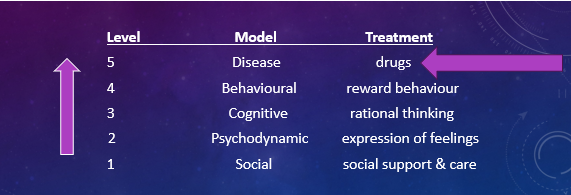
What was timeline for drugs relating to mental disorders
19th century - just sedating people
1952 - first antipsychotic -chlorpromazine
1953-57 - first antidepressants - iproniazid and imipramine
1960 - first anxiolytics - diazepam
These drugs had actually therapeutic benefits
What is psychopharmacology?
The study of how drugs affect the brain and behaviour; closely linked with neuroscience
What is the Golgi stain used for?
A chemical technique that stains individual neurons so they can be viewed microscopically
What was Cajal’s major contribution?
He proposed that neurons are discrete cells that communicate across gaps (synapses)
What is the role of glial cells?
To provide physical and chemical support for neurons
What is the resting potential of a neuron?
‑70 mV, where the inside of the neuron is more negative than the outside
What does it mean when a neuron is “polarised”?
It maintains an electrical difference across its membrane at rest
What are ion channels?
Proteins that allow charged ions to move across the neuron’s membrane
What forces drive ion movement across the membrane?
Concentration gradients (diffusion) and electrical forces (electrostatic pressure - positive and negative attract each other etc)
What does the sodium‑potassium pump do?
Uses ATP to pump 3 Na+ ions out and 2 K+ ions in, maintaining the resting potential
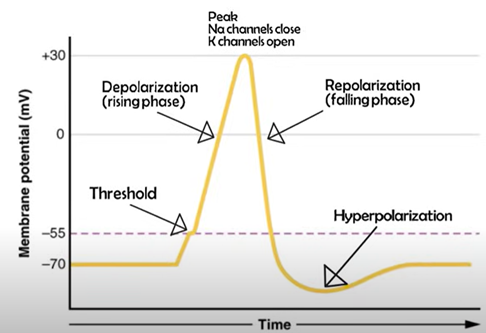
What is action potential arc?
Start at -70 = resting potential
When threshold is reached (-55mv)
voltage dependent Na+ channels open causing influx of positive Na+ into the cell = Depolarisation
When cell reaches its peak, Na+ voltage channels turn off and cant turn on again
Inside cell is now + 40 charged so diffusion and electrostatic pressure pushes K+ ions out
Voltage dependent K+ channels are less sensitive than Na+ so they open later allowing for K+ to flow out
Refractory period = brief time where membrane potential is less than normal in RP, membrane is hypo polarised
What is the absolute refractory period?
A period where no new action potential can occur regardless of stimulus strength
What is the relative refractory period?
Time when a stronger-than-normal stimulus can trigger an action potential
What is a synapse?
The junction between neurons where chemical communication occurs

What triggers neurotransmitter release?
Arrival of an action potential that opens voltage‑gated calcium channels
Influx of Ca2+ ions cause vesicle to migrate to synaptic membrane
Vesicles fuse with the membrane, rupture and release the neurotransmitters into the synapse
diffuse across the synapse and bind to postsynaptic receptors
What is a postsynaptic potential (PSP)?
An electrical change in the postsynaptic neuron caused by neurotransmitter binding
What is an EPSP?
Excitatory postsynaptic potential that increases firing likelihood via Na+ influx
increase in positive ions casing more likely chance of depolarisation
What is an IPSP?
Inhibitory postsynaptic potential that decreases firing likelihood via Cl− influx or K+ efflux
How is neurotransmitter release inhibited?
Through negative feedback via presynaptic autoreceptors on nerve terminal → once enough has binded it tells it to stop being released
What is enzymatic degradation?
Enzymes break neurotransmitters into inactive components
active reuptake - Transporters return neurotransmitters to the presynaptic neuron
What is a neurotransmitter receptor?
A protein that selectively binds neurotransmitters and converts chemical signals to electrical responses
What is a ligand?
Any molecule, including drugs, that binds to a receptor
Why do neurotransmitters have different effects?
Each neurotransmitter has multiple receptor subtypes (e.g., dopamine D1–D5)
What is an ionotropic receptor?
A ligand‑gated ion channel that opens directly in response to neurotransmitter binding
What are the characteristics of ionotropic receptors?
Fast response and short‑term neural plasticity
What is a metabotropic receptor?
A G‑protein‑coupled receptor that indirectly influences ion channels
What are characteristics of metabotropic receptors?
Slow response and long‑term neural plasticity via G‑protein or second‑messenger pathways
What are the seven steps of neurotransmitter action?
Synthesis, transport, storage, release, autoreceptor interaction, postsynaptic binding, inactivation
How do psychoactive drugs work?
By increasing or decreasing chemical communication in the brain
Why do synapses not function in isolation?
Neural circuits integrate multiple synapses, pathways, and modulatory systems