polarity and inter-molecular forces
0.0(0)
Studied by 8 people Call Kai
 Learn
Learn Practice Test
 Spaced Repetition
 Match
Match Flashcards
 Knowt Play
Card Sorting
1/40

Earn XP
Description and Tags
Last updated 11:45 PM on 2/14/23
Name | Mastery | Learn | Test | Matching | Spaced | Call with Kai | Chat |
|---|
No analytics yet
Send a link to your students to track their progress
41 Terms
1
New cards
Electronegativity-
the ability of an atom within a covalent bond to attract electrons to itself.
2
New cards
Polar covalent bonds-
a covalent bond that has an unequal charge distribution (a dipole) due to differences in electronegativities of the atoms sharing electrons to form the bond.
3
New cards
Nonpolar covalent bonds-
electrons are shared equally between two atoms.
4
New cards
Ionic Bonds
Metal and Nonmetal
5
New cards
Intermolecular forces-
electrostatic attraction (coulombic) between molecules
6
New cards
Intramolecular forces-
forces that hold atoms together to form compounds and molecules
7
New cards
Dipole
A bond where the ends have opposite charges
8
New cards
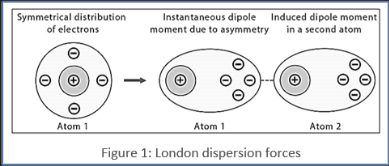
Temporary dipole
Dipole typer during London Disperion
9
New cards
induced Dipole
weak form of a dipole, for example hydrogen bonding with water.
10
New cards
London dispersion-
electrostatic forces that result from temporary shifts in the density of electrons in electron clouds
11
New cards
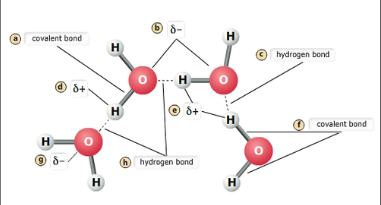
Hydrogen bonding-
is a strong electrostatic attraction that occurs between molecules containing a hydrogen atom covalently bonded to a small and highly electronegative atom (N, O, or F) and the lone pair of electrons to another molecule containing N, O, or F
12
New cards
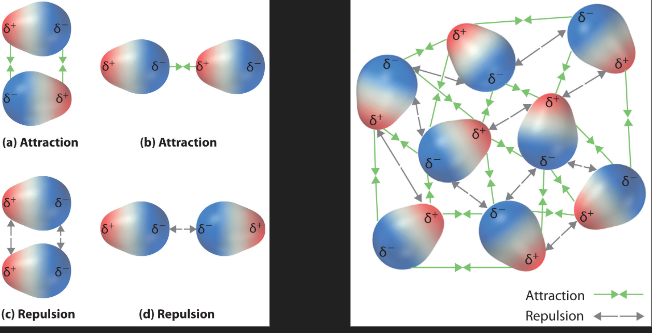
Dipole-Dipole-
attractions between oppositely charged regions of polar molecules
13
New cards
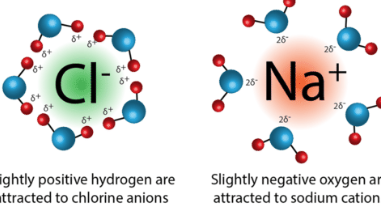
Ion - Dipole-
electrostatic interaction between a charged ion and a molecule that has a dipole
14
New cards
Micelle-
Spherical aggregates that spontaneously self-associate.
15
New cards
Immiscible-
will not form a homogeneous mixture together
16
New cards
Miscible-
will form a homogeneous mixture together
17
New cards
Hydrophilic
Attracted to water
18
New cards
Hydrophobic
Repels from water, resistant
19
New cards
Adhesive forces-
force of attraction between different types of molecules/substances
20
New cards
Cohesive forces-
force of attraction between molecules of the same substance
21
New cards
Surface tension-
Example of a cohesive force
22
New cards
Polar Bond
Significantly different electronegativities
23
New cards
Polar molecule-
Bonds within must have a dipole moment, Dioples don't cancel out.
24
New cards
Nonpolar Molecule
Dipoles cancel out
25
New cards
London Dispersion Force
26
New cards
Dipole-Dipole
27
New cards
Hydrogen Bonding
28
New cards
Ion-Dipole
29
New cards
What does intermolecular mean?
Between
30
New cards
What does intramolecular mean?
Within
31
New cards
\#1 Strongest
Ionic and Covalent bonds
32
New cards
\#2 Strongest
Ion-Dipole Interactions
33
New cards
\#3 strongest
Hydrogen Bonding Interactions
34
New cards
\#4 Strongest
Dipole-Dipole interactions
35
New cards
\#5 strongest
London Dispersion interactions
36
New cards
Why is Hydrogen Bonding only possible with Hydrogen?
Because it uses the lone pairs of a (N, O, or F)
37
New cards
What substances were used to make soap?
Tallow (Solid Fat), Olive Oil, Sodium Hydroxide
38
New cards
What are some parts of a micelle?
Nonpolar dirt and grease droplets, ionic polar “head:, aqueous solution, nonpolar hydrocarbon tail
39
New cards
What are parts of the Micelle attracted to?
The non polar hydro carbon tails are attracted toward the interior of the micelle giving it a hydrophobic core, while the ionic heads are attracted to the outside which is surrounded by water.
40
New cards
Glass and water
Example of adhesive force
41
New cards
What causes dispersion forces?
when the electrons in two adjacent atoms occupy positions that make the atoms form temporary dipoles.