Additional diseases the impact movement
 Call Kai
 Learn
Learn Practice Test
 Spaced Repetition
 Match
Match Flashcards
 Knowt Play
1/30

There's no tags or description
Looks like no tags are added yet.
Name | Mastery | Learn | Test | Matching | Spaced | Call with Kai | Chat |
|---|
No analytics yet
Send a link to your students to track their progress
31 Terms
What is the prevalence ranking for diseases that effect movement?
PD
CP
MS
MD
HD
MND
What is MS?
Multiple sclerosis - autoimmune disease
Own immune system attacks myelin sheaths in the spinal cord
Typically affects patients between 25-35
How is MS acquired?
Unknown - but women are 2:1 times more likely, caucasians are twice as likely too
Is MS genetic?
If both parents have MS, 20% - if you have an identical twin there is a 30% chance. More risk factors for urban settings
What are other MS risk factors?
if you are born aboce or below 40 degrees, your risk factors increases
Symptoms of MS?
Movement challenges, tingling across the body, pain, depression
What are the four types of MS?
CIS - clinically isolated syndrome
RRMS - relapsing remitting MS
SPMS - secondary progressive MS
PPMS - primary progressive MS
What happens in CIS?
First episode of MS, inflammation and demyelination. Some but not all progress to MS
What happens in RRMS?
85% of patients, has ‘attacks’, they have periods of stability and then can have relapses, RRMS can be active - new MRI activity, or not active
What happens in SPMS?
Starts as RRMS, but is more aggressive, does not go back to baseline
What happens in PPMS?
Worseining accumulation of disability without relapses or remissions, about 15%
How is MS treated?
Medications used in three ways:
Modify the disease course
Manage relapses
Manage symptoms
What is modifying the disease course?
Supressing the activity of the immune system to slow progressions.
Interferon 1a or 1b proteins injected. Glatiramer acetate can serve as a decoy for the immune system
How to manage MS relapses?
oral or IV corticosteroids - anti-inflammatory
Prednisone - steroidal anti-inflammatory
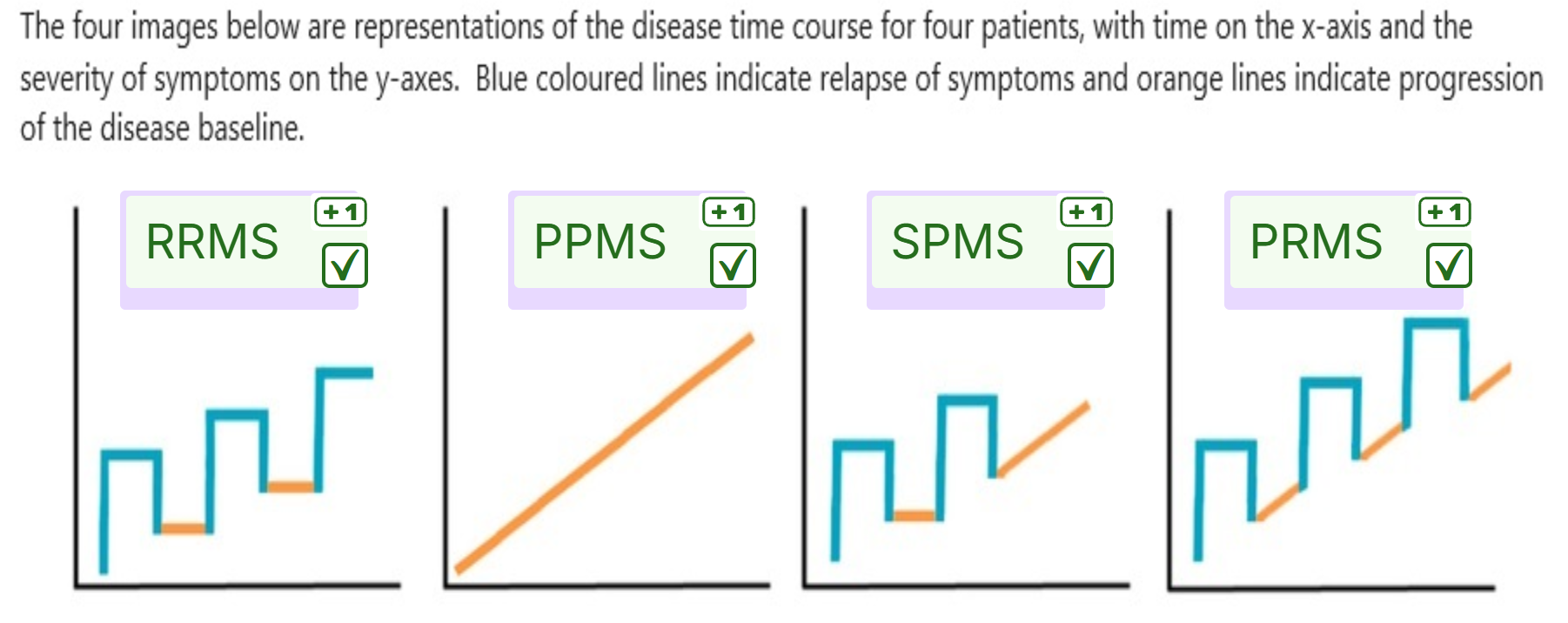
MS progression
Treatment of MS may involve the use of glutimer acetate, which resembles myelin protein, and may "decoy" the body's immune system.
True
What is MND?
motor neuron disease - a group of siseases in which the motor neurones undergo degeneration and die
Symptoms of MND?
Weakness, muscle wasting, respiratiory failure leading to death in 2-5 years
What is happening in MND?
Disruption in signals between lower motor neurons and the muscle & upper motor neurons and the lower motor neurons
What causes MND?
5-10% genetic
90% are sporadic, MND linked to enzyme SOD1 that protects cells from death from ROS
What is the treatment for MND?
Riluzole - may block voltage gated Na channels, reducing glutamate release from motor neurons, glutamate is excitatory and reducing this may be protective.
Baclofen - GABA b agonist, inhibits spasticity
What is MD?
Muscular dystrophy - a group of disorders which involve progressive loss of muscle mass and loss of strength
Most common is Duchenne muscular dystrophy, impacting young boys but other variants can effect adulthood

Why are majority of MD patients men?
It is X-linked, caused by genetic mutations which interfere with muscle proteins
Symptoms of MD?
Pain and stiffness in muscles, difficult gait, walking on toes, learning disabilities, breathing may require assistance, eventually losing ability to walk
How is MD diagnosed?
Blood test for creatine kynase (CK), which is produced by damaged muscles, elevation in this can suggest MD
What drugs are being used for MD?
Corticosteroids - to slow progression and inflammation
Heart medications - if muscular dystrophy impacts the heart, using beta blockers
In Duchenne's MD, there is a lack of dystrophin complex present in skeletal muscles, which usually enables the smooth movement of contracting fibres.
True - MD question
What is CP?
Cerebral palsy - most common physical disability
caused by brain issues or injury before during or immediately after birth
What are MS symptoms?
Low muscle tone, muscle spasms, unable to hold up head, poor muscle control, development delated, feeding or swallowing difficulties
Treatment of CP?
Physical and occupational therapy, assistive technology, surgery, some medications to help with spasticity
Botulin toxin type A can affect spasticity
Revision