c6 chemical reactions
 Call Kai
 Learn
Learn Practice Test
 Spaced Repetition
 Match
Match Flashcards
 Knowt Play
1/34

There's no tags or description
Looks like no tags are added yet.
Name | Mastery | Learn | Test | Matching | Spaced | Call with Kai | Chat |
|---|
No analytics yet
Send a link to your students to track their progress
35 Terms
physical vs chemical change
physical changes are when a reaction doesnt make any new substances, and a chemical change is when the bonds between atoms break and they change places creating new substances
what is rate of reaction
how fast the reactants are changed into the products, can be affected by temp, concentration, particle size
what is collision theory
that when particles collide with enough energy it can break the bonds of the other particle to rearrange the atomic structure and react
how does temp increase rate of reaction
when particles have a higher temperature they have a higher kinetic energy so so there would be more collisions meaning more successful collisions and faster reaction
how does concentration increase rate of reaction
higher concentration means that that there are more particles so the chance of successful collision is higher
why does increasing surface area increase rate of reaction
more surface area means more exposed particles that can collide with. increasing the surface area to volume ratio increases rate of reaction
what do catalysts do for the rate of reaction
they increase the rate of reaction and dont get used in the reaction: there can be small amounts of catalyst for large amount of reactants.
what happens to activation energy when catalysts are present
the activation energy decreases because the catalyst provides an alternate reaction pathway that allows for the reaction to happen with less energy
how do you measure rate of reaction
rate of reaction = amount of reactants used or product formed / time
2 ways to measure rate of reaction
using a gas syringe to measure amount of gas produced over time, use a balance(scale) to measure the amount of weight loss as escaped gas over time
what are reversible reactions
a reaction were reacting the products result in the formation of the same reactants
example of a reversible reaction
hydrated copper sulfate → anhydrous copper sulfate + water(endothermic) | anhydrous copper sulfate + water → hydrated copper sulfate(exothermic)
what is equilibrium
when in a reversible reaction the products and reactants are constantly reacting at a steady rate, meaning that when one reaction starts going faster, the change in concentration means that the opposite reactions speeds up to maintain equilibrium
what is required to sustain equilibrium
a closed system were nothing can get in and out, so the amount of substances doesnt change and the equilibrium isnt interrupted
how does equilibrium counteract temperature changes
if temperature is lowered then the equilibrium is moved in the exothermic direction and more heat and reactants are produced from more exothermic reactions happening, opposite is true for increasing the energy resulting in a shift to endothermic reactions
how does equilibrium counteract pressure changes
it only affects equilibrium that involves gasses, equilibrium tries to reduce pressure if there is too much by increasing the rate of reaction that takes in gas, the inverse happening when there is not enough pressure
what is the Haber process
when nitrogen and hydrogen are reacted using a catalyst to make ammonia and reach equilibrium, so that when the ammonia is removed equilibrium increases rate of reaction in the direction of the ammonia
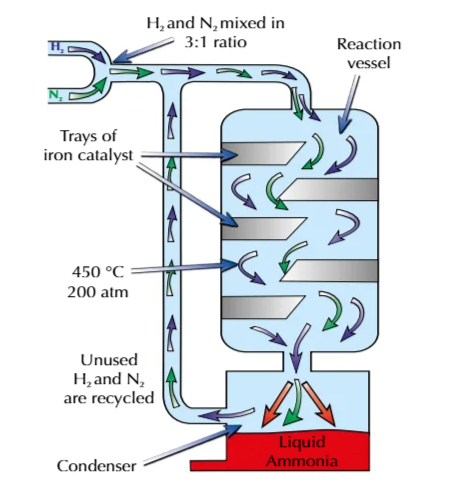
what conditions are maintained for efficient use of the haber process
high temperatures(450 degrees Celsius) and pressures(200 atmospheres), presence of an iron catalysts, a condenser to make liquid ammonia, and a recycling tube that cycles leftover hydrogen through the system again
why is the haber process effective on an industrial scale
the reactants are easy to obtain and it can be used to make a very nitrogen rich and sought after fertilizer called ammonium nitrate
why are the conditions in the haber process a compromise
sustaining temperatures or pressures too high can be very costly and it also brings danger, while temps and pressures to low means that the yield and rate of production are drastically decreased
asses the temps used in the haber process
since the reaction that produces ammonia is exothermic, lower temperatures would mean that more ammonia is produced, but the temperature is still higher to increase the rate of reaction due to collision theory
what do catalysts do for equilibrium
they allow it to be reached faster but doesn’t change the position of equilibrium since it only allows it to be reached faster and speeds up the rate of reaction both ways. the iron catalyst in the haber process allows lower temps and pressures to be used
what is the contact process used for
to produce sulfuric acid
what are the four main steps in the contact process
creating sulfur dioxide by burning sulfur in oxygen(S(s) + O2(g) → SO2(g)), oxidizing the sulfur dioxide into sulfur trioxide(2SO2(g) + O2(g) ←→ 2SO3(g)), dissolving sulfur trioxide in sulfuric acid to make oleum(SO3(g) + H2SO4(l) → H2S2O7(l)), and mixing oleum with water to make sulfuric acid(H2S2O7(l) + H2O(l) → 2H2SO4(l))
what are the conditions required for formation of sulfur trioxide from sulfur dioxide
you need 450 degrees celcius of heat, 2 atmospheres of pressure, and a vanadium(v) oxide(V2O5) catalyst
explain why the conditions behind oxidation of sulfur dioxide are carefully chosen
the forward reaction is exothermic so increasing the temp will increase the rate of reaction but decrease the yield so the temperature needs to be carefully chose. higher pressures are used since less moles of gas are formed but the gasses are hard to keep safe and expensive
what does oxidation mean
it means that oxygen is gained or electrons are lost
what does reduction mean
it means that oxygen is lost or electrons are gained
why does reduction and oxidation result in loss/gain of electrons
in oxidation a substance loses electrons when bonding with another substance(usually but not exclusively oxygen), and reduction is when that state of lost electrons is ‘reduced’ meaning that the substance gains its electrons back
what is a reducing/oxidizing agent
a reducing agent is a substance that loses electrons for another substance to get reduced and gain them. an oxidizing agent gains electrons from another substance and causes it to be oxidized
what is a redox reaction
a chemical reaction where the oxidizing and reducing agents oxidize and reduce each other, transferring electrons and changing electrical charges between them at the same time
what is the oxidation number
it tell you how many electrons an element has lost/gained. when an element is oxidized its oxidation number increases and when its reduced its oxidation numbers lowers
what are the oxidation numbers of single atoms, homonuclear molecules and monatomic ions
in single atoms and homonuclear molecules the atoms usually have a oxidation number of 0 and monatomic ions have a oxidation number that is the same as the charge
what is the oxidation number of combined oxygen and hydrogen
oxygen is -2 and hydrogen and +2
what do the oxidation numbers of elements in a molecule determine
the sum of the oxidation numbers is the charge