L7 Case management and symptoms management
 Call Kai
 Learn
Learn Practice Test
 Spaced Repetition
 Match
Match Flashcards
 Knowt Play
1/23

There's no tags or description
Looks like no tags are added yet.
Name | Mastery | Learn | Test | Matching | Spaced | Call with Kai | Chat |
|---|
No analytics yet
Send a link to your students to track their progress
24 Terms
Define what is case management
An integrated collaborative process of assessment, planning, facilitation, and advocacy of options and services to meet an individual’s health needs through communication and available resources to promote quality cost-effective outcomes
A way of helping people identify the areas where they need help and connecting them to the personal and community resources that will help them
List the client-centered goals of case management (4)
Promote optimal health
Ensure effective coordination of care
Provide clients with continuity of care
Improve quality of life
List the system-centered goals of case management (3)
Manage resource allocation
Alleviate fragmentation of care
Emphasizes service delivery in a cost-effective way
What are the 5 essential elements of case management ?
An accurate assessment and ongoing evaluation of client needs
The ability to link clients to resources appropriate to their needs
The power to ensure that appropriate and needed services are actually delivered
The capacity to see that services are utilized
A commitment to evaluating the impacts and outcomes of interventions
How to effectively teach clients ?
TEACH mnemonic:
Tune in: listen before you start teaching, client’s needs should direct the content
Edit information: teach necessary information first, be specific
Act on each teaching moment: teach whenever possible, develop a good relationship
Clarify often: make sure your assumptions are correct, seek feedback
Honor the client as a partner: build on the client’s experience, share responsibility with the client
Describe the step 1 of case management
Defining the problem
Start with an information-gathering procedure
To find out everything about a client and his/her life that could be relevant to problem-solving
Use of standard form to guide information-gathering
(ie. assessment, referral & history form ; CBNS. system: initial assessment, Barthel index, wound, Morse scale, Braden scale, social support, homer care record…)
Barthel index: measures a person's level of independence in basic activities of daily living (ADL)
Braden scale: patient's risk of developing pressure ulcers
Morse scale: Fall risk
Describe the step 2 of case management
Determining the severity of the problem
Aware of a series of possible client problems
Determine the severity of a problem, to direct indication of how immediately it needs to be addressed
Take into consideration of clients, respect for their sense of themselves
(e.g. pain on operation site, fall risk, cultural belief, drug compliance, worried about daughter’s away, risk of dislocation…)
Describe the step 3 of case management
Developing hypotheses concerning why client problems are occurring
Assessment
To understand how the interplay of forces from micro to macro that affect the client
Micro: e.g. what role does the family play? What attempts have the client and family made to resolve the problem?
e.g. Does Mary’s daughter make any arrangement for Mary during her business trip ?
Macro: e.g. what are the governmental policies and regulations that govern support for the clients
e.g. Could the client be referred to respite service OAH under SWD for a short-term stay ?
Provide direction of service interventions
(Hypothesis e.g. Walking triggered painful sensation, unsteady gait further triggered unwillingness / afraid of walking, cultural belief affects drug compliance)
Describe the step 4 of case management
Establishing goals
Include both long-term and short-term goals and have measurable goals for different areas worked into a timeline.
Consider the client’s cultural background, values, and interests in order to ensure that the plan is appropriate for that individual.
(e.g. Physically, Psychosocially, Culturally)
Describe the step 5 of case management
Developing and Implementing A service Intervention Plan
Work with the client: crisis intervention, focused short-term casework, making referrals, advocacy for services, coordinating service delivery, or tracking service utilization and goal attainment
Work at the community intervention level to pave the way for support services for your clients, enhance existing resources at agencies, or develop resources where none exist
(e.g. Physically: take medication as prescribed, Psychosocially: referal to OAH for short-term until daughter’s return, Culturally: advise Mary to take prescribed drug as scheduled and take CMed at least 2 hours after drug taking)
Describe the step 6 of case management
Evaluation
To determine the degree of goal-attainment
The evaluation questions are dictated by goals
e.g. Did the client adhere to the medication regimen? If yes, to what extent? If no, why?
If clients consistently fail to attain goals, may not represent the failure of case manager. Some client’s problems are very resistant to measurable changes in short term
Heavy caseloads may be causing the failure to meet the goals
Describe the step 7 of case management
Termination
Terminate if:
Clients have reached their goals
Clients have satisfactorily demonstrated they can self- manage their own movement toward goals
Clients successfully working with social service agencies, community support systems, or other referral sources
Ultimate goal of case management:
To teach clients to be able to successfully identify, assess, and solve their problems using their own abilities
What is the overall aims of virtual ward ?
To reduce avoidable admission
To improve care
A virtual ward, also known as "hospital at home," allows patients to receive acute, hospital-level care, monitoring, and treatment in their own homes rather than a hospital bed. It utilizes technology (apps, wearables, monitoring devices) for remote supervision by a multidisciplinary team, reducing hospital admissions and freeing up physical beds.
Who is the target of virtual ward
Patients living with the family or caregiver at home
High readmission risk (HARRPE ≥0.4)
Moderate to end stage chronic illnesses
Complex care and/or end-of-life care
What is the management purpose for virtual ward ? (3)
Providing a timely assessment and intensive support to patients experiencing an acute exacerbation of their condition and coordinating a range of services to reduce admission to hospital
Facilitating earlier discharge of patients with long term condition thereby reducing length of stay
Identifying a single point of contact for care and advice for patients, carers and other health professionals
what are the characteristics of virtual ward ? (6)
Case management approach
Multidisciplinary team care
Extended service hours
Protocol-driven investigations
Substitutive hospital-at-home interventions
Regular ward round and case conference
(high satisfaction in cost-effectiveness as well)
Explain the symptom management theory
SMT states that symptom management is a multidimensional dynamic process encompassing three core concepts: symptom experience, symptom management strategies, and outcomes.
What are the common symptoms among community-dwelling clients ? (6)
Weight loss
Dizziness
Fever
Chest pain
Dyspnoea
Ankle swelling
Suggest the management for weight loss
Identify possible causes, provide psychological support & nutritional counselling, provide suitable assistive devices, maintain oral hygiene
e.g. overactive thyroid, loss of appetite, celiac disease, addison’s disease, heart condition, DM, rheumatoid arthritis, cancer, depression pancreatitis, parasite…
Refer to urgent management if getting deteriorated
Suggest the management for dizziness
Keep bed rest with eyes closed, monitor vital signs, withhold anti -hypertensive drugs if BP on low side
Refer to emergency care if experience is new, with severe dizziness along with other symptoms such as severe headache, chest pain...
Suggest the management for fever
Encourage fluid intake, promote surface cooling, administer anti-pyretic,
Refer to emergency care if no response to symptomatic relief management, with deteriorating vital signs, increasing drowsiness, presence of convulsion...
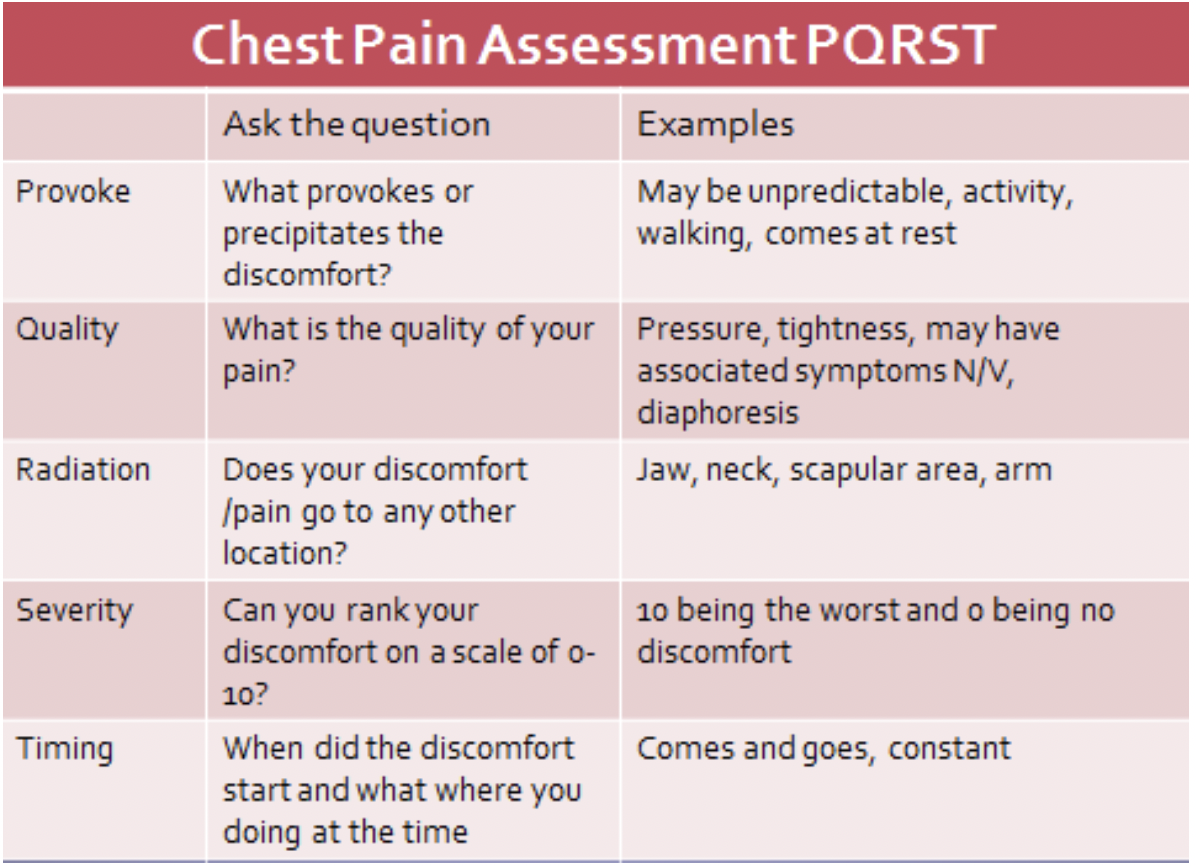
Suggest the management for chest pain
Keep resting, TNG for heart origin, antacid for GI origin, local analgesics for musculoskeletal origin
PQRST assessment
Refer to urgent treatment if symptoms persisted, which may indicate acute condition
Suggest the management for dyspnoea
Prop up, keep bed resting, rule out suffocation, assess airway, provide psychological support, purse-lip breathing for COPD exacerbation, fluid restriction for CHF exacerbation
Refer to urgent treatment if severe dyspnoea, associated with retrosternal chest pain
Suggest the management for ankle/leg swelling
vital signs monitoring, administer prescribed diuretics, educate drug compliance, elevate limbs, restrict fluid and salt intake, educate foot care, prevent fall, check urine output and urine albumin, give analgesic and dressing for tissue injury
Refer to emergency treatment if severe SOB with wheezing, severe pain after trauma, no urine output for 12 hours, acute onset of severe unilateral swelling