2130 unit 8
 Call Kai
 Learn
Learn Practice Test
 Spaced Repetition
 Match
Match Flashcards
 Knowt Play
1/73

There's no tags or description
Looks like no tags are added yet.
Name | Mastery | Learn | Test | Matching | Spaced | Call with Kai | Chat |
|---|
No analytics yet
Send a link to your students to track their progress
74 Terms
reproductive system
GOAL → make gamete & pass on genes into new organism
ACTION → meiosis (reg by hormones)
X focus homeostasis
key terms
nucleosome (DNA packed around histone) → nucleosome be sister chromatids & join → chromosomes
diploid = 2n
# distinct chromosomes → each cell 23 chromosomes pairs
23 sperm + 23 oocyte = 46 chromosomes = 1 diploid cell
cell replicate = 2n & 2 copies
haploid = n
# distinct chromosomes w/ 1/2
cell split after 1/2 DNA to 1 daughter cell & 1/2 other
gamete = haploid cells during fertilization
in gonads of parents
make diploid w 2n
germ line cells = cells in goands make gametes during meiosis
fertilization & chromosomes
each cell = 23 chromosome pairs (2n) → 1 pair = sex chromosomes
sex chromosomes = big X, small Y
oocyte = X
sperm = X or Y
XX = AFAB likely
XY = AMAB likely
meosis
diploid cell becomes a haploid GAMETE
then used in fertilization to make a gamete
meosis I steps
INTERPHASE I
DNA replicates, 2 copies of each chromosome (46 total)
PROPHASE I
Homologous pairs of sister chromatids (1 from each parent) form tetrad
THEN opposing sister chromatids cross over & recombination occur
INC genetic variation
METAPHASE I
sister chromatids line up
homologous pairs separated
ANAPHASE I
separate in anaphase via spindle fibers
each daughter cells will have 23 distinct chromosomes (2N-> N)
TELOPHASE I & CYTOKENESIS
2 daughter cells form w cleavage & separation
each cell w/ 1 set sister chromatids
has 46 chromosomes BUT 23 distinct chromosomes (DNA compliment N)
What is the end result of meiosis I?
2 haploid daughter cells
46 chromosomes BUT only 23 distinct chromosomes
meosis II steps
X DNA replication
PROPHASE II
chromatins condense to chromosomes
new spindle fiber form
METAPHASE II
spindle fibers attach to pull apart sister chromatids
ANAPHASE II
sister chromatids separated
TELOPHASE II & CYTOKENESIS
cleavage w each daughter cell split into 4 total diff sex cells
THUS → 4 genetically distinct cells w 23 chromosomes (DNA compliment N)
What is the end result of meiosis II?
4 haploid(n) gamete daughter cells w 23 chromosomes
how are feedback loops involved in reproduction?
dvlp of each reproductive system X start ASAP post fertilization
fuck up feedback loop = rpxdtn issue
use (-) & (+) feedback loops to regulate gamete pxdtn
(-) loops→ hormone balance by DEC GnRH + gonadotropins (LH + FSH) when high enough & prevent overpxdtn gametes
(+) loops → INC LH bc INC estrogen = ovulation to release mature egg
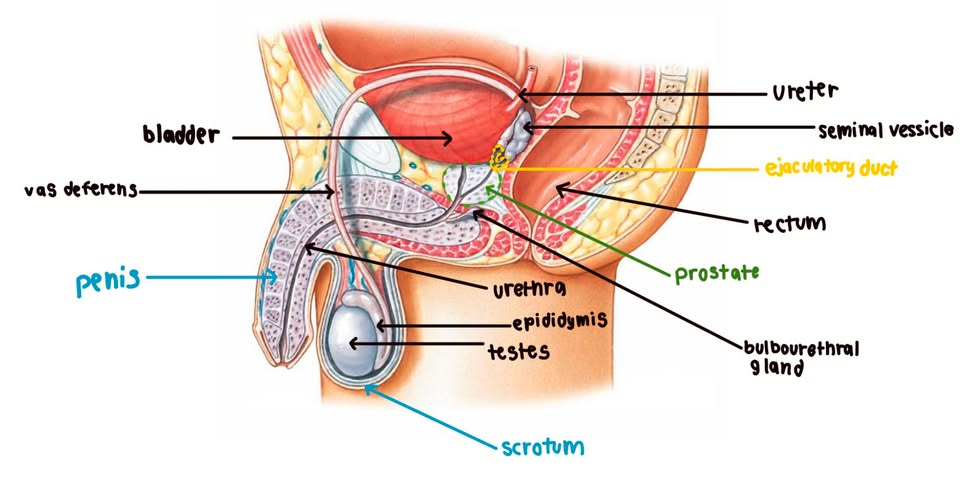
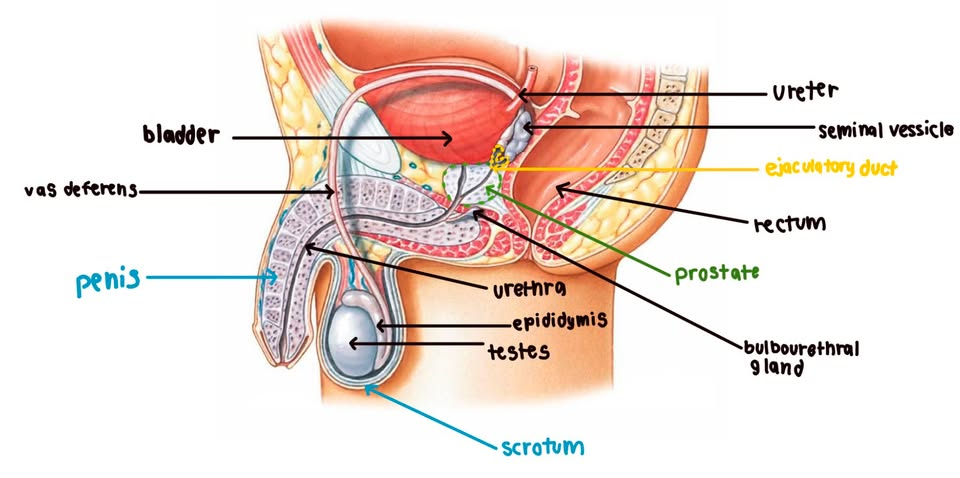
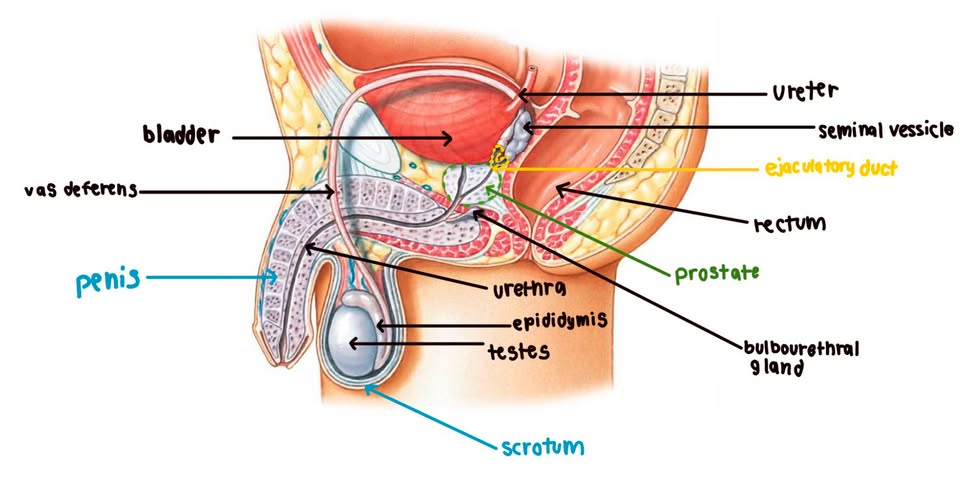
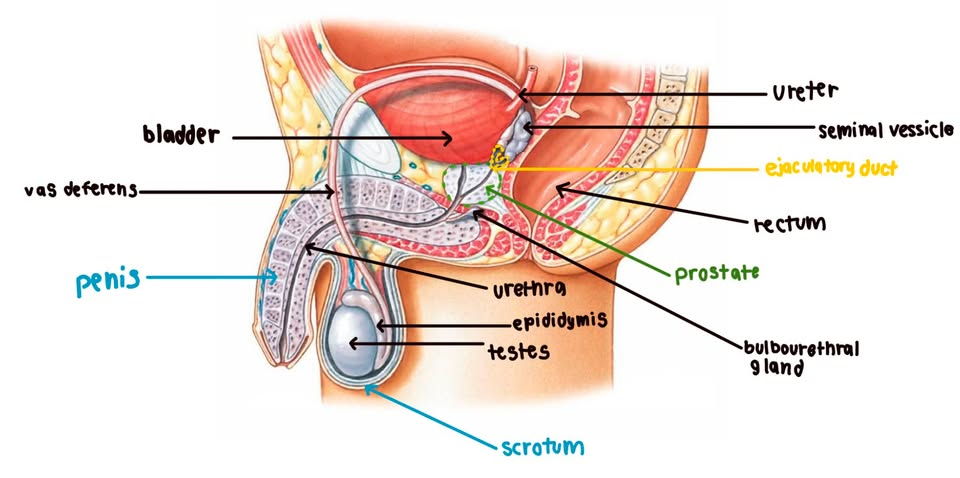
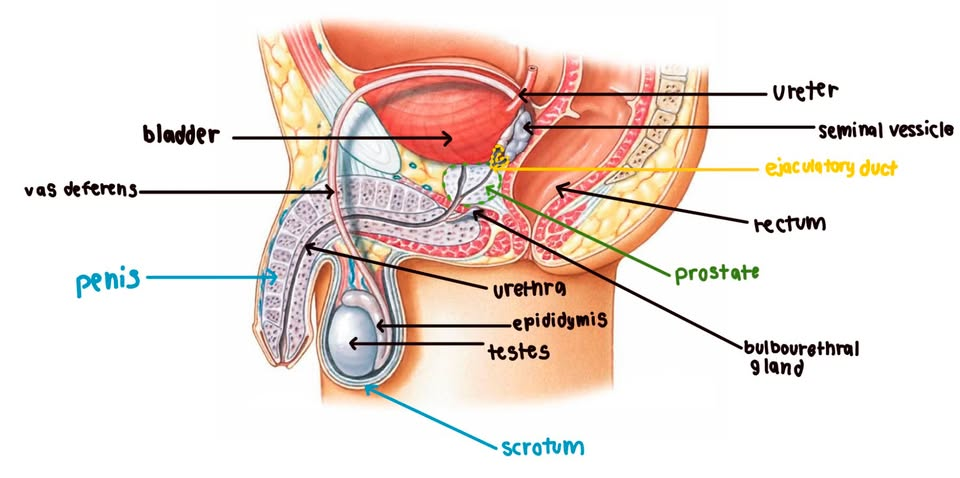
biological male reproductive system
EXTERNAL
penis
scrotum
INTERNAL
penis → urethra, erectile penis tissue
scrotum → testes, epididymis
vas deferens
ureter
bladder
seminal vesicle
ejaculatory duct
prostate
bulbourethral gland
rectum
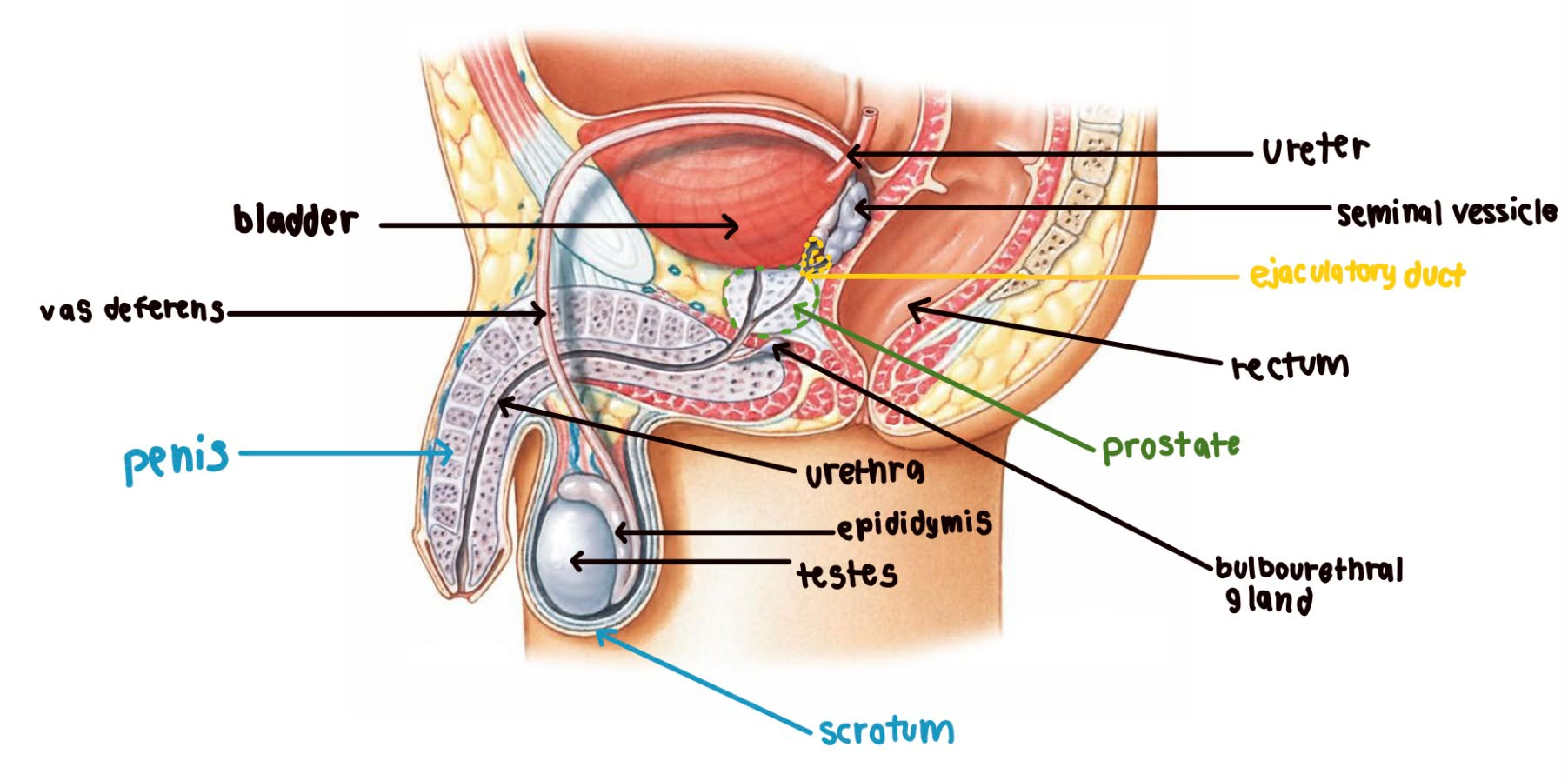
scrotum
flesh sac hold testes + epididymis
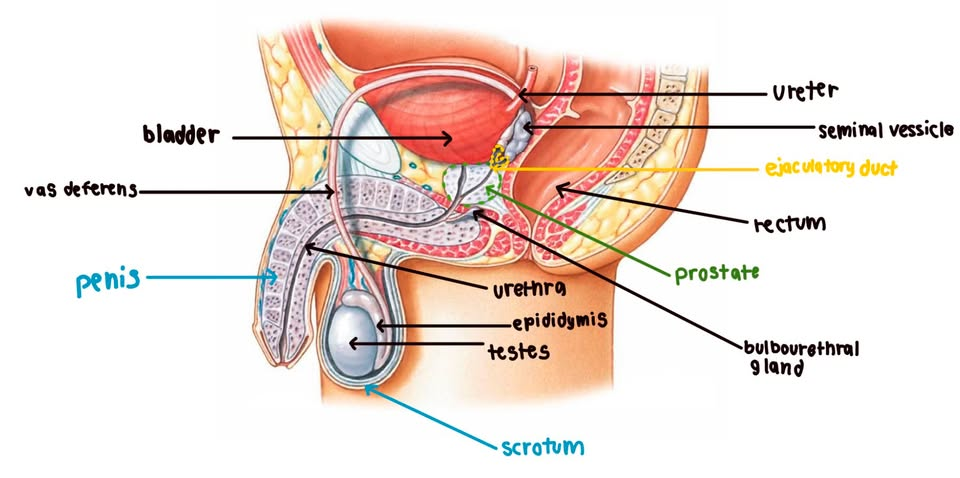
testes
inside scrotum
site sperm pxdtn
site hormones → testosterone + inhibin
both respond to gonadotropins from anterior pituitary
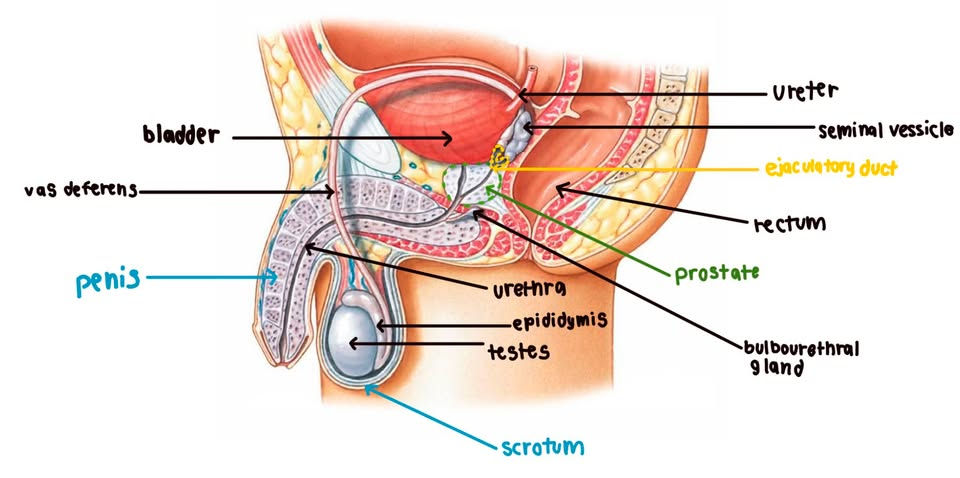
epididymis
sit on top of testes in scrotum
site sperm maturation & storage
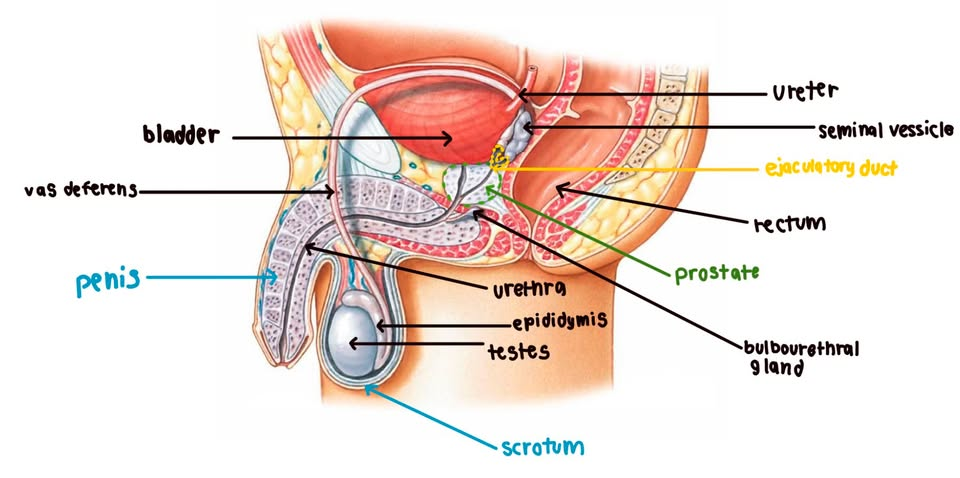
vas deferens
tube connect testes → urethra
send sperm during ejaculation
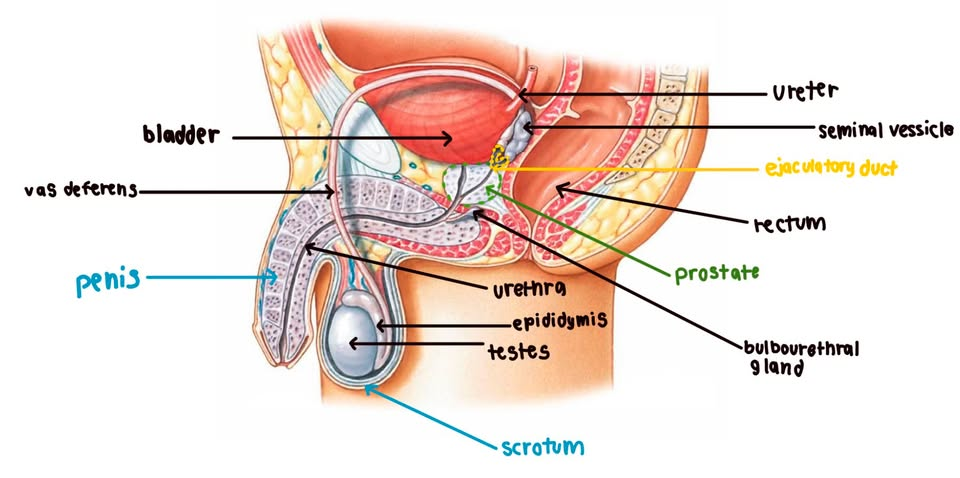
ureter
connection to kidney & bladder
sends urine via urethra to penis
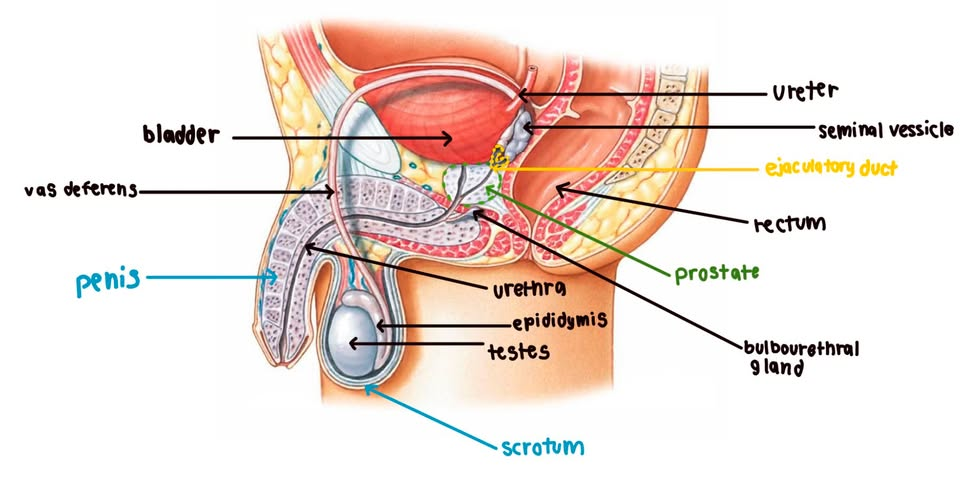
bladder
landmark next to seminal vesicles & prostate
store urine
connect ureter w tube (run thru prostate)
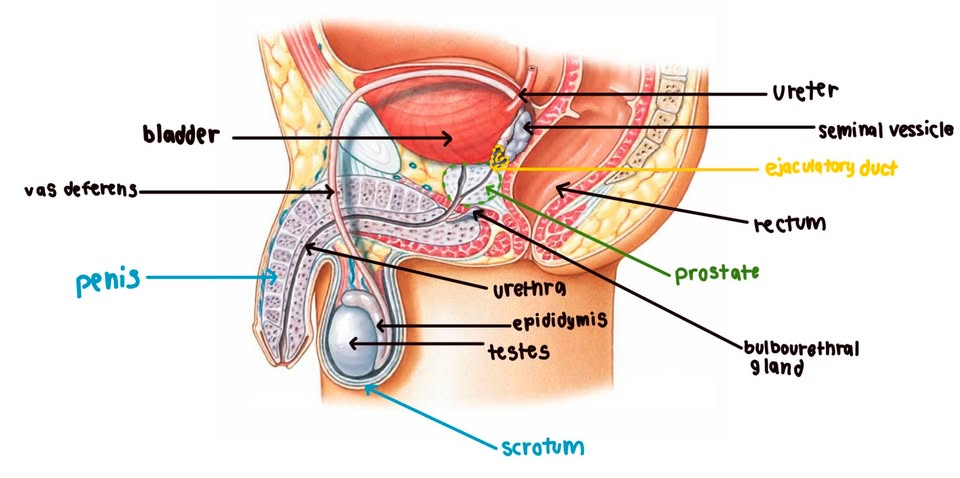
penis
organ excrete urine & sperm
made mainly of erectile tissue
site sperm transfer during ejaculation/s ex
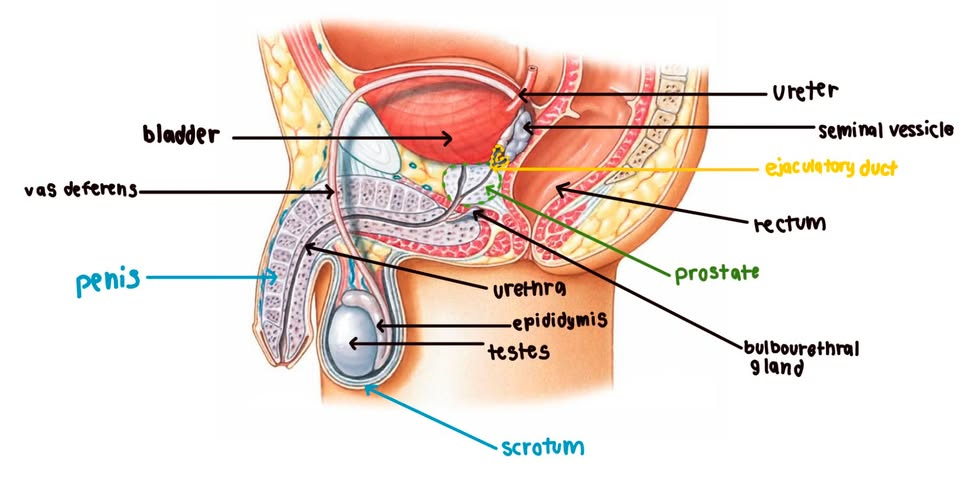
urethra
tube carry urine & sperm → penis & out of body
connect to testes 4 sperm ejaculation
ejaculatory duct
run thru prostate
drains into urethra 4 empty sperm & seminal fliud
junction of vas deferens & seminal vesicles
seminal vessicle
organ near bladder & above prostate
USE → add to seminal fluid (semen) during ejaculation
fluid = rich in fructose + enzymes give sperm E
bulbourethral gland
under prostate as small bulb
USE → release neutralizing & lubricating fluid into urethra before ejaculate
fluid = alkaline to neutralize acidic urethra before pee (carry pee & semen)
ACTION → release fluid during arousal, before seminal vesicle & prostate & give fluid during cumming to protect sperm
prostate
gland under bladder
connects to urethra
USE → secrete enzyme & alkaline fluid neutralize acidic urethra & vagina enviro so sperm live
GROW → reg w testosterone
rectum
landmark
store feces till poo via anus
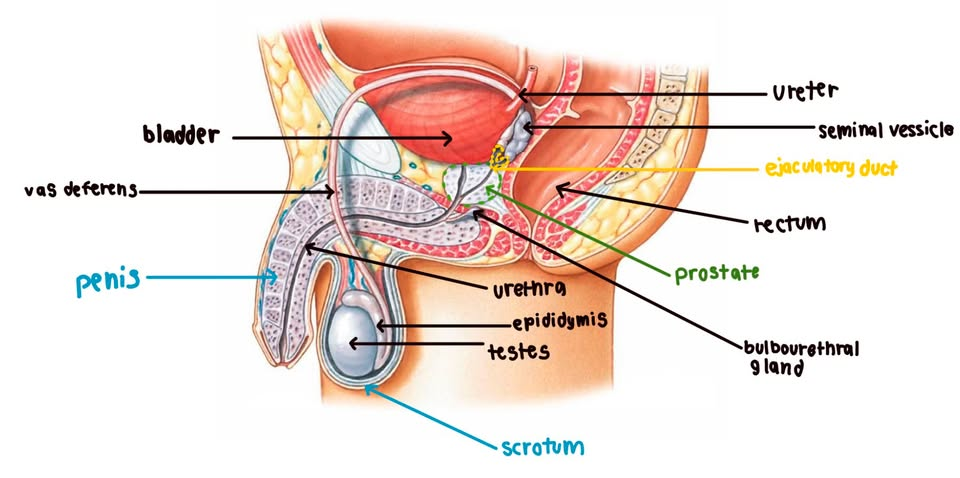
pathway of FLUID release during ejaculation
Bulbourethral Gland
secretes clear, lubricating fluid → clean & lubricate urethra before ejaculation during arousal
give to fluid post seminal vesicle & prostate
Seminal Vesicle
give thick, nutrient-rich fluid → LOTS fluid + E
Prostate
secretes fluid to nourish sperm & neutralize acidity → good f(x) & protected
pathway of SPERM release during ejaculation
Seminiferous tubules → sperm cells made here
epididymis → sperm moves & store ontop of testes
vas deferens → ejaculation occur & contract to pump sperm from scrotum thru thus to pelvic cavity
ejaculatory ducts → vas deferens join seminal vesicles @ ejaculatory duct & add fluid
prostate → fluid move past to urethra & add fluid
urethra → sperm pass prostate & add fluid to make semen & sent thru to penis
penis → seme exit via opening
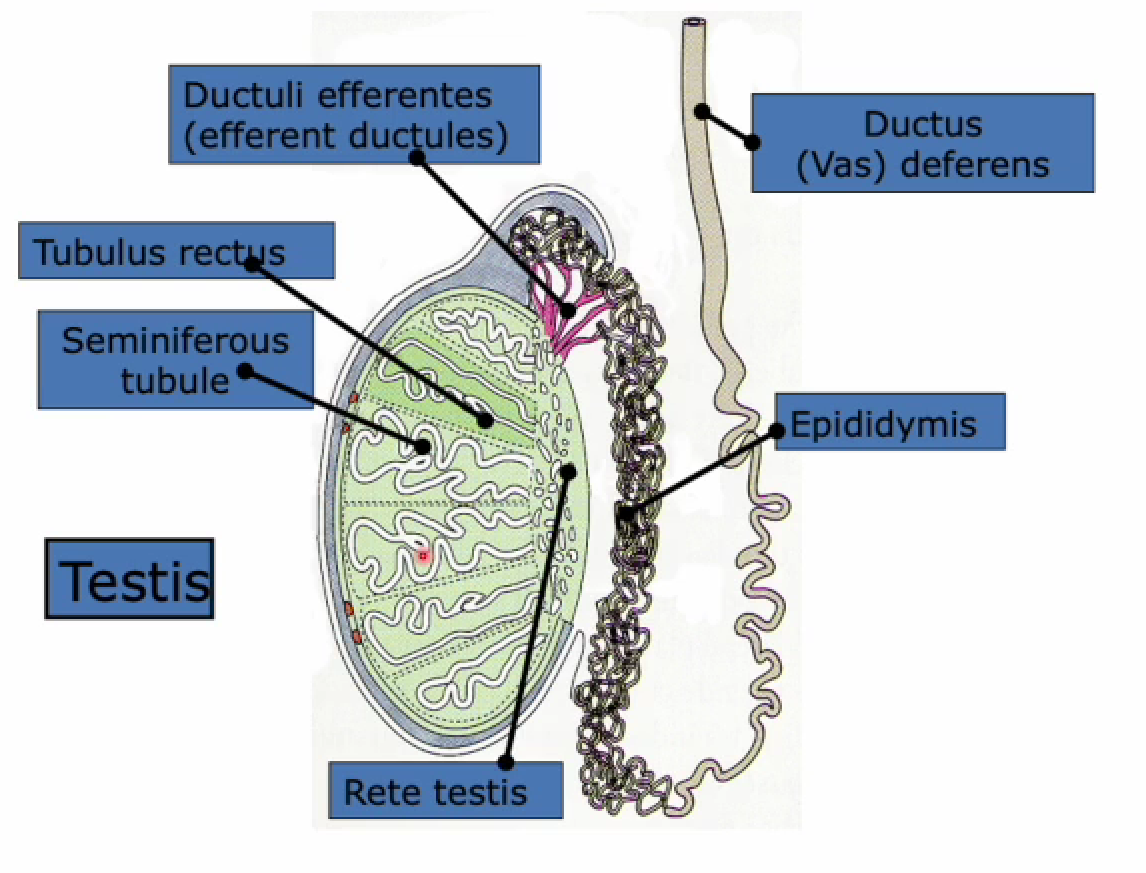
testicular anatomy & function
seminiferous tubule → site of spermatogenesis & start of sperm dvlp (meiotic actions occur)
rete testis → sperm cont. dvlp & pushed here
efferent ductules → sperm pushed here from rete testis to go to epididymis (conected)
epididymis → sperm sit here from efferent ductules (2-3 weeks & mature)
tubulus rectus → connection site rete testis + seminiferous tubule
vas deferens → connect urethra & testes
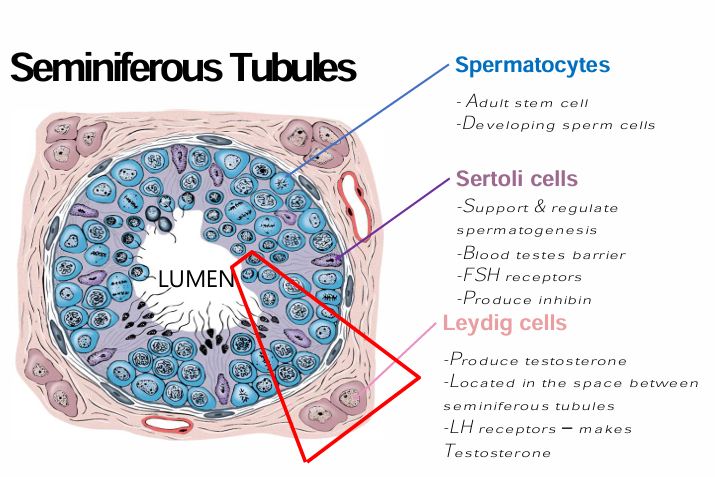
seminiferous tubules
(1) spermatocytes
adult stem cells → itself +daughter cell when divide
dvlp sperm cells
(2) sertoli cells
support & reg spermatogenesis → build micro enviro
FSH receptors
make inhibin → inhibit release of gonadotropin
blood testes barrier → tight junctions w sertoli cells
(3) leydig cells
make testerone → reg sprm pxdtn
inbtwn seminferous tubules
LH receptors
(4) lumen → internal empty space that sperm travel toward
blood testes barrier
tight junctions w sertoli cells
prevent immune system destory spermatocytes
how do sertoli cells help spermatogenesis?
build micro enviro to support & regulate
ACTION → testes blood barrier (tight junctions w sertoli cells) allow spermatocytes move btwn sertoli cells when differnetiate
THEN → sertoli cells release cytokins & peregrine factors to lumen
THEN → condition spermocytes, reg meiotic division
what hormoes stimulate the cells of the seminiferous tubules?
anterior pituitary = GnRH
Leydig cell = anterior pituitary
Sertoli cell = FSH
What is spermatogenesis?
DEF → mitosis & meiotic dvision from spermatogonium to spermatids
CAUSE → T pxdtn = sperm pxdtn start w/ puberty
LOCATE → seminiferous tubules
PXD → 4 gametes from 1 cell (haploid gametes)
based on hypothalamic-pituitary-gonadotropin axis
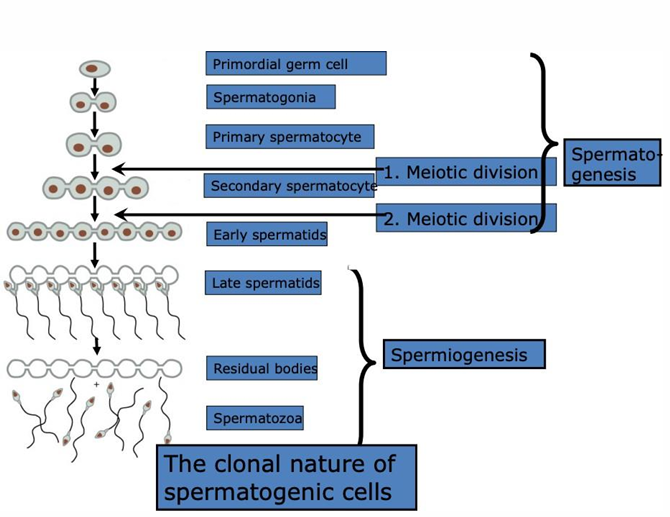
SPERMAtogenesis process
spermatogoniua (2n) divide w mitosis → new spermatognium (2n) + primary spermatocyte (2n)
spermatogonia = true stem cell
make 2 daughter cells (each w 46 chromosomes)
1st = cont as spermatogonia
2nd = primary spermatocyte
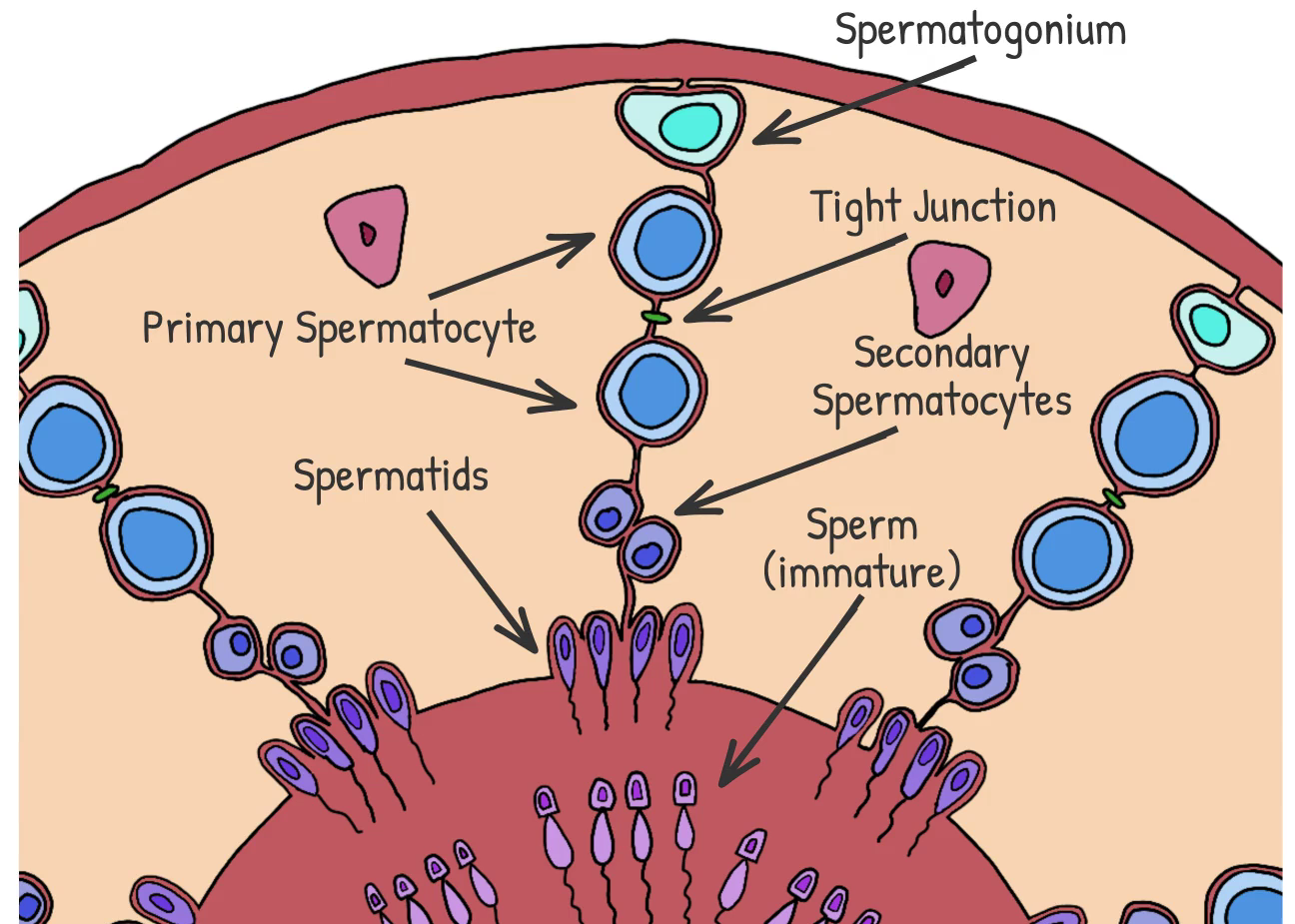
primary spermatocyte cross tight junction
move outer → inner seminiferious tubles
tight junctions = protect & seperate envrio to help sperm mature
primary spermatocyte divide w meiosis I → 2 secondary spermatocytes (n)
each 2nd spermatocyte = 2 copies of 23 chromosomes (sister chromatids together)
each 2nd spermatocyte divide w meosis II → 2 early spermatids (n)
each spermatid = 1 copy 23 chromosomes (1 chromatid each)
then move onto spermiogenesis
What is spermiogenesis?
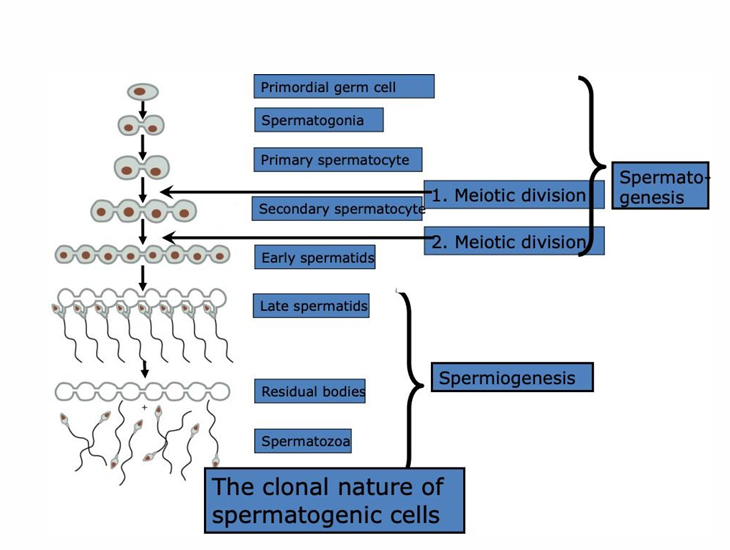
maturating & physical changes of spermatids to mature sperm (spermatozoa)
SPERMIogenesis process
post spermatogenesis
take 64-72 days
early spermatid → spermatozoa (n)
exit intercellualr space → lumen of semiinferous tubues by sertoli cells
spermatozoa = late spermatid
spermatozoa travel thru seminiferous tubules → epididymus → mature as mature sperm
change shape → shed cytosl & grow tail
cont. mature as move & settle in epididymis
What are spermatocytes/spermatogonium?
True stem cells
make 1 spermatogonia + 1 primary spermatocyte when differentiate
What is the progression of sperm during spermiogenesis?
Early spermatid --> late spermatid --> residual bodies + spermatozoa in lumen --> mature sperm in epididymis
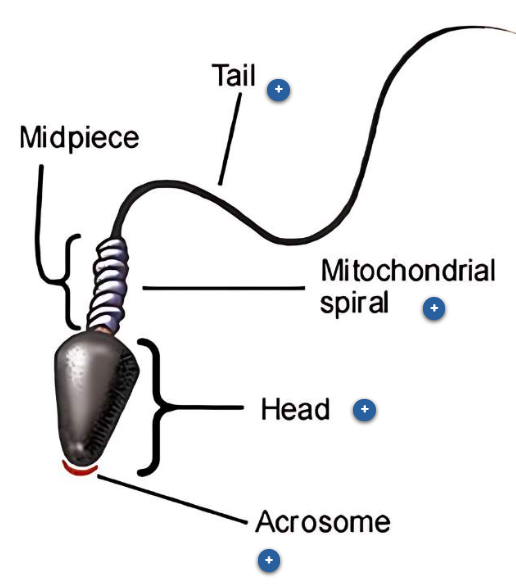
What are the five parts of a mature sperm?
head → nucleus + 23 VV condensed chromosomes to deliver to oocyte 4 fertilization
acrosome → speclalized organelle w enzymes help penetrat oocyte 4 fertilization
midpiece → has mitocondrial sprial
mitochondrial spiral → mito dense pack 4 E move tail
tail → sperm propel itslef to oocyte
mt ham
what is the hormonal control and regulation of the male reproductive system?
teste f(x) based on FSH + LH
CAUSE → anterior pituitary release FSH & LH to respond to GnRH from hypothalamus
connect via hypothalamic hypophysioal protal system
hormones travel to testes
FSH act on sertoli cells → spermatogenesis occur + make inhibin
Inhibin feedback anterior pituitary → DEC FSH +LH
LH stimulates leydig cells & make testosterone
testosterone → feedback to brain + help spermatogenesis
hypothalams (-) feedback = DEC GnRH
anterior pituitary (-) feedback = DEC FSH +LH
THUS → DEC inhibin & T lvls = release inhibitory effect & INC GnRH + FSH + LH
testosterone
main M hormone → made inleydig cells from LH stimulation
F → make in adrenal glands (muscle form, blood pxdtn, etc.)
PXDTN: cholesterol → diff intermediates → testerone
testerone functions
diff impacts on each person
S3XUAL
sex drive in puberty
spermatogenesis
dvlp male rpxdtn tract + external in dvlping baby
grow & dvlp male rpxdtn organs in puberty
2nd s3x characterstics → muscle, hair face & genitals, deepr voice
NON S3XUAL
bone & skeletal muscle growth
INC aggressive
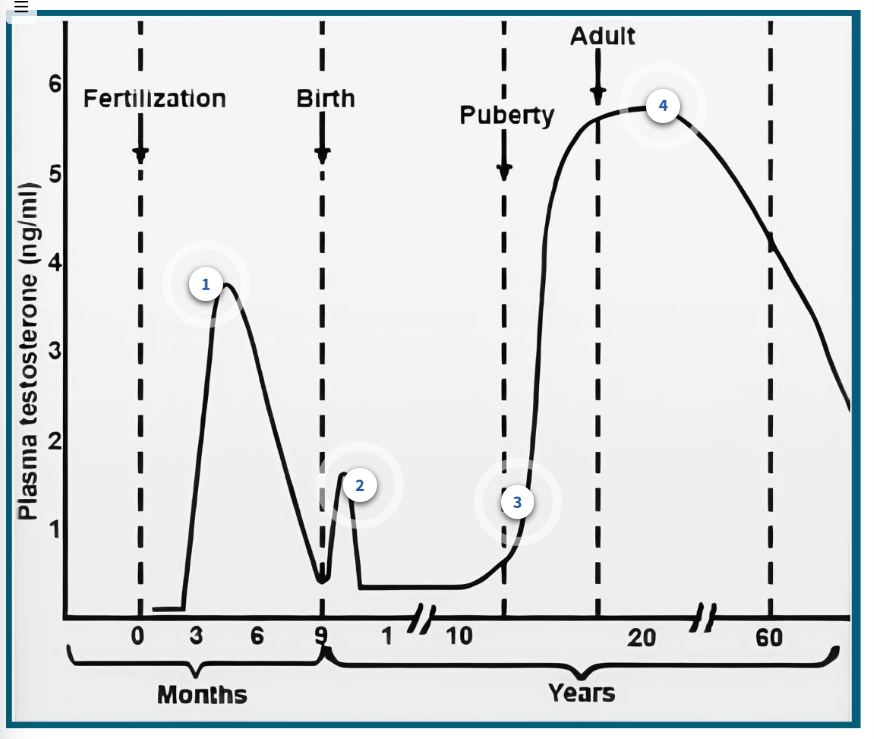
how does testerone levels change through life?
(1) fertilization
INC during dvlp 4 rpxdtn tract & external genitals
(2) birth
slight DEC w/o reason
(3) puberty
GnRH lvl INC = INC FSH & LH = T INC = final mature rpxdtn system & mature sperm
peak 16-18
(4) adult
same lvls till 40 & slow DEC testerone
50 → andropause start + DEC sex desire, DEC erectile f(x), tired, DP, DEC lean body mass, INC obese, DEC bone density
What is andropause?
period where sperm production DEC (50+)
biological female reproductive system
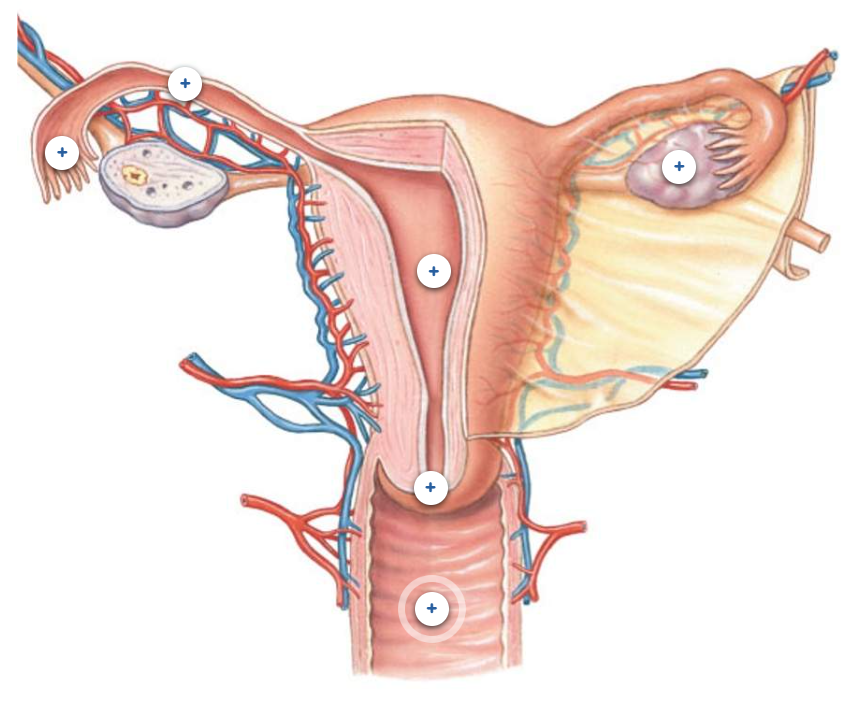
ovary → site dvlp F gamete oocyte
respond to FSH & LH
secrete estrogen & progesterone
release oocyte during ovulation
fimbrea → catch oocyte post release by ovary w ovulation
finger like projection sweep into uterine tube
uterine/fallopian tube → sperm & oocyte meet & fertilize
cilia move oocyte/embryo → uterus
uterine tube mve = progesterone reg little
uterus → muscle organ 4 pregnancy
normal embryo implant into endometrium
endometrium dvlpmt = estrogen reg
endometrium mature = progesterone reg
cervix → connect vaginal canal + uterus
secrete mucus → vary type & thickness
vagina → get penis/sperm, discharge fluid, birth canal
When does the oocyte reservoir develop and how does it change over the life course?
oocyte YOU come from when bio MOM in bio GRANNY womb
oocyte # peak in fetal dvlp & DEC till X @ menopause
THUS → ovary stockpile when born so have enough & healthy oocyte 4 rpxdtn
oocyte X replace self & DEC til menopause
how do oocytes do meiosis?
normal meosis during fetal dvlp → prophase 1 (germinal vesicle stage)
only pair up homologus chromosomes
reg prophase 1 → crossing over happen & homologous chromosomes exchange genetic material to INC genetic diversity
puberty restart meiosis → metaphase 2
puberty = hormal signals trigger oocyte recruitment 4 mature w each cycle
X recruit = dormant till recruit OR die
recruited = meiosis cont till metaphase 2
asymmertical cytokenesis →
(1) 1 large oocyte
(2) smaller polar bodies w excess hormones → X fertilize
metaphase 2 = sister chromatids seperated BUT finish post fertilization
fertilization restart & finish meosis
fertilization trigger meiosis 2 finish
fertilization = symmetrical cytokinesis & oocyte expel another polar body → be haploid cell
sperm DNA + oocyte DNA = zygote & start embryonic dvlpt
dvlp oocyte & meiotic process start BEFORE birth
blocked till puberty most & some till menopause
meiotic process cont w ovulation (1 dom oocyte suround w cumulus cell complex)
meiotic process finish when fertilization occur
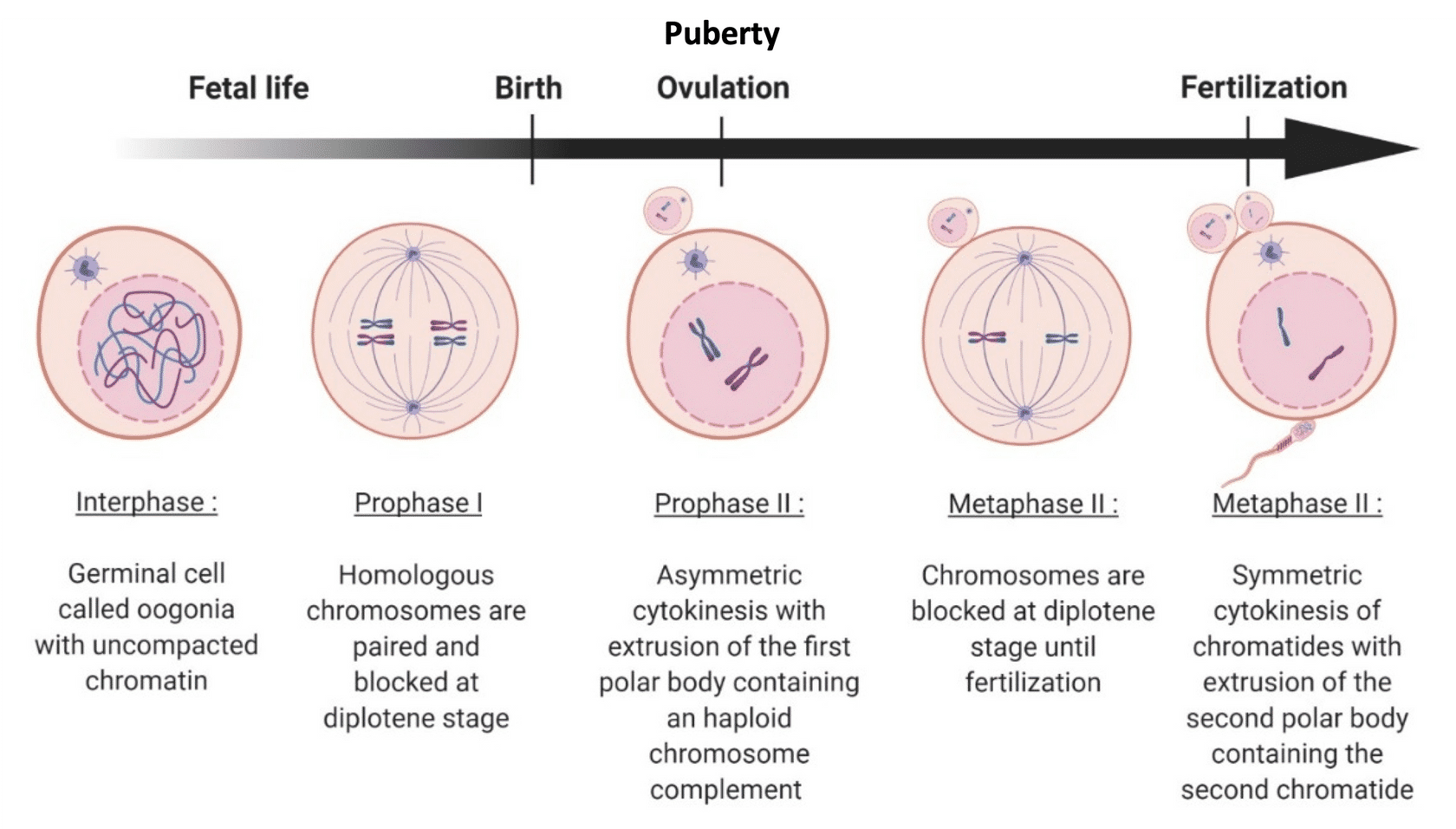
At birth what stage are most oocytes blocked at?
Diplotene stage of prophase I
spermatogenesis VS oogenesis
O →
makes follicle
supported w granulosa cell
start @ gestation
makes only 1 viable gamete
blocked MOSTLY @ prophase 1
finish meiosis when fertilize
S →
supported w sertoli cells
makes 4 viable gametes
start @ pubety & true stem cell w mitosis
finish meosis before fertilize
oocyte
immature egg cell
What is folliculogenesis?
GOAL → get ready 4 F fertility
RESULT → 1 haploid germ cell
F(x)→
get dvlping folliclies from resting primordial pool
grow follicle wall w INC granulosa + theca cell layers
select & grow 1 mature graffian preovulatory follicle
REGULATE → hypothalamic-pituitary-gonadal axis
1. GnRH released from hypothalamus
2. release FSH & LH anterior pituitary
3. travel to ovaries & regulate gametogensis
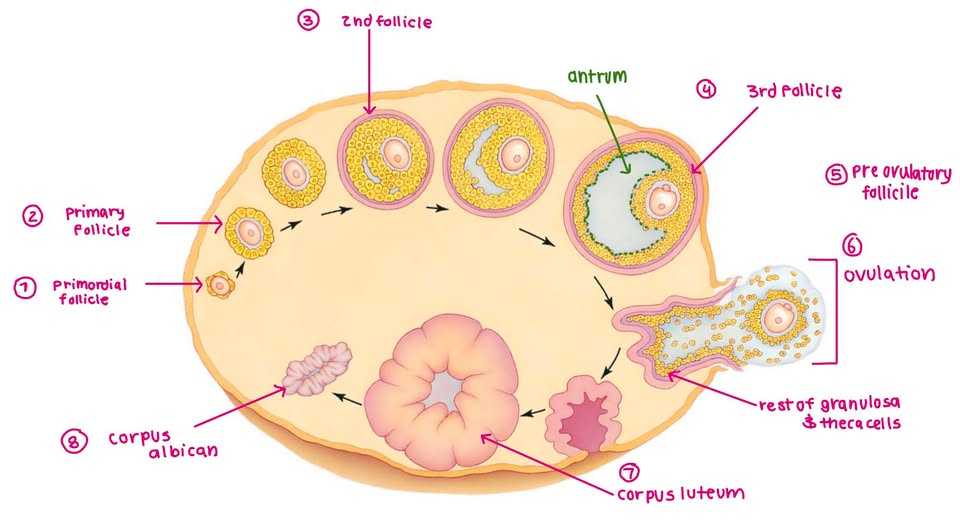
what are the steps of folliculogenesis
(1) primordial follicle
start w folliciles made in fetal (dormant till puberty)
born w all primodiral follicle one needs
follicles = 1 oocyte + 1 layer flat granulosa cell
(2) primary follicle
during puberty follicle activated
go primordial → primary follicle (30-50)
1 oocyte = ovulated
rest = atresia
granulosa cell proliferate → VV layers around oocyte
NEW → zona pellcida
(3) secondary follicles
primary follicile mature → 2nd follicile
granulosa cells cont proliferate & make hormones
still 1 oocyte + zona pellcida
NEW → theca cells & make hormones
(4) tertiary/antral follicles
2nd follicile → 3rd follicle
granulosa cells cont proliferate = follciles grow big
still 1 oocyte + zona pellucida + theca cells
NEW → antrum (fluid filled cavity) help follcile swell 4 ovulation
NEW → 2nd oocyte + polar body & ready for ovulation if matured enough
(5) pre ovulatory follicle
3rd follcile mature & antrum INC size → folliciles ready to release oocyte 4 ovulation
(6) ovulation
if enough hormone made & stim ovulation = rupture follcile
THEN → 2nd oocyte release in uterine tube 4 fertilization + granulosa cells around oocyte leave
still have granulos & theca cells left
(7) corpus lutenum forms
left over follicle cells → corpus luteum
secrete hormones 4 pregnancy
X pregnancy = degrate as corpus albican (scar tissue)
Primordial follicle → primary follicle → secondary follicle → tertiary follicle → pre-ovulatory follicle → ovulation → corpus luteum → corpus albican
What is oogenesis?
oocyte development → only egg/oocyte itself
What is the zone pellucida?
gelatinous layer made during oogenesis
btwn oocyte & cells of the follicle
What are granulosa cells?
nurse cells → help mature, care & maintain oocyte
secrete estrogen
What are theca cells?
nurse cells → help mature, care & maintain oocyte
secrete progesterone
atresia
follicle degrates
What occurs during ovulation?
follicle rupture → release mature oocyte into uterine tube
REG → hypothalamic-pituitary-ovarian axis
CAUSE → surge LH
hypothalamic-pituitary-gonadal axis (HPG)
regulate menstural cycle
(1) folliculogenesis → grow & mature ovarian follecules 4 ovulation
(2) endometrial change → thick & prep uterine lining 4 implantation
ACTION→ comm. w hypothalamus, putlairy gland & ovaries w each cycle
GOAL → help egg mature + release & prep uterus 4 preggy
How do hormones from the hypothalamic-pituitary-gonadal axis (HPG) affect folliculogenesis?
(1) hypothalamus release GnRH (gonadotropin-releasing hormone)
GnRH in pulses → travel to anterior pituitary via hypothalamic-hypopheseal portal system
pulse frequency = control FSH & LH release (change w cycle phase)
(2) pituitary release FSH + LH
(3) ovaries make estrogen + progesterone
growing follicles release estrogen
post ovulation empty folliclle → corpus luteum & secretes progesterone
(4) (-) feedback loops reg cycle
INC estrogen & progesterone = inhibit FSH & LH @ hypothalamus & pituitary
THUS → X 1+ ovulations
(5) estrogen (+) feedback loop on LH
right before ovulation, swtich (+) loop to ensure ovulation right time
ACTION →
dom follicle mature = INC lvl estrogen made
estrogen reach critical threshold (12-14th day cycle) = stim hypothalamus & pituitary w dff neurons
(+) feedback = rapid INC LH & little FSH INC
LH surge = ovulation = egg release from follicle
post ovulation = estrogen DEC = progesterone in corpus luteum go (-) loop = DEC LH
(6) X preggy
corpus lutem break = DEC progesterone & estrogen = mensutration (endometrial lining shed
cycle restart → hypothalamus release GnRH
follicle stimulating hormone (FSH)
LOCATE → gonadotrophs in anterior pituitary
stim folliculogenesis = grow ovarian follicles w 1 dominant follicle
dom follicle make estrogen
LH
LOCATE → gonadotrophs in anterior pituitary
work w/ FSH to mature dominant follicle
surge LH = ovulation
estrogen
relese by growing follicle
USE →
(1) stim thickening of endometrial lining 4 implantation
give feedback to brain (reg FSH + LH lvl)
progesterone
hormone released by corpus luteum
USE → stabilize endometrial lining 4 fertlized egg implant
How are FSH and LH regulated normally?
via (-) feedback loop by estrogen
INC estrogen & progesterone = inhibit FSH & LH @ hypothalamus & pituitary
How is LH regulated just before ovulation?
(+) feedback loop caused by estrogen = surge in LH = ovulation
How does the positive feedback loop work?
Dominant follicle matures
high levels of estrogen produced
estrogen reaches critical level
acts on different neurons with a positive effect
stimulates the hypothalamus and pituitary
surge in LH & little FSH
ovualtion trigger
egg release from follicle
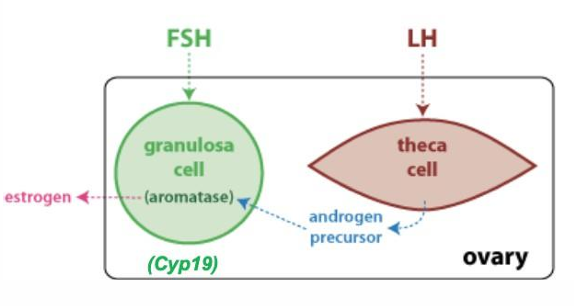
how do the e pituitary hormones affect the cells of the follicle/gonadotropin?
thecha cells = LH hormone receptors
response w convert cholesterol → androgen precusor (testerone)
testerone qickly move to granulosa cell
granulosa cells = FSH hormone receptors
use aromataste/Cyp19 convert testerone → estrogen
THEN → follicle make INC estrogen to stim LH surge
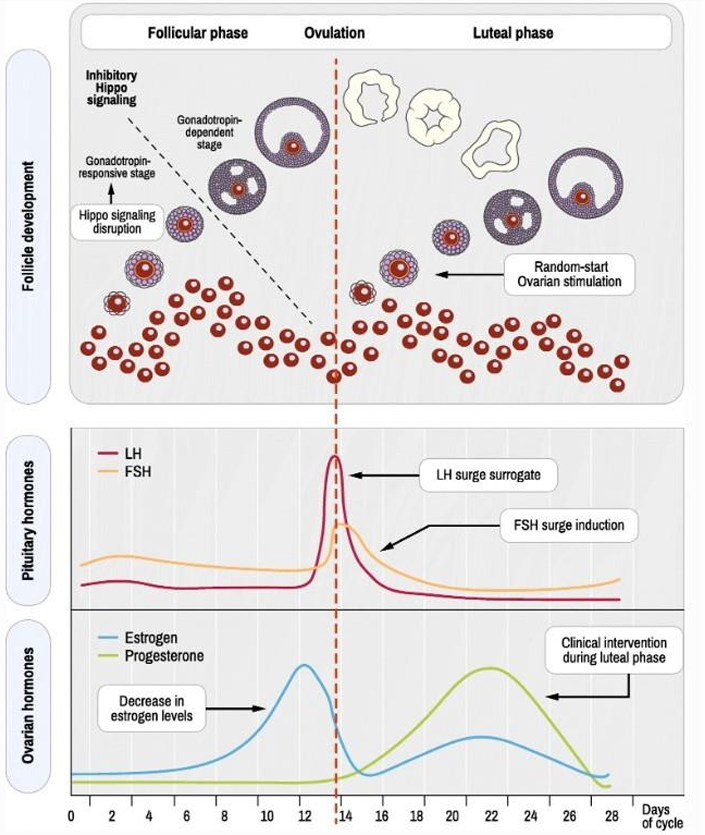
how are the stages of the female reproductive cycle regulated by hormones?
follicular phase
many primodial follicules recruited & some dvlp occur (b/c ovarian signalling)
follicles start making LH & FSH receptors → dom follicule expressing MOST FSH selected to progress
ovulation
egg released from follicule
new recruitment of diff folicules start → bc ovarian stimulation
near ovulation = granulosa cells INC LH receptor & lose FSH receptors
luteal phase
post ovlation = granulosa & theca cells be corpus luteum
THUS → only LH receptors
LH receptors control process cholesterol → progesterone sent in blood + some → estrodiol (help hypothalamic pitutitary gonatroppin axis)
THEN → degrate into corpus albicans
new recruitment of diff folicules start → bc ovarian stimulatioin
ovarian hormones → make by follicle cells (granulosa + theca)
estrogen made
main (-) inhibt effect → DEC FSH & LH
some (+) effect → INC estrogen enough signal release LH w 1 dom follicle selected
progesterone INC post ovulation
how do hormones affect the uterine lining?
based on estrogen & progesterone lvls
(1) proliferation phase
follicular phase when follcile dvlp + INC estrogen
follicule changes in ovary w granulasa & techa cells
estrongen = stim uterus make INC endometrium to prep implantation
INC estrogen till LH surge
(2) secretory phase
post ovulation = INC progesterone (corpus luteum)
progesterone mature endomatrium → help dvlp vasculature & endometrium dvlp right thickness to get proper implanation
(3) menses
X pregnancy = progsterone lvl DEC = X endometrium
if pregnant = INC progesterone lvl b/c embryo makes hormone maintain corpus luteum
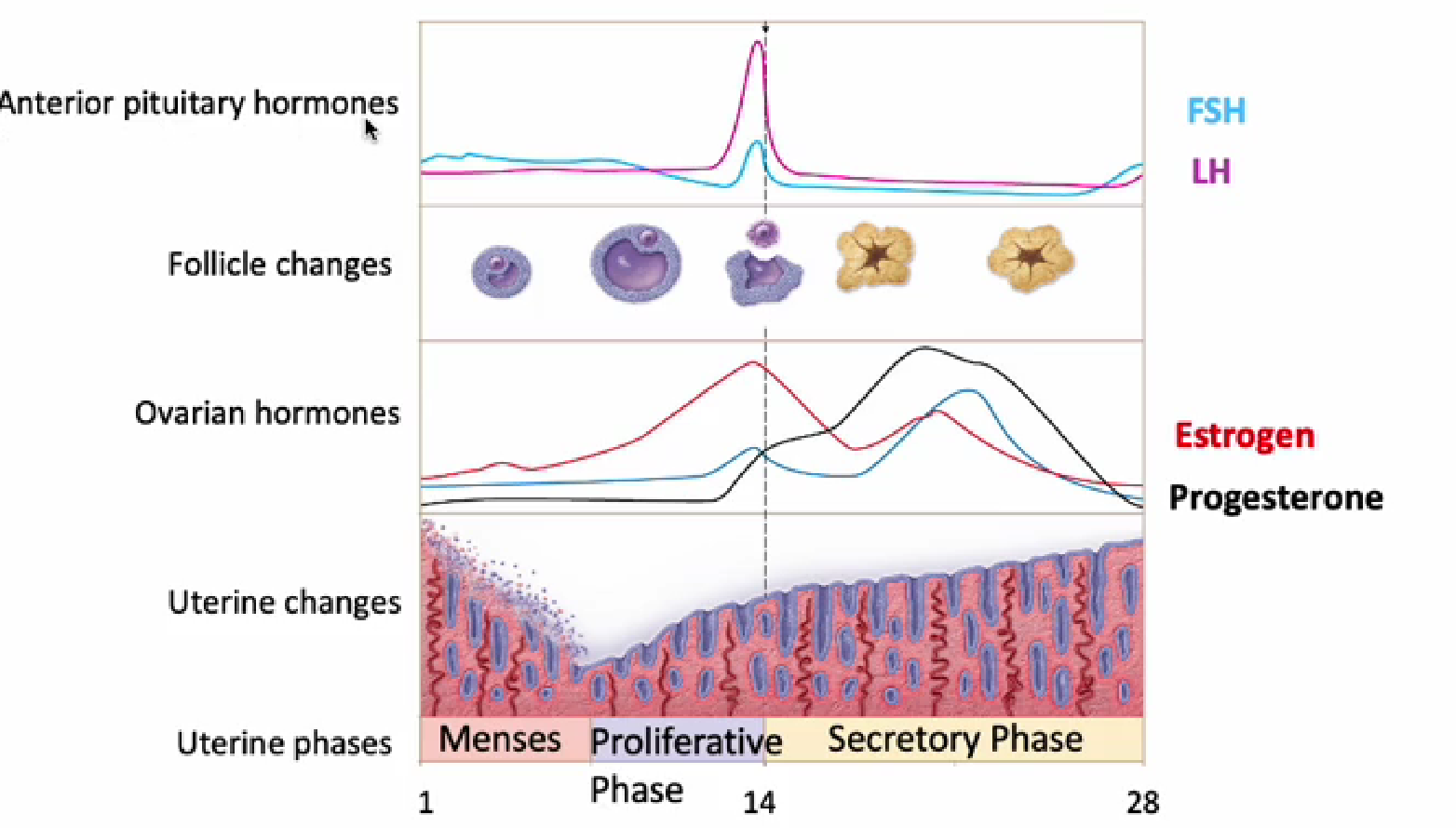
menstrual cycle
follicular phase
@start = DEC estrogen & progesterone
THUS → top of uterus lining shed & menstural bleeding
pituitary gland send FSH to ovaries→ stim dvlp range of follicules
each follicule w immaure egg & estrogen
1 dom follicule dvlp → INC estrogen = inhibit FSH (smaller follicile die)
INC estrogen = thicken endometrium lining
ovulation phase
INC in LH & FSH hormones → surge LH = ovulation w egg release
egg move into fallopian tube → uterus
16-32 hrs post surge (day 14)
luteal phase
LH & FSH DEC = make corpus luteum
corpus luteum make estrogen & progesterone = thicken endometrium lining
fertlizied = progeserone support
X fertilized = corpus lutem break = DEC progesterone & estrogen & mensus
combined birth control pills
synthetic estrogen & progestone
estrogen alone = carcinogenic
missing dose = hormone lvl DEC = ovulate & preggy
F(x) → take 21 days, 7 day placebo & mensus
7 day placebo to follow natural hormone cycle
GOAL →
suppress ovulation & prevent implantation
keep constant stable lvl hormones = override natural cycle
ACTION → stable mid estrogen & progestin lvl 4
(1) estrogen (-) loop to hypothalmus & pituitary
THUS → X LH surge = X ovulation
(2) progestin → thicken cervical mucus (hard sperm reach egg) & thin endometrial line (DEC implant)
menopause
nautral DEC rxpdtn hormones w ovaries
45-55 yrs
RESULT → end ovulation & menstural cycle
causes for menopause
DEC ovary follicules
born limited # follicles → most lost w ovulation & atresia
menopause hit = X functional follicles left
DEC estrogen & progesterone
DEC follicles = DEC estrogen
X estrogen = X LH = X ovulation = X progesterone from corpus luteum
FSH & LH X respond
DEC estrogen = X (-) loop = pituitary release INC FSH & LH
BUT X response bc → X functional follicles left + ovarian cells X sensitive signals
effect of menopause on hypothalamic-pituitary-gonadal (HPG) axis
GnRH → cont release hypothalamus, DEC effective w X response to stim from ovaries
FSH → INC lots, try stim ovaries w/o response bc X follicules
LH → INC lots, X ovulation
estrogen → DEC = hot flash, mood change, bone loss
progesterone → DEC, X corpus luteum w/o ovulation
physical effects of menopause
hot flast & night sweat → hypothalamus X good T reg
irregular & X period → X ovulation & irregular cycle till stop
osteoporosis risk → DEC estrogen = DEC bone density help = INC fracture risk
mood change & sleep issues → estrogen affect ntm 4 mood & sleep
vag dry & skin change → DEC estrogen = DEC elasticity = thin & dry