M2 Acids,Bonding & Structure, Electron Structure
 Call Kai
 Learn
Learn Practice Test
 Spaced Repetition
 Match
Match Flashcards
 Knowt Play
1/23

There's no tags or description
Looks like no tags are added yet.
Name | Mastery | Learn | Test | Matching | Spaced | Call with Kai | Chat |
|---|
No analytics yet
Send a link to your students to track their progress
24 Terms
Strong acids
Proton donors that Completely dissociates in aqueous solution
HCl, H2SO4, HNO3
Weak acids
Proton donors that Partially dissociates in aqueous solution
Ethanoic acid (CH3COOH)
Neutralisation reactions
Acid + base → salt + water
Acid + carbonate → salt + water + CO2
Jet space?
If the jet space is not filled properly prior to commencing the titration it will lead to errors if it then fills during the titration it will lead to errors if it the fills during the titration it leads to a larger than expected titre reading
Chromium (Cr)
1s2 2s2 2p6 3s2 3p6 4s1 3d5
Copper (Cu)
1s2 2s2 2p6 3s2 3p6 4s1 3d10
Electron configuration shorthand
[Ne] 10 e
[Ar] 18 e
[Kr] 36 e
2BP
Linear 180°
3BP
Trigonal Planar 120°
4BP
Tetrahedral 109.5°
6BP
Octahedral 90°
3BP 1LP
Pyramidal 107°
2BP 2LP
Non linear 104.5°
2BP 1LP
117.5°
Explaining bond angles
Electron pairs repel to get as far apart as possible
__ has X bonding pairs and Y lone pairs
Lone pairs repel more than bonding pairs
Hydrogen bonding (N/O/F)

Explain 2 anomalous properties of water
Water has a higher melting/boiling point than expected as the strong hydrogen bonds holding the water molecules together require a lot of energy to overcome
The solid is less dense than the liquid as hydrogen bonding holds the molecules apart in an open lattice structure
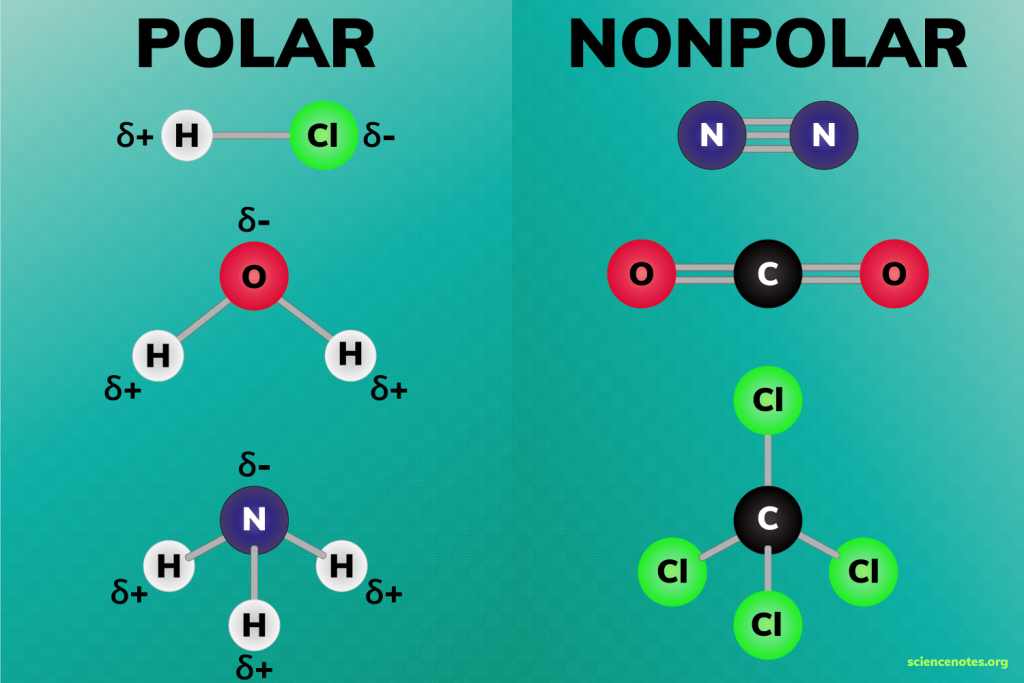
Polar / Non Polar
Polar = Difference in electronegativity (unsymmetrical)
Non polar = symmetrical molecules
Simple Covalent
Simple covalent molecule/lattice + Has IDDI between molecules
Requires littles energy to overcome/break
Has no mobile charge carriers so cannot conduct electricity
(Insoluble -cant interact with water cant form H-bond)
Giant covalent
Giant covalent lattice + Strong covalent bonds
Requires a large amount of energy to break
Does not contain mobile charged particles so does not conduct electricity
Eg. (Diamond/Silicon/Boron
(Graphite & Graphene contain mobile delocalised electrons so does conduct electricity)
(Insoluble-Doesn’t interact with water molecules)
Giant ionic
Giant ionic lattice - strong ionic bonds
Requires a large amount of energy to break
Solid - no mobile ions so doesn’t conduct
Molten - mobile ions conducts electricity
(Soluble - dissociates into ions which interact with polar water molecules
Metallics
Giant metallic lattice + strong electrostatic attraction between cations & delocalised electrons
Requires a large amount of energy to break
Has mobile delocalised electrons and so conducts electricity
(Insoluble- does not interact with water molecules)