Wrong - Chem/Phys
 Call Kai
 Learn
Learn Practice Test
 Spaced Repetition
 Match
Match Flashcards
 Knowt Play
1/152

There's no tags or description
Looks like no tags are added yet.
Name | Mastery | Learn | Test | Matching | Spaced | Call with Kai | Chat |
|---|
No analytics yet
Send a link to your students to track their progress
153 Terms
Linear (2 domains)
2 bonds
0 lone pairs
180°
Trigonal Planar
3 bonds
0 lone pairs
120°
Bent (3 domains)
2 bonds
1 lone pair
less than 120°
Tetrahedral
4 bonds
0 lone pairs
109.5°
Trigonal Pyramidal
3 bonds
1 lone pair
less than 109.5°
Bent (4 domains)
2 bonds
2 lone pairs
less than 109.5°
Trigonal Bipyramidal
5 bonds
0 lone pairs
90°, 120°
Seesaw
4 bonds
1 lone pair
less than 90°, less than 120°
T-shaped (5 domains)
3 bonds
2 lone pairs
less than 90°
Linear (5 domains)
2 bonds
3 lone pairs
180°
Octahedral
6 bonds
0 lone pairs
90°
Square Pyramidal
5 bonds
1 lone pair
less than 90°
Square Planar
4 bonds
2 lone pairs
90°
T-shaped (6 Domains)
3 bonds
3 lone pairs
less than 90°
Linear (6 bonds)
2 bonds
4 lone pairs
180°
In galvanic cells, half reactions with more positive E …
are reduced.
In galvanic cells, half reactions with less positive E …
are oxidized.
In electrolytic cells, half reactions with more positive E …
are oxidized.
In electrolytic cells, half reactions with less positive E …
are reduced.
A galvanic cell uses redox reactions to…
convert chemical energy into electrical energy (spontaneous)
An electrolytic cell uses redox reactions to…
convert electric energy to chemical energy (non-spontaneous)
The cathode is the site of…
reduction
The anode is the site of..
oxidation
Formula for the wavelength of standing wave in a tube with one open end
wavelength=4L/n
L=length of tube
n=harmonic
Formula for the wavelength of standing wave in a tube with two open ends
wavelength=2L/n
L=length of tube
n=harmonic
Linear Position of X Equation
x=xo+vt+(1/2)at²
Pyranose
6 carbon ring sugar
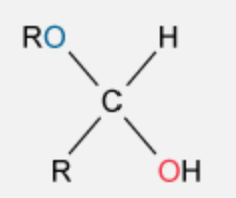
Hemiacetal
Functional group originating from an aldehyde containing one OR and one OH group
Partial Pressures are equivalent to…
Mole Fractions
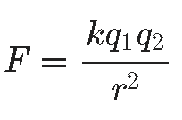
Coulombs Law
F = Magnitude of electrostatic force (N)
k = Coulombs constant ((N*m²)/C²)
q1/2: Magnitude of electric charge in coloumbs
r = distance between charges (m)
dB are measured on a … scale
log scale
An increase in 30 dB is actually an increase of 10³ in terms of sound intensity
Esterification Process
Carboxylic acid and alcohol undergo condensation reaction to form ester and water. Acid is used as a catalyst to make the carbonyl oxygen more electrophilic by providing protons
Order of reactivity of functional groups (most reactive to least)
Acyl/Acid Halides > Acid Anhydrides > Esters/Carboxylic Acids > Amides > Carboxylate ions
Aldehydes > Ketones for nucleophilic addition
d molecules refer to…
The prefix dex or a (+) clockwise rotation of light which must be determined experimentally
l molecules refer to..
The prefix levo or a (-) counterclockwise rotation of light which must be determined experimentally
A D-enantiomer can be determined if..
In a Fischer projection, the highest priority substituent is pointing to the right (wedge)
An L-enantiomer can be determined if…
In a Fischer projection, the highest priority substituent is pointing to the left (dash)
UV irradiation affects..
Electrons - causes them to jump to a higher energy level
Alpha decay
Nuclease releases alpha particle (2 protons and 2 neutrons)
Atomic mass decreases by 4 and atomic number decrease by 2
Low penetration, deadly via injestion
C^12 →Be^8
Beta decay
Neutron converted to proton/vice versa. Release of electron (beta minus) or positron (beta positive)
Beta minus: Neutron turns into proton, electron shot out, element goes up one number
Beta plus: Proton turns into neutron, positron shot out, element goes down one number
Moderate penetration
Gamma decay
Releases photons
Very high penetration
Formula for radius of curvature for spherical lens
2f=r
f = focal length (half the radius of curvature)
r = radius of curvature
Borane (BH3) +THF is used to…
Reduce carboxylic acids over other carbonyls
NaBH4 is used to …
Selectively reduce ketones and aldehydes
Order of strength of IMF (low to high)
(also measurement of boiling points)
Alkanes → Aldehydes/ketones → Alcohols → Carboxylic Acids
Gas chromatography elutes according to?
Boiling point
eV to J
1 eV = 1.6×10^-19 J
Concerted means?
Occurring in one step.
Fusion
Heat energy to go from solid to liquid
Venturi Meter
Measures the flow rate of liquids/gases passing through a pipe.
Venturi Effect
Decreasing area causes an increase in speed and a decrease in static pressure.
Bernoulli’s Principle
Energy is conserved for a fluid with steady flow. Pressure energy + kinetic energy + potential energy = constant.
Power is the… (in a circuit)
amount of energy used/dissipated
P=IV
SN1 reaction
2 steps
Formation of stable carbocation
Better for bulkier stable electrophiles
Better for weak nucleophiles
SN2 reaction
One fast step
Better for exposed electrophiles
Better for strong nucleophiles
Characteristics of an ideal fluid
Incompressibility
Zero viscosity
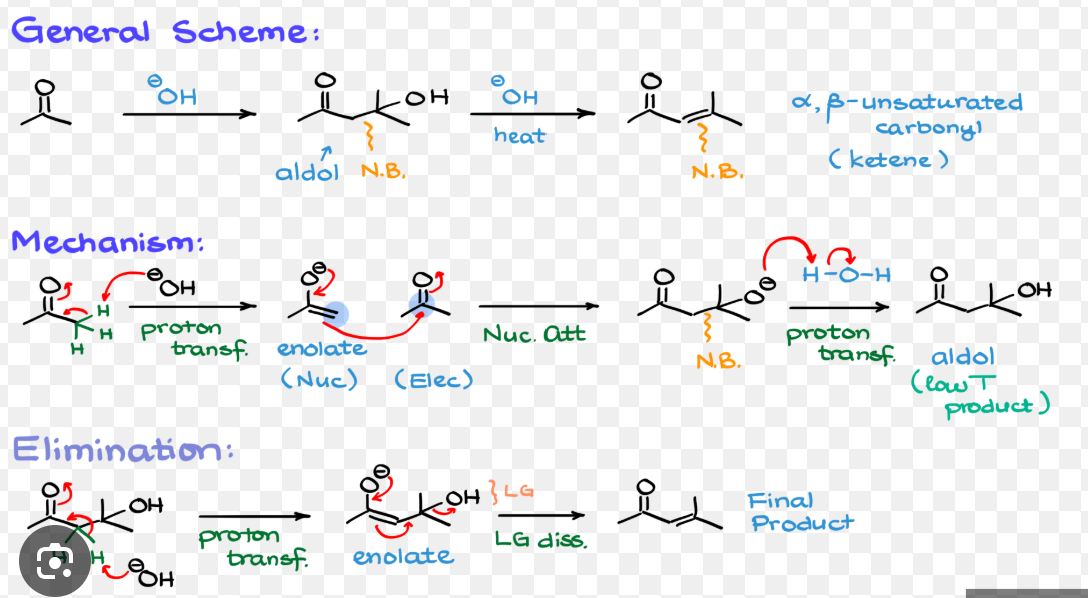
Self-aldolization reaction
All monosaccharides are…
reducing sugars
Aldoses can reduce directly, ketoses tautemerize into aldoses.
Waves get faster in media that are…
less compressible and have more intermolecular reactions (fastest in solids, slowest in gasses)
Hill coefficient greater than 1?
Positive cooperativity: S Curve
Hill coefficient equal to 1
No cooperativity: Hyperbolic Curve
Hill coefficient 0-1
Negative cooperativity: Steep hyperbolic
Shorter or longer fatty acids have higher boiling point
Longer fatty acids have higher boiling points
Shorter fatty acids have lower boiling points
This is the predominant factor
IR spec for single bonds
4000-2500
IR spec for triple bonds
2500-2000
IR spec for double bonds
2000-1500
IR spec for OH bond
3300-3500
IR spec for NH bond
3300-3500
IR spec for CH bond
2800-3300
IR spec for C=O bond
1700-1750
IR spec for C=C bond
1600
IR spec for aromatic compound
1500-1600
E is…
trans
Z is…
cis
Acids/bases are added to in separation to…
precipitate out acids/bases as salts
Mechanical Advantage
Fo/Fi
Wo=Wi
Fodo=Fidi
Transverse Waves
Propagate perpendicular to surface
Longitudinal Waves
Propagate parallel to surface
Lactonization
Alcohol + carboxylic acid = cyclic ester
Lactamization
Amine + carboxylic acid = cyclic amide
Meso Compound
Compound that has stereocenters (chiral centres) but is not chiral due to being symmetrical
Chymotrypsin
Cleaves carboxyl end of aromatic amino acids
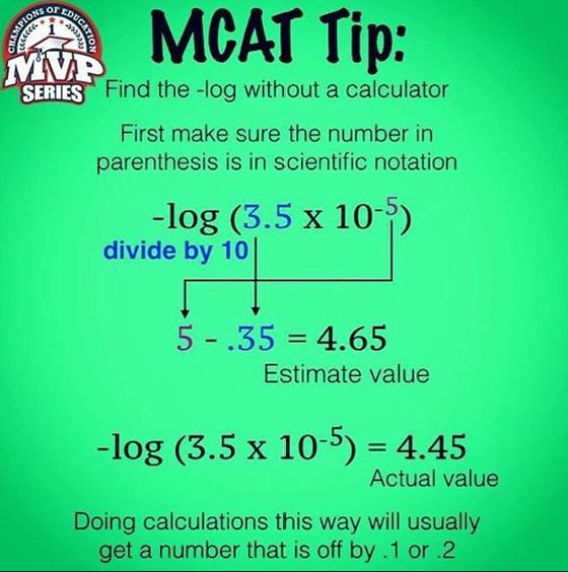
Rule for calculating -logs
PCC
Mild oxidizing agent
Electric fields always go…
Positive to negative (the effect on a positive charge)
For boiling to occur
Vapor pressure of liquid must be equal to ambient pressure.
Systems under vaccum
Have pressure less 1 atm
Ideal gases exist at
High temp - enough energy to break IMF
Low Pressure - Far away from each other such that no IMF forms and volume of particles negligible.
SOCl2 is …
a reagent to convert primary and secondary alcohols into alkyl chlorides via SN2
Mutarotation
Open chain carbohydrate closing in on itself to form beta or alpha anomer.
Adiabatic process
No heat transfer
Heterocylic
A ring with at least one non carbon
Energy of a photon
E=hf=hc/wavelength
Determine between sp1, 2 and 3 hybridization
sp1: Connected to 2 electron bonding domains
sp2: Connected to 3 electron bonding domains
sp3: Connected to 4 electron bonding domains
sp3d: Connected to 5 electron bonding domains
sp3d2: Connected to 6 electron bonding domains
Hybridization key notes
Lone pairs count as electron bonding domains
Resonance is in affect
Carbocations have only 3 bonds, no lone pairs, sp2
Order of polarity of functional groups
Amides → Carboxylic acids → Alcohol → Amine → Ketone → Ester → Ether → Alkyl Halide → Alkane
Vapor pressure
Pressure exerted by gas on liquid it comes from in an enclosed system
Inversely correlated with boiling point
Lower boiling point will have higher vapor pressure
Coordinate covalent bond
Covalent bond in which one atom shares both electrons
Solubility constant
Ksp = [disassociated products]/[associated reactant] (NO SOLIDS)
Systolic blood pressure
Pressure in arteries when heart beats, numerator