AP Psychology Flashcard
 AP Practice
 Call Kai
1/175

Earn XP
Description and Tags
AP Psych flashcards deeper than just memorizing vocabulary and simple enough to easily understand, often paired with an example (still has vocabulary cards dw)
Name | Mastery | Learn | Test | Matching | Spaced | Call with Kai |
|---|
No analytics yet
Send a link to your students to track their progress
176 Terms
Sensation vs. Perception
Sensation is the sensory process of detecting a stimulus, Perception is the cognitive process of interpreting and understanding a stimulus
Schema vs. Perceptual Set
Schemas are the preconceptions in which we organize information (Long-term, Top-down processing) Perceptual Set is the idea we see things based on our current expectations and emotional state (Short-term, Top-down processing)
Gestalt Psychology
proposes humans organize the world into groups and wholes instead of single parts. “The whole is greater than the sum of the parts”
Depth Perception
Ability to recognize distance
Relative Size
Objects farther away are seen as small and objects closer are seen as larger.
Interposition
When an object is blocking another, the object behind will be perceived as farther away.
Selective Attention
Ignoring everything else when focused on something
Cocktail Party Effect
Being able to tune background noise out to focus on one stimulus, but still being able to hear relevant stimuli in the background such as your name or a glass being dropped
Prototype
the average representation of a category, like imagining a golden retriever when someone mentions a dog
Accomodation
When new information challenges your existing schema, so you alter your schema to incorporate the new information
Mental Set
Relying on previously successful methods to solve every problems even if it’s not the best way
Repition Priming
When you reocognize a stimulus after experiencing it before (recognizing your friend’s ringtone after hearing it once before)
Semantic Priming
phenomenon where exposure to one prime word influences the processing of following related word(s) (e.g. ‘doctor’ followed by ‘nurse’ ‘hospital and ‘infection’)
Framing
When something is presented in a way that influences decisions (80% fat free vs contains 20% fat)
Gambler’s Fallacy
Incorrectly thinking previous outcomes influence future outcomes
Sunk-Cost Fallacy
Continuing with something simply because you’ve already put effort/money/time into it.
Explicit Memories
Memories you can clearly recall; Split into Episodic Memory (Personal events) and Semantic Memory (General Knowledge 2+2=4)
Implicit Memory
Unconcious Memories; contains Procedural memory (riding a bike)
Prospective Memory
Mental to-do list
Visuospatial Sketchpad
Part of Working Memory Model; Temporary holding for visual spatial processing (where you parked your car)
Phonological Loop
Part of Working Memory Model; Temporary holding place for auditory information (Repeating a phone number before dialing)
Episodic Buffer
Part of Working Memory Model; Limited capacity storage system for binding sources together to create a complete memory
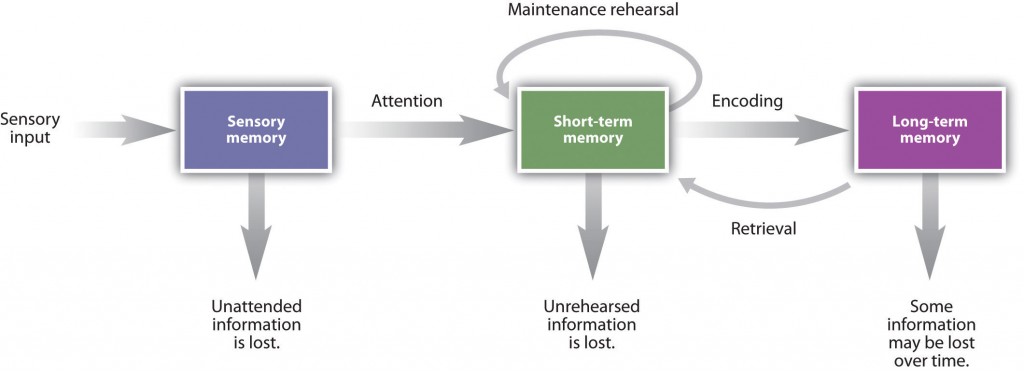
Memory Process
Sensory memory to Short-tem memory by paying attention, rehearse in short-term memory, encoded into long term memory, retrieved by recall or recognition.
3 Types of Encoding
Visual (seeing) Acoustic (hearing) Tactile (touch)
Mnemonic Device
Acronyms, rhymes, or patterns to help you remember
Chunking
Grouping things up to remember them better (phone numbers seperated into threes)
Spacing Effect
The idea that by spacing out learning over a longer period of time it will be more easily encoded than if you learned it over a short period of time.
Serial Position Effect
Tendency to remember things at the start and end of something (grocery list, study session)
Primacy Effect
Tendency to remember the things at the beginning of a series
Recency Effect
Tendency to remember things at the end of a series
What two brain structures help with forming explicit memories?
The Hippocampus and Frontal Lobe help with forming explicit memories.
What two brain structures help with forming implicit memories?
The Basal Ganglia and Cerebellum
Flooding
A Behavioral therapy technique where a client is entirely exposed to their feared stimulus (pushing someone in the deep end of a pool)
Systematic Desensitization
Behavioral therapy technique where a client is gradually exposed to their feared stimulus
Encoding Failure
When encoding process is disrupted, usually when not paying attention
Proactive Interference
When old memories block newer memories
Retroactive Interference
When new memories block old memories
Misinformation Effect
When someone is presented with information that changes how they remember an event
Standardization
Having uniform procedures to administer and score a test
Validity
How well a test masures what it is intended to measure
Reliability
How well a test produces consistent results
Test-Retest Reliability
How reliable a test is if you take it multiple times over different occasions
Split-Half Reliability
If a test is divided into two parts, they should be comparable
Flynn Effect
The rise of IQ scores due to external factors like food, healthcare, and access to education
Achievement Test
Measures what you’ve already learned
Aptitude Test
Measures what you’re capable of learning
Placebo Effect
When a person improves after recieving a fake treatmenet
Psychology
The science of behavior and mental processes
Theory of Multiple Intelligences
Proposed by Howard Gardener; Linguistic, Logical, Spatial, Bodily Kinesthetic, Musicaal, Interpersonal, Intrapersonal, Naturalistic
G-Factor
The idea that those who excell in one subject will generally do well in all others
Types of Reinforcement
Positive Reinforcement (add good) Negative Reinforcement (remove bad) Positive Punishment (add bad) Negative Punishment (remove good)
EEG
Measures electrical activity in the brain by putting electrodes on the scalp
fMRI
Shows active brain areas with blood flow changes
Frontal Lobe
Contains Prefrontal Cortex (personality & decision making), Motor Cortex (voluntary movement), and Broca’s Area (speech production)
The Four Lobes
Frontal, Parietal, Occipital, Temporal
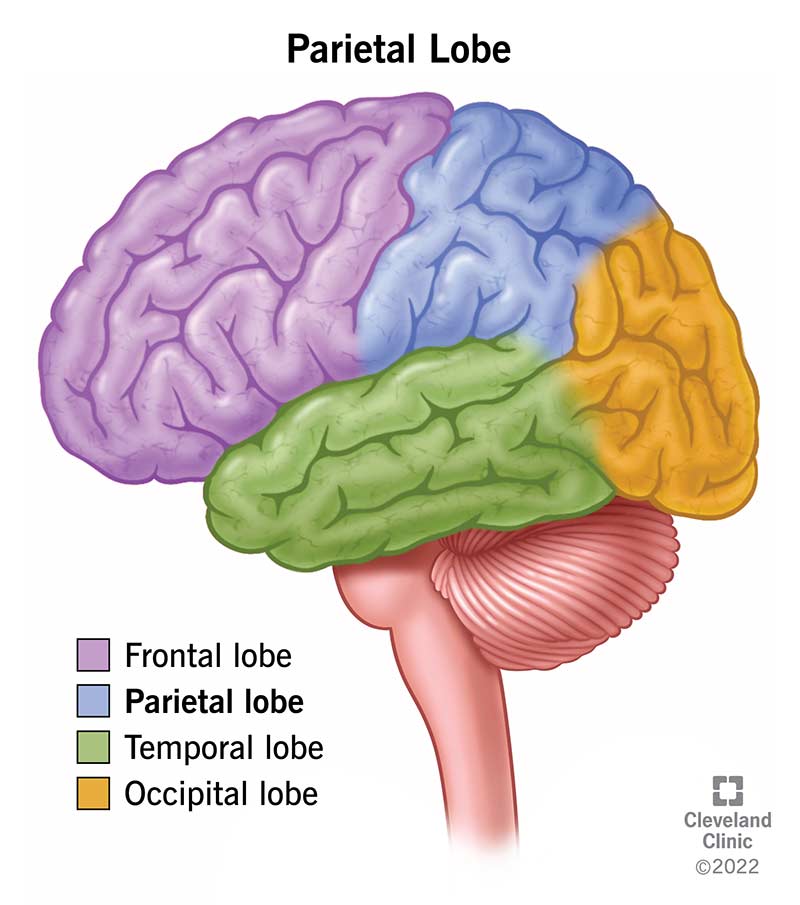
Occipital Lobe
Located at the back of the brain; Processes visual information
Temporal Lobe
Located ‘above’ brainstem; Processes sounds; Contains Wernicke’s Area (language comphrension)
Parietal Lobe
Located behind the Frontal Lobe and in front of the Occipital Lobe; Processes touch, pain, temperature, and pressure
Corpus Callosum
A thick band of neural fibers in the Limbic System that connect the two brain hemispheres
Contralateral Control
Where the hemisphere on the opposite side of the body controls it. (Left hemisphere controls the right side of the body, Right hemisohere controls the left side of the body)
Amygdala
Processes emotion, especially fear and agression
Hippocampus
Helps form memories, does NOT store them
Hypothalamus
Maintains homeostasis; Regulates hunger, thirst, body temp, libido
Thalamus
Recieves all sensory information (except smell) and sends it to the right place
The Limbic System
Located immediately above the brainstem; Contains the Thalamus, Hypothalamus, Amygdala, Hippocampus, and Corpus Callosum
Sensory Neurons vs. Motor Neurons
send signals from the sensory receptors to the CNS; send signals from the CNS to the PNS
Autonomic Nervous System (ANS)
Part of the PNS; Divided into the Sympathetic N.S. (fight or flight) and Parasympathetic N.S. (rest and digest)
Somatic Nervous System (SNS)
Part of the PNS; Controls voluntary movements
Central Nervous System (CNS)
Made up of the brain and spinal cord; Controls all body functions
Agonist
Causes action, increases neurotransmitter effectiveness
Antagonist
Prevents action
Neurons
The body’s communication network; Made up of the Soma (cell body) Neucleus (contains DNA) Dendrites (lil fingers) Axon (long boi) Axon Terminals (exit gate) and myelin sheath (chainmail armor)
Synapse
The gap between neurons
Reuptake
Reabsorption of a neurotransmitter by the sending neuron
Electrical Synapses
Used when rapid communication is needed
Negative Schizophrenia Symptoms
Takes away from who you are; confused with depression; low mood, social withdrawal, low motivation, reduced speech
Positive Schizophrenia Symptoms
Added symptoms; hallucinations (hearing/seeing things that aren’t there) Delusions (believing untrue things)
Extrasensory Perception (ESP) Claims
Telepathy (mind reading-Edward) Clairvoyance (seeing things happening elsewhere) Precognition (seeing the future-Alice)
Olfactory
Related to smell
Sleep Stages
N1 - light sleep N2 - deeper sleep, sleep spindles N3 - deepest sleep, delta waves REM - dream sleep
Types of Brain Waves
Beta - awake and focused, Alpha - relaxed but awake, Theta - light sleep, Delta - sleep
Clinical Depression
two-week incident of being in a low state and finding no pleasure in things
PDD/Dysthymia
Chronic, low-grade depression lasting at least two years
S.A.D
Seasonal Affective Disorder, low mood relating to the weather
Stages of Dying
Denial, Anger, Bargaining, Depression, Acceptance
Types of Motivation
Intrinsic - internally motivated; Extrinsic - externally motivated
Phobia
Intense irrational fear towards a person, place, thing, or concept
Asperger’s Syndrome
high-functioning autism
Chronological Developmental Psychology
focuses on how people change throughout their life
Thematic Development Psychology
Focused on themes throughout life explaining human growth
Longitudinal Study
Tracking something over an extensive period of time; expensive and time-consuming
Stability vs. Change
Do we stay the same or change over the span of our lives?
Nature vs. Nurture
Do genetics or environment play a bigger role?
Continous vs. Discontinous
Steady upward development or developing in large stages
Piaget’s Cognitive Development Stages
Sensory-Motor Stage 2. Preoperational Stage 3. Concrete Operational Stage 4. Formal Operational Stage
Erikson’s Stages of Development
Trust v Mistrust (-18m); Autonomy v Shame (-3yrs); Initiative v Guilt (-5yrs); Industry v Inferiority (-11yrs); Identity v Role Confusion (-18yrs); Intimacy v Isolation (-40yrs); Generativity v Stagnation (-65yrs); Integrity v Despair (above 65ys)
Cross-Sectional Study
Describes a variable by analyzing different groups; less expensive and time-consuming
Cohort Effect
Research result that comes from groups of individuals with shared characteristics, like the same birth year
Teratogens
Subtances that causes defects or development problems in a fetus like alcohol, drugs, tobacco, and environment
Fetal Alcohol Syndrome
When a fetus is exposed to alcohol, causing development problems