BIO421L | GENERAL BOTANY LAB - Forms of Plants
 Call Kai
 Learn
Learn Practice Test
 Spaced Repetition
 Match
Match Flashcards
 Knowt Play
1/11

Earn XP
Description and Tags
A set of vocabulary flashcards defining plant strategies, life stages, and structural forms as described in the General Botany Lab lecture notes.
Name | Mastery | Learn | Test | Matching | Spaced | Call with Kai | Chat |
|---|
No analytics yet
Send a link to your students to track their progress
12 Terms
Plant Strategies
Mechanisms and responses that plants use in order to reproduce, defend, survive, and compete on the landscape.
Evergreen
Plants that have green leaves all throughout the year and can survive different changes of climate and weather, such as gymnosperms and Acacia.
Deciduous
Plants that shed their leaves, usually as an adaptation to changes in climate such as cold or dry/wet seasons, for example Quercus sp.
Annuals
Plants that complete their life cycles in a single year, such as Helianthus annuus, Zea mays, and Oryza sativa.
Biennials
Plants whose life cycles last 2 years; they typically have vegetative growth in the first year and proceed to flowering and fruiting in the second year before dying.
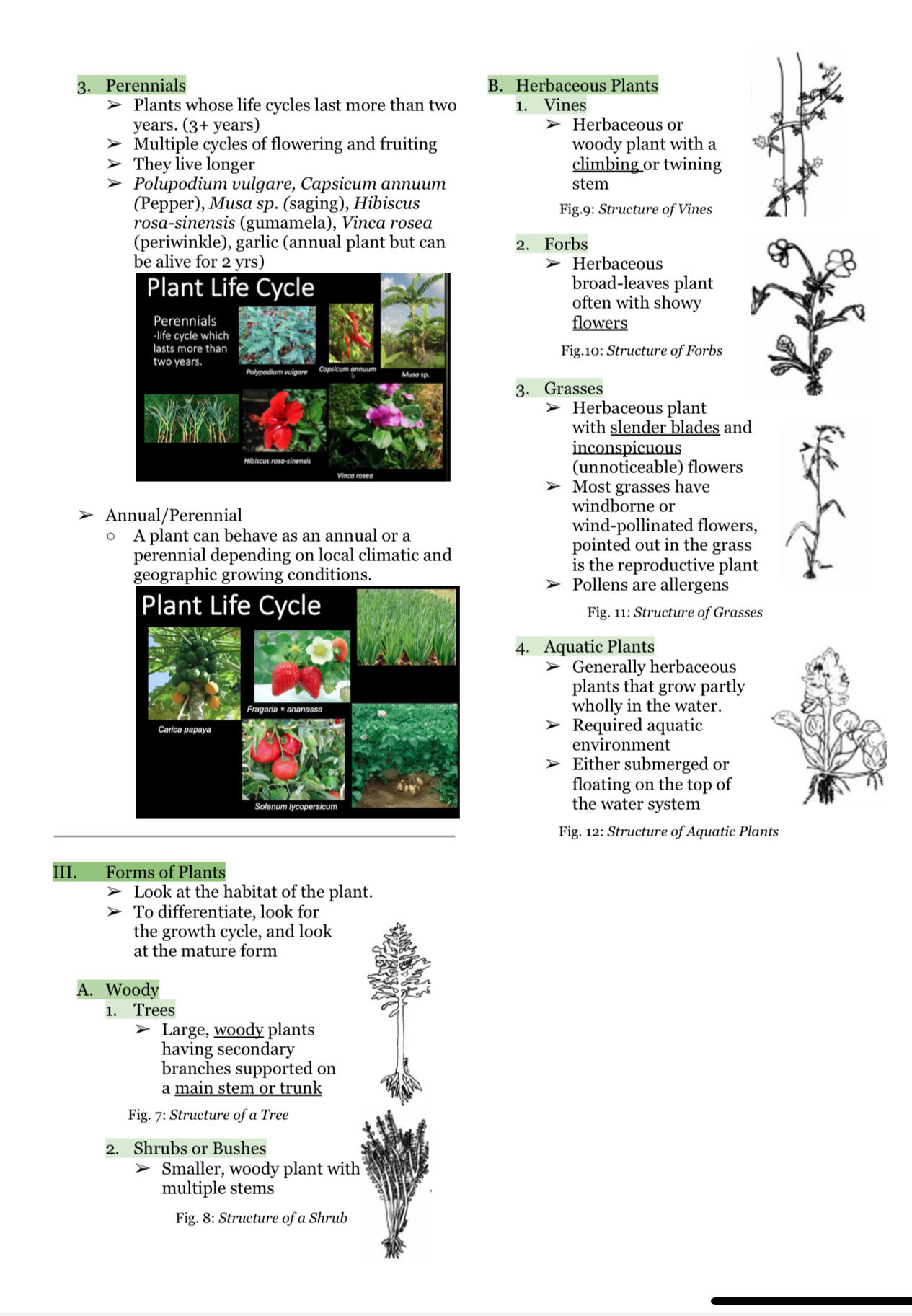
Perennials
Plants whose life cycles last more than 2 years (3+ years), with multiple cycles of flowering and fruiting, such as Hibiscus rosa-sinensis and Musa sp.
Trees
Large, woody plants having secondary branches supported on a main stem or trunk.
Shrubs or Bushes
Smaller, woody plants characterized by having multiple stems.
Vines
Herbaceous or woody plants with a climbing or twining stem.
Forbs
Herbaceous broad-leaves plants often with showy flowers.
Grasses
Herbaceous plants with slender blades and inconspicuous flowers that are often windborne or wind-pollinated.
Aquatic Plants
Generally herbaceous plants that grow partly or wholly in the water, either submerged or floating on top of the water system.