TOPIC4 CHEM - The Ozone Story
 Call Kai
 Learn
Learn Practice Test
 Spaced Repetition
 Match
Match Flashcards
 Knowt Play
1/49

There's no tags or description
Looks like no tags are added yet.
50 Terms
Define the term electrophile:
A positive ion or molecule with a partial positive charge that is attracted to a negatively charged region + accepts a pair of electrons from a covalent bond (electron deficient)
Define the term addition:
A reaction where at least 2 molecules join together to form only product
Give a few example of electrophiles:
H⁺
NO₂⁺
Br⁺ (in reactions involving bromine)
What is an intermediate that is formed when undergoing electrophilic addition?
Carbocation (C+), plus other molecule in the reaction
Define the term intermediate species:
Species (molecules or ions) formed in one of the steps of a mechanism
What is a characteristic of an intermediate species?
They are unstable
Give an example equation of alkenes reacting with hydrogen: and what does it produce?
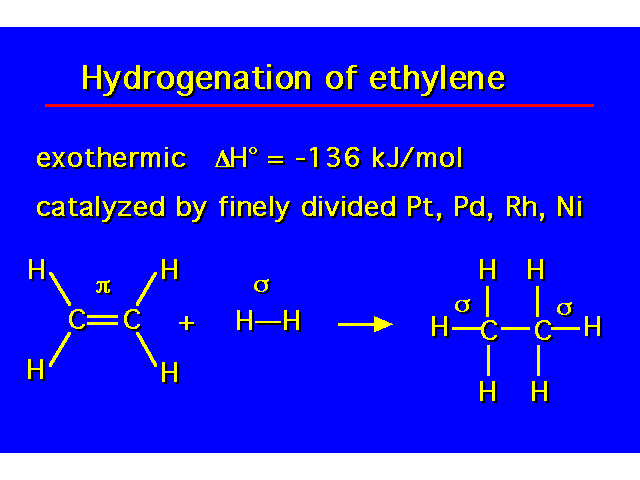
This happens in the presence of a finely divided nickel catalyst at a temp of about 150 degrees to produce ALKANES
Define the term substitution:
A reaction in which one atom or functional group in a molecule is replaced by another atom or functional group
Define the term nucleophile:
A molecule or negatively charged ion + lone pair of electrons which can donate to a positively charged atom to form a covalent bond
Explain why halogenoalkanes are vulnerable to nucleophile attacks:
The C-X bond is polar due to halogens being more electronegative than carbon
This makes the carbon atom partially positive (δ+), allowing it to accept a pair of electrons from a nucleophile. The C-X bond is also sufficiently weak to break during this process
Give two essential features of a nucleophile:
Must have a lone pair of electrons to donate
Does not necessarily need to be negatively charged (can be neutral), but must be electron-rich
Which hydrocarbon does electrophilic addition happen with?
ALKENES
Which hydrocarbon does nucleophilic addition happen with?
ALKANES
What attacks haloalkanes?
Haloalkanes can be attacked by nucleophiles, species with a lone pair of electrons e.g. OH-, CN- and NH3
Why is ethanol used in the hydrolysis of haloalkanes?
Used as a solvent in the hydrolysis of haloalkanes because it dissolves both the organic haloalkane and the aqueous nucleophile and allow it to mix with the aqueous silver nitrate
What process is SN1?
It is a two-step process (formation of a carbocation)
What process is SN2?
It is a one-step process - nucleophile attacks simultaneously with the leaving group’s departure
Which species undergo SN1?
Weak nucleophiles = H₂O — water
NH₃ — ammonia
ROH — alcohols, e.g. ethanol
RCOOH — carboxylic acids
Cl⁻ — chloride ion
Which species undergo SN2?
Strong nucleophiles = OH⁻ — hydroxide ion
CN⁻ — cyanide ion
NH₂⁻ — amide ion
I⁻ — iodide ion
Br⁻ — bromide ion
Give the definition of hydrolysis (to do with hydrolysis of haloalkanes):
Is defined as the splitting of a molecule ( in this case a haloalkane) by a reaction with water
How would the experiment of hydrolysis of haloalkanes start?
Prepare two test tubes, each containing aqueous silver nitrate and ethanol and place them in a water bath of 60 degrees. Then, add five drops of each haloalkane: e.g 1-iodobutane, 1-bromobutane, 1-chlorobutane (added separately to each of the test tubes).
Experiment to do with hydrolysis of haloalkanes: Describe what the student would see as the reactions progress that would show that 1-iodobutane reacts faster:
A yellow precipitate forms sooner than 1-chlorobutane
(Hydrolysis of haloalkanes): Suggest why ethanol is used in the mixture:
Ethanol is used to dissolve the haloalkane and allow it to mix with the aqueous silver nitrate
To determine which halide ion is present , nitric acid then silver nitrate is added: Give the colour of the precipitates formed:
Silver bromide = cream colour
Silver chloride = white colour
Silver iodide = yellow colour
For the silver halide precipitate, state their solubility when aqueous ammonia is added:
Silver bromide = dissolves in partly concentrated ammonia
Silver chloride = dissolves in dilute ammonia
Silver iodide = doesn’t dissolve in ammonia
Write the ionic equations for the formation of precipitates for the silver halides:
Ag+(aq) + Br - (aq)—> AgBr (s)
Ag+(aq) + Cl- (aq)—> AgCl (s)
Ag+(aq) + I- (aq)—> AgI (s)
Describe how you would purify the haloalkane produced from 2-methylpropan-2-ol and hydrochloric acid, removing traces of other substances:
Separate the organic layer containing the haloalkane using a separating funnel.
Wash the organic layer with water to remove water-soluble impurities.
Wash with sodium hydrogencarbonate solution to neutralise and remove any remaining hydrochloric acid. Vent the separating funnel because CO₂ is produced.
Separate the organic layer and add anhydrous sodium sulfate to remove traces of water.
Filter/decant the liquid from the sodium sulfate.
Distil the product and collect the fraction at the boiling point of the haloalkane to obtain a purified sample.
What impurities are removed when draining off the aqueous layer for the first time
Most of the hydrochloric acid and the water
What is 1% in ppm?
1% = 10,000ppm
Define the term free radical: (what is their reactivity?)
It is any species with an unpaired electron (highly reactive species)
Give an example of free radical substitution:
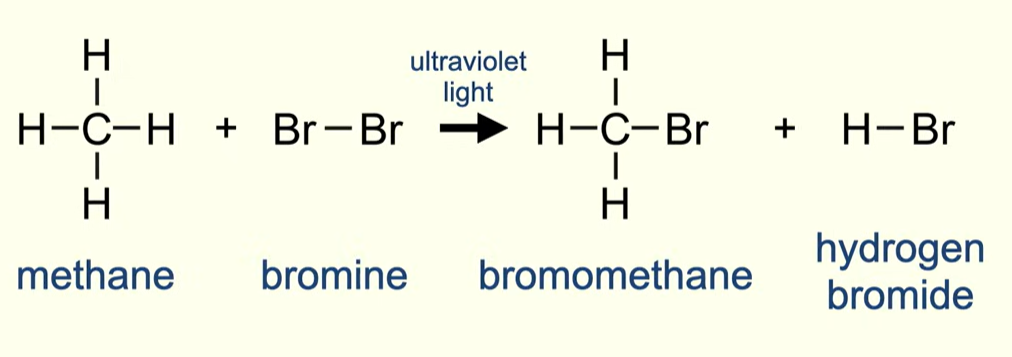
Methane + bromine (Br2) —> Bromomethane + hydrogenbromide
For free radical substitution which radiation is and can be used?
Ultra-violet radiation
Describe the process of free radical substitution:
Initiation > propagation > termination
Describe the initiation step of Br (example):
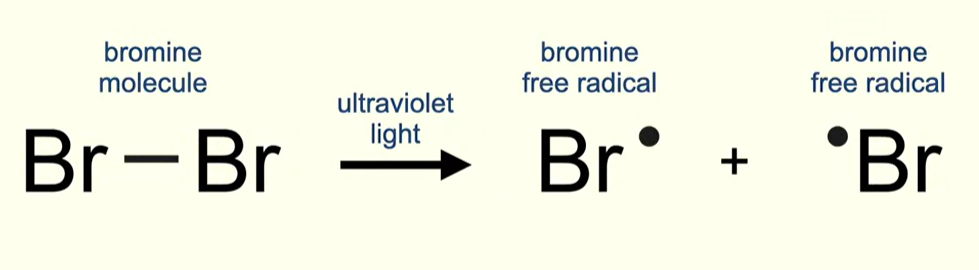
Has been exposed to UV light !!
Describe propagation step 1 for methane and the bromine free radical:
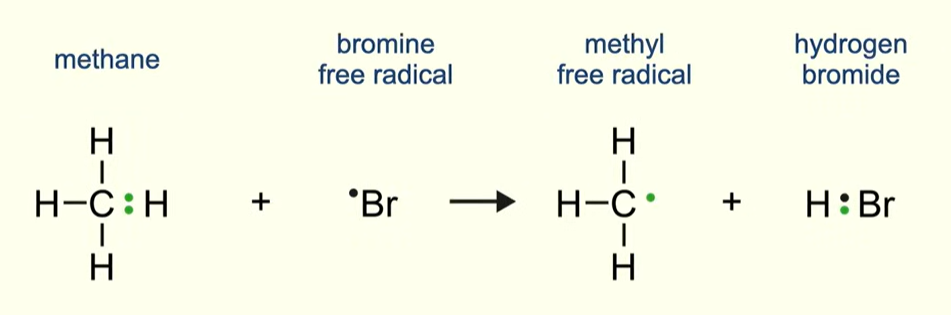
This reaction produces both hydrogen bromide and a methyl free radical
Describe propagation step 2 for methane and bromine - the methyl free radical in this case:
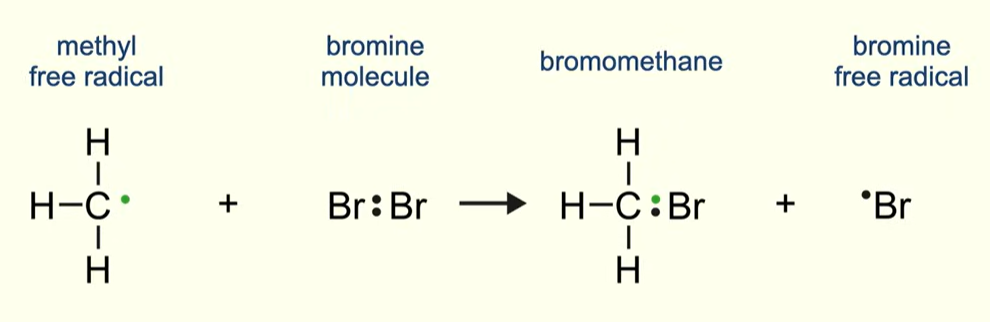
The methyl free radical now reacts with a bromine molecule forming a bromine free radical
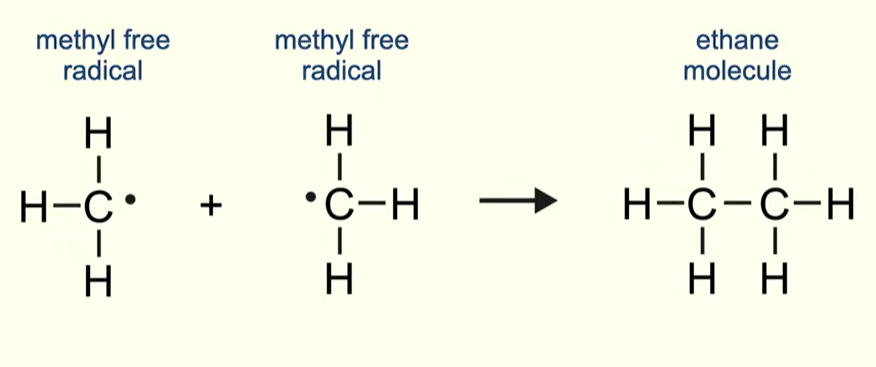
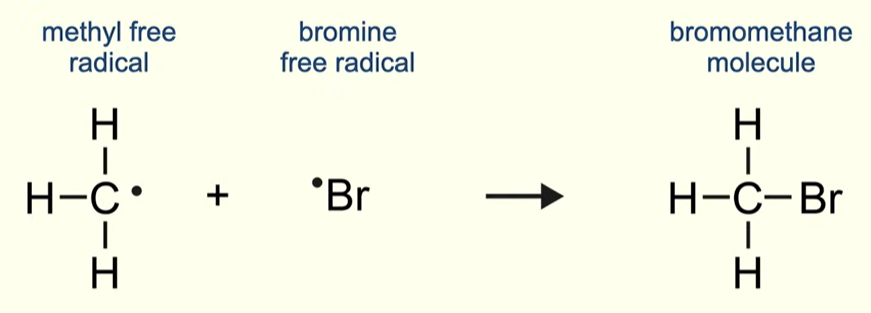
Describe the termination step in free radical substitution with methane and bromine:
There is 3 possible reactions in termination:
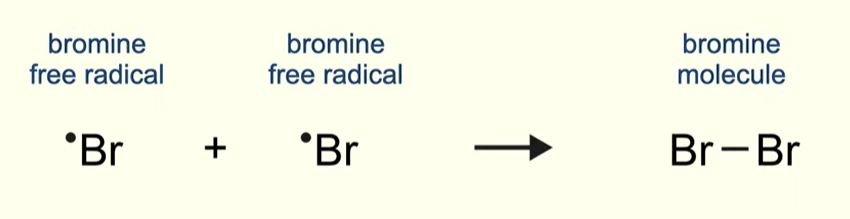
Bromine free radical + bromine free radical —> bromine molecule
Methyl free radical + methyl free radical —> ethane molecule
Methyl free radical + bromine free radical —→ bromomethane
What happens in termination?
2 free radicals react together (a stable molecule can be formed)
What can be formed in free radical substitution?
Side products
When free radical is formed what is it called when it is split?
Homolytic fission
(Ozone depletion): Why does the C-Cl bond in CFCs break instead of the C-F bond?
Because a C-Cl bonds are weaker = it has a lower bond enthalpy so it requires less energy to break
What is used in the initiation step to break up the C-Cl bond?
U-V radiation
Since the C-Cl bond is weaker how will it break up?
Through homolytic fission - both the C and Cl will get one unpaired electron forming a chlorine free radical and CF2Cl free radical
Describe what happens in propagation step 1:

A chlorine free radical reacts with ozone and forms a ClO will also form and an oxygen molecule
Describe what happens in propagation step 2:

The ClO free radical will react with ozone and form another chlorine free radical (which is regenerated causing a chain reaction) and an oxygen molecule
Give the overall equation for propagation step in ozone depletion:
2O3 —→ 3O2
So in summary the chlorine radical act as what in ozone depletion?
They act as catalysts
Use the equation to explain why one chlorine radical can be responsible for the depletion of thousands of ozone molecules:
This is because the chlorine radicals initiates the reaction forming other chlorine free radicals causing them to be continuously regenerated and forming a chain reaction causing the depletion of thousands of ozone molecules
What happens in free radical substitution?