physiology notes day 2: plasma membrane, passive & active transport
 Call Kai
 Learn
Learn Practice Test
 Spaced Repetition
 Match
Match Flashcards
 Knowt Play
1/41

There's no tags or description
Looks like no tags are added yet.
Name | Mastery | Learn | Test | Matching | Spaced | Call with Kai | Chat |
|---|
No analytics yet
Send a link to your students to track their progress
42 Terms
generalized body cell
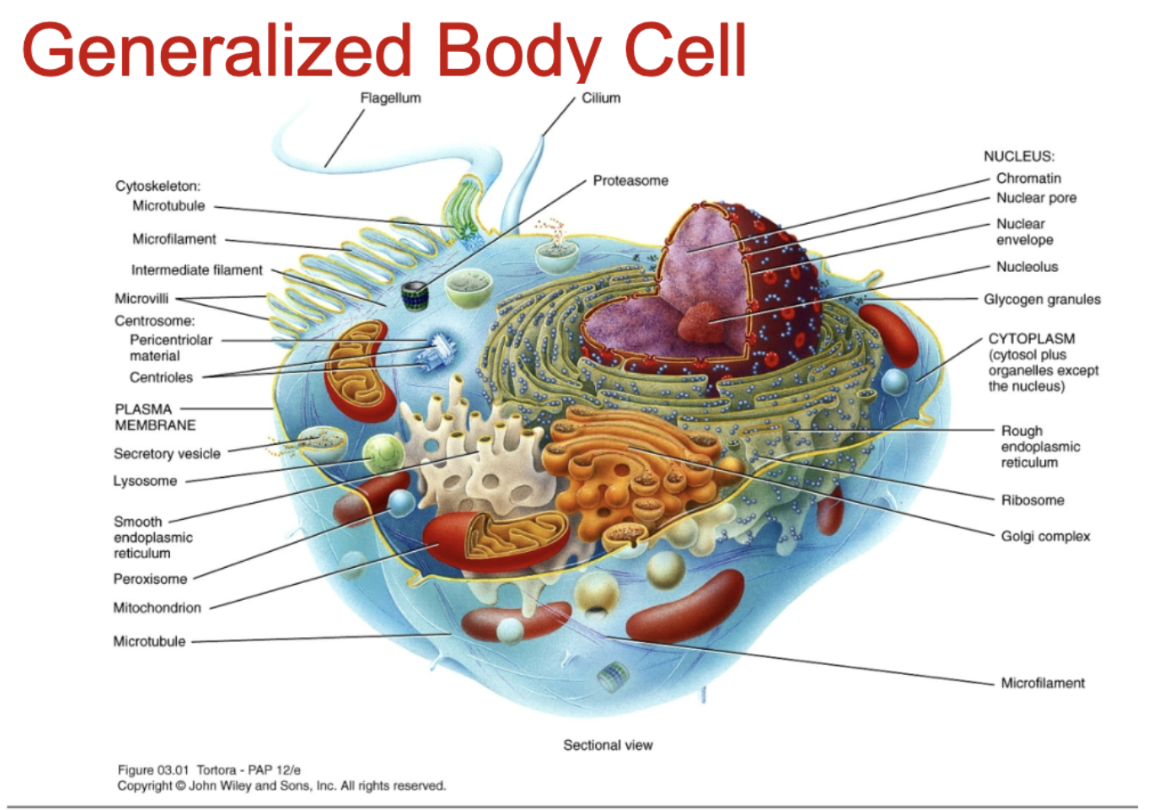
plasma membrane (fluid mosaic model)
arrangement of molecules within the membrane that resembles a sea of fluid lipids that contain a mosaic of many different proteins
lipid bilayer
made up of phospholipids, cholesterol, and glycolipids
types of proteins present in membrane
integral and peripheral proteins
structure of the plasma membrane

functions of plasma membrane proteins
transporter
enzyme
cell surface receptor
cell surface identity marker
cell adhesion
attachment to the cytoskeleton

membrane permeability
how easily substances can pass through a cell membrane
selectively permeable
some substances can pass thru, others arent able to
homeostasis
exchange with the internal environment
crucial regulator of homeostasis
plasma membrane
determinants of transmembrane passage
size = small
hydrophilic-lipophilic balance (HLB) = lipidic
water-loving
hydrophilic (have difficulty passing through membrane)
fat/lipid-loving
lipophilic (easily passes through membrane)
processes for transmembrane passage
passive processes (
passive processes
no energy input required
down a concentration gradient (high to low concentration)
diffusion process
types diffusion processes
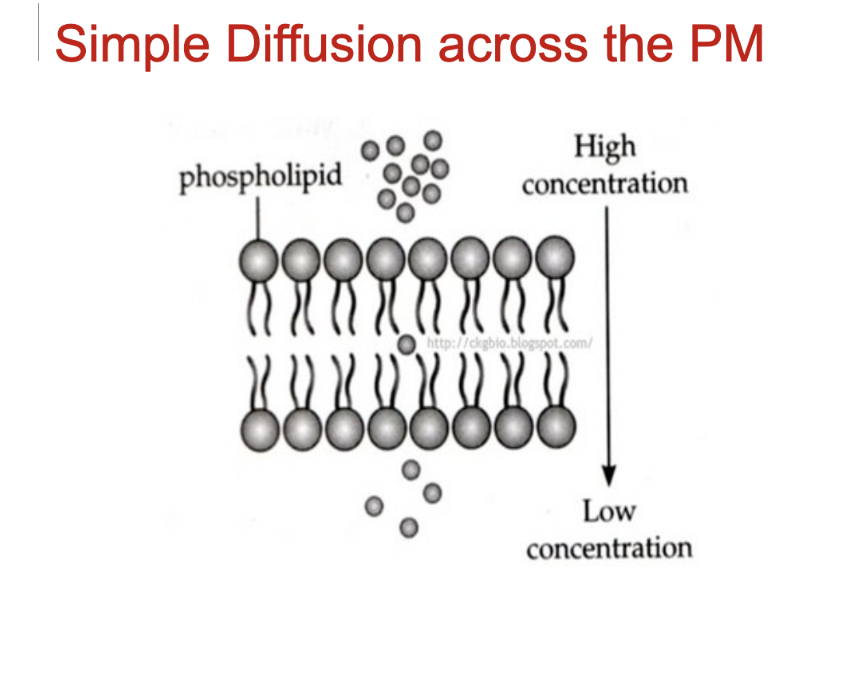
simple diffusion
facilitated diffusion (channel-mediated, carrier-mediated)

simple diffusion
solute diffuses from an area of high concentration to an area of low concentration
across lipid bilayer/plasma membrane
passive, down concentration gradient
small, lipidic moleucles
fatty acids, steroids, fat-soluble vitamins
respiratory gases
facilitated diffusion (carrier-mediated, channel-mediated)
the movement of substances from high concentration → low concentration through a membrane protein, without using energy (ATP).
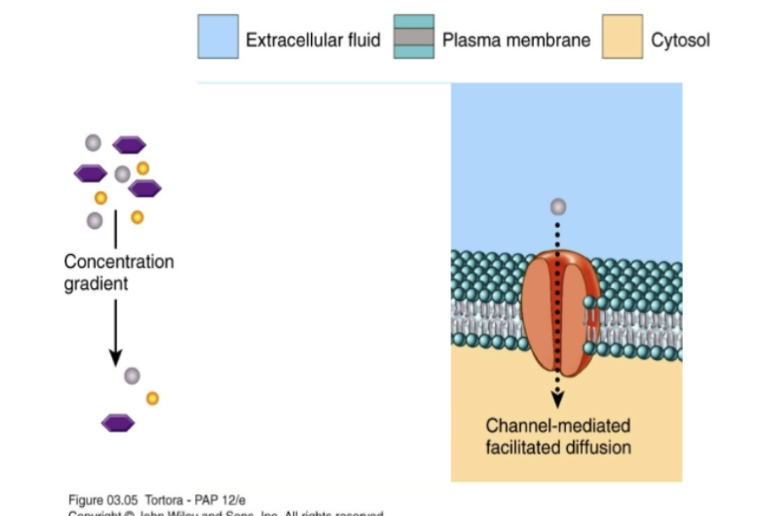
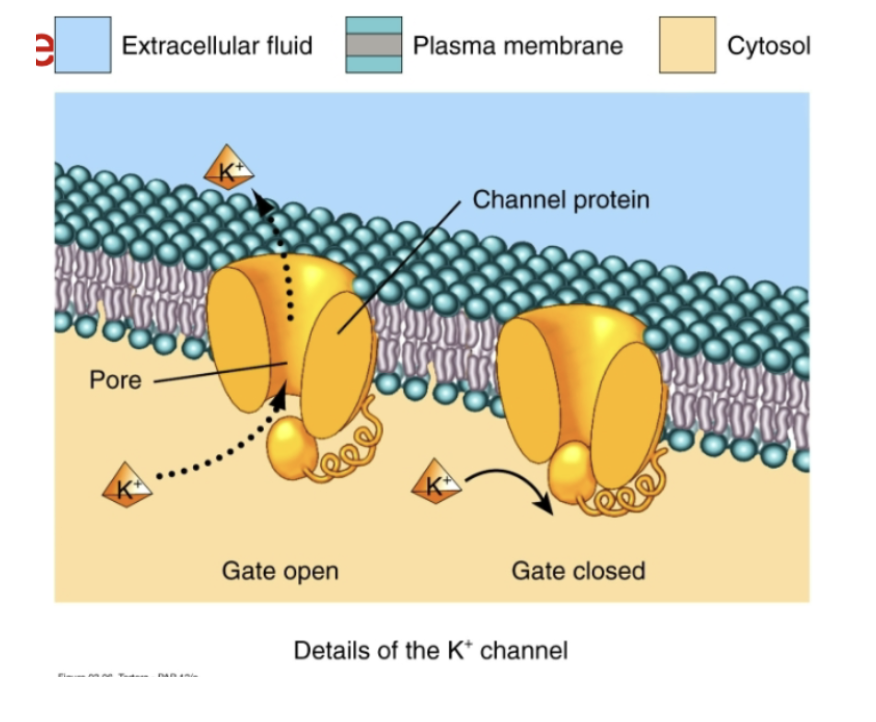
channel-mediated facilitated diffusion
transport of ions (K+, Cl-, Na+, Ca++)
integral transmembrane proteins function as ion channels
passive, down a concentration gradient
the channel can have a gate; opens/closes in response to chemical or electrical changes inside/outside the cell
ex: diffusion of potassium ions through gated K+ channel
carrier-mediated facilitated diffusion
membrane carrier changes its shape
transport of larger, polar, charged molecules (glucose, amino acids, vitamins)
process
molecule binds to specific transporter
transporter undergoes a conformational change
molecule released on other side of membrane
passive, down concentration gradient
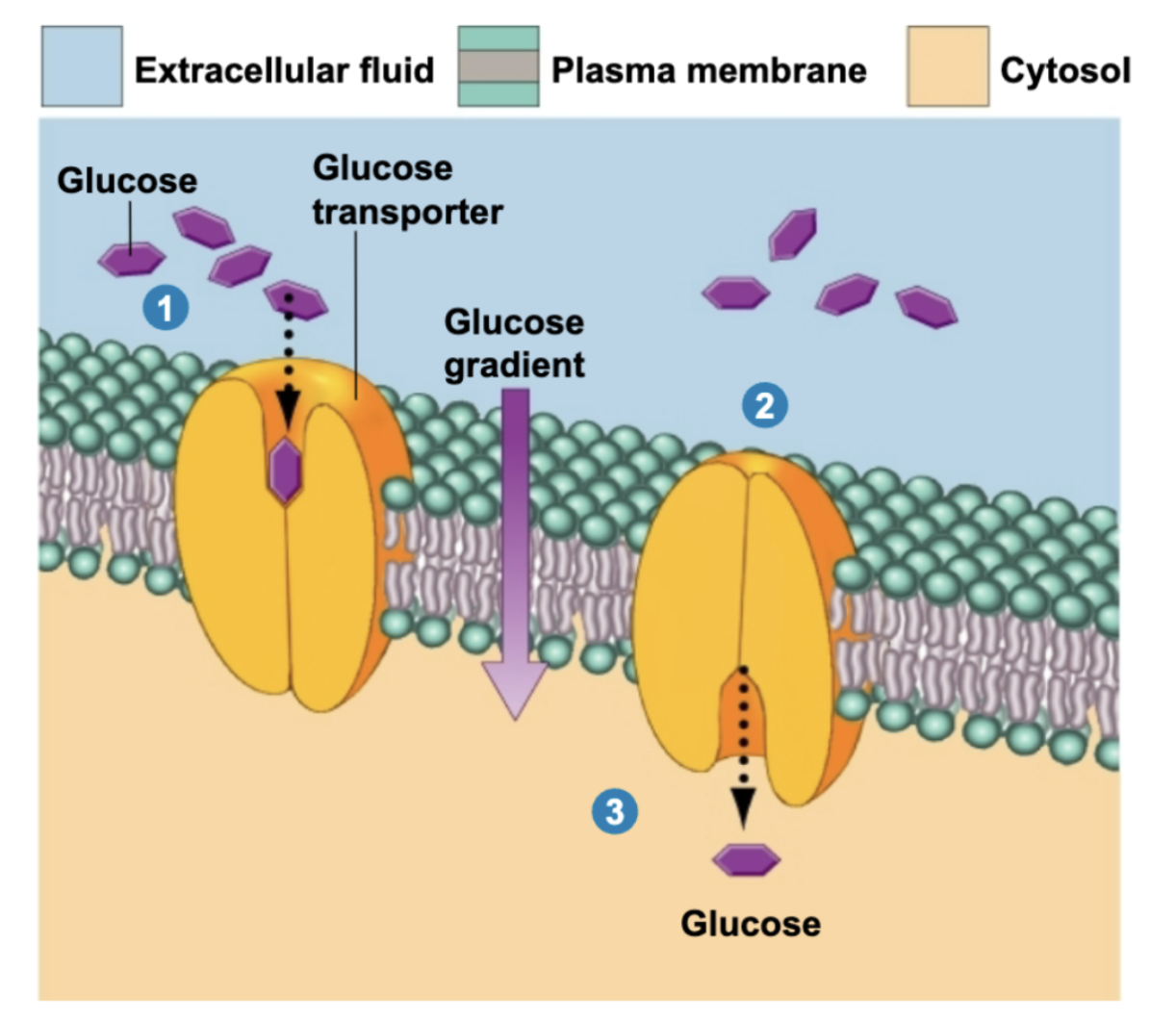
glucose transporters (GLUTs)
characteristics: specificity, saturation, competition
active transport
cell uses energy (primarily from breakdown of ATP) to move substances across the membrane against a concentration gradient
goes from area of lower concentration to an area of higher concentration
breakdown of ATP
ATP → ADP + P, loss of phosphate group, provides energy
sodium potassium pump (salty banana)
active transport mechanism
contains transmembrane protein
Na+ / K+ / ATPase
pumps Na+ out of cells (against concentration gradient)
pumps K+ into the cells (against concentration gradient)
works to maintain an equilibrium

transmembrane protein
undergoes conformational changes
can bind (attach) & hydrolyse (break down) ATP → energy
sodium potassium pump must work non stop bc
ion-gradients: action potentials in nerve cells
tonicity in all cells
drives secondary active transport (ex: pump glucose into all cells)
vesicles
small fluid-filled spherical sac, formed by budding off from a membrane
vesicular transport
material is moved into, or out, of cell wrapped in a membrane
typically, involves the transport of very large molecules (proteins) & bacteria
endocytosis
transport of material into a cell via a vesicle
3 types of endocytosis
phagocytosis, pinocytosis, RM endocytosis
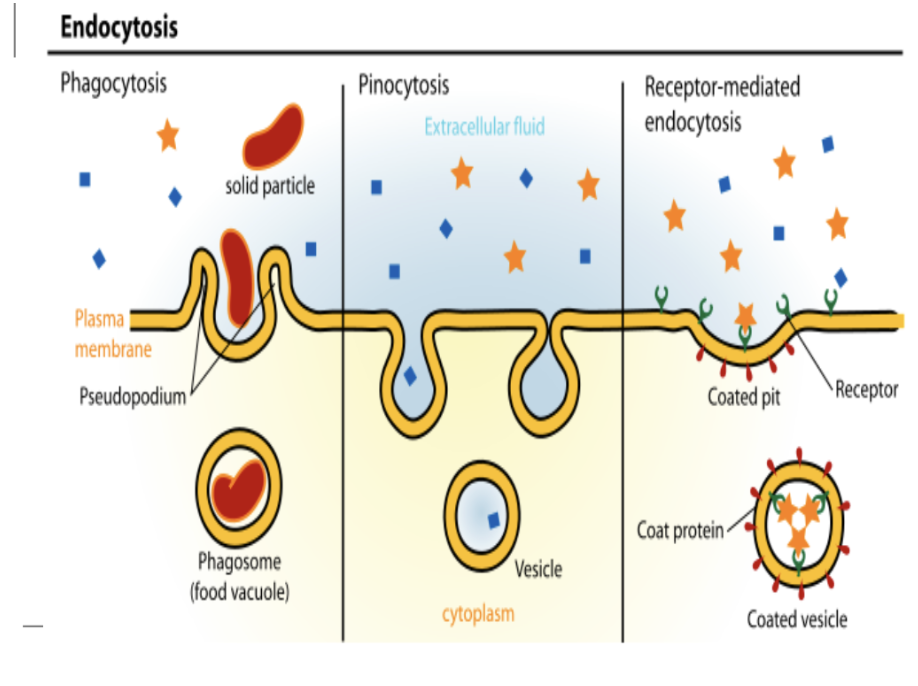
phagocytosis
cell “eating”
only specialized cells=macrophages
membrane extends pseudopods and ingest a particulate
target bacteria & virusus
formation of a phagosome
phagosome fuses with lysosome → breakdown
Phagosome = holds it
Lysosome = digests it

psuedopods
temporary extension of a cell’s membrane and cytoplasm that help the cell surround engulf a particle during phagocytosis
particulate
small solid particle
phagosome
small membrane-bound sac inside a cell that contains the particle the cell has engulfed
lysosome
organelle containing enzymes that break down waste, particles, and damaged cell parts.
pinocytosis
cell “drinking”
all cells do this
invagination of the cell membrane, takes in surrounding fluids, including all solutes present
formation of pinosome
pinosome fuses with lysosome → breakdown

invagination
a cell membrane folds inward, creating a pocket or indentation.
pinosome
a small vesicle formed when a cell takes in extracellular fluid through pinocytosine
receptor mediated (RM) endocytosis
specific receptor on the cell binds with ligand
specific transport
invagination of the cell membrane to form vesicles
fusion with lysosomes, or avoid lysosomal trafficking
ex: LDL cholestrol levels
exocytosis
export from the cell, by fusion of the vesicle with the PM and expulsion of contents into ECF
transcytosis
combination of endocytosis and exocytosis
summary of plasma membrane transport mechanisms
Passive (2)
Simple Diffusion
Facilitated Diffusion (2)
Channel-mediated
Carrier-mediated
Active
Primary active
Vesicular Transport
Phagocytosis
Pinocytosis
Receptor-mediated endocytosis