Genetics Unit Studyguide
 Call Kai
 Learn
Learn Practice Test
 Spaced Repetition
 Match
Match Flashcards
 Knowt Play
1/51

Earn XP
Name | Mastery | Learn | Test | Matching | Spaced | Call with Kai | Chat |
|---|
No analytics yet
Send a link to your students to track their progress
52 Terms
Why exactly can’t cells get too big?
their surface area-to-volume ratio drops as they grow
Explain what the cell cycle is and why it’s important.
—The cell cycle is a series of stages (G1, S, G2, and M phase) , -—facilitating growth, tissue repair, reproduction in multicellular organisms, and ensuring accurate genetic transmission.
Describe the reasons why cells divide
to facilitate growth, repair damaged tissues, replace old cells, and allow for reproduction.
What are the two main stages of the cell cycle?
interphase and the mitotic (M) phase.
Name the three parts of interphase and describe what is happening during each step
G1 (Gap 1): The cell grows physically, increases its cytoplasm, produces RNA, and synthesizes proteins.
S (Synthesis): DNA replication occurs, resulting in the duplication of chromosomes and centrosomes.
G2 (Gap 2): The cell continues to grow, produces proteins, and reorganizes its contents to prepare for mitosis.
Explain why DNA replication during S phase is important.
to ensure that each daughter cell receives an identical, complete set of genetic information during cell division
Know the four phases of MITOSIS and what is happening during each phase
PMAT
Prophase: Chromosomes condense and become visible, the nuclear envelope breaks down, and the spindle apparatus begins to form.
Metaphase: Chromosomes line up individually along the center of the cell (metaphase plate) and attach to spindle fibers.
Anaphase: Sister chromatids are pulled apart by spindle fibers toward opposite poles of the cell, becoming individual chromosomes.
Telophase: Chromosomes arrive at opposite poles, nuclear envelopes reform around each set of DNA, and chromosomes decondense.
Explain what cytokinesis is.
the final physical process of cell division that divides the cytoplasm of a parental cell into two distinct daughter cells
Explain what cancer is
uncontrolled growth and spread of abnormal cells, rather than following the body's normal, regulated cell division cycle
Know the difference between asexual and sexual reproduction?
Asexual-uses mitosis
Sexual-uses meiosis
Explain the difference between haploid and diploid cells.
Haploid cells (n) contain a single set of chromosomes, while diploid cells (2n) contain two sets, one inherited from each parent
Know the difference between gametes and somatic cells and where they would be found.
-Gametes (sperm/egg cells) are haploid reproductive cells with one set of chromosomes ( in humans), produced via meiosis for sexual reproduction.
-Somatic cells are diploid body cells (skin, muscle, etc.) with two sets of chromosomes ( in humans), produced via mitosis for growth, repair, and daily function
Name the two goals of meiosis
-to reduce the chromosome number by half (from diploid to haploid) to produce gametes (sperm/egg cells)
-generate genetic diversity among the offspring through crossing over
Know the steps of MEIOSIS and describe what is happening in each step.
Meiosis I: Reductional Division
Prophase I: Chromosomes condense, the nuclear envelope breaks down, and homologous chromosomes pair up (synapsis) to exchange genetic material through crossing over, creating genetic variation.
Metaphase I: Pairs of homologous chromosomes (tetrads) line up along the metaphase plate, with spindle fibers attaching to each chromosome.
Anaphase I: Homologous chromosomes are pulled apart to opposite poles, but sister chromatids remain attached at their centromeres.
Telophase I & Cytokinesis: Chromosomes arrive at the poles, the cytoplasm divides, and two haploid daughter cells are formed, though chromosomes may still consist of sister chromatids.
Meiosis II: Equational Division
Prophase II: Chromosomes condense again, and a new spindle apparatus forms in both daughter cells.
Metaphase II: Individual chromosomes line up single-file along the metaphase plate in both cells.
Anaphase II: Sister chromatids are finally separated at the centromere and pulled toward opposite poles.
Telophase II & Cytokinesis: Nuclear envelopes reform around the four sets of chromosomes, and cytokinesis produces four genetically non-identical haploid gametes.
Explain what crossing over is and when it occurs.
a genetic process where paired homologous chromosomes exchange segments of DNA, creating new combinations of alleles (genetic recombination) and increasing genetic diversity
Explain the differences between mitosis and meiosis.
Mitosis maintains the chromosome number, whereas meiosis halves it.
What is genetics?
the branch of biology studying genes, genetic variation, and heredity—how traits are passed from parents to offspring through DNA
What is heredity?
biological process of transmitting genetic traits—such as hair color, height, and disease predisposition—from parents to their offspring.
Who was Gregor Mendel and what did he accomplish?
-an Austrian monk and scientist recognized as the "father of modern genetics."
-he discovered the fundamental laws of inheritance, including dominant and recessive traits, which established the principles of heredity
What are alleles?
one of two or more alternative versions of a gene located at a specific position (locus) on a chromosome
What is a trait?
a distinguishing quality or characteristic of a person, animal, or thing
What are genes?
he basic physical and functional units of heredity, consisting of short segments of DNA located on chromosomes within a cell's nucleus
What is the difference between dominant and recessive alleles?
- Dominant alleles mask the presence of recessive alleles, expressing their trait even if only one copy is inherited (heterozygous),
- recessive alleles only show their trait when two copies are present (homozygous)
What is genotype?
the specific genetic makeup or complete set of genes inherited by an organism, representing the precise, internal DNA sequence
What is phenotype?
the set of observable characteristics, traits, or physical features of an organism,
What is the relationship between genotype and phenotype?
an organism's genotype—its inherited genetic makeup (DNA)—directly determines its phenotype
What is probability?
The mathematical likelihood of an event to occur
What is a Punnett Square? How is it used to predict probability?
a visual, grid-based tool used in genetics to predict the potential genotypes and phenotypes of offspring from a specific cross
What is homozygous?
having two identical versions (alleles) of a specific gene,
What is heterozygous?
having two different versions (alleles) of a specific gene
Draw a nucleotide of DNA and identify the three parts.
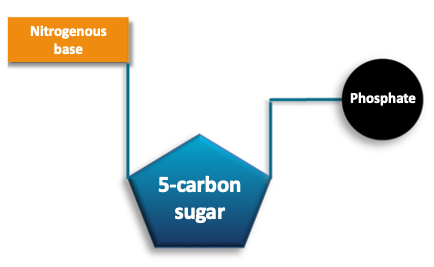
Identify the 4 nitrogen bases in DNA
adenine (A), cytosine (C), guanine (G), and thymine (T)
The strands of DNA molecules are held together by hydrogen bonds. Does a molecule of RNA have hydrogen bonds? Explain why or why not.
Yes, to achieve complex, stable, three-dimensional shapes and to facilitate crucial biological functions
What parts of the nucleotide make up the rungs of the ladder?
Base pairs
Why is DNA referred to as a double helix?
because it consists of two, separate strands of nucleotides that twist around each other, resembling a spiral staircase or a twisted ladder
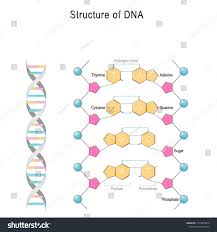
identify the following:
Be able to indentify the following
a nucleotide of DNA
a deoxyribose sugar.
all of the nitrogen bases.
phosphate group.
hydrogen bonds.
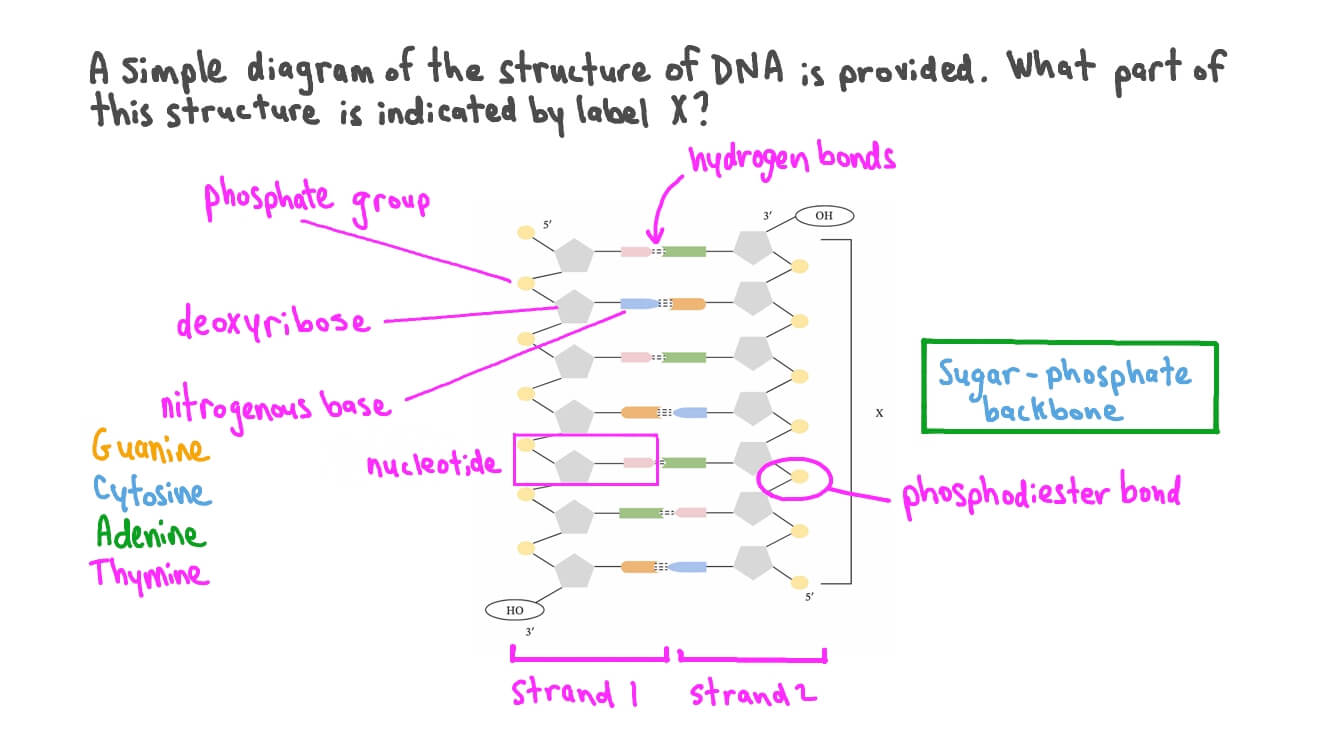
The backbone of DNA is made up of repeating _____________ and _________________.
__sugar__ and __Phosphate molecules__
where it occurs in the cell, what is produced and why the process is necessary.
Replication:
Where it occurs: Inside the nucleus of eukaryotic cells.
What is produced: A complementary strand of RNA, specifically pre-mRNA (which is later processed into mRNA), based on the DNA template.
Why it is necessary: It allows the cell to copy specific genes into a "portable" format (mRNA) that can travel to the cytoplasm to instruct the ribosome on how to build proteins. Without transcription, the genetic information stored in DNA could not be expressed as functional proteins
where it occurs in the cell, what is produced and why the process is necessary.
Transcription:
Where it occurs: Inside the nucleus of eukaryotic cells.
What is produced: A complementary strand of RNA, specifically pre-mRNA (which is later processed into mRNA), based on the DNA template.
Why it is necessary: It allows the cell to copy specific genes into a "portable" format (mRNA) that can travel to the cytoplasm to instruct the ribosome on how to build proteins. Without transcription, the genetic information stored in DNA could not be expressed as functional proteins
where it occurs in the cell, what is produced and why the process is necessary.
Translation:
Where it occurs: Ribosomes, which are located in the cytoplasm or attached to the rough endoplasmic reticulum.
What is produced: A polypeptide chain (or protein) is created by linking amino acids together.
Why it is necessary:
Protein Synthesis: It converts the genetic information from DNA (via mRNA) into functional proteins, which are essential for structure, function, and regulation of body tissues and organs.
Cellular Function: The proteins produced are necessary for almost every cellular process, including metabolism and defense.
What is the Central Dogma of Genetics?
describes the one-way flow of genetic information within a biological system: DNA RNA Protein
The process of replication is described as semi-conservative. What does this mean?
during DNA duplication, the original double-stranded DNA molecule separates, and each single strand acts as a template for a new complementary strand
List the differences between DNA and RNA.
| RNA | |
|---|---|---|
Strands | Double-stranded | Single-stranded |
Sugar | Deoxyribose | Ribose |
Bases | A, T, C, G | A, U, C, G |
Function | Long-term storage | Protein synthesis |
Location | Nucleus | Nucleus/Cytoplasm |
Stability | High | Low/Reactive |
Identify the 3 types of RNA.
messenger RNA (mRNA), transfer RNA (tRNA), and ribosomal RNA (rRNA)
What is produced by transcription?
a single-stranded RNA molecule (often called an RNA transcript) that is complementary to the DNA template strand
Explain how DNA and mRNA relate to a protein.
mRNA is actually the translated form of DNA that the machinery can recognize and use to assemble amino acids into proteins
Explain the relationship between codons and amino acids.
Amino Acids (The Ingredients): These are the 20 different building blocks that make up all proteins.
Codons (The Recipe Words): These are 3-letter codes found in DNA/RNA (using letters A, C, G, U).
The Relationship: Each 3-letter codon instructs the cell to add one specific amino acid to a growing protein chain.
Explain what happens in translation. Include the role of mRNA, the ribosome, tRNA, amino acids, the start codon, mRNA codons and tRNA anticodons.
The ribosome reads mRNA in triplets called codons, matching them with tRNA anticodons to add specific amino acids to a growing chain,
Define triplet, codon and anticodon.
Triplet: General term for a 3-nucleotide code (DNA or RNA).
Codon: The 3-base sequence on mRNA.
Anticodon: The complementary 3-base sequence on tRNA.
Know Which mutations above are frameshift mutations?
Frameshift mutations occur when nucleotides (DNA bases) are inserted or deleted in numbers not divisible by three, disrupting the "reading frame" of the genetic code.
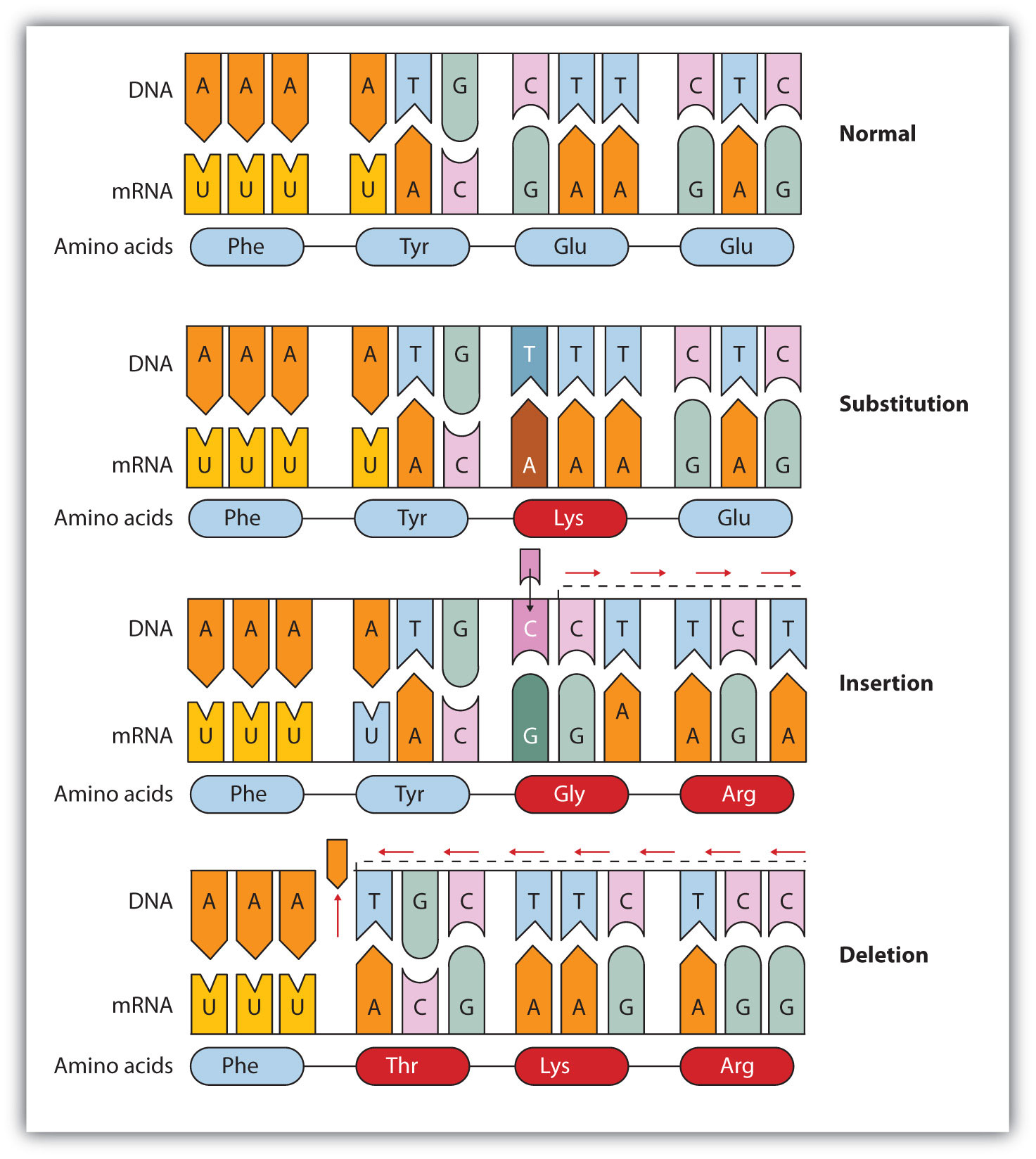
Be able to use the following DNA sequence, identify each of the following: Substitution, insertion and deletion mutations.