Quiz 6
0.0(0)
Studied by 1 person Call Kai
 Learn
Learn Practice Test
 Spaced Repetition
 Match
Match Flashcards
 Knowt Play
Card Sorting
1/44

Earn XP
Description and Tags
Last updated 2:25 PM on 10/5/22
Name | Mastery | Learn | Test | Matching | Spaced | Call with Kai | Chat |
|---|
No analytics yet
Send a link to your students to track their progress
45 Terms
1
New cards
Functions of Nucleic Acids
Storage of genetic info (DNA)
Transmission of genetic info (mRNA)
Protein synthesis (tRNA and rRNA)
Processing of pre-mRNA (small nuclear RNA)
Transmission of genetic info (mRNA)
Protein synthesis (tRNA and rRNA)
Processing of pre-mRNA (small nuclear RNA)
2
New cards
Functions of Nucleotides
Energy for metabolism (ATP)
Enzyme cofactors (NAD+)
Signal transduction (cAMP)
Enzyme cofactors (NAD+)
Signal transduction (cAMP)
3
New cards
syn conformation
Which conformation is this nucleoside?
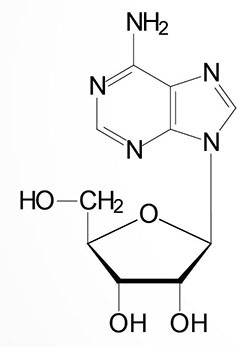
4
New cards
anti conformation
Which conformation is this nucleoside? Hint: It's favored in normal DNA.
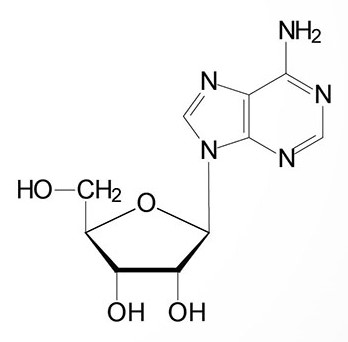
5
New cards
3’,5’-phosphodiester bonds
The Nucleic Acid Backbone (same strand) is held together by what bond?
6
New cards
3'
The new nucleotide always gets added to what end (on existing strand)?
7
New cards
Structure of RNA
Always composed of a single-strand
Primary structure is 5' --> 3' sequence
Can adopt 2 prime and 3 prime structures
Primary structure is 5' --> 3' sequence
Can adopt 2 prime and 3 prime structures
8
New cards
2
How many H-bonds are between A-U?
9
New cards
3
How many H-bonds are between G-C?
10
New cards
lacks OH group (RNA can undergo rapid hydrolysis)
Why is DNA double helix more stable than RNA in alkaline conditions?
11
New cards
Structure of DNA
Two polynucleotide strands wind together to form a long, helical molecule.
Strands run antiparallel.
Negatively charged phosphate groups are all situated on the exterior surface.
Base pairs (planar) stack together on the interior through hydrophobic interactions and van der Waals forces (called base stacking). Allows them to more easily H-bond.
Hydrogen bonds formed between A=T and CΞG bases.
Strands run in opposite directions (antiparallel).
Double-helix = 2o structure
Strands are held together through interchain hydrogen bonds with complementary bases (base pairing).
Strands run antiparallel.
Negatively charged phosphate groups are all situated on the exterior surface.
Base pairs (planar) stack together on the interior through hydrophobic interactions and van der Waals forces (called base stacking). Allows them to more easily H-bond.
Hydrogen bonds formed between A=T and CΞG bases.
Strands run in opposite directions (antiparallel).
Double-helix = 2o structure
Strands are held together through interchain hydrogen bonds with complementary bases (base pairing).
12
New cards
2
How many H-bonds between A-T?
13
New cards
3
How many H-bonds between C-G?
14
New cards
Rosalinda Franklin
Who used X-ray diffraction methods to discover that there are two forms of DNA, A and B (more common)
15
New cards
Watson and Crick
Who used model-building to solve the DNA structure problem?
16
New cards
DNA is helical
In this picture, what does the cross mean?
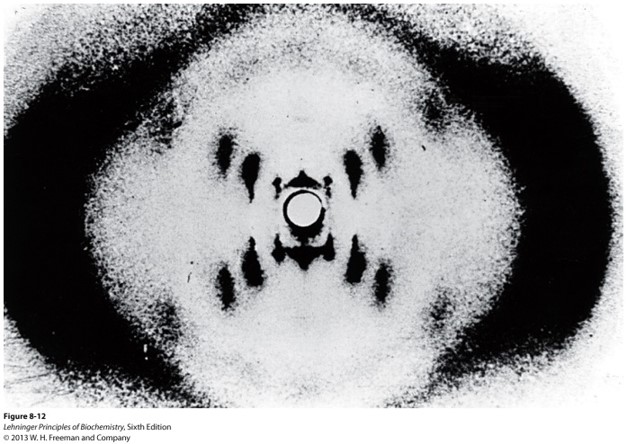
17
New cards
The phosphate-sugar backbone is on the outside
In this picture, what do the diamonds mean?
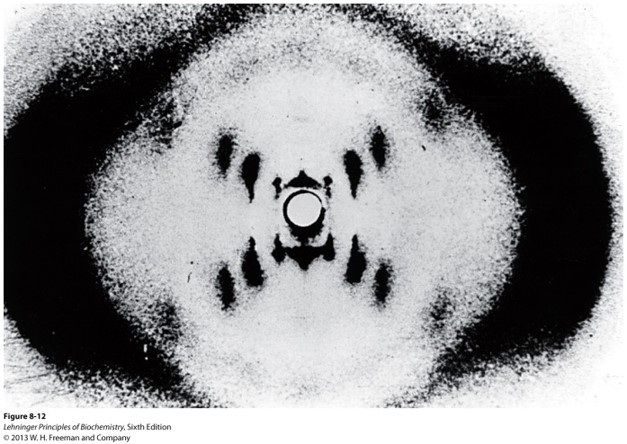
18
New cards
The sugar-phosphate backbones of the helix are not equally spaced along the helix axis
Why does DNA have major and minor grooves?
19
New cards
Major groove
What groove is large enough to accommodate an alpha helix from a protein?
20
New cards
They influence DNA binding by regulatory proteins
Why are local variations in DNA conformation (chromatin) important in the regulation of gene expression?
21
New cards
conformational variations of the sugar residues and the relative orientations of the planes of the bases between the two strands
Additional forms of the double helix exist as a result of:
22
New cards
B
What is the major conformation of DNA?
23
New cards
Disruption of hydrogen bonds (temperature, pH, ionic strength)
Nucleic Acids can be denatured and renatured through:
24
New cards
Higher
Does a higher G-C content result in a higher or lower melting temp?
25
New cards
Hyperchromic effect
decrease in A280 from free nucleotides to single strands to double strands
26
New cards
its UV absorbance increases by 30-40% (hyperchromic shift). (stacked base pairs in native DNA absorb less light)
When DNA is heated to >80oC (unwinding of the DNA double helix)...
27
New cards
base composition, DNA length (longer DNA, higher Tm), pH and ionic strength (high salt increases Tm)
The midpoint of melting (Tm) depends on:
28
New cards
Replication by DNA polymerase
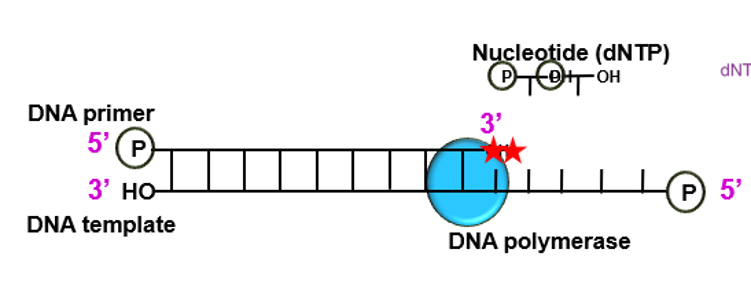
29
New cards
Analogs of glutamine
Chemotherapeutic/Antiviral Drug used to synthesize nitrogenous bases. Competitively inhibits enzyme in purine synthesis.
30
New cards
Truvada (emtricitabine/tenofovir)
Chemotherapeutic/Antiviral Drug that inhibits reverse transcriptase. Affects ability to add new nucleotides during genome replication.
31
New cards
Lipids
Class of biomolecules defined by low solubility in water and high solubility in nonpolar solvents (largely hydrocarbon in nature).
32
New cards
storage, membrane, specific biological activities
Classes of lipids:
33
New cards
Fatty acids
The simplest lipids, which are also constituents of many more complex lipids.
Their basic structure exemplifies the amphipathic lipid model:
a long hydrocarbon chain (“tail”) and a terminal carboxyl group (“head”)
Almost all have an even # Cs
Most are unbranched
Occur in large amounts in cells but are rarely in a free, uncomplexed state
Their basic structure exemplifies the amphipathic lipid model:
a long hydrocarbon chain (“tail”) and a terminal carboxyl group (“head”)
Almost all have an even # Cs
Most are unbranched
Occur in large amounts in cells but are rarely in a free, uncomplexed state
34
New cards
Saturated fatty acid
no double bonds between carbons in the chain
35
New cards
Monounsaturated
one double bond between carbons in the chain (prevents close packing and increases flexibility)
36
New cards
Polyunsaturated
more than one double bond in the alkyl chain (prevents close packing and increases flexibility)
37
New cards
Partial hydrogenation
What is the process done to cooking oils that produces trans fatty acids to improve their shelf life?
38
New cards
triacylglycerols (TAGs) or triglycerides (fats)
Energy storage lipid
Fatty acid esters of glycerol
Three fatty acids each in ester linkage to 1 glycerol
Stores chemical potential energy in nonpolar covalent bonds (C-C and C-H)
Fatty acid esters of glycerol
Three fatty acids each in ester linkage to 1 glycerol
Stores chemical potential energy in nonpolar covalent bonds (C-C and C-H)
39
New cards
Waxes
Used as storage and water repellent
Esters of long-chain (C14 to C36) saturated and unsaturated fatty acids with long-chain alcohols (C16 to C30)
Esters of long-chain (C14 to C36) saturated and unsaturated fatty acids with long-chain alcohols (C16 to C30)
40
New cards
lipid bilayers.
In cells, lipids do not pack well into micelles but rather tend to form...which are amphipathic and consist of two leaflets of lipid monolayers.
41
New cards
Phospholipids
hydrophobic region attached to polar group by phosphate
42
New cards
Glycolipids
hydrophobic region attached to polar group (sugar)
43
New cards
Sterols
rigid system of four fused hydrocarbon rings
44
New cards
Glycerol backbone
glycerophospholipid
2 fatty acids at C1 & C2 (usually one saturated & one unsaturated)
C3 carbon has a highly polar or charged group attached through a phosphodiester bond
2 fatty acids at C1 & C2 (usually one saturated & one unsaturated)
C3 carbon has a highly polar or charged group attached through a phosphodiester bond
45
New cards
Sphingosine backbone
phosphosphingolipid
one fatty acid at C2
C1 carbon attachment to head group
one fatty acid at C2
C1 carbon attachment to head group