State of Consciousness, Attention, and Arousal
 Call Kai
 Learn
Learn Practice Test
 Spaced Repetition
 Match
Match Flashcards
 Knowt Play
1/84

Earn XP
Description and Tags
U1T3LB45
Name | Mastery | Learn | Test | Matching | Spaced | Call with Kai | Chat |
|---|
No analytics yet
Send a link to your students to track their progress
85 Terms
Normal Waking Consciousness (NWC)
The state of consciousness experienced when we are awake and aware of our thoughts, feelings, and perceptions.
Altered States of Consciousness (ASC)
Any state that differs significantly from NWC in terms of awareness, arousal, or cognitive functioning.
Sarah is reading a novel, fully understanding the plot and aware of her surroundings.
Normal Waking Consciousness (NWC)
After being awake for 30 hours, Tom is seeing shadows that aren't there.
Altered State of Consciousness (ASC)
During meditation, Priya loses track of time and feels detached from her body.
Altered State of Consciousness (ASC)
Marcus is having a focused conversation with his teacher about his assignment.
Normal Waking Consciousness (NWC)
After a car accident, Jess reports that time seemed to slow down and she felt like she was watching from outside her body.
Altered State of Consciousness (ASC)
What is ‘Arousal’?
The degree of physiological activation or responsiveness to the environment at any given time.
What is arousal controlled by?
The reticular activating system (RAS)
Where is the reticular activating system (RAS)?
In the brain stem.
What does the reticular activating system (RAS) do?
regulates wakefulness and alertness
What are physiological indicators of arousal?
heart rate, muscle tension, brain wave activity (EEG), skin conductance, and pupil dilation.
What is ‘awareness’?
The ability to perceive and recognise stimuli; both from the internal world and external environment.
What does the ‘internal world’ refer to?
thoughts and emotions
What does ‘external environment’ refer to?
objects, sounds, events
Is awareness broad or narrow?
Both broad and narrow.
Is awareness focused or diffuse?
Both focused and diffuse
Awareness is typically clear during….
Normal Waking Consciousness (NWC)
Awareness may be reduced, heightened, or distorted during….
Altered States of Consciousness (ASC)
How does arousal and awareness work together?
to determine a persons overall state of consciousness.
A student deeply asleep at 3am with no dreams
Arousal: low
Awareness: low
A surgeon performing a complex operation
Arousal: high
Awareness: high
A person day dreaming during a boring lecture
Arousal: moderate
Awareness: moderate
Someone experiencing a panic attack in a crowd
Arousal: high
Awareness: low
What is the continuum of arousal?
A continuum that represents the full range of arousal levels (lowest to highest).
What is the first stage on The Continuum of Arousal?
Deep Sleep (Delta Sleep)
Altered state of consciousness (ASC)
What is the fifth level on The Continuum of Arousal and its state of consciousness
Hyperarousal (Extreme Activation/Panic State)
Altered State of Consciousness: dysfunctional, cognitively impaired
Why is the Continuum of Arousal a continuum?
Arousal exists on a spectrum
Movement along the Continuum of Arousal reflects…..
changes in both physiological activation and the quality of consciousness
What is the second level on The Continuum of Arousal
Drowsiness
Low, transitional arousal level
Between Normal Waking Consciousness and sleep
What is the third level on The Continuum of Arousal?
Alertness (Optimal/Normal Waking)
Moderate, optimal for functioning
Normal Waking Consciousness
What is the fourth level of The Continuum of Arousal
Heightened Alertness
Aroused NWC/Fight-or-Flight Activated
What are common contexts for stage four of The Continuum of Arousal (Heightened Alertness)?
exams
sports competitions
public speaking
car accidents
perceived threats
What is the fifth stage of The Continuum of Arousal (Hyperarousal) associated with?
panic attacks
PTSD flashbacks
severe trauma responses
extreme anxiety
threat perception
How is arousal and attention linked?
As arousal changes along the continuum, the quality, focus, and capacity of attention also change.
What is selective attention?
The ability to focus on one specific stimulus while ignoring irrelevant stimuli in the environment.
How does selective attention work?
The brain actively filters of distracting information
Directs mental resources toward the target
The reticular activating system (RAS) prioritises relevant stimuli
Examples of selective attention are…
reading a textbook while ignoring background noise
listening to a friend at a noisy party
playing chess, focusing on pieces while ignoring the crowd
solving a complex maths problem
a surgeon concentrating on one area during surgery
When is selective attention most optimal?
moderate arousal
What is divided attention?
The ability to process multiple stimuli or tasks simultaneously by splitting attention between them.
How does divided attention work?
The brain allocates mental resources between multiple targets
requires greater cognitive effort
Examples of divided attention are….
texting while watching a film
listening to a teacher while taking notes
cooking while having a conversation
driving while monitoring mirrors and speed
playing a video game with music on
What stage of The Continuum of Arousal is divided attention at?
between moderate and heightened alertness
What part of the brain manages selective and divided attention?
prefrontal cortex (PFC)
How does the prefrontal cortex (PFC) manage selective and divided attention?
regulating which stimuli reach conscious awareness.
What provides arousal with “fuel”
the reticular activating system (RAS)
Without sufficient arousal, attention fails; with excessive arousal, the ______ becomes overwhelmed and attention rigidity occurs.
prefrontal cortex (PFC)
Selective or divided attention? Maya is writing an essay for her English class. She's ignoring her phone vibrating and the TV in the background.
Selective attention
Selective or divided attention? Jamal is playing tennis while listening to commentary about the match on a speaker.
Divided attention
Selective or divided attention? During a calm yoga class, Sophie concentrates deeply on her breathing and body sensations.
Selective attention
Selective or divided attention? A driver navigates a busy road while occasionally glancing at their satnav and listening to a podcast.
Divided attention
Selective or divided attention? In a silent library, Ahmed reads a textbook and blocks out all other stimuli
Selective attention
What are the psychological features of hyperarousal?
racing, disorganised thoughts
impaired decision making and judgement
distorted time perception
tunnel vision
emotion flooding
difficulty processing new information
dissociation or feeling “unreal”
What are the physiological features of hyperarousal?
tachycardia
hyperventilation
muscle tension and trembling
increased sweating
pupil dilation
elevated cortisol and adrenaline
high frequency beta brain waves
Consciousness is biologically regulated through a dynamic system involving brain ____, ____, and ____ _____ that interact with environmental cues
structures, hormones, internal rhythms
Where is the suprachiasmatic nucleus (SCN) located?
hypothalamus
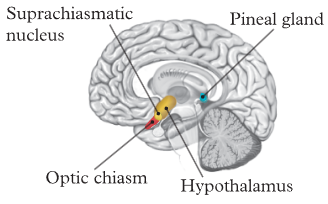
What part of the hypothalamus acts as an internal body clock?
the suprachiasmatic nucleus (SCN)
What is the circadian rhythm?
A 24-hour biological cycle that regulates physiological processes including the sleep-wake cycle, body temperature, hormone secretion and metabolism.
What is the circadian rhythm controlled by?
`suprachiasmatic nucleus (SCN)
What is the circadian rhythm primarily influenced by?
light slash zeitgeber
The SCN receives light information from the retina via the __________ ___
retinohypothalamic tract
What is melatonin
Melatonin is a hormone that promotes sleep and regulating the timing of the sleep-wake cycle
What is melatonin released by?
the pineal gland
Melatonin is secreted in
darkness
Disruptions to circadian rhythms (jet lag, shift work) can impair _____ ______, ____, and _____
cognitive performance, mood, and health
What are signs of high melatonin in the body?
reduced alertness, increased sleepiness
What are signs of low melatonin in the body?
increased arousal and high energy when waking
What does ‘SCN’ stand for?
Suprachiasmatic Nucleus
What controls melatonin release based on light information for the eyes?
Suprachiasmatic Nucleus (SCN)
Light exposure starts melatonin exposure
false, it inhibits production
Melatonin production is highly sensitive to light exposure, particularly blue light. What does artificial light at night (phones, screens) do to melatonin production?
suppresses melatonin, causing delays in sleep and disrupt circadian rhythms
Why do we feel sleepy at night?
Due to a natural rise in melatonin levels
Using a phone in bed before sleep may cause you to have difficulty falling asleep. Why?
The blue artificial light from phones may result in reduced melatonin production
What is cortisol?
Cortisol is a hormone that plays a key role in wakefulness, alertness, and the body’s stress response.
What is cortisol released by?
Adrenal glands
What does a cortisol increase in the morning suggest?
waking and alertness
What does decreasing cortisol levels throughout the day suggest?
The body winding down for sleep
What is the relationship between cortisol and melatonin?
regulating the sleep-wake cycle
The __________ _____ helps regulate cortisol release in response to light
Suprachiasmatic Nucleus (SCN)
How does cortisol react to morning light exposure?
signals the body to increase cortisol production
How does a short-term increase of cortisol respond to stress?
helps the body respond effectively (e.g. increased energy, focus)
How does long-term elevated cortisol respond to stress?
disrupts sleep and negatively affects health
Waking up feeling alert in the morning is partly due to a natural spike in ______.
cortisol
Feeling “wired” at night after stress (e.g. exams) may be due to elevated _______ levels interfering with sleep.
cortisol
In low light, the _________ ____ in the ________ and the ______ _____ work together to secrete more melatonin.
suprachiasmatic nucleus (SCN), hypothalamus, pineal gland