Lab Week 3

0.0(0)
Studied by 0 people
call kaiCall Kai
Locked
learnLearn
examPractice Test
spaced repetitionSpaced Repetition
heart puzzleMatch
flashcardsFlashcards
GameKnowt Play
Card Sorting

1/163

encourage image

There's no tags or description

Looks like no tags are added yet.

Last updated 8:40 PM on 9/19/26
Name
Mastery
Learn
Test
Matching
Spaced
Call with Kai
Chat

No analytics yet

Send a link to your students to track their progress

164 Terms

1
New cards

Nematoda General Features

Round worms, no internal segments or septa, pseudocoelomates, sexually dimorphic, membrane bound cuticle, ecdysis, longitudinal muscles, complete digestive tract, and eutely.

2
New cards

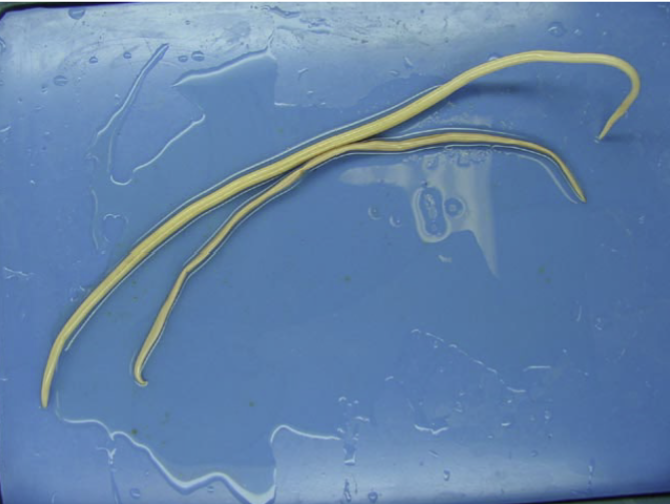
Are Nematoda acoelomates, pseudocoelomates, or coelomates?

Pseudocoelomates

3
New cards

Sexual Dimorphism

When males and females of the same species have different physical appearances beyond just their reproductive organs.

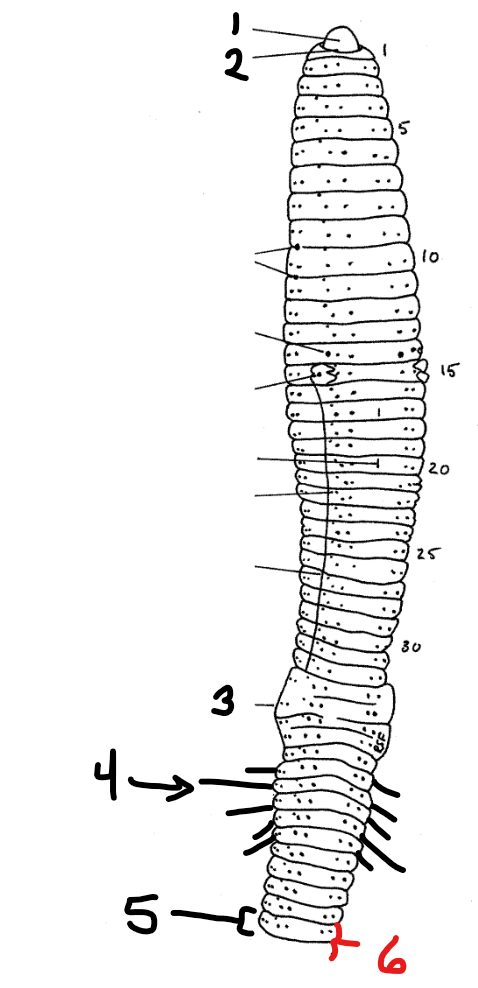
4
New cards
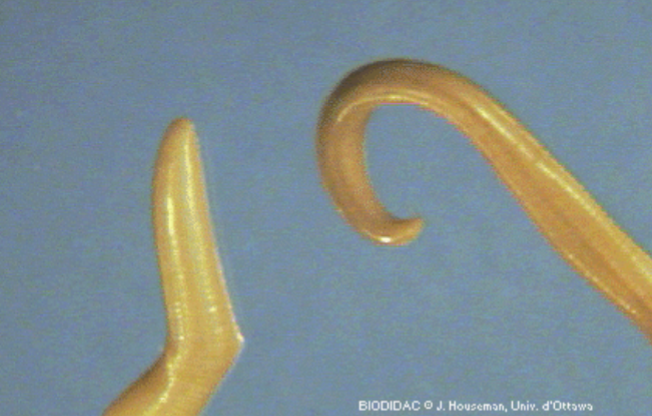
<p>What gender is the left?</p>

What gender is the left?

Female

5
New cards
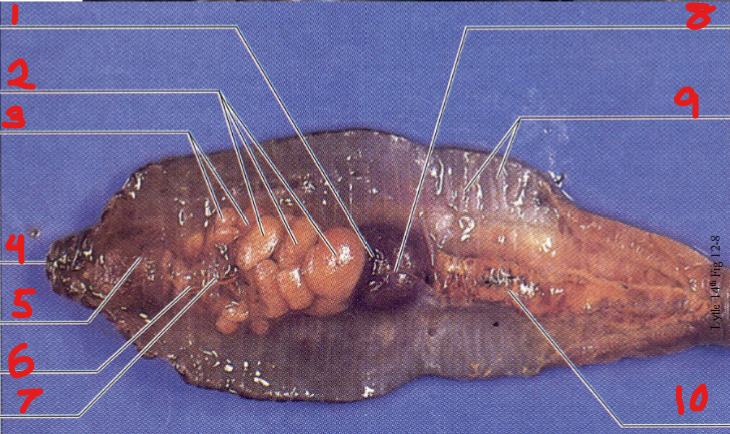
<p>What gender is the right?</p>

What gender is the right?

Male

6
New cards
<p>What gender is the bigger one?</p>

What gender is the bigger one?

Female
7
New cards
<p>What gender is the smaller one?</p>

What gender is the smaller one?

Male

8
New cards
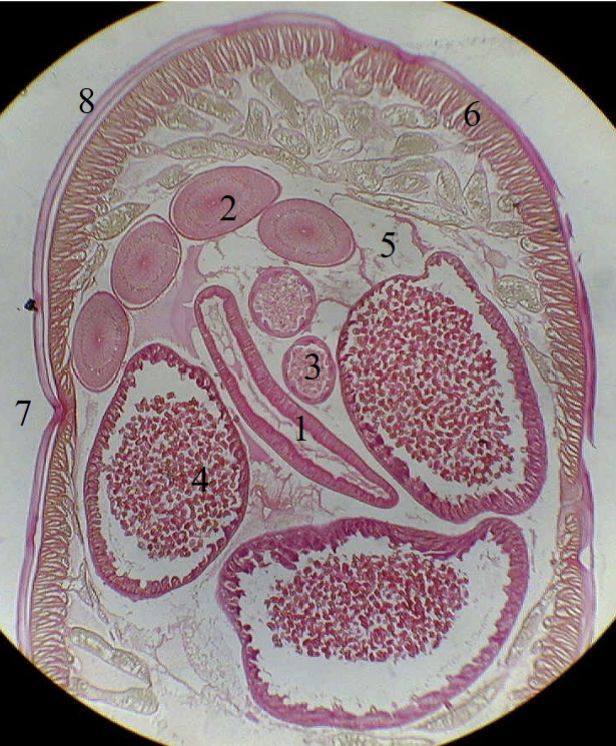
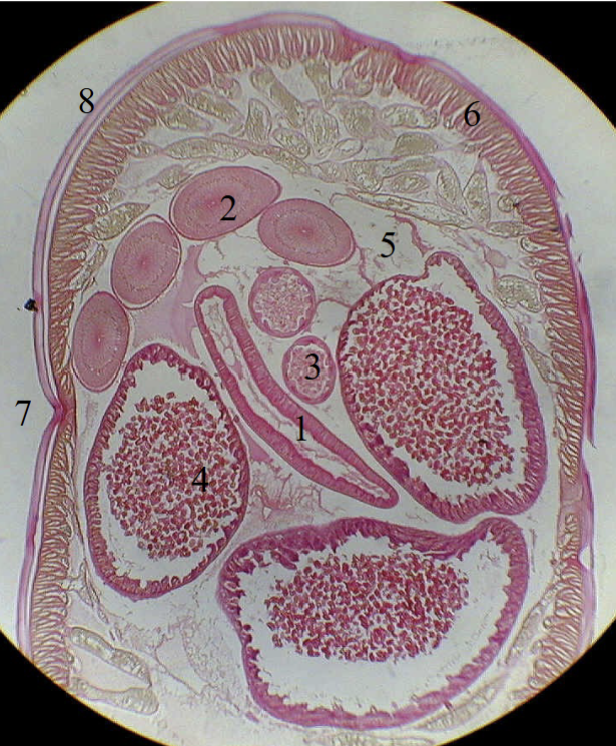
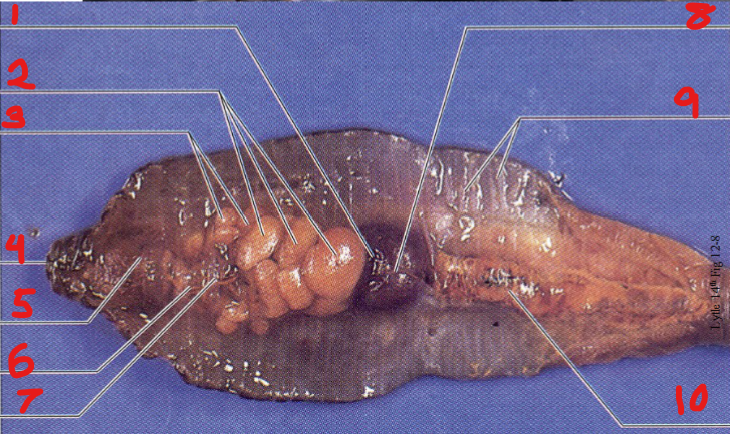
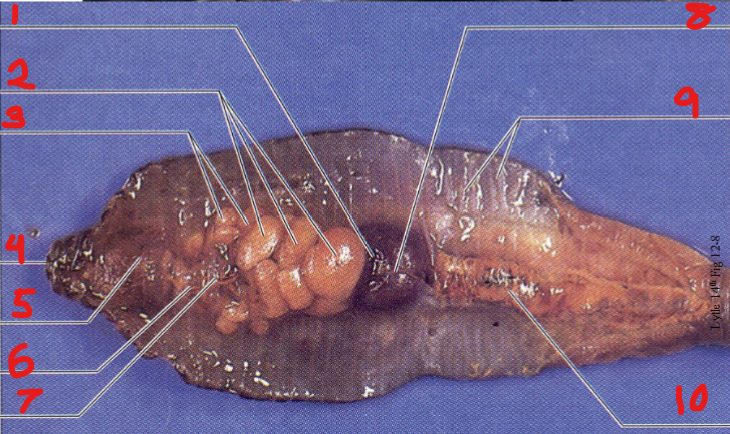
<p>What Phylum is this?</p>

What Phylum is this?

Phylum Nematoda

9
New cards
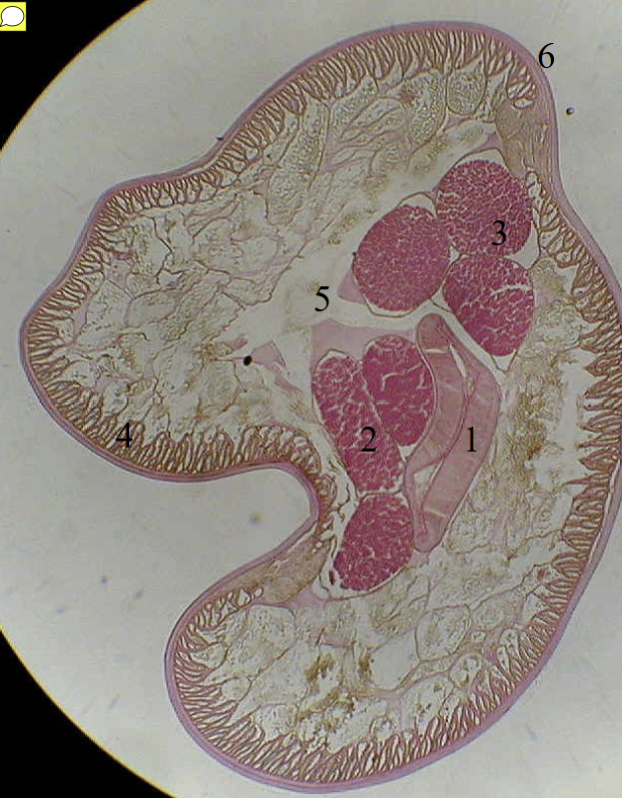
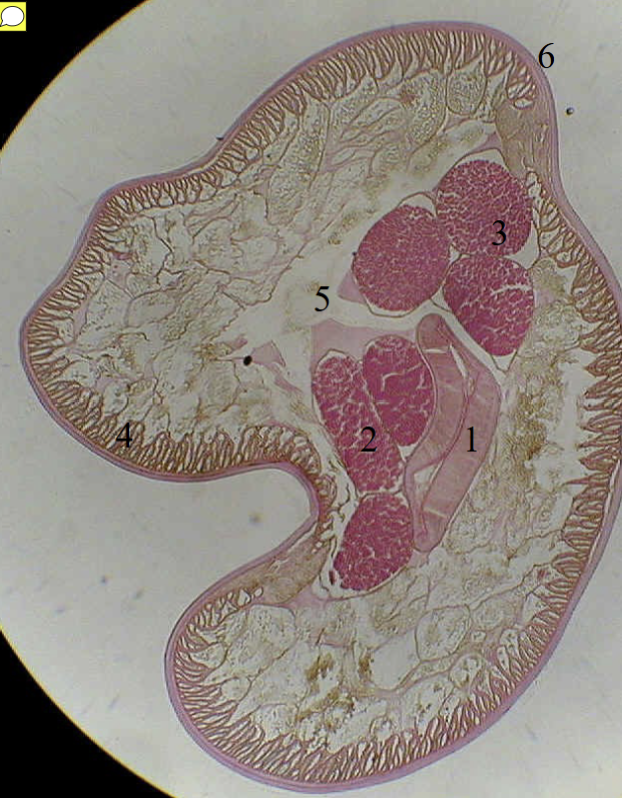
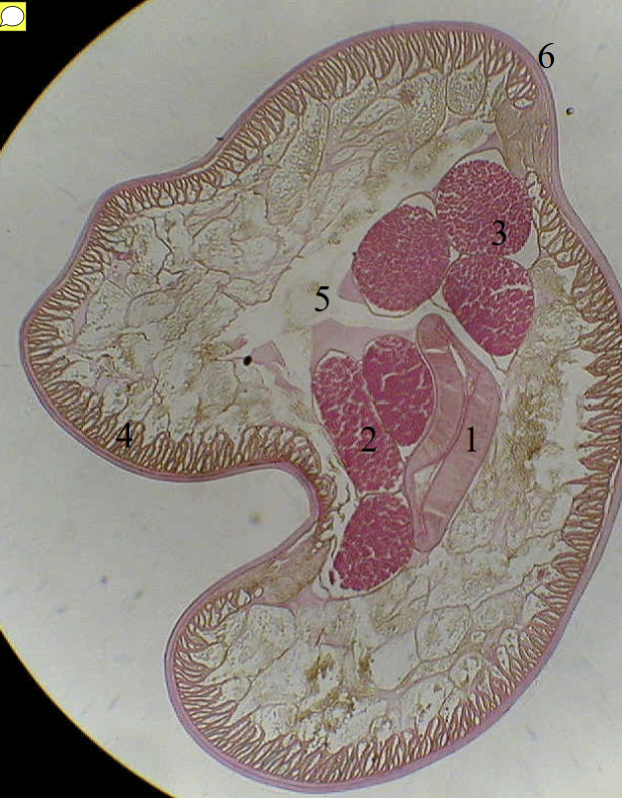
<p>What gender is this?</p>

What gender is this?

Male

10
New cards
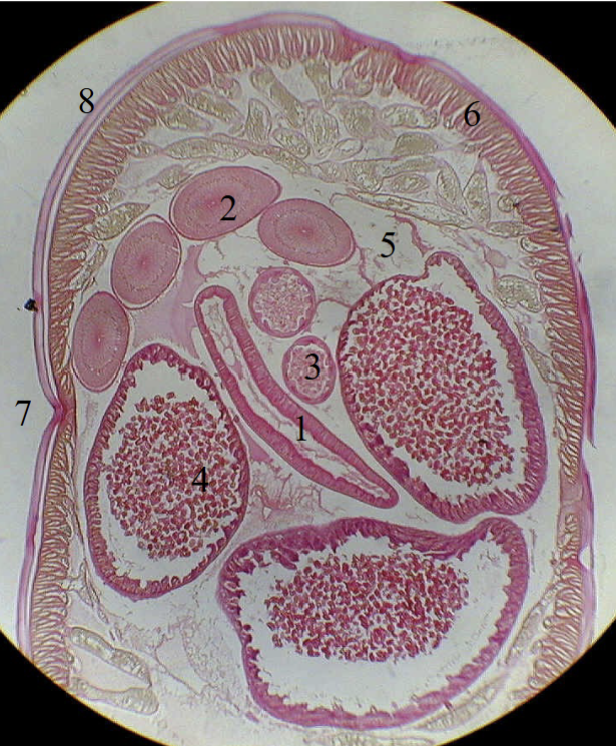
<p>1</p>

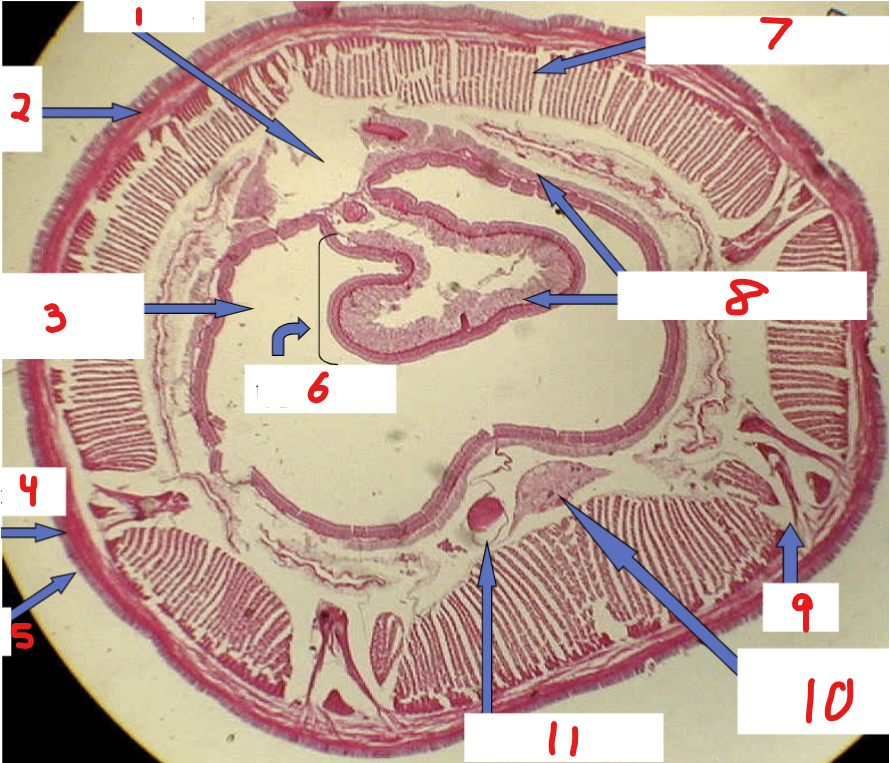
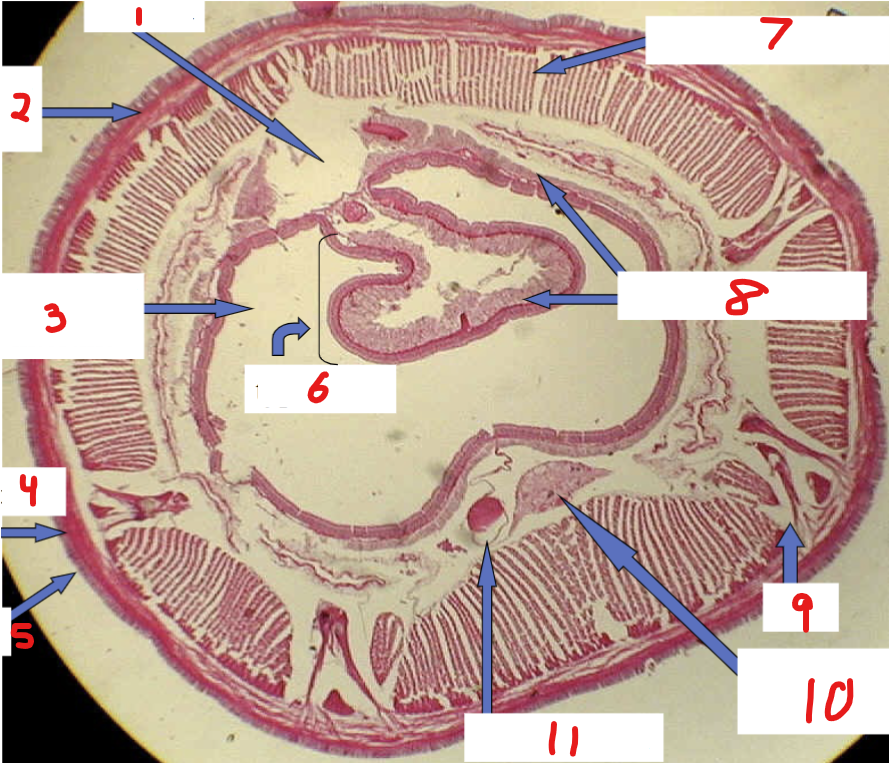
1

Intestine

11
New cards
<p>2</p>

2

Vas Deferens

12
New cards
<p>3</p>

3

Testes

13
New cards
<p>4</p>

4

Longitudinal Muscle

14
New cards
<p>5</p>

5

Pseudocoelom

15
New cards
<p>6</p>

6

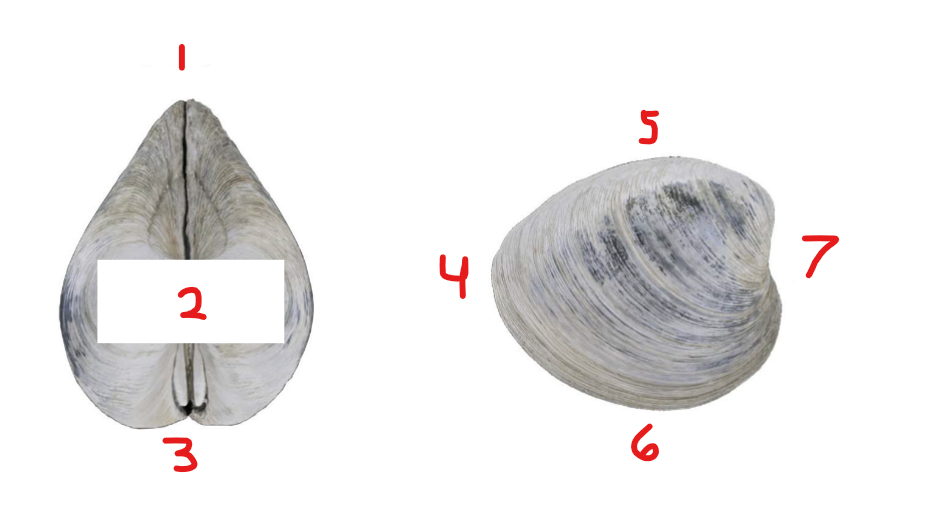
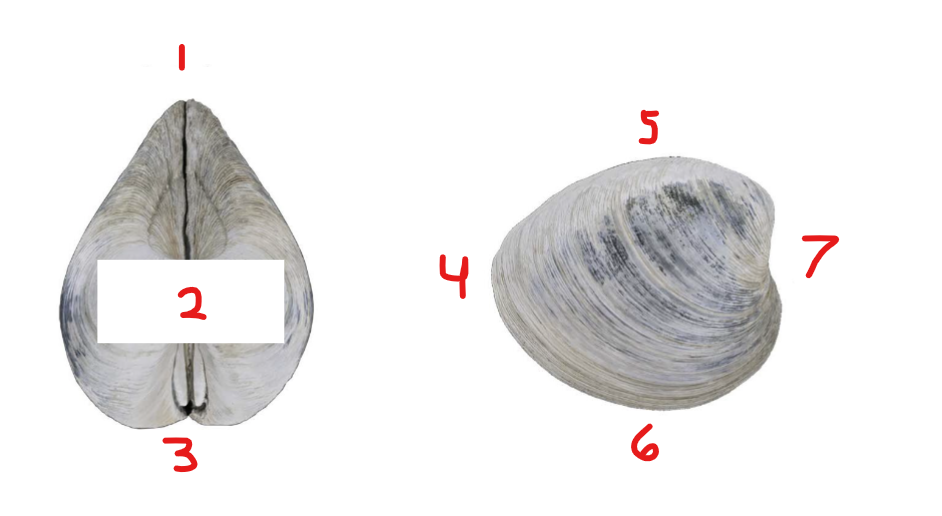
Cuticle

16
New cards
Testes
The male reproductive organ that produces sperm, seen as a coiled tube in the cross section.
17
New cards
Vas Deferens
Also called ductus deferens, it is the tube that carries sperm from the testes to the seminal vesicle.
18
New cards
Seminal Vesicle
A storage organ for sperm before it is released during mating.
19
New cards
Intestine and Intestinal Lumen
The digestive tube and its hollow center where food is digested and nutrients are absorbed.
20
New cards
Pseudocoelom
The fluid-filled body cavity that is not fully lined by mesoderm and functions as a hydrostatic skeleton.
21
New cards
Cuticle
The tough, flexible, non-living outer covering that protects the worm and is molted during growth.
22
New cards
Ovary
The female reproductive organ that produces eggs, seen as coiled tubes in the cross section.
23
New cards
Oviduct
The tube that carries eggs from the ovary to the uterus.
24
New cards
Uterus
The organ where eggs are stored before being released.
25
New cards
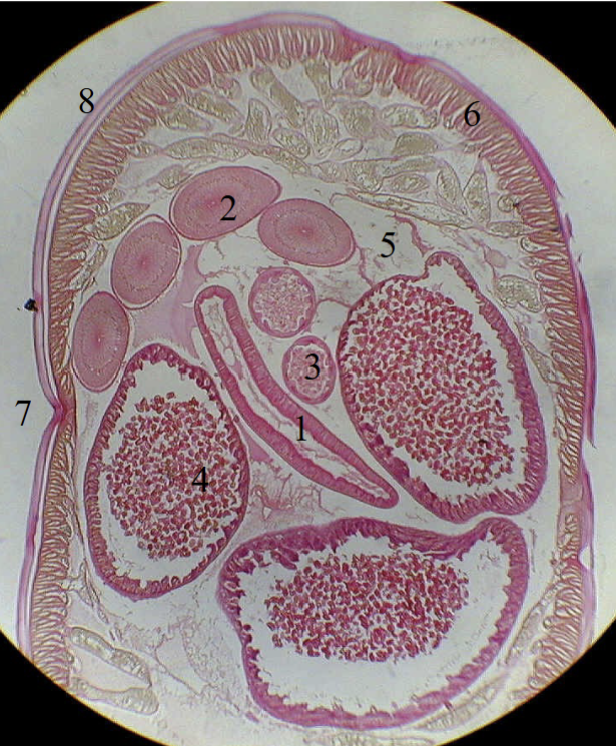
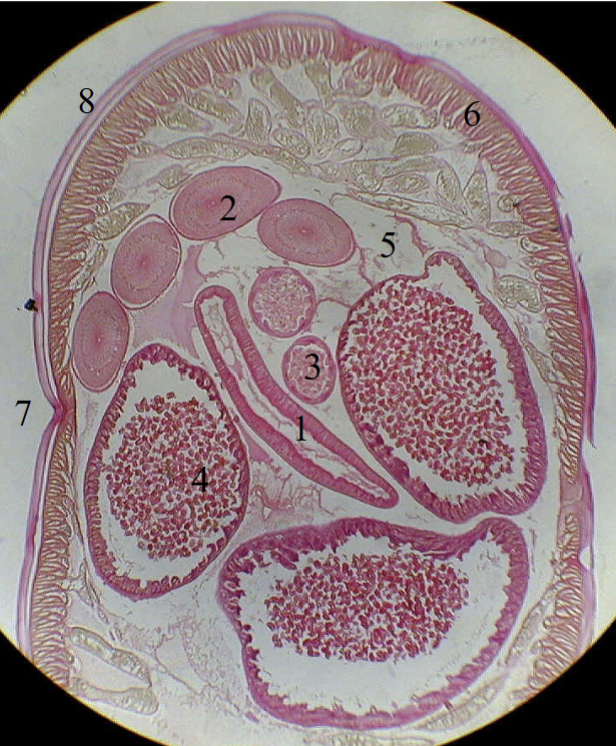
<p>What Phylum is this?</p>

What Phylum is this?

Phylum Nematoda

26
New cards
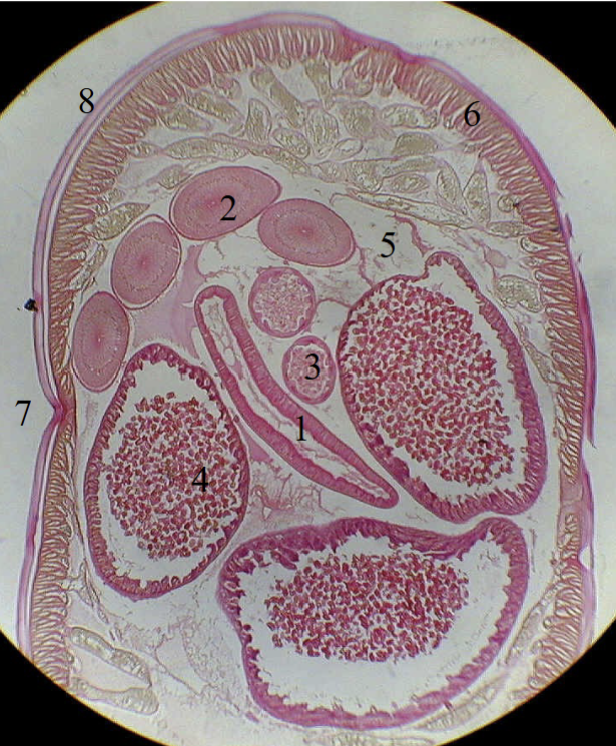
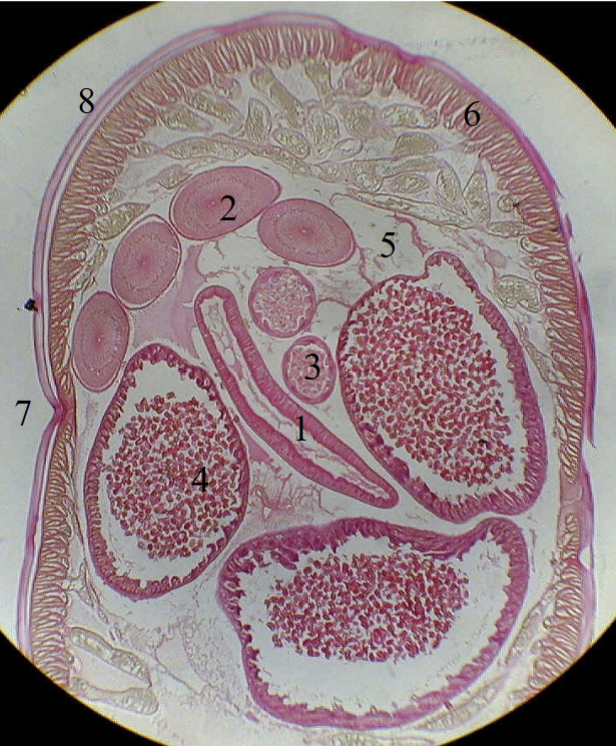
<p>What gender is this?</p>

What gender is this?

Female

27
New cards
<p>1</p>

1

Intestine

28
New cards
<p>2</p>

2

Ovary

29
New cards
<p>3</p>

3

Oviduct

30
New cards
<p>4</p>

4

Uterus

31
New cards
<p>5</p>

5

Pseudocoelom

32
New cards
<p>6</p>

6

Longitudinal Muscle

33
New cards
<p>7</p>

7

Lateral Line

34
New cards
<p>8</p>

8

Cuticle

35
New cards

Annelida General Features

Bilateral symmetry, commonly called segmented worms, classified based upon septa, setae and appearance of clitellum, acephalic, partitioned coelom common, cuticle present as a surface secretion not membrane bound, and classes include Oligochaeta, Polychaeta, and Hirudinida.

36
New cards

Do Annelida have radial or bilateral symmetry?

Bilateral

37
New cards
Class Oligochaeta
Distinguishing features include having few setae per segment, being acephalic (no head), having a clitellum, and living in freshwater or terrestrial environments. Ex.) Earthworms like Lumbricus terrestris.
38
New cards
Class Polychaeta
Distinguishing features include having many setae per segment, having a well-developed head with eyes and tentacles, having parapodia for movement, and living in marine environments. Ex.) Marine worms like Nereis.
39
New cards
Class Hirudinida
Distinguishing features include having no setae, having anterior and posterior suckers for attachment, having a fixed number of segments, and being parasites or predators that feed on blood or small invertebrates. Ex.) Leeches like Hirudo medicinalis.
40
New cards
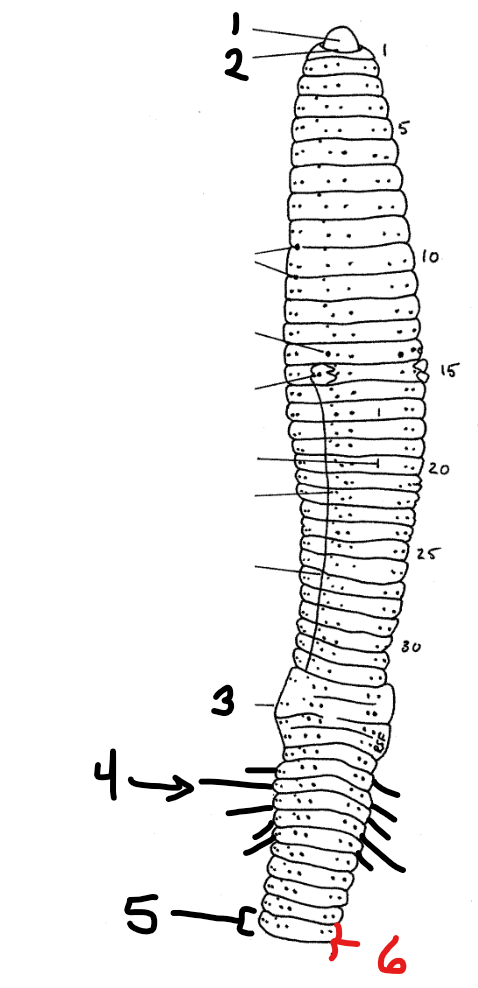
<p>What Phylum and Class is this organism?</p>

What Phylum and Class is this organism?

Phylum Annelida, Class Oligochaeta
41
New cards
<p>1</p>

1

Prostomium (“lip”)

42
New cards
<p>2</p>

2

Mouth

43
New cards
<p>3</p>

3

Clitellum

44
New cards
<p>4</p>

4

Setae

45
New cards
<p>5</p>

5

Metameres (segments)

46
New cards
<p>6</p>

6

Cuticle

47
New cards
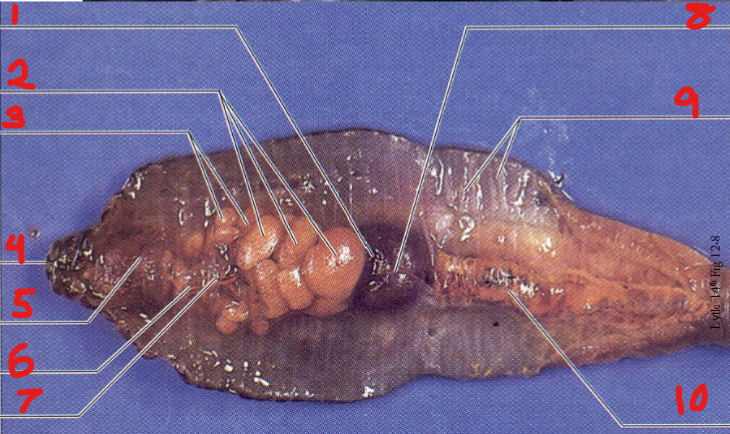
<p>What is this a dissection of?</p>

What is this a dissection of?

Annelida
48
New cards
<p>1</p>

1

Crop

49
New cards
<p>2</p>

2

Seminal Vesicles

50
New cards
<p>3</p>

3

Seminal Receptors

51
New cards
<p>4</p>

4

Mouth

52
New cards
<p>5</p>

5

Pharynx

53
New cards
<p>6</p>

6

Dorsal Blood Vessel

54
New cards
<p>7</p>

7

Esophagus

55
New cards
<p>8</p>

8

Gizzard

56
New cards
<p>9</p>

9

Nephridia

57
New cards
<p>10</p>

10

Intestine

58
New cards
<p>11</p>

11

Aortic Arch (heart)

59
New cards
Setae
Stiff hair-like bristles on the outside of each segment that provide traction for movement through soil.
60
New cards
Mouth
The opening at the anterior end where food enters.
61
New cards
Prostomium
The "lip" that overhangs the mouth and helps sense the environment.
62
New cards
Clitellum
A swollen, glandular band of segments that secretes a mucous cocoon for egg deposition during reproduction.
63
New cards
Metameres
The individual body segments that make up the earthworm.
64
New cards
Cuticle
The thin, non-living outer layer that protects the body surface.
65
New cards
Pharynx
The muscular organ that pumps food into the digestive tract.
66
New cards
Esophagus
The tube that connects the pharynx to the crop.
67
New cards
Crop
A storage organ for food before it enters the gizzard.
68
New cards
Gizzard
A muscular organ that grinds food into smaller pieces.
69
New cards
Seminal Vesicles
Organs that store sperm produced by the earthworm.
70
New cards
Seminal Receptacles
Organs that receive and store sperm from a partner during mating.
71
New cards
Aortic Arches
Also called hearts, these are muscular vessels that pump blood through the circulatory system.
72
New cards
Nephridia
Osmoregulatory structures found in annelids and other invertebrates that filter fluid from the coelom and excrete waste while reabsorbing useful ions and water. In earthworms, they are paired in each segment and help maintain fluid and ion balance.
73
New cards
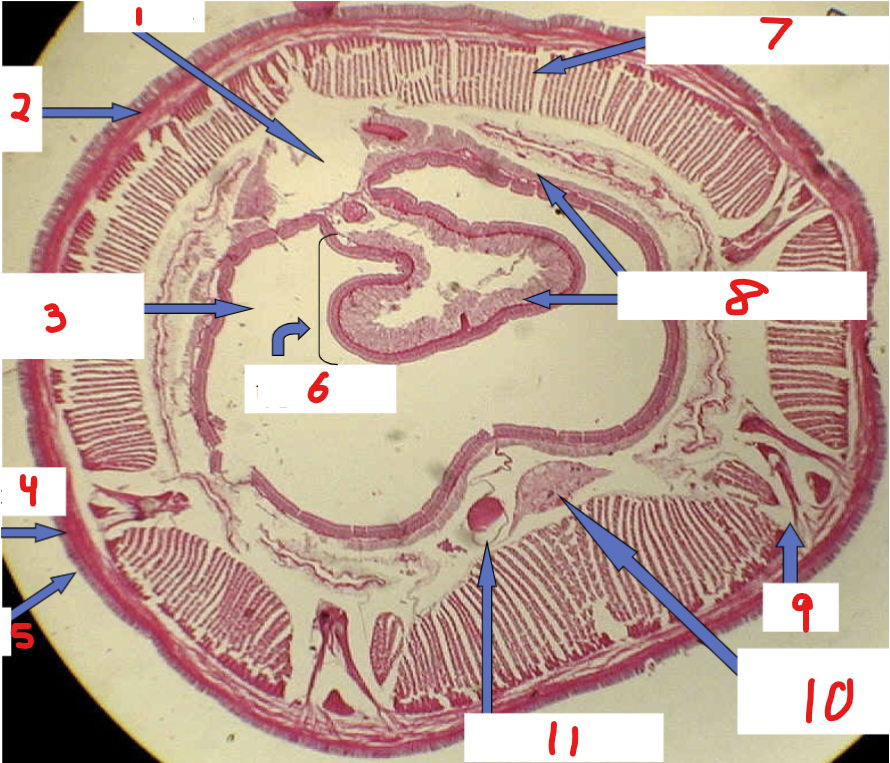
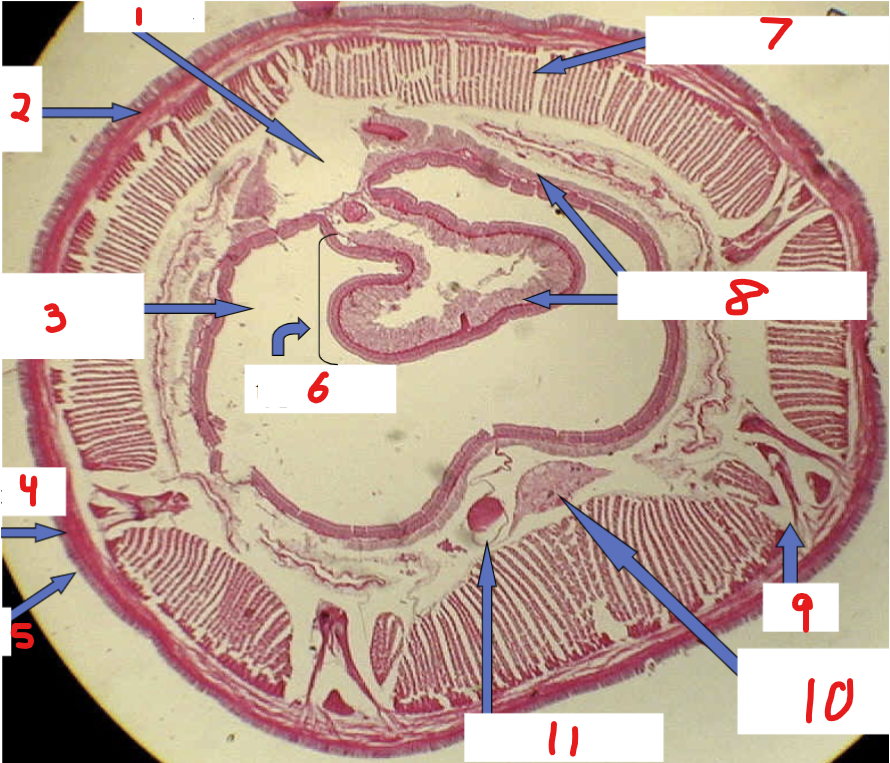
<p>What Phylum does this cross section belong to?</p>

What Phylum does this cross section belong to?

Phylum Annelida
74
New cards
<p>1</p>

1

Coelom

75
New cards
<p>2</p>

2

Circular Muscle

76
New cards
<p>3</p>

3

Lumen of Intestine

77
New cards
<p>4</p>

4

Hypodermis

78
New cards
<p>5</p>

5

Cuticle

79
New cards
<p>6</p>

6

Typhlosole

80
New cards
<p>7</p>

7

Longitudinal Muscles

81
New cards
<p>8</p>

8

Chlorogogue Cells

82
New cards
<p>9</p>

9

Seta

83
New cards
<p>10</p>

10

Ventral Nerve Cord

84
New cards
<p>11</p>

11

Ventral Vessel

85
New cards
Hypodermis
The cellular layer beneath the cuticle that secretes the cuticle.
86
New cards
Circular Muscle
Muscle fibers that run around the body and help with movement and shape change.
87
New cards
Longitudinal Muscle
Muscle fibers that run lengthwise along the body and help with movement and shape change.
88
New cards
Dorsal and Ventral Blood Vessels
The main blood vessels that run along the top and bottom of the earthworm and circulate blood.
89
New cards
Coelom
The true body cavity fully lined by mesoderm that contains the internal organs.
90
New cards
Typhlosole
A fold of the intestine that increases surface area for nutrient absorption.
91
New cards
Chlorogogue Cells
Cells around the inner surface of the typhlosole and outer surface of the intestine that store glycogen and fats and help detoxify harmful substances.
92
New cards

Mollusca General Features

Head-foot animals, triploblastic, bilateral symmetry, coelomates of limited size, muscular foot that is significantly modified in cephalopods, and visceral mass in mantle cavity.

93
New cards

Are Mollusca Diploblastic or Triploblastic?

Triploblastic

94
New cards

Do Mollusca have radial or bilateral symmetry?

Bilateral

95
New cards

Are Mollusca Acoelomates, Pseudocoelomates, or Coelomates?

Coelomates
96
New cards
Class Gastropoda
A class of Mollusca that includes snails and slugs.
97
New cards
Class Bivalvia
A class of Mollusca that includes clams, oysters, and mussels.
98
New cards
Class Cephalopoda
A class of Mollusca that includes squid, octopus, and nautilus.
99
New cards
<p>Which side of the Mollusca is 1?</p>

Which side of the Mollusca is 1?

Anterior
100
New cards
<p>What is 2 referring to?</p>

What is 2 referring to?

Valves