Types of Functions
0.0(0)
Studied by 2 people Call Kai
 Learn
Learn Practice Test
 Spaced Repetition
 Match
Match Flashcards
 Knowt Play
Card Sorting
1/7

Earn XP
Description and Tags
Last updated 5:43 AM on 9/7/22
Name | Mastery | Learn | Test | Matching | Spaced | Call with Kai |
|---|
No analytics yet
Send a link to your students to track their progress
8 Terms
1
New cards
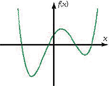
Polynomial function
The graph crosses the x-axis up to n times and has up to n - 1 vertices (points where the function changes direction). The domain is all real numbers.
General equation: f(x)=a_n xⁿ+a_n -1xⁿ-1 + . . . + a₁x+a₀, where n is a nonnegative integer.
General equation: f(x)=a_n xⁿ+a_n -1xⁿ-1 + . . . + a₁x+a₀, where n is a nonnegative integer.
2
New cards
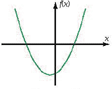
Quadratic function
The graph changes direction at its one vertex. The domain is all real numbers.
General equation: f(x)=ax²+bx+c
General equation: f(x)=ax²+bx+c
3
New cards
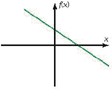
Linear function
The straight-line graph, f(x), changes at a constant rate as x changes. The domain is all real numbers.
General equation: f(x)=ax+b (or f(x)=mx+b)
General equation: f(x)=ax+b (or f(x)=mx+b)
4
New cards
Direct Variation function
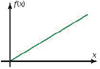
The straight-line graph goes through the origin. The domain is x ≥ 0 (as shown) for most real-world applications.
General equation: f(x)=ax (or f(x)=mx+0) (or f(x)=ax¹)
General equation: f(x)=ax (or f(x)=mx+0) (or f(x)=ax¹)
5
New cards
Power function
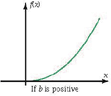
The graph contains the origin if b is positive. In most real-world applications, the domain is nonnegative real numbers if b is positive and positive real numbers if b is negative.
General equation: f(x)=ax∧b (a variable with a constant exponent)
General equation: f(x)=ax∧b (a variable with a constant exponent)
6
New cards
Exponential function
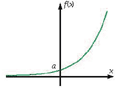
The graph crosses the y-axis at f(0) = a and has the x-axis as an asymptote.
General equation: f(x)=a·b∧x (a constant with a variable exponent)
General equation: f(x)=a·b∧x (a constant with a variable exponent)
7
New cards
Inverse Variation function
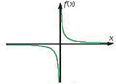
Both of the axes are asymptotes. The domain is x ≠ 0. For most real-world applications, the domain is x > 0.
General equation: f(x)=a÷x (or f(x)=ax⁻¹) (or f(x)=a÷xⁿ) (or f(x)=ax⁻ⁿ)
General equation: f(x)=a÷x (or f(x)=ax⁻¹) (or f(x)=a÷xⁿ) (or f(x)=ax⁻ⁿ)
8
New cards
Rational Algebraic function
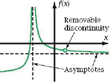
A rational function has a discontinuity (asymptote or missing point) where the denominator is 0; it may have horizontal or other asymptotes.
General equation: f(x)=(p(x))÷(q(x²) where p and q are polynomial functions
General equation: f(x)=(p(x))÷(q(x²) where p and q are polynomial functions