Commercial Checkride Prep Questions
 Call Kai
 Learn
Learn Practice Test
 Spaced Repetition
 Match
Match Flashcards
 Knowt Play
1/86

There's no tags or description
Looks like no tags are added yet.
Name | Mastery | Learn | Test | Matching | Spaced | Call with Kai | Chat |
|---|
No analytics yet
Send a link to your students to track their progress
87 Terms
Where do you find the Commercial Pilot Eligibility Requirements?
61.123
Where do you find the Medical Requirements and Duration?
61.23
Where do you find Medical Standards and Certifications?
FAR 67
Where do you find Basic Medical and Special Issuance process Information?
FAR 68
You are working for a company and at the company your boss decides to buy an aircraft that he is going to use to fly around to different work meetings. He finds out in the company that you are a commercial pilot, he decides to hire you to fly him around to the different work meetings. Would you be allowed to do this as a commercial pilot?
Yes, as long the boss is not make money off the flight itself. Example would be not making money for carrying other people or cargo for profit.
As long as you boss isn’t carrying person or property for the flight, you can do the service. You are just flying him and dropping him off for meetings then picking him back up.
So now lets say your boss then decides to start flying people/ passengers for hire, what would he need to do?
Get a commercial certificate under 121, 125, and 135
What is Holding out?
act of representing oneself as willing to provide air transportation to the public or a segment of the public, which is a key element in determining common carriage.
How would you describe the word airworthy?
When an aircraft is kept in airworthiness standards.
Maintenance is maintained (AVIATES)
Aircraft Documents (SPARROWS)
Preflighting according to the POH
What is standard lapse rate for both temperature and pressure?
2°C per 1,000ft, and 1 inch of mercury (inHg) per 1,000ft.
What is the speed limit for Class B?
Above 10,000MSL in airspace: Mach 1
Bellow 10,000MSL in airspace: 250kts
Underlying Class B and in VFR cooridors: 200kts
What is the speed limit for Class C?
200kts within 2,500feet AGL and 4NM
What is the speed limit for Class D?
200kts within 2,500feet AGL and 4NM
What is the Speed limit above 10,000MSL?
Mach 1
91.817 (Civil aircraft sonic boom)
you need a special flight permit to fly over mach 1 per 91.818
What is the Airspeed for operating an aircraft below 10,000MSL?
250kts
What are the forces acting in a Turn?

What is a Hazard?
A present, real-world condition or object. (e.g., A large nick in your propeller blade).
What is a Risk?
The future assessment or consequence of that hazard. (e.g., The probability and severity of the propeller fracturing mid-flight)
What is a Spin?
an aggravated stall that results in what is termed an “autorotation” wherein the airplane follow a downward corkscrew path. As the airplane rotates around the vertical axis, the rising wing is less stalled than the descending wing creating a rolling, yawing, and pitching motion.
What is our oil pressure range?
What are the load factor limitations for our aircraft?
What kind of ailerons do we have?
Frise and differential (20° deflection up, 15° deflection down)
What does it mean to have operational control?
with respect to a flight, means the exercise of authority over initiating, conducting or terminating a flight
Kind of like a “store manager,” they decide when the store opens, how it operates and when it closes.
What is a SODA?
A Statement of Demonstrated Ability allows pilots with static, disqualifying medical conditions to fly. You earn it by passing a medical flight test. Once granted, the SODA does not expire. You do not need to renew it. It acts as permanent FAA approval for a specific condition.
What is a Authorization for Special Issuance of a Medical Certificate? (SI)
a conditional medical certificate granted by the FAA to a pilot who does not meet the standard, baseline medical requirements but can still fly safely under specific medical tracking
you must submit fresh medical test results to be re-evaluated every single time you renew your medical certificate.
What are 121 ops?
FAA regulations governing scheudled airines, major carrier, and large cargo haulers
The FAA’s definition of a scheduled operation is
at least “5 round trips per week on at least one route between two or more points according to the published flight schedule.”
What are 129 ops?
sets the safety and operating standards for foreign air carriers flying into, out of, or across the United States. It also applies to foreign operators of U.S.-registered aircraft
What are 135 ops?
commercial, non-scheduled aviation like private jet charters, air taxis, and medical transports.
only applies to aircraft with 30 or fewer seats or a maximum payload capacity of 7,500 pounds
What are 125 ops?
FAA regulation for operating large aircraft for private use (non-common carriage). It applies to U.S.-registered civil airplanes with 20 or more passenger seats or a payload of 6,000 pounds or more. It bridges the gap between private rules and strict airline standards.
Common examples include:
Corporate Shuttles: Companies moving employees between corporate headquarters.
Sports Teams: Professional or college teams flying together on a private charter.
Private Operators: Wealthy individuals or corporations using large private jets or turboprops.
Specialized Use: Aerial surveying and research flights using large airframes
Define the terms: Category, Class and type
Category: broad class of aircraft (airplane, rotor craft, glider)
Class: classification within a category with similar operations (single engine land, multi-engine land, single engine sea(
Type: specific make and model of the aircraft (C172, C182, B737)
What is Vy?
Best rate of climb.
What is Vx?
Best angle of climb.
What are the different types of NOTAMs?
ARTCC NOTAMs: cover wide-area hazards not tied to a single airport, like laser light activity or widespread GPS testing. [1, 2]
NAVAID NOTAMs: Cover outages, maintenance, or restrictions on ground-based navigation facilities like VORs, NDBs, or ILS components. [1, 2]
GPS NOTAMs: Specifically track satellite-based system service interruptions, anomalies, or scheduled testing outages affecting GPS and WAAS availability
NOTAM (D): handles the bulk of day-to-day ground changes, such as taxiway closures, personnel on fields, or runway lighting failures.
Subcategory according to FAA internal operational documentation (FSS handbook)
(U) NOTAMs: Unverified
(O) NOTAMs: other
FDC NOTAMs: Regulatory, mandatory amendments that affect flight safety. This includes changes to published Instrument Approach Procedures (IAPs), modified airway charts, or Temporary Flight Restrictions
Special Activity Airspace (SAA) NOTAMs: alert pilots when a Military Operations Area (MOA), restricted zone, or warning area is activated outside its standard published hours
International NOTAMs: intended for distribution to multiple countries.
Military NOTAMs: Formatted specifically for military personnel.
When are you required to file a flight plan?
IFR flight
Flight above 18,000mls (class A airspace)
Crossing a boarder
Special VFR at night
Flying into special use airspace
What is a service ceiling? What is ours?
maximum density altitude at which an aircraft can maintain a steady rate of climb of exactly 100 feet per minute (fpm)
14,000 Feet
What is Absolute Ceiling?
The absolute maximum altitude; the plane cannot climb any higher.
What is Vx and Vy relationship to service ceiling (as we gain altitude)?
Vx increases, Vy decreases, they get closer together with altitude, and they become equal at the absolute ceiling.
Vx goes up with altitude.
Vy goes down with altitude.
Service ceiling: almost equal.
Absolute ceiling: they are equal.
What are the weather minimum to takeoff under VFR in controlled airspace?
3SM visibility, 1,000 foot ceilings.
Draw the table showing ceiling and visibility requirements for VFR, MVFR, IFR, and LVFR
VFR: >5SM Visibility, >3,000ft Ceilings
MVFR: 3-5SM Visibility, 3,000-1,000ft Ceilings
IFR: 1-3SM Visibility, 1,000-500ft Ceilings
LIFR: <1SM Visibility, <500ft Ceilings
Where do you find the Commercial training required for part 61 pilots and for Part 141 pilots?
Part 61: 61.129
Part 141: 141 Appendix D
What are the time requirements for your commercial certificate under part 141
Ground:
35 Hours of Ground training
Flight Time:
Total of 190 Hours (private 35, instrument 35, commercial 120)
120 Hours of training
55 hours of flight training from a certificated flight instructor on the approved areas of operation listed in paragraph (d)(1) of this section that includes at least
Ten hours of instrument training
Ten hours of training in a complex airplane, a turbine-powered airplane, or a technically advanced airplane
One 2-hour cross country flight in daytime conditions in a single engine airplane that consists of a total straight-line distance of more than 100 nautical miles from the original point of departure;
One 2-hour cross country flight in nighttime conditions in a single engine airplane that consists of a total straight-line distance of more than 100 nautical miles from the original point of departure; and
3 hours in a single-engine airplane in preparation for the practical test within 60 days preceding the date of the test.
Flight Solo Time:
Ten hours of solo flight time in a single engine airplane
One cross-country flight with landings at a minimum of three points, and one segment of the flight consisting of a straight-line distance of at least 250 nautical miles; and
5 hours in night VFR conditions with 10 takeoffs and 10 landings at an airport with an operating control tower.
What are the Eligibility requirements to receive your commercial pilot license?
Must be at least 18 years old
Be able to read, speak, write, understand english
Receive logbook endorsement form an authorized instructor
Pass Required knowledge test
Receive the required training and logbook endorsements
Meet the aeronautical experience requirements
Pass the practical test
Hold at least a Private pilots license
For 141 all of the above plus:
pass instrument rating test prior to taking commercial pilot test
pass stage checks and EOC
What are the Privileges for a Commercial Pilot?
61.133(a):
Can act as PIC of an aircraft carrying persons or property for compensation or hire.
Can fly for compensation or hire
Walk me through how you would determine whether you could get paid or not as a pilot?

Explain to me what a Wet Lease and a Dry Lease is.
Wet Lease: the owner supplies the aircraft as well as at least one crew member, according to the FAA. The owner assumes operational responsibility, which includes performing maintenance, procuring insurance, and other legal responsibilities of operations.
Dry Lease: the owner supplies the aircraft as well as at least one crew member, according to the FAA. The owner assumes operational responsibility, which includes performing maintenance, procuring insurance, and other legal responsibilities of operations.
What are some operations you can do under part 119.1?
Student instruction
Nonstop commercial air tours (subject to specific criteria outlined in Part 119)
Ferry or training flights
Aerial work operations including:
Crop dusting, seeding, spraying, and bird chasing
Banner towing
Aerial photography or survey
Fire fighting
Powerline or pipeline patrol
Nonstop flights within 25-mile radius of takeoff location for conducting intentional parachute operations
Emergency mail service
What is a TCDS?
an official regulatory document issued by aviation authorities (such as the FAA or EASA) that defines the approved design and airworthiness standards for a specific civilian aircraft, engine, or propeller. Includes operating limitations, approved components and design details.
like a birth certificate for an aircraft model
What is a STC?
Supplemental Type Certificate. It is an official design and airworthiness approval issued by civil aviation authorities (such as the FAA) to modify an aircraft, engine, or propeller from its original certified design.
What is Common Carriage?
Person or organization that “hold out” its willingness to transport persons or property from place to place, for compensation.
A common carrier requires either an air carrier certificate or a commercial operating certificate
What is Private Carriage?
Carriage for hire, which does not involve “holding out” to the public generally referred to as “contract carrier”
Walk me through the steps you would take if you found an inoperative piece of equipment on the aircraft during your preflight.

What is a Special Flight Permit and when would you use one?
FAA-issued authorization that legally allows an aircraft to be flown even if it does not currently meet standard airworthiness requirements.
Maintenance and repairs: Flying the aircraft to a base where repairs, alterations, or maintenance can be performed.
Delivery and export: Delivering or exporting the aircraft to a new owner or destination.
Production flight testing: Testing a new production aircraft before it receives its final airworthiness certificate.
Evacuation from danger: Evacuating the aircraft from areas of impending danger, such as hurricanes, floods, or wildfires.
Customer demonstration: Flying the aircraft for customer demonstration flights in a new production aircraft that has completed production flight tests.
Excess weight operations
What are the VOR Volumes for the New Service Volumes? Where do you find them?
AIM 1-1-8

What is the inflight Military Intercept Procedure?
Do not change heading, altitude, or airspeed until directed to by the intercepting aircraft. An intercepted aircraft must, without delay:
adhere to instruction s relayed through the use of visual devices, visual signals, and radio communications from the intercepting aircraft
Attempt to establish radio communicant with the intercepting aircraft or with the appreciate ATC facility by making a general call on guard (121.5), giving identify, position, and nature of the flight
If transponder equipped, Squawk 7700 unless other wise instructed by ATC
The crew of the intercepted aircraft must continue to comply with intercepted aircraft signal and instructions until positively released.
What is an Accident according to the NTSB?
Defined within the time frame of when you board the aircraft with intention to fly till you disembark from the aircraft.
Fatal injury
someone dies within 30 days of the accident
Serious injury
broken bones, 2nd burns or burns of more than 5% of the body, internal damage
Substantial Damage
aircraft is no longer airworthy due to accident
What is an Incident according to the NTSB?
Everything that is not classified as an accident. Start with an Accident first, and if it do not fall under accident then it is in incident.
aircraft is unsafe to fly but still airworthy
When do you need to notify the NTSB Immediate?
Accident:
within 10 days
Serious incident (major problem with flight controls, crew member is unable to perform job, inflight fire):
only if you are requested to
Overdue Aircraft:
within 7 days
Explain what is going on in a Cold Occlusion?
The advancing cold air mass is colder than the cool air mass already in place. It pushes under both the warm air and the cool air. Cold Front Catches up to a Warm front

What is going on in a Warm Occlusion?
The advancing cold air mass is not as cold as the cool air mass in place. It rides up and over the cool air mass. Warm front catches up to a cold front
Warm Front on leading edge, Coldest air is in the front, the cool air behind slides inbetween the Cold and warm air
Embedded thunderstorms, Rain and Fog
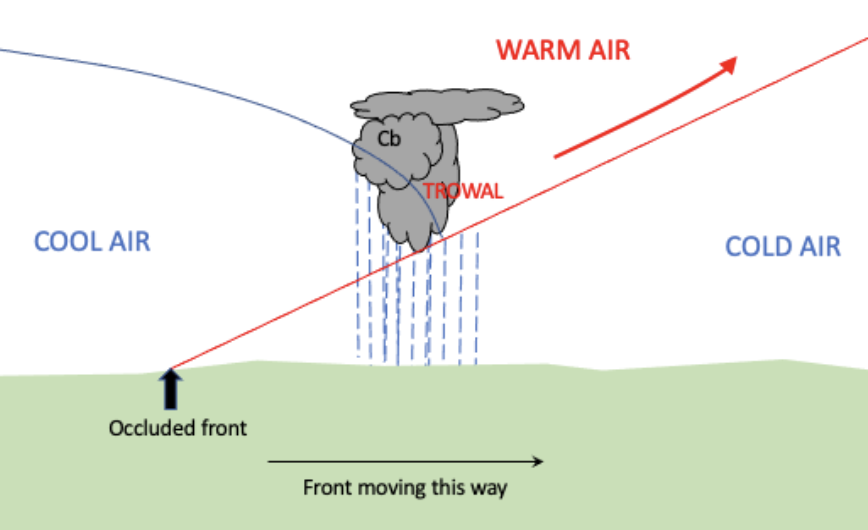
What is an Occluded Front?
when a faster moving front catches up with a slower moving front causing the merging of 3 air masses
When is Supplement Oxygen Required in a Pressurized cabin?
Above FL250 - an addition of at least 10 minutes of supplemental O2 for each occupant is required.
Above FL350 - one pilot at the controls must wear and use an O2 mask unless two pilots are at the control with quick-donning masks and the aircraft is at or below FL410.
If one pilot leaves the controls above FL350, the other pilot must wear and use his O2 mask regardless if it’s a quick donning type.
Above FL410 always on
Think about Time of useful consciousness
What is ground effect
the conditions of slightly increased air pressure below an airplane wing that increases the amount of lift produced
It exists within
approximately one wing span from the ground.It results from a reduction in upwash, downwash and wingtip vortices, and produces a corresponding decrease in induced drag.
What is stability?
the quality of an airplane to correct for conditions that may disturb its equilibrium, and to return or to continue on the original flight path
It is primarily an airplane design characteristic.
What is static stability? And the different types?
Initial response after a disturbance (describes the aircraft's immediate reaction)
Positive Static Stability:
Returns toward the
original position (ball in a halfpipe)Neutral Static Stability:
Stays in the new position (ball down hill)Negative Static Stability:
Continues moving away from the original position (ball on upside down halfpipe)
What is dynamic stability? And the different types?
Response over time after a disturbance
Positive Dynamic Stability:
Oscillations decrease and return to equilibriumNeutral Dynamic Stability:
Oscillation remains constantNegative Dynamic
Stability: Oscillations increase and diverge from equilibrium
What are the aircraft designed limit load factor for Normal Category?
3.8 to -1.52Gs
What is the aircraft designed limit load factor for utility Category?
4.4 to -1.76G
What is the aircraft’s designed limit load factor for acrobatic?
6 to -3G
What is the maximum oil temp?
245F (118C)
What are the weight limits for Utility Category?
• Maximum Ramp Weight:
2208 Ibs.
• Maximum Takeoff Weight:
2200 Ibs.
• Maximum Landing
Weight: 2200 Ibs.
• Maximum Weight in
Baggage Compartment:
In the utility category, the baggage compartment must be empty and rear seat must not be occupied.
What are some other Limitations for our aircraft?
FLAP LIMITATION:
Approved Takeoff Range: 0° to 10°
Approved Landing Range: 0° to 30°
What is Pressure Altitude?
the height above the Standard Datum Plane (SDP).
• When an altimeter is set to 29.92 in Hg, the altitude displayed is the pressure altitude.
What is density altitude?
Pressure altitude corrected for nonstandard temperatures
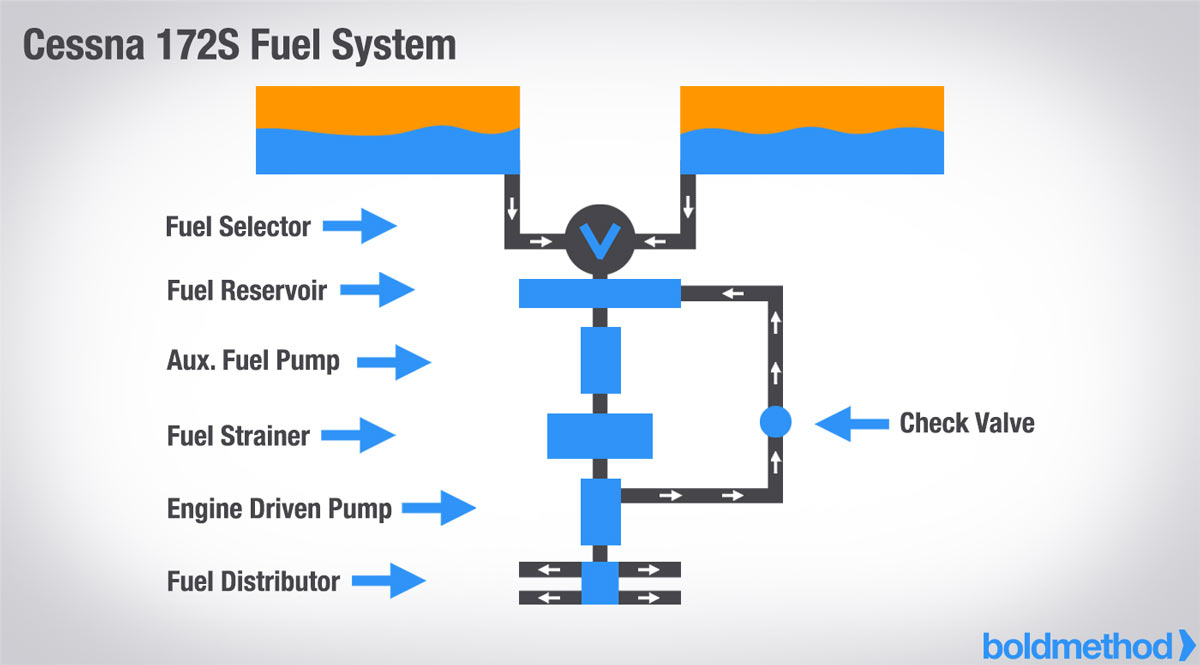
Draw our fuel system
What are the two types of oil systems for a reciprocating engines?
wet-sump system, the oil is located in a sump that is an integral part of the engine.
• dry-sump system, the oil is contained in a separate tank and circulated through the engine by pumps.
What type of oil do we use?
Oil Grades & Type:
• Summer: SAE 15w-50 ashless dispersant
• Winter: SAE 15w-40 ashless dispersant
What is the Electrical System in our 172?
• 28 volt - Direct Current system
• Belt-driven 60 Amp Alternator
• 24 volt, 14 Amp Hour Battery
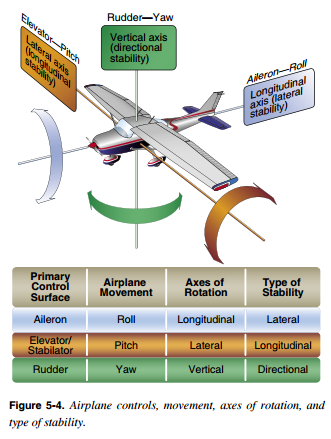
What are the primary flight controls!, airplanes movement, axes of rotation, and type of stability?
What are some Oxygen Systems?
Cannula (can-you-la)
• Quick Donning
• Diluter-demand 02 system
• Pressure-Demand 02 system
• Continuous-Flow Oxygen System
Explain Supersonic Aerodynamics (Air meeting sonic speed?, Air compressibility)
• When local airflow reaches sonic speed, shock waves can form.
• More Compressible air cause:
• Increased drag
• Buffeting
• Stability problems
• Control difficulties
Air compressibility dominates and shock waves become significant.
What are the different Airspeed Ranges?
• Subsonic-Mach numbers below
0.75
• Transonic-Mach numbers from
0.75 to 1.20
• Supersonic-Mach numbers
from 1.20 to 5.00
• Hypersonic—Mach numbers above 5.00
What is Critical Mach Number (Mcrit)?
• where airflow over the airfoil first hits Mach 1.
• Marks the onset of transonic effects and is determined primarily by wing and airfoil geometry.
What can happen if you exceed Critical Mach
Number?
can cause shock waves, airflow separation, buffet, and handling difficulties.
What is a shockwave?
compression waves formed when a body moves through air at a speed greater than the speed of sound
• Air molecules pill up in front of the wing rather than flowing around wing
Explain the process of shockwaves
At subsonic speeds, pressure disturbances from an aircraft travel ahead at the speed of sound, allowing air to "move out of the way" smoothly before the aircraft arrives.
• air ahead is "warned" of the airplane's coming
When an aircraft reaches Mach 1, it "catches up" to its own pressure waves causing air to compress sharply in front of it and forming a shock wave, which marks a sudden change in pressure, temperature, density, and velocity.
What is wave drag?
aerodynamic drag produced by shock waves that form when an aircraft flies near or above the speed of sound
Can you describe what is going on with Wave Drag?
As an aircraft approaches the speed of sound, air molecules begin to compress and effectively "pile up" ahead of the aircraft, forming shock waves that create a large increase in drag known as wave drag.