9: population dynamics
 Call Kai
 Learn
Learn Practice Test
 Spaced Repetition
 Match
Match Flashcards
 Knowt Play
1/32

There's no tags or description
Looks like no tags are added yet.
Name | Mastery | Learn | Test | Matching | Spaced | Call with Kai |
|---|
No analytics yet
Send a link to your students to track their progress
33 Terms
What determines population size?
Population size is determined by four opposing processes:
births and immigration increase population size, while deaths and emigration decrease it
What is population dynamics?
Study of how and why population size changes over time
with implications for extinction risk, endangered species, pest control, and resource management
Dispersal:
Why is dispersal important?
Dispersal moves individuals between areas, increasing or decreasing local population density and connecting populations
What are the main drivers of dispersal?
Climate change, food availability, and transport mechanisms
How does climate change drive dispersal?
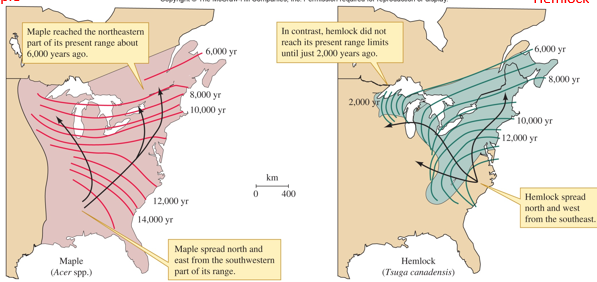
Species shift ranges over time (e.g., tree movement tracked using pollen records)
What is a numerical response?
(Food availability) A change in predator population size in response to changes in prey abundance
How does transport influence dispersal?
Organisms may drift in flowing systems (rivers/streams) or actively move to new areas
What is the drift paradox?
Some organisms avoid being washed downstream by dispersing upstream during mobile life stages
Metapopulations:
What is a metapopulation?
A set of subpopulations connected by dispersal between habitat patches
What is a subpopulation?
A smaller population within a larger system, often maintained by immigration
How does patch size affect population size?
Larger patches support more individuals and have lower extinction risk
How does distance (isolation) affect populations?
Greater distance reduces dispersal, making it harder to maintain populations
Why is connectivity important?
It allows movement between patches, supporting population persistence
What is the effect of habitat fragmentation?
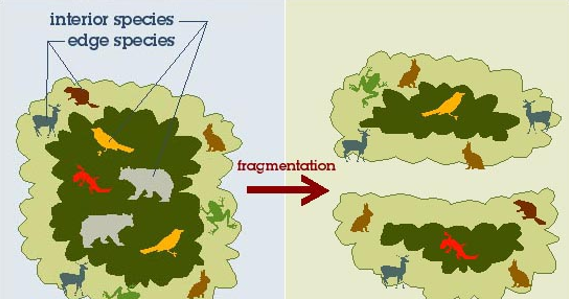
Increases edge habitat, decreases interior habitat, and often reduces biodiversity
Survival:
Why is survival important in population dynamics?
Survival rates directly influence population size and growth
What is a life table?
A table summarizing survivorship and mortality across different age groups
Life Tables:
What is a cohort life table?
Tracks a group from birth to death; accurate but difficult to obtain
What is a static life table?
Estimates survival using ages at death from many individuals; easier but less precise
What is age distribution?
The proportion of individuals in each age class within a population
Age Distribution:
What can age distribution reveal?
Past environmental conditions, population trends, and effects of climate or resource availability
Example of environmental impact?
High rainfall years increase young individuals; drought years increase mortality, with long-term effects
Survivorship:
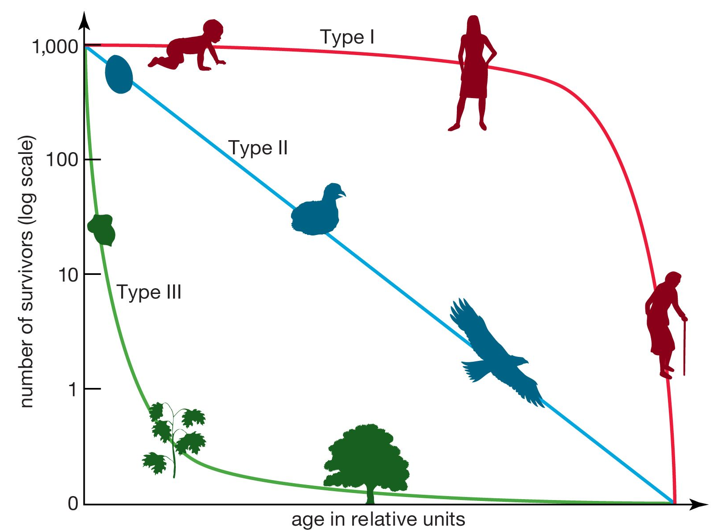
What are the main survival patterns?
High survival of young (late-life mortality), constant mortality, and high early-life mortality
What is a Type I curve?
High survival in early/mid life, with mortality increasing in old age (common in large vertebrates)
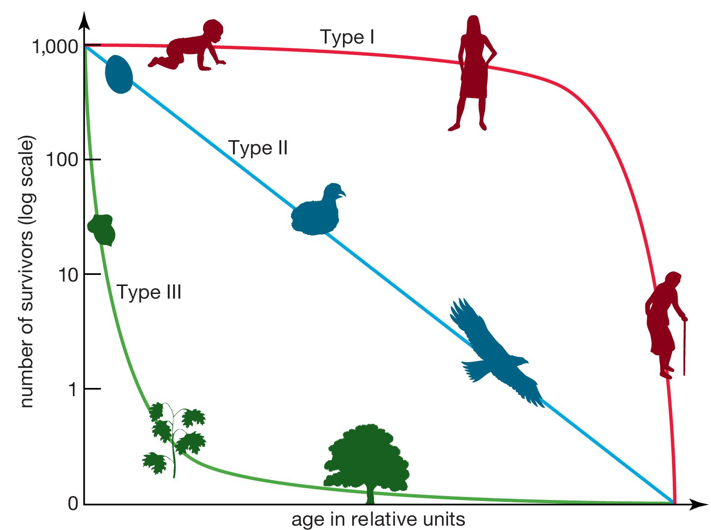
What is a Type II curve?
Constant mortality rate across all ages (e.g., birds, turtles)
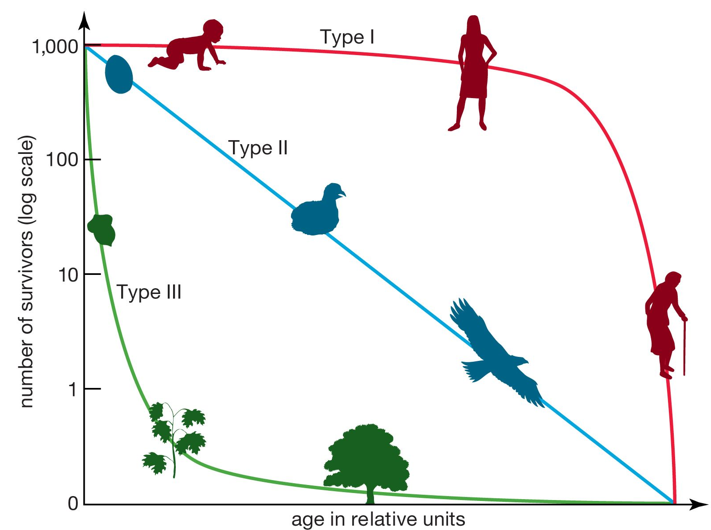
What is a Type III curve?
High mortality early in life, with few individuals surviving to adulthood (e.g., fish, many plants)
Population Growth:
How do life tables and fecundity schedules help?
They allow calculation of population growth parameters and prediction of future population trends
What is a fecundity schedule?
The reproductive output of individuals at different ages
What is net reproductive rate (R₀)?
Average number of offspring an individual produces over its lifetime
What does R₀ < 1 mean?
Population is declining because individuals are not replacing themselves
What is geometric rate of increase (λ)?
Ratio showing how population size changes from one time step to the next
What is generation time (T)?
Average time between the birth of parents and their offspring
What is intrinsic rate of increase (r)?
Per capita rate of population growth under ideal conditions
Applications:
How are life tables used in ecology and society?
Predict population declines, guide conservation of endangered species, estimate human mortality, and study aging to improve lifespan

