The Chemistry Of life
 Call Kai
 Learn
Learn Practice Test
 Spaced Repetition
 Match
Match Flashcards
 Knowt Play
1/64

There's no tags or description
Looks like no tags are added yet.
Name | Mastery | Learn | Test | Matching | Spaced | Call with Kai | Chat |
|---|
No analytics yet
Send a link to your students to track their progress
65 Terms
Which elements make up 96% of body mass by weight
Oxygen (O) 65%, Carbon (C) 18-18.5%, Hydrogen (H) 9.5-10%, Nitrogen (N) 3%
What are the most common elements of the human body
Major: Oxygen (O) 65%, Carbon (C) 18.5%, Hydrogen (H) 9.5%, Nitrogen (N) 3%, Calcium (Ca) 1.5%, Phosphorus (P) 1%
Minor Sulfur (S) 0.25%, Potassium (K) 0.20%, Sodium (Na) 0.15%, Chlorine (Cl) 0.15%, Magnesium (Mg) 0.05, Iron (Fe) 0.006%
What does a Shell Model Look like

What does a Cloud Model look like
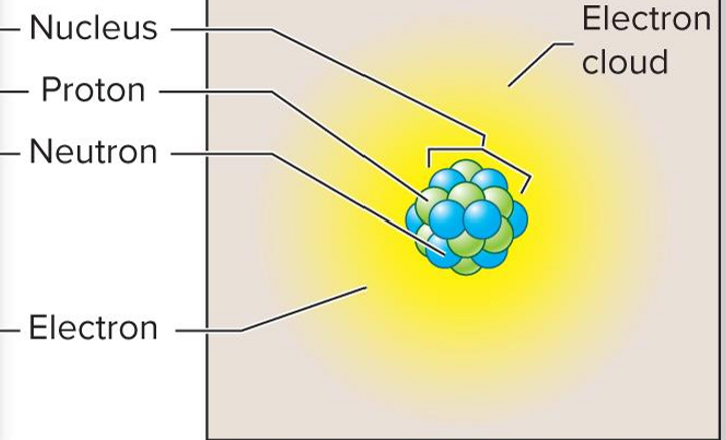
What is the octet Rule
When elements lose, pair , or share electrons to make complete outer shells with 8 electrons
How many electrons are in the first shell to be considered full
2 electrons
Ionic Bond
The giving or taking of electrons between two elements/atoms to make a full shell
Covalent Bond
The sharing of electrons between two elements to make a full shell
Molecule
Two or more atoms bonded togther
Ex. H2 , C6H12O6
Compound
Two or more different kinds of atoms bonded together
Ex. C6H12O6
What makes up 60-80% of the volume of living cells
Water
What is what kind of compound
The most important inorganic compound
Functions of Water: Transportation
Substances dissolved in water move easily throughout the body
Major [blank] in body
Functions of Water: Lubrication
Decreases friction between body structures
Ex. Joints
Functions of Water: Cushions
Absorbs sudden force of body movements
Functions of Water: Excretion of waste
Unwanted substances dissolve in water are easily eliminated
Cohesion
Attraction between water molecules due to hydrogen bonding
Adhesion
Attraction between water molecules and a substance other than water
Surface Tension
Inward pulling of cohesive forces at surface of water
What does surface tension cause in the lungs
Moist sacs of air in lungs to collapse
Surfactant, a lipoprotein, prevents collapse
Temperature
Measure of kinetic energy of atoms or molecules within a substance
Specific Heat
Amount of energy required to increase temperature of 1 gram of a substance by 1 degree Celsius
Does water have a high specific heat
Yes, water’s value is extremely high due to the energy needed to break hydrogen bonds
This contributes to keeping the bodies temperature constant
What are Salts
Ionic compounds that dissociate into ions in water.
Ions/Electrolytes conduct electrical currents in solution
Why are ions/electrolytes important
Ionic balance is vital for homeostasis
Ions play specialized roles in body functions
Ex. sodium, potassium, calcium, iron
What are salts made of
Salts contain cations more than H+ and anions more than OH-
Solutions
Homogeneous mixture of material smaller than 1 nanometer
Colloids
A gel like substance
Smaller particles than a suspension but larger than in a solution
Suspension
Material larger in size than 1mm mixed with water
Materials do not remain mixed unless in motion
Emulsion
A mixture of two or more substances/liquids that do not mix
Solvent
Present in greatest amount usually a liquid
Solute
Present in smaller amounts
Acids
Proton donors that release (hydrogen ion H+) in solutions
HCl —> H+ + Cl-
What are some important acids
HCl, HC2H3O2 (HAc) and H2CO3
Bases
Proton acceptors (Take up H+ form a solution)
NaOH——> Na+ + OH-
What accepts an available proton
OH- accepts an available proton (H+)
OH- + H+ ———→ H2O
What are some important bases
Bicarbonate ion (HCO3 --) and ammonia (NH3) are important bases
What do acid solutions contain
They contain [ H+ ]
As [ H+ ] increases pH decreases
Acid pH
0-6.99
pH scale logarithmic
a pH 5 solution has 10 times more H+ than a pH 6 solution
What do alkaline solutions contain
They contain bases
As [ H+ ] decreases/ as [OH-] increases alkalinity increases
As [ H+ ] decrease pH increases
Alkaline pH
7.01-14
What pH is water
7 it is neutral
Chemical energy
Stored in bonds of chemical substances
Electrical Energy
Results from movement of charged particles
Mechanical Energy
Directly involved in moving matter
Radiant or Electromagnetic energy
exhibits wavelike properties
Ex. visible light, ultraviolet light, and x-rays
Chemical reactions
Occur when chemical bonds are formed, rearranged or broken
Represented as chemical equations
What are in chemical equations
Molecular formula for each reactant and product
Relative amounts of reactants and products, which should balance
Reactant
The kind and number of reacting substances
Product
The substance that is formed
Synthesis reactions
Combination to form a larger more complex molecule
Always involve bond formation
Anabolic, constructive
A+B——> AB
Decomposition Reactions
Molecules are broken down into smaller molecules
Reverse synthesis reactions
Involve breaking of bonds
Catabolic, degradative
AB ——→ A + B
Exchange Reactions
Bonds are made an broken, the reactants change partners
Reverse synthesis reactions
Involve breaking of bonds
Catabolic, degradative
AB + C ——→ AC + B
What are rate of reactions influenced by
Increase in temperature = Increase in reaction rate
Decrease/smaller particle size = Increase in reaction rate
Increase of a concentration reactant = Increase in reaction rate
Catalysts
Increase rate of reaction without being chem8cally changed, lower activation energy
Factors influencing collisions
Increase temperature = increased energetic collisions (normal body temp is optimal)
Lower activation energy = Faster reaction rate
Increased reactants = increased frequency of collisions
Molecules must collide with proper orientation = successful collision (determined by shape of molecules)
Metabolism
All chemical reactions of the body
Catabolism (Catabolic)
Energy releasing (Exergonic) decomposition reactions
Break covalent bonds
Produces smaller molecules
Anabolism (Anabolic)
Energy-storing (Endergonic) synthesis reactions
Require energy input
Ex. Production of protein or fat
How are catabolism and anabolism linked
Anabolism is driven by the energy released by catabolism
Oxidation reaction
A chemical reaction in which a molecule gives up electrons and releases energy
A molecule is [blank] when it loses electrons
The [blank] agent is the electron acceptor
What is usually the oxidizing agent
Oxygen
Reduction Reaction
Any chemical reaction in which a molecule gains electrons and energy
Molecule is [blank] when it accepts electrons
The [blank] agent is the molecule that donates electrons
Oxidation reduction reactions
Chemical reactions where electrons are being lost and gained