Q pack combined
 Call Kai
 Learn
Learn Practice Test
 Spaced Repetition
 Match
Match Flashcards
 Knowt Play
1/50

There's no tags or description
Looks like no tags are added yet.
Name | Mastery | Learn | Test | Matching | Spaced | Call with Kai | Chat |
|---|
No analytics yet
Send a link to your students to track their progress
51 Terms
A student postulated that the sodium pump directly causes action potentials along neurons. Is this hypothesis reasonable?
A. No; action potentials result in an increased permeability of the plasma membrane to sodium.
B. No; the myelin sheaths of neurons prevent movement of ions across the plasma membranes of the neurons.
C. Yes; sodium is transported out of neurons during action potentials.
D. Yes; action potentials are accompanied by the hydrolysis of ATP.
A

Based on Reaction A, if all the energy produced from glycolysis were used to remove Na+ from a cell, how many molecules of Na+ would be removed per molecule of glucose?
A. 3
B. 6
C. 9
D. 12
B
H. pylori infection may cause increased proliferation of mucosal cells in the stomach. This may lead to gastric cancer if:
A. genetic mutations occur in proliferating germ cells.
B. genetic mutations occur in proliferating somatic cells.
C. the immune system fails to recognize bacterial antigens.
D. crowded mucosal cells are likely to remain in interphase.
B
Which of the following statements explains most plausibly why host antibodies are ineffective against H. pylori?
A. Antibody proteins may be denatured in the harsh environment of the stomach.
B. Antibodies are not generally effective against bacteria.
C. H. pylori infection may suppress the activity of the immune system.
D. Antibodies are not secreted from host tissues into extracellular spaces.
A
Expression of another gene, cagA, leads to inflammation and may be related to the genesis of gastric cancer
According to the passage, the cagA gene product will cause:
A. the disruption of host cell enzymatic activity.
B. the disruption of host cell protein synthesis.
C. the movement of leukocytes into mucosal tissue.
D. the vasoconstriction of arterioles in the mucosal layer.
C
Infected individuals have a two-fold increased risk of gastric cancer, although >75% of patients with active infections do not develop cancer
Most people infected with H. pylori do not develop gastric cancer because they:
A. do not incorporate bacterial genes in their chromosomes.
B. have robust immune systems that defeat early cancers.
C. eradicate the infection before any tumors develop.
D. tolerate the infection without developing tumors.
D
Studies of the wood frog, Rana sylvatica, suggest that a main cryoprotective strategy involves accelerated glucose release from hepatic glycogen stores that consequently raises the glucose concentration of body fluids
The extreme hyperglycemia of these animals suggests that major changes in the normal glucose regulatory mechanisms occur during freezing. Which of the following observations would support this hypothesis?
A. Suppression of insulin secretion during freezing episodes
B. Suppression of glucagon secretion during freezing episodes
C. Slowing of glycogen catabolism in the liver during freezing episodes
D. Increased sensitivity of all pancreatic endocrine responses during freezing episodes
A
The persistence of a pulse for several hours after the onset of ice formation (Figure 1) is crucial to the cryoprotective role of glucose because:
A. circulating blood distributes the glucose throughout the body tissues.
B. circulating blood equilibrates the temperature throughout the body.
C. a beating heart warms body tissues and slows ice formation.
D. a beating heart requires a constant supply of glucose as an energy source.
A
But in these animals, slow cooling permits redistribution of water among the various fluid compartments, such that only extracellular water freezes.
According to the passage, which of the following parts in the frozen body of a freeze-tolerant frog would contain ice?
I. Cytoplasm
II. Blood plasma
III. Lymph
A. II only
B. III only
C. I and II only
D. II and III only
II and III only
In the macronucleus, the genes for rRNA are located extrachromosomally. This suggests that the rRNA genes are:
A. nonlinear.
B. nonfunctional.
C. self-replicating.
D. rearranged.
C
An extra S phase occurs during amitotic division in a small macronucleus to minimize fluctuations in DNA content. This is most likely triggered by the presence of:
A. low concentrations of DNA in the macronucleus.
B. centromeres in the macronucleus.
C. high concentrations of DNA in the micronucleus.
D. mitotic enzymes in the micronucleus.
A
Each daughter cell receives an exact copy of the micronuclear DNA and an uneven (but approximately equal) amount of DNA from the amitotic macronucleus.
The macronuclei of the asexual progeny in Tetrahymena and the cytoplasm of the ova-producing cells of female vertebrates share a common feature in that both:
A. undergo uneven division.
B. contain uneven amounts of nuclear material.
C. regulate their contents by adding or skipping an S phase.
D. are apportioned at mitosis.
A
The macronucleus does not go through the process of
meoisis
The antisense molecules will bind specifically to the sense mRNA and prevent the production of the natural gene product.
When used as described in the passage, antisense drugs prevent:
A. DNA replication.
B. RNA transcription.
C. RNA translation.
D. cell replication.
C
To be an effective therapy, an antisense gene that is incorporated into a genome that contains the target gene must be:
A. on the same chromosome as the target gene but not necessarily be physically adjacent.
B. on the same chromosome as the target gene and must be physically adjacent.
C. regulated in a similar manner as the target gene.
D. coded on the same strand of DNA as the target gene.
C
works to prevent the expression of undesirable genes but does nothing to remedy the problem of a gene that produces an ineffective product.
an antisense drug
Which of the following nucleotide sequences describes an antisense molecule that can hybridize with the mRNA sequence 5′-CGAUAC-3′?
A. 5′-GCTATG-3′
B. 3′-GCUAUG-5′
C. 5′-GCUAUG-3′
D. 3′-GCAUAG-5′
B
An effective and efficient method for the delivery of an antisense gene could be:
A. orally as an emulsified product.
B. microinjection into individual body cells.
C. intravenously as a nonantigenic, blood-stable product.
D. infection of an embryo by a virus modified to carry the gene.
D
If oligonucleotides such as mRNA were not degraded rapidly by intracellular agents, which of the following processes would be most affected?
A. The production of tRNA in the nucleus
B. The coordination of cell differentiation during development
C. The diffusion of respiratory gases across the cell membrane
D. The replication of DNA in the nucleus
B
the coordination of cell differentiation during development is extremely sensitive to the timing of
mRNA turnover
During the initial skin diving session, when her heart and breathing rates were increased, Sarah noticed that she produced more urine than usual. This was most probably a result of:
A. increased blood pressure caused by her excitement or anxiety.
B. reduced blood pressure caused by her excitement or anxiety.
C. absorption of water from the ocean.
D. inability to cool the skin through evaporative water loss.
A
After Sarah’s accident, her attending physician detected the protein myoglobin in her urine. What type of injury is consistent with this observation?
I. Broken bone
II. Damaged muscle
III. Damaged kidney
A. I only
B. III only
C. I and III only
D. II and III only
II and III only
Sarah noted that her skin blood vessels were usually constricted to conserve body heat in the cold environment of the mountains. However, her skin blood vessels would occasionally dilate for short periods of time. What would be the most probable physiological purpose for this periodic vasodilation?
A. Maintain normal skin tone
B. Maintain sufficient oxygenation of cells
C. Reduce excessive blood pressure
D. Maintain normal muscle tone
B
A lower-than-normal blood pressure will cause which of the following effects on the rate of plasma clearance of Substance A?
A. An increase, because the concentration of Substance A in the urine will increase
B. An increase, because the ADH levels will be very low
C. A decrease, because the decreased rate of urine output will allow more reabsorption by the kidney
D. A decrease, because ADH levels will be very high
C
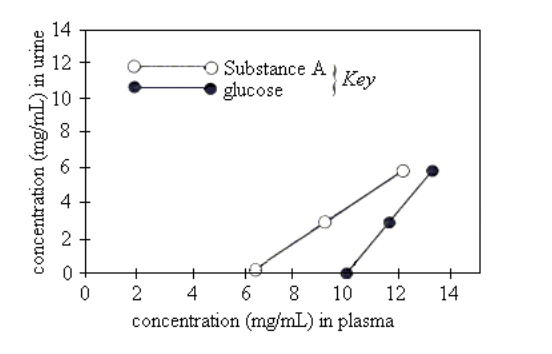
Equal concentrations of 8 mg/mL of Substance A and glucose are found in a volunteer's plasma. Based on Figure 1, which substance will the kidney clear from the plasma more rapidly?
A. Substance A, because the slope of the clearance line for Substance A is higher than that for glucose
B. Substance A, because Substance A reaches its Tm at a lower plasma concentration than does glucose
C. Glucose, because glucose reaches its Tm at a higher plasma concentration than does Substance A
D. Glucose, because the slope of the clearance line for glucose is lower than that for Substance A
B
In Experiment 2, the increased blood pressure resulting from the higher-than-normal concentration of ADH most likely affected the urinary output of Substance A by increasing the:
A. glomerular filtration rate.
B. Tm of solutes.
C. water reabsorption from the tubules.
D. concentrating ability of the loop of Henle.
A
Increased vasoconstriction has an important role in which of the following situations?
A. Causing the decrease in blood pressure associated with fainting
B. Increasing blood flow to muscle during exercise
C. Increasing blood flow to skin during blushing
D. Maintaining blood pressure during a hemorrhage
D
Accumulation of DDT in the testes may cause reduced fertility in males because the uncoupling of oxidative metabolism from ATP production may reduce:
A. glucose concentration of semen.
B. testosterone concentration of semen.
C. blood circulation in the testes.
D. sperm motility.
D
If DDT accumulates in the liver, all of the following bodily functions may be significantly impaired EXCEPT:
A. absorption of fats in the small intestine.
B. production of bile.
C. detoxification of poisons.
D. regulation of blood pressure.
D
DDT would most likely initiate cancer or cause a mutation if which of the following structures is damaged?
A. Nuclear envelope
B. Chromosome
C. Ribosome
D. Histone
B
Stomach ulcers have long been thought to result from the overproduction of HCl by the gastric mucosal cells…
Scientists suspected that another factor was the true cause of ulcers. A spiral-shaped bacterium, Helicobacter pylori (H. pylori)
Based on the passage, which of the following methods would best prevent the recurrence of stomach ulcers?
A. Use of drugs that prevent the production of acid
B. Use of drugs that neutralize stomach acid
C. Use of drugs that inhibit bacterial protein synthesis
D. Use of drugs that inhibit acid production and bacterial protein synthesis
D
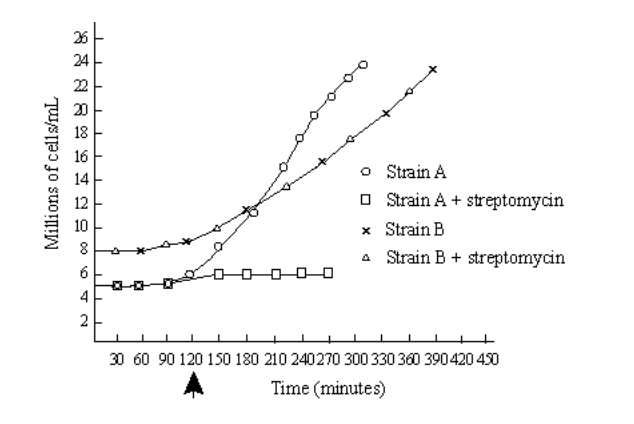
Which of the following explanations best accounts for the results in Figure 1?
A. Strain A grows faster than strain B.
B. Strain A grows faster than strain B and is also resistant to streptomycin.
C. Strain B grows faster than strain A and is also resistant to streptomycin.
D. Strain B grows slower than strain A and is also resistant to streptomycin.
D
Most bacterial cells and human cells are alike in:
A. the ability to produce ATP via ATP synthase.
B. the chemical composition of their ribosomes.
C. their enclosure within cell walls.
D. the shape of the self-replicating structures that carry their DNA.
A
A low level of calcium in the plasma will trigger an increase of:
I. osteoclast activity.
II. parathyroid hormone.
III. vitamin C.
A. I only
B. I and II only
C. I and III only
D. II and III only
B
Under what condition would the level of calcitonin tend to increase?
A. When there is a dietary deficiency of calcium
B. When there is a dietary deficiency of vitamin D
C. When the level of calcium in the plasma is high
D. When the level of parathyroid hormone is too low
C
What would be the result of complete removal of the parathyroid glands?
A. Severe neural and muscular problems due to deficiency of calcium in the plasma
B. An increase in calcitonin production to compensate for calcium deficiency in the plasma
C. A drastic change in the ratio of mineral to matrix tissue in bones
D. Calcification of some organs due to accumulation of calcium in the plasma
A
If Anolis lizards have X-Y chromosomal sex determination, the locus of a gene for the UV reflectance pigment:
A. must be on the X chromosome.
B. must be on the Y chromosome.
C. must be on an autosome.
D. could be on a sex chromosome or on an autosome.
D
Two neighboring lizard populations would be considered separate species if:
A. one population inhabited the forest and the other lived in a field.
B. one population had a UV-reflective dewlap and the other did not.
C. they did not communicate with each other.
D. they did not interbreed and produce fertile offspring.
D
The chemical gramicidin inserts into membranes and creates an artificial pathway for proton movement. Based on Figure 1, if mitochondria are treated with gramicidin, the rate of ATP synthesis will most likely:
A. increase, because of increased proton movement back into the mitochondria.
B. decrease, because of a decreased rate of hydrogen-atom donation by NADH.
C. decrease, because the proton gradient will rapidly reach equilibrium.
D. not be altered, because sufficient protons will remain between the membranes to generate ATP.
C