Chemistry Quiz 8 Study Guide Terminology
 Call Kai
 Learn
Learn Practice Test
 Spaced Repetition
 Match
Match Flashcards
 Knowt Play
1/13

There's no tags or description
Looks like no tags are added yet.
Name | Mastery | Learn | Test | Matching | Spaced | Call with Kai | Chat |
|---|
No analytics yet
Send a link to your students to track their progress
14 Terms
What is organic chemistry?
The study of molecules composed primarily of carbon, but could also contain hydrogen, oxygen, nitrogen, sulfur, phosphorus, and/or halogens
Includes:
naming organic molecules
properties of organic molecules
reactions of organic molecules
What are the organic molecules?
Ethanol
Tylenol
Acetic Acid
Vitamin C
Amino Acids
Testosterone
Glucose
Fatty Acid
Acetone
Carbon Dioxide
Methane
What are the inorganic molecules?
Sodium Chloride
Silicon Dioxide
Iron
Potassium Hydroxide
Hydrochloric Acid
Nitrogen Gas
Calcium
Rust (iron oxide)
Why is carbon so special?
Contains 4 valence electrons
Can make 4 bonds
Small in size
Forms single/double/triple bonds
Medium electronegativity
Can make strong bonds with various other atoms
Gets polar & non-polar molecules
What are hydrocarbons and their types?
Simplest organic compounds that only contain carbons and hydrogens.
Types
Alkanes
Alkenes
Alkynes
What are alkanes?
Contain only single bonds
Saturated hydrocarbons: max number of single bonds
Tetrahedral structure
# of isomers increases as the # of carbons
General Formula:
CnH2n+2 (open chains)
What are alkenes?
Contain at least one C=C double bond
General Formula:
CnH2n (for one double bond, acyclic)
What are alkynes?
Contains at least one C≡C triple bond
General Formula
CnH2n-2
What are isomers?
Compounds with same molecular formula but different structures.
Structural isomers: occur due to branching in an alkane.
Stereoisomers (later: geometric isomers for alkenes, enantiomers for chiral centers).
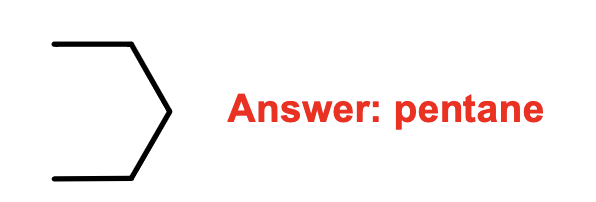
Rules for Naming Linear Chain Alkanes
Find the longest continuous carbon chain
Suffix is “-ane.”
Count Carbons to get Prefix
1 = meth-
2 = eth-
3 = prop-
4 = but-
5 = pent-
6 = hex-
7 = hept-
8 = oct-
9 = non-
10 = dec-
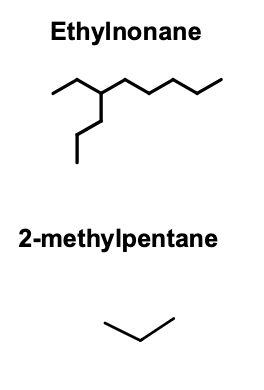
Rules for Naming Branched Alkanes
Find the longest continuous carbon chain
Branches (substituents) get suffix “-yl.”
Count Carbons to get Prefix
1 = meth-
2 = eth-
3 = prop-
4 = but-
5 = pent-
6 = hex-
7 = hept-
8 = oct-
9 = non-
10 = dec-
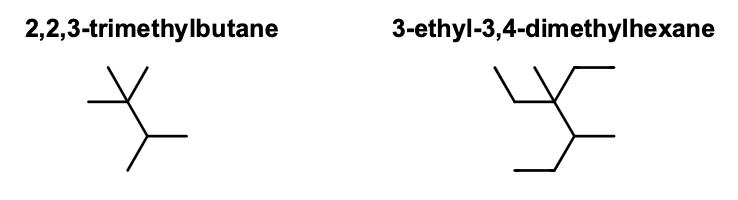
Rules for Naming Multiple Alkane Substituents
Linear Chain with Multiple Offshoots
Find the longest chain
Order substituents alphabetically
Use a prefix for repeating groups & give them the lowest #’s
2 = di-
3 = tri-
4 = tetra-
5 = penta-
6 = hexa-
Physical Properties
Non-polar → insoluble in water.
Density < 1 g/mL (float on water).
Boiling & melting points increase as the # of carbons in the alkane increases
Greater surface area to make more dispersion forces (interactions).
Branching lowers melting & boiling points as molecules cannot get as close together.
Cycloalkanes: similar to acyclic of same carbons; small rings (cyclopropane) are strained.