Licensing a New Drug PY367
 Call Kai
 Learn
Learn Practice Test
 Spaced Repetition
 Match
Match Flashcards
 Knowt Play
1/184

There's no tags or description
Looks like no tags are added yet.
Name | Mastery | Learn | Test | Matching | Spaced | Call with Kai | Chat |
|---|
No analytics yet
Send a link to your students to track their progress
185 Terms
Thalidomide issues
Phocomelia
Correlated with increased exposure to
Television
radioactive fallout from atomic bomb testing
Birth defects became apparent within a year of launch of the drug and ceased within 9 months of withdrawal
Expectations for medicines?
Safety - safe for consumption
Quality - equal quality for each dose
Efficacy - is it working?
What is the MHRA?
Medicines and healthcare products regulatory agency
What do the MHRA do?
Maintaining safety, quality and efficacy for all products like insulin pumps and blood components
Educate public and HCP about benefits and risks of medicine for safer practise
Promote international standardisation and harmonisation to assure the effectiveness and safety of biological medicines
What are the key questions for the MHRA?
Do advantages outweigh disadvantages?
Does medicine do most good than least harm for most people taking it?
Are side effects acceptable?
The MHRA handles the safety profile, but who handles the commercial side and how?
NICE handle commercial side
Funding of the drug
Whether its routinely used in NHS
Is the drug better than its opposition already on market
Why is an increase in HIV diagnosis not bad?
Increases are because of more testing and screening than prior
No correlation with deaths as it did not change after this
What was the Government’s 20 point plan of action?
Fund testing
Government
Tackle stigma
Mandatory training for staff
Prioritise partner notification
Treat all late diagnosis as serious incidents
Fund HIV prevention
PrEP = pre-exposure prophylaxis
Publicly available granular data
Funding
What is Combination Prevention?
Use condoms when possible
PEP - Treat with high dose Efavirenz ASAP
Prevents acquisition following potential exposure
Treatment as prevention - Prevents transmission between partners
PrEP - Prevents acquisition
EMTRICIBINE + TENOFOVIR
Expand HIV testing - Very sensitive and easy to use
Structure of HIV
Single stranded RNA
Reverse transcriptase
Inside capsid
Inside matrix
Inside cell
gp120 spike protein which helps virus infiltrate CD4+
Host cell proteins come from person you caught virus from
HIV Lifecycle
Binding - HIV Gp120 binds to receptors on CD4 surface
Fusion - HIV envelope and CD4 cell membrane fuse which allows HIV to enter CD4 cell
Reverse transcription - HIV releases this to convert RNA to DNA, allows HIV to enter CD4 nucleus and combine with cell DNA
Integration - Inside nucleus, HIV uses integrase to insert viral DNA into CD4 DNA
Replication - Begin to make long HIV proteins
Assembly - Move to cell surface and assemble to immature HIV
Budding - Immature HIV pushes out cell and releases protease to break up long chains to form mature HIV
What two things does HIVRT do?
Two enzymes in one
Builds DNA strand using viral RNA template
Degrades original RNA strand to build complimentary DNA strand because body has TLR3 (toll-like receptors) which protects cell against foreign RNA
Can continue replication process
What should a scientific study do?
Seeks to establish facts
Things known to have occurred or be true (OED)
Contributes to knowledge
Confirms, adds to or establishes theory
a conceptual framework that explains existing observations and predicts new ones
Should be controlled to be free of bias
Should be designed on a scale that the results can be statistically evaluated
What is the 4 step basis for clinical trials?
Hypothesis
Experiments
Data
Conclusions
What are two issues with detailed scientific studies?
Expensive to conduct
Require specialised skilled operators
Design
Analyse
Interpret data
What is Epidemiology?
Study of how often diseases occur in different groups of people and why
Used to plan and evaluate strategies to prevent illness and as a guide to the management of patients
Relate primarily to specific groups of people
What are 3 types of clinical studies?
Qualitative research
Focus groups and individual interviews
Observational studies
Case studies
Cohort studies
Cross-sectional studies
Experimental studies
Clinical trials
What is qualitative research?
Collect and analyse non-numerical data
Understand concepts, opinions and experiences
Gather in-depth insights into problems
Generate new ideas for research
What are observational studies?
Researchers observe effect of something on a population
Disease
Risk factor
Diagnostic test
Treatment or intervention
Not experimental
What are cross-sectional studies?
Measure frequency of a disease or condition in a defined population at a given time
What are case studies?
Medical history of one (or small group of) patient
No control group
What are case control studies?
Compares patients who have condition with a group who do not have that condition
Look at risk factors that may have impact on condition
Advantages:
Good for studying rare conditions
Quick to set up
Limitations:
Clinical records may be inconsistent
May rely on memory
What are cohort studies?
Observational studies of subjects with a specific disease or characteristic
May be compared to a control group
Usually over a long time period
What time period do these 3 focus on?
Case control - past
Cross sectional - present
Cohort - future
What are experimental studies?
Introduce intervention and study effects on treated population
What are 4 requirements for clinical trials?
Specified condition
Specified treatment
Test and control group
Measure outcomes
What are randomised controlled trials?
Population of patients
Divided into 2 groups
Trial group compared with control group
What is meta-analysis?
Systematic review that focuses on numerical results
Combine results to produce estimate of overall effect size
Data from several trials are pooled and averaged to estimate overall effect
No new raw data collected
Hierarchy of evidence
Systematic review / meta analysis↓
Randomised control trials↓
Cohort studies↓
Case control studies↓
Case series /reports
What 5 things does admin of new substances with therapeutic potential determine? EBSTA
Efficacy
Bioavailability
Safety
Tolerability
Acceptability
The medicines for human use regulations 2004
GCP
GMP
Regulatory inspection and enforcement
Protections of incapacitated adults
Protection of minors
Pharmacovigilance arrangements
What is good clinical practice under IHC guidelines?
Risks and potential benefits assessed before trials starts
Interests of the individual study subject must take precedence over those of science or society
All trial subjects must give consent
Trials must be scientifically sound and have clear protocol
Trials must be approved by ethics committee
Only qualified staff
Preclinical testing complete
Product of adequate quality
What are the 4 phases of clinical trials?
First admin and safety evaluation in man - usually healthy volunteers (don’t have to do this for older drugs being used for new disease trials)
Early exploratory and dose-finding studies in patients
Large scale studies
Post-marketing safety monitoring
Some complications to consider with population
Most phase 1 volunteers are men
In EU, Only post-menopausal woman can participate
Genetic polymorphisms
Fast or slow metabolisers
What are phase 1a trials and what do they test?
Single dose trials
Escalating dose from one cohort to the next
Max tolerated dose determined
Establishes pharmacokinetic parameters
Peak
Time to peak
Vol. of distribution
Rate of elimination
Bioavailability
What are phase 1b trials?
Similar participants to phase 1a
Escalating repeated-dose
Establishes steady state dosing requirements
What is the difference between phase 2a and 2b trials?
a is exploratory, b is confirmatory
a aims for preliminary safety and efficacy to support go/no-go decision
Dose and regimen based on p1 data
Randomised or double blind trials
b aims for dose selection to support registration
b uses selected dose levels whereas a works off p1a
What does phase 3 trials do?
Patients in target indications
Provides efficacy and safety data to support registration
May include pharmacoeconomics
Includes different ages and ethnic groups rather than singular cohort groups
Data is statistically rigorous
What are phase 4 trials?
Post-marketing surveillance
Reveals unexpected adverse events and/or toxicity
Done on treated patients
Why do trials fail?
Insufficient biological activity (Lack of therapeutic efficacy)
Unacceptable toxicity
Problems in design of trial
Patient selection
Sample size and duration
Problems in execution of trial
Patient randomisation
What is the yellow card scheme?
Reporting system for side effects in medication
Used by HP and made by pts.
MHRA takes action to ensure medicines are used in way that minimises risk, maximising benefit
What are black triangle drugs and products?
Monitored for 2 years after marketing
HP recommended to report all suspected adverse reactions to these products through yellow card scheme
There is relatively limited info about safety of new drugs from clinical trials in UK
They contain new combo of active substances
New routes of admin or drug delivery systems
Significant new indications which may alter established risk/benefit profile of that drug
What do the DMRC do?
Issues alerts to HP, hospitals, GP surgeries and wholesalers
Tells them when a medicine is being recalled or when there is concern about quality
What are 4 classes of recalls?
Life threatening: immediate e.g. complete wrong drug inside packaging
Harmful: within 48 hours e.g. fungal contamination
Unlikely to harm: action required within 5 days e.g. PIL errors
No threat to patient safety: caution advised e.g. Wrong number of tablets in packs
What is marketing authorisation?
Given by MHRA to freely place products on the market
Demonstrates evidence of quality safety and efficacy before MA approved
What is the process of making the product work?
Take lead activity molecule
Make structural modifications to achieve best possible pharmacodynamic and kinetic properties
Formulate into acceptable medicine
How is efficacy shown?
Animal models at start then to human models (in-vitro to in-vivo)
If it has effect you wanted but does not benefit pt. it won’t get approved
Provides benefit to patient with minimal SE
Improves symptoms as well as having desired effect
Does showing efficacy reduce the risk of something happening?
Event rate = number of people experiencing an event (e.g. myocardial infarction) as a proportion of the population (e.g. HTN pt.)
How is the benefit quantified?
loTens technique
ARR = ARC - ART
RRR = (ARC - ART) ÷ ARC
Number needed to treat (NNT) Equation
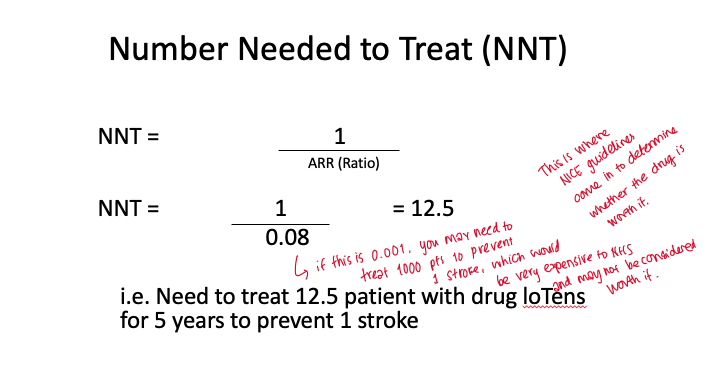
How do you demonstrate efficacy?
Provide robust evidence that product will do as label describes
Evidence needs to be scientific and capable of statistical analysis
What is a placebo?
Inert substance or dosage form which is identical in appearance, flavour and odour to active form
Used as negative control in bioassay
Are placebos always acceptable?
No because of ethics as not treating conditions like HIV would be unethical
What does statistical analysis require?
Requires comparison between two groups by use of maths
What is the null hypothesis?
Clinical outcome for patients receiving drug X will not be better than those receiving placebo
How to set up clinical trials?
Recruit a number of patients with a condition which depends on frequency of condition e.g. diabetes easier than Lupus (poor market)
Divide them into two groups, test and control
At end of trial compare results
How to remove the play of chance in clinical trials?
Use a bigger sample to remove play of chance
What are confounding factors?
Difference in groups that may affect results e.g. City A is industrial, City B is seaside town
What is central assumptions made on results?
Outcomes of trial applicable to treatment population as whole
DOES NOT always follow this so we have POST TRIAL MA
Also try to mirror treatment population as much as possible
Possible flaws in trials
Are there enough people to see a statistically significant event?
Unethical to run underpowered study
There could be observation bias hence double blind trials
Confounding factors like lifestyle and diet
Type I and II errors
How to identify treatment population?
Must mirror treatment population
Nature of condition
Demographics
Age
Gender
Ethnicity
Social background (probably not married people for HIV)
Inclusion criteria
Identify the condition to be treated precisely
Use clinical diagnosis and standardised measurement scales
Exclusion criteria
Exclude those for whom the treatment would not apply
E.g. - Exclude type-1 diabetics from a trial for a drug for type-2 diabetes
Identify factors that might interfere with the results
Co-morbidities
Other medications
Factors affecting adherence to protocol e.g. Alzheimer’s
Normal distribution
Population shows variance when measured against criteria
Trial population MUST mirror the treatment population in all criteria
Trial population is divided into two
Test or intervention group
Control group
How to make outcome of trial true?
Randomisation of allocation of test and control
Test and control groups same at start of trial
Outcomes at end of trial for test and control are different if demonstrated statistically
What is double-blind trial?
Neither operators nor patients know treatment
What is crossover trial?
Switch control and test groups halfway through which should show in results
Applicable to conditions like pain relief, insomnia and some chronic conditions
What is the power of trial determined by?
Sample size
Larger sample size, larger power
Increasing sample size = Increased costs
Size of experimental effects
If null hypothesis is wrong by a substantial amount, power will be higher than if is wrong by a small amount
Level of errors in experimental measurements
Intention to treat (ITT)
ITT analysis includes all randomised patients in the groups to which they were assigned
Regardless of treatment received and drop-outs
They leave cuz of AE and do not want continue
High drop-out rate compromises power of the trial and could hide confounding factor
ITT reduces risk of bias
On-treatment analysis (OT)
Analyse data from the completionists (drop-outs not accounted for)
How to maintain consistency in data collection?
All participants treated equally
Data collected by same protocol for each person
Deviation = bias
Impact of the outcome of a trial relates to……
Overall health benefit of therapy
Relative risk reduction
Absolute risk reduction
Numbers needed to treat
How to measure Adverse Effects?
Number needed to harm
SAME AS NNT
What 3 centres form MHRA?
Clinical practise research datalink
National institute for biological standards and control
Medicines and healthcare products regulatory agency
What is an IND?
Investigation into a new drug
Requirement for IND application
Extensive evidence of pre-clinical studies on animal cells
Therapeutic evidence
Pharmaco and kinetic evidence
Design of trial
How was it manufactured
Parts of IND application
Part A: Introductory statement and general investigational plan
Part B: Protocols
Part C: Chemistry, manufacturing and control info
Part D: Pharmacology and toxicology info
Part E: Previous human experience with investigational drug
Part F: Additional info
Assessment process
Medicinal group look at your plan
Chemical group look at standard of manufacturing
Pharmaco and toxic group look at pre-clinical studies
Statistical group in depth evaluation on number of sampling done
What is the CTA?
Clinical trial authorisation
What does the toxicologist, medical assessor and pharmacist look at?
Toxicologist: Safety of product from non-clinical testing and design side
Medical assessor: Look at safety of trial from human data and pre-clinical perspective
Pharmacist: Look at safety of quality of drug
What happens with a MA application?
Common technical document or new drug application
Module 2: Detailed appendix of whole application - most critical area
Module 3: Quality
Module 4: Non-clinical study reports
Module 5: Clinical study reports
Explain Module 3: Quality
Variety of info on compound and its manufacturing
Recommended international non-proprietary name
Characterisation of compound
Manufacturing process
Control and stability
Explain Module 4: Non-clinical study reports
Pharmacology and pharmacokinetics
Toxicology data
Genotoxicity
Carcinogenicity
Productive and developmental toxicity
Explain Module 5: Clinical study reports
Biopharmaceutical studies
Pharmacokinetic studies using human biomaterials
Human pharmaco and kinetic studies
Efficacy and safety reports
How is new drug application assessed?
Reviewed by Medical, pharmacology, chemistry, biopharm, statistical, microbio groups
Module 3 would be chemistry or biopharm
Module 4 would be pharmacology
Module 5 would be medical
All modules looked at by stats
Module 3 looked at by microbio
Final things are label review and site inspections acceptable
Generic drug review process
Plant inspection
Chem and micro review
Labelling review
Bioequivalence review
What is mutual recognition?
When two countries are happy with a single process used for supply of a drug
What does antiviral chemotherapy try to do? And 3 targets?
Try to exploit differences that exist between viral and host cells
Targets unique to virus
Targets in virus similar but not identical to those in host cells
Target in virus shared by host cell, but vary in importance between viral and host cell
What are the 4 aims of HIV treatment? as well as why it is incurable?
Eradication of HIV infection cannot be achieved with current antiretroviral regimens
In earliest stage of HIV infection, large pool of infected CD4s
Primary goals for initiating antiretroviral therapy:
Reduce mortality and morbidity
Restore and preserve immunological function - recoup CD4s
Maximally and durably suppress plasma HIV viral load
Reduce transmission of disease - condoms + treatment
What is latent infection?
Retroviral genome is present but is not transcribing viral genome or mRNA for structural proteins
Only DNA present, RNA indicates active infection
3 more aims of HIV treatment?
Balance of prevention of latent → active and risks of toxicity
Need commitment to treatment and adherence
Drug resistance generally overcome by using drug combo
When to start treatment?
Start treatment ASAP after diagnosis
Advantages of HIV treatment
Once viral load undetectable, HIV cannot be passed on
Less illness due to restoring CD4 function
Treatment stops HIV reproducing in body
Immune System gets stronger
What are key target sites for treatment and drug classes?
Fusion inhibition
Chemokine receptor antagonists
Inhibition of reverse transcriptase
NRTIs and NNRTIs
Inhibition of DNA integration
INIs
Interference with protein manipulation
Protease inhibitors
Interference with capsid maturation
Maturation inhibitors
What are 4 examples of fusion/entry inhibitors?
Fusion inhibitor - Enfuvirtide
Unclear MOA
CCR5 antagonists - Maraviroc
Most commonly used
- Virus requires CCR5 to enter cell
Post-attachment inhibitors - Ibalizumab
After HIV binding, prevents entry
Attachment inhibitor - Fostemsavir
Prevent initial binding
How do NRTIs work?
They are nucleoside analogs that when phosphorylated, mimic deoxyribonucleoside triphosphates (DNA bases)
Become incorporated into growing DNA chain and terminate elongation because they’re recognised as foreign so not full length of DNA
This is competitive inhibition
Examples
Zidovudine (side)
Abacavir (side)
Emtricitabine (side)
Lamivudine (side)
Tenofovir (tide)
What can cause resistance to NRTIs?
Mutations in HIV RT’ase can cause resistance via two mechanisms
Discrimination: RT becomes smarter and detects difference between drug and DNA base so drug isn’t incorporated into chain
Excision: Removes drug from chain to continue chain addition
How to prevent resistance to NRTIs?
Combo of different drugs like Emtricitabine and Tenofovir = nucleoside and tide
RT struggles to mutate to differentiate between nucleoside and nucleotide
How do NNRTIs work?
Non-competitive inhibition of HIV-1 RT
Binds hydrophobic pockets adjacent to enzyme-active site
Changes structure of active site so you lose enzyme activity
Not chain breaker
Resistance possible as RT can change shape of pocket where NNRTI binds so they can’t bind and work
Examples
Nevirapine
Efavirenz
Increased incidence of TDM, CNS events and cardiac events
Name a 2nd gen NNRTI and any changes from 1st gen
Etravirine
Continued development due to high toxicities with earlier drugs
Still one of first line drugs
Taken every single day so toxicity reduction is necessary
Rilpivirine
Improved tolerability esp. CNS and less susceptible than other NNRTIs to resistance mutations