C4.1 Population & Communities
 Call Kai
 Learn
Learn Practice Test
 Spaced Repetition
 Match
Match Flashcards
 Knowt Play
1/41

There's no tags or description
Looks like no tags are added yet.
Name | Mastery | Learn | Test | Matching | Spaced | Call with Kai | Chat |
|---|
No analytics yet
Send a link to your students to track their progress
42 Terms
Define population
Interacting groups of organisms of the same species living in one area
Compare the interactions within & between populations [3]
Members of a population share a common gene pool & typically breed w/ each other
Different populations are often separated by geographical or other barriers
No gene flow = reproductive isolation
Explain why sampling is used to measure population size [4]
Counting every individual is an impractical way of measuring population size due to the following reasons:
Populations may be very large & vastly spread
Animals are mobile & many are camouflaged
As a result, a representative sample is used as an estimate
Describe and evaluate the use of random sampling [3]
Sampling procedures require randomness, meaning subjects have an equal chance of selection
This is to reduce bias, both conscious & unconscious
However, this method inevitably results in sampling error where the estimated population size differs from the true size
What is a quadrat and its use?
A quadrat is a square frame used to mark a small area in a habitat
It is used to count how many sessile (non-moving) organisms are inside
It is placed randomly to avoid bias
Describe the method of random quadrat sampling [5]
Step | Method |
1. Define the area | Measure the total site to be estimated |
2. Select positions | Generate random x- and y-coordinates & place quadrats at those positions |
3. Count consistently | Identify the species correctly & use a fixed rule for individuals touching the quadrat boundary |
4. Repeat | Use many quadrats to represent spatial variation |
5. Estimate population size |  |
What is standard deviation & its use in population measurement? [4]
Standard deviation is a statistic that measures variability of data
In context of population, it can measure how evenly distributed organisms are:
Low standard deviation: Similar number in each quadrat = population evenly spread
High standard deviation: More clumped in some quadrats = population unevenly spread
What is the use of Capture-Mark-Release-Recapture?
Estimate the population size of motile (moving) animals
Describe the method of Capture-Mark-Release-Recapture [4]
Capture a sample of individuals (M) & mark them
Release these individuals & allow them to mix
After some time, capture another sample (N)
Count how many marked individuals are recaptured (R)
What are the assumptions of Capture-Mark-Release-Recapture? [6]
1) No immigration or emigration during study
2) No births or deaths during study
3) Marked individuals mix evenly back into the population
4) Marked & unmarked individuals have equal chance of capture
5) Marks stay identifiable
6) Marks do not affect behaviour or survival
What is the Lincoln Index, and its use?
The Lincoln Index uses values collected from CMRR to estimate population size

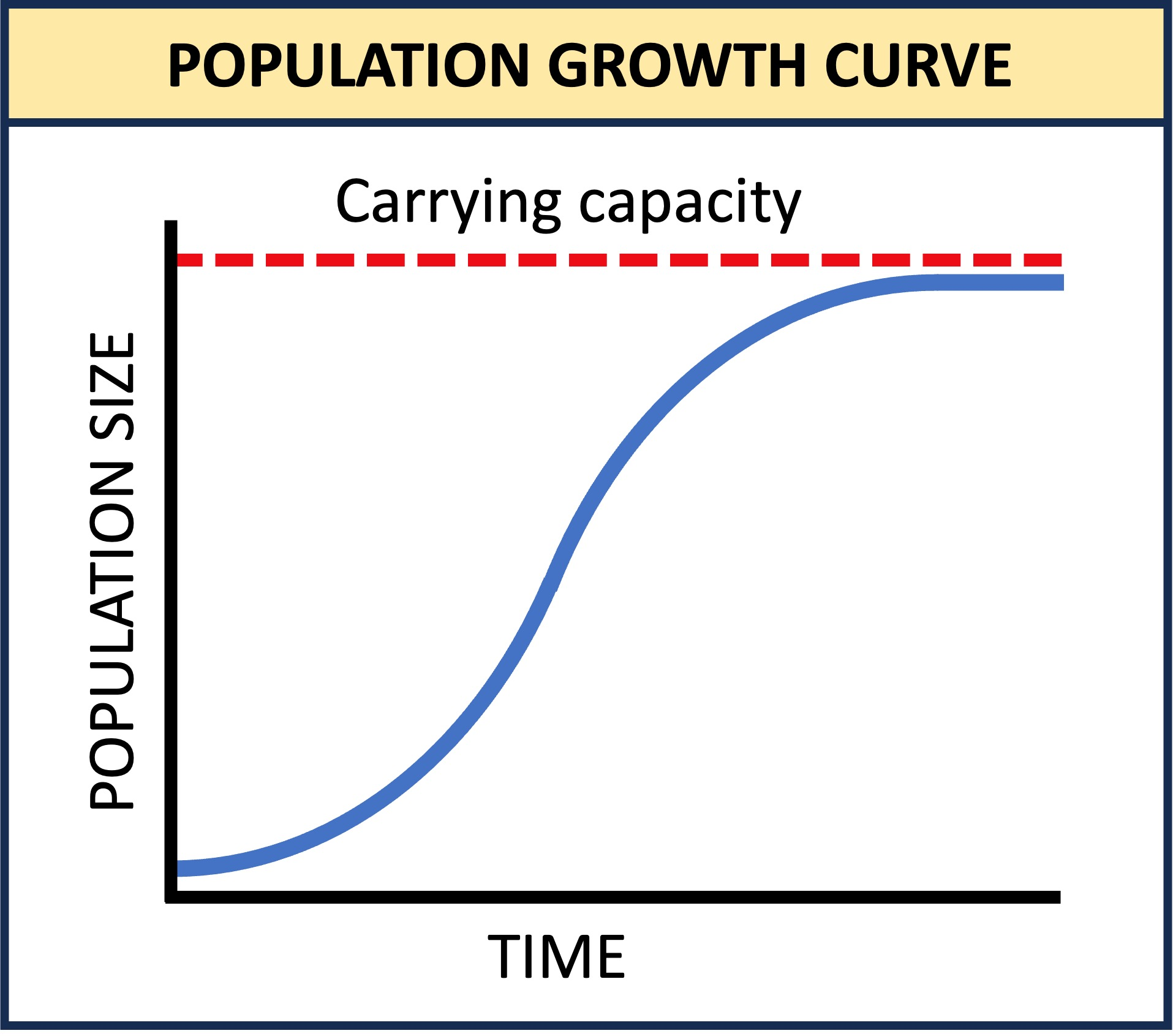
Define carrying capacity
The maximum number of individuals an environment can support
Explain the principle of carrying capacity [2]
As resources are limited, once a population exceeds its carrying capacity, competition will begin
Examples: Food/mineral nutrients, water, space, & light
What are the two types of factors that impact population growth?
1) Density-dependent
2) Density-independent
Describe the role of density-dependent factors and give examples [5]
Have stronger effects on greater population density
Examples: competition for resources, increased predation, diseases, pests
They create a negative feedback effect:
When population grows too big → effects strengthen to reduce it back towards carrying capacity (death rate ⬆, birth rate ⬇)
When population drops too low → effects lessen to allow growth again
Describe the role of density-independent factors and give examples
Impacts populations regardless of density (fluctuations only)
Examples: Natural disasters, weather changes, fires
What is a sigmoid curve?
A sigmoid (S-shape) curve is a model that illustrates an ideal population growth with three phases
Describe the phases of sigmoid curve of population growth
Phase | Main trend | Features |
1. Exponential phase | Rapid population growth |
|
2. Transitional phase | Growth slows |
|
3. Plateau phase | Population levels off at carrying capacity |
|

[CS] Population growth - St Matthew Island reindeer [3]
A herd of reindeer were introduced to the island, with population increasing rapidly
Then, demand exceeded food supply (e.g. lichens) & harsh winter conditions led to severe drop in population
It shows why real growth may not follow a stable sigmoid curve
Define intraspecific relationship
A relationship that exists between individuals of the same species, and typically within the same population
Explain intraspecific competition [3]
Some members of a population have the same ecological niche = require same resources
Since resources are limited, individuals will compete for them
Successful individuals will survive & reproduce → natural selection that pass down traits advantageous for competition
Explain intraspecific cooperation [2]
Members of the same species also work together for mutual benefit
This helps improve survival through boosting the efficiency of hunting, defence, or care for offspring
Define community
All populations of different species living and interacting together in the same area
Define ecosystem
A community of organisms and its abiotic environment, along with interactions between them
Define interspecific relationship
A relationship that exists between individuals of different species
Describe the categories of interspecific relationship & give examples for each [6×3]
Category | Description | Example |
Herbivory | When primary consumers feed on producers | Caterpillar feeding on leaves |
Predation | When one consumer species (predator) kills & eats another consumer species (prey) | Anteaters feeding on ants |
Interspecific competition | Two or more species using the same resource, where the amount taken by one species reduces the availability for another | Ivy competing with oaks for water & nutrients |
Mutualism | Two species live in close association, with both species benefiting from it | Coral & zooxanthellae exchange resources |
Pathogenicity | One species (pathogen) lives inside another species (host) & causes a disease in it | Anthrax bacteria in kudu (African antelope) |
Parasitism | One species (parasite) lives in/on another species (host) & obstains food from them → parasite benefits but host is harmed | Black-legged ticks on white-tailed deer |
[CS] Describe the mutualistic relationship between Fabaceae & Rhizobium bacteria [3]
Plants in the pea & bean family, e.g. Fabaceae, form a mutualistic relationship w/ Rhizobium bacteria
Benefit to Bacteria | Benefit to Fabaceae |
Fabaceae grows a root nodule which provides sugars & a low oxygen environment for bacteria to live | Bacteria can convert nitrogen gas into ammonium ions (NH4) → some are supplied to the plant which promotes growth in low-nitrogen soils |
[CS] Describe the mutualistic relationship between Orchid & Mycorrhizal fungi [3]
The hyphae of mycorrhizal fungi, e.g. Russula, grow & penetrate orchid’s root cell wall
Benefit to Orchid | Benefit to Fungus |
The hyphae serves as extension to the root system, passing water & mineral nutrients to orchid | Orchid supplies fungus w/ sugars & other carbon compounds made by photosynthesis |
[CS] Describe the mutualistic relationship between Zooxanthellae & Coral [3]
The cells of most reef-building hard corals contain zooxanthellae
Benefit to Zooxanthellae | Benefit to Coral |
Coral provides shelter & nutrients (e.g. CO2 from aerobic respiration) | Zooxanthellae perform photosynthesis which supplies sugar to the coral |
Distinguish an endemic & alien species
Endemic: A species that occurs naturally in an area
Alien: while species that are introduced by humans
How does a species become invasive?
When an alien species increases in number, spreads rapidly, & causes ecological harm, they become an invasive species
Explain the competitive advantage of invasive species & the consequence [5]
Invasive species often have a competitive advantage over endemic species in acquiring resources due to:
Lack of natural enemies (e.g. predators)
Rapid reproduction & spread
Genetic traits (e.g. better resource use/tolerance to tough conditions)
Consequence: As a result, endemic species may occupy a smaller realised niche, decline in population, or eventually become extinct
Invasive species example - Red lionfish [3]
Invaded Caribbean & Atlantic waters
Due to lack of predators, they multiplied & spread on coral reefs
They outcompeted endemic fish like Groupers for food & space, establishing territories exclusive to their species

Describe the different tests for interspecific competition
1) Observation - Use random sampling to compare abundance/distribution of both species
2) Laboratory experiments - Growing species together & apart while controlling abiotic conditions
3) Field manipulation experiments - Remove or reduce one species from selected plots & study response of the other species
Competition is evidenced if the other species increases in number or biomass
Describe the steps to a chi-squared test for association between two species [7]

Describe how predator-prey interactions allow density-dependent population control
The size of one population influences the size of another
High prey density supports larger predator populations, while low prey density reduces predator numbers
The numbers of predators & prey often show a regular cyclical pattern over time
[CS] Describe the density-dependent control of Red fox and mountain hare in Sweden [4]
Change | Consequence |
1. Hare population grows | Due to prey availability, fox population increases |
2. Fox population grows | Due to intensified predation pressure, hare population decreases |
3. Hare population falls | Due to lower food supply, fox population decreases |
4. Fox population falls | The system stabilises until hare numbers recover, restarting the cycle |
Describe the two types of population control in communities [3]
1) Top-down control - Higher trophic levels (predators) regulate the population sizes of lower trophic levels (prey)
2) Bottom-up control - Lower trophic levels (producers) regulate the population sizes of higher trophic levels (consumers)
Both controls can operate in the same community, but one may have a dominant effect
What is allelopathy & its role? [6]
Definition: A process where plants secrete chemicals (allelochemicals) into the soil or air to that negatively affect the growth of other plants
This process will inhibit:
Seed germination
Root growth
Nutrient absorption
This allows allelopathic plants to secure more resources for survival (e.g. sunlight, water, nutrients), giving them a competitive advantage
[Example] Describe the allelopathic nature of the Tree of Heaven [2]
It releases the secondary metabolite alianthone into the soil, inhibiting germination, growth, & survival of other tree species for up to 5m from its trunk
This reduces competition for nutrients & space
What is the secretion of antibiotics, & its role?
Definition: A process where microorganisms produce & secrete chemical substances (antibiotics) that kill or inhibit the growth of other microorganisms
Antibiotics target critical cellular processes in bacteria, such as:
Inhibiting cell wall synthesis
Blocking protein production
Disrupting DNA replication
This gives microbes a competitive advantage
[Example] Describe how Penicillium uses antibiotics to reduce competition [3]
Penicillium is a genus of fungi secrete penicillin, an antibiotic that is toxic to bacteria
It interferes with the cross-linking of peptidoglycan molecules in the cell walls of Gram-positive bacteria → weakening walls so bacteria burst & die
This reduces competition for habitat & food