Monster Test - WHH Cook
 Call Kai
 Learn
Learn Practice Test
 Spaced Repetition
 Match
Match Flashcards
 Knowt Play
1/20

There's no tags or description
Looks like no tags are added yet.
Name | Mastery | Learn | Test | Matching | Spaced | Call with Kai | Chat |
|---|
No analytics yet
Send a link to your students to track their progress
21 Terms
World War I (pg 678-697)
…
When was the war fought?
1914-1918
Four sources of tension in Europe which led to the war
M - militarism (many countries, esp germany and england were growing their militaries, grew out of social Darwinism)
A - alliances (Triple Entente and Triple Alliance —> Allies and Central Powers)
N - nationalism (franco-prussian war, russia & the balkans)
I - imperialism (france & germany fight over morocco)
Event that sparked the war — Why did it occur?
Assassination of Archduke Franz Ferdinand in Bosnia, Austria-Hungary. The Black Hand, a terrorist organization with members plagued by tuberculosis, wanted to assassinate the archduke. They failed initially, but Gavrillo Princip managed to shoot him being in the right place at the right time. From there, Austria-Hungary declared war on Serbia, which then caused Germany to support AH and then Russia supported Serbia, and France supported Russia, and then Germany declared war on France.
Final Alliances (before the war)
Triple Entente — France, Russia, Britain
Triple Alliance — Germany, Austria-Hungary, Italy
New weapons of war — explain the impact of each
Vicker’s machine gun: most casualties, cooling chambers and steam, not revealing location/getting jammed
Barbed wire: people got caught and then shot, trench coats, the bowing chap
Artillery: creeping barrage, cannons —> tanks —> flamethrowers
Mustard Gas: chemical warfare, so bad it eventually got banned at the Geneva convention, gas masks
Airplanes: surveillance, dogfighting, fitted with vicker’s machine guns
Flamethrowers: first oil, then flame so the victim can’t put themselves out
U-boats: germany
Lusitania incident
Many ships were sent by the US to Europe. The Lusitania was a passenger ship sunk by the German U-boats which grew a lot of American outrage against the Germans, and pushed the American government to get more involved in the war.
The Zimmerman telegram
A note intercepted in 1917 by Britain from the Germans addressed to Mexico. The note declares if Mexico helps Germany in WWI, Germany would help Mexico take back parts of the US.
1st Russian Revolution
(March Revolution): caused by disasters at war, Tzar going to the front, Czarina Alexandra and Rasputin in power; leads to St. Peterburg bread riot, workers strikes, Czar abdicates, Duma set up as a provisional government (Alexander Kerensky appointed leader, continued the war) The Soviets were then controlled by the Bolsheviks (communists)
2nd Russian Revolution
(November Revolution): bloodless revolution due to Lenin’s communist/marxist influence over the Russian people. Bolsheviks took control, Red Guards joined sailors in attacking provisional; Government, Lenin’s forces take over within days, provisional government fell without struggle. capital moves from St. Petersburg to Moscow, changed calendar/religion, history/allusion to the old monarchy is removed
What brought the US into the war?
The Lusitania incident and the Zimmerman telegram, public outrage as a result of the two.
Signing of the Armistice — When? Who signed it?
Signed on November 11, 1918. Signed by Germany and France in the famous boxcar.
Paris Peace Conference
The big three gather, Wilson’s 14 points are revealed, League of Nations established, Treaty of Versailles signed (Germany’s punishments are set out)
“Big Three” countries and their representatives
US - President Woodrow Wilson
France - Prime Minister Georges Clemenceau
Britain - Prime Minister David Lloyd George
Main ideas of Wilson’s “14 points”
Open Diplomacy (end to secret treaties and agreements), Freedom of the Seas (fair trade and equal access), Free Trade (removal of economic barriers), Disarmament (all countries, to prevent future wars), Adjusting Colonial Claims (consider the claims of both the colonizers and colonized), National Self-Determination (allows nations to choose their own governments and borders), Readjusting Italian Borders, Creation of an Independent Poland, League of Nations (only thing that didn’t get rejected)
Treaty of Versailles — How did it punish Germany?
Germany was to accept full blame for the war, pay reparations to their enemies of the war ($30 billion), not allowed to have an army, forced to give up much of its territory
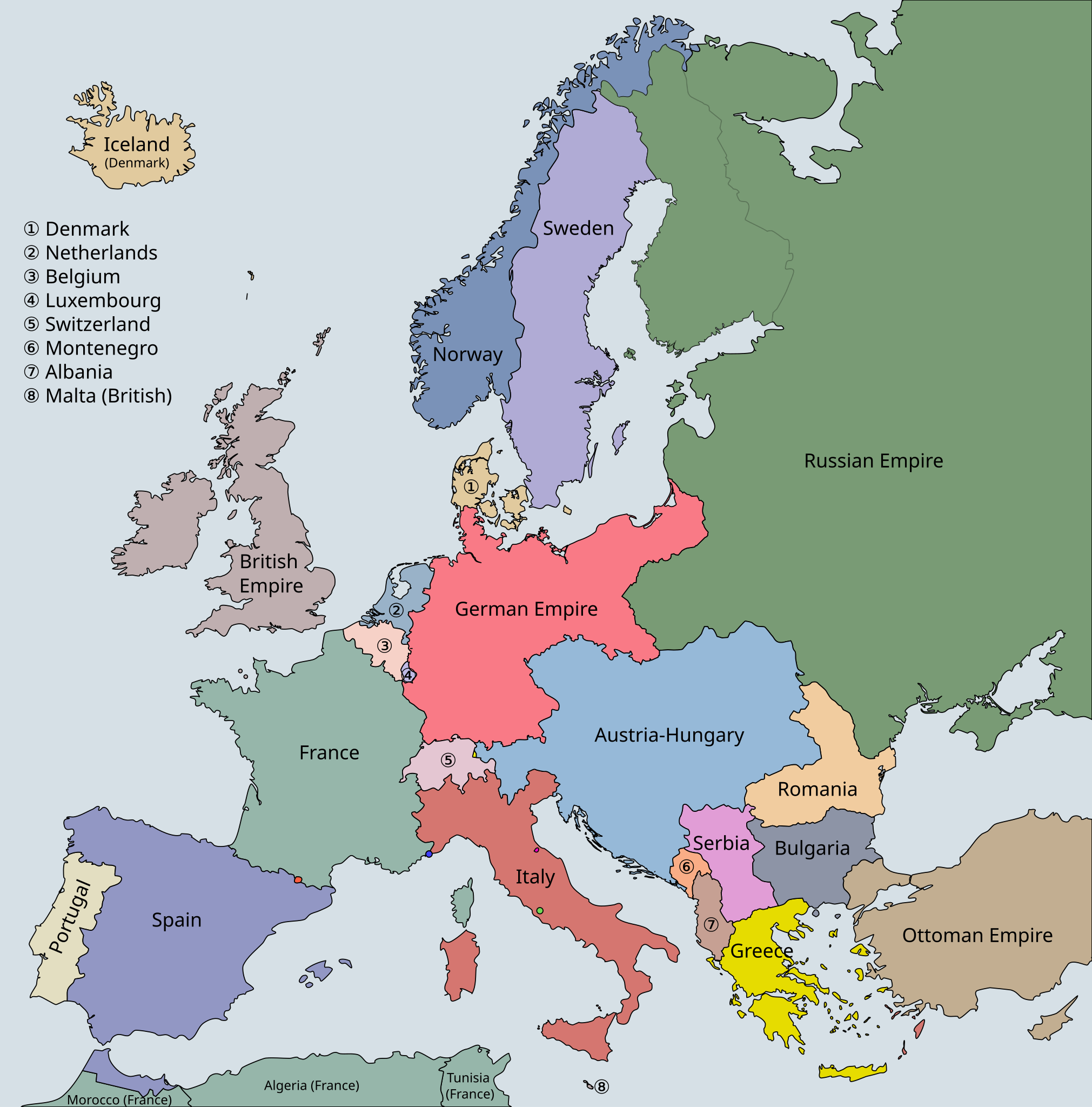
Map of Europe in 1914 —- be able to identify nations involved/battle sites
Battle of Tannenberg
France, Germany, Ottoman Empire, Montenegro, Sweden, Serbia, Great Britain, Switzerland, Austria-Hungary, Italy, Spain, Albania, Norway, Romania, Portugal, Belgium, Bulgaria, Greece, Russia, Denmark, Netherlands
Schlieffen Plan
Created by General Alfred Von Schlieffen, developed in an attempt to avoid a two-front war. Germany would invade France through neutral Belgium (which was not allowed), to surprise France and defeat them quickly so the Germans could then move to defeat the Russians. Britain was outraged that the Germans invaded through a neutral country so they joined the French in the fight against Germany.
People
…
Otto Von Bismarck
Imperial Chancellor of Germany 1871-1890
Well liked by the Germany people, since he won the Franco-Prussian war. Formed the “Triple Alliance” with Austria-Hungary and Italy to prevent France from attacking.
Nicholas II
Tzar of Russia during WWI and Totalitarianism