ACIS2115 CH9-11
 Call Kai
 Learn
Learn Practice Test
 Spaced Repetition
 Match
Match Flashcards
 Knowt Play
1/23

There's no tags or description
Looks like no tags are added yet.
Name | Mastery | Learn | Test | Matching | Spaced | Call with Kai | Chat |
|---|
No analytics yet
Send a link to your students to track their progress
24 Terms
Current liability
Due within 1 year or the operating cycle
Examples:
Accounts Payable
Sales Taxes Payable
Wages Payable
Notes Payable due soon
Unearned Revenue
Warranty Liability
Payroll Tax Payable
Long-term liability
Due after 1 year or the operating cycle
Examples of:
Long-term Notes Payable
Bonds Payable
Long-term Lease Liabilities
Short-term notes payable
A note payable is a written promise to pay a certain amount on a future date within one year.
Notes payable usually include interest.
Interest formula
Principal × Rate × Time = Interest
Known liabilities
are liabilities where the amount and timing are mostly known.
Examples:
Accounts Payable
Sales Taxes Payable
Unearned Revenue
Notes Payable
Payroll Liabilities
Warranty Liabilities
Net pay formula
Net Pay = Gross Pay - Deductions
warranty
is a company’s promise to repair or replace a product if something goes wrong.
contingent liability
is a possible liability that depends on a future event.
Example: A company is being sued.
The company might have to pay, but it depends on the outcome of the lawsuit.
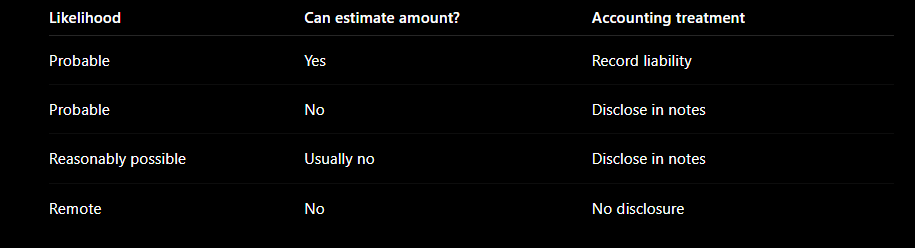
Accounting treatment depends on two things:
How likely the loss is.
Whether the amount can be estimated.
Rules for contingent liabilities
Simple version:
Probable and estimable = record it
Reasonably possible = disclose it
Remote = ignore it
installment note
is a liability that requires the borrower to make a series of payments over time.
Each payment usually includes: Interest expense + reduction of the note payable
Example: A car loan or mortgage is like an installment note because you pay it off in repeated payments.
Par
means the bond’s face value — the amount the company promises to pay back when the bond matures.
Contract rate / Stated rate / Coupon rate
is the interest rate printed on the bond.
Market rate
Interest rate investors currently want in the market
bond
is a company’s written promise to pay back borrowed money plus interest.
Companies issue bonds when they need a lot of money for big projects.
Maturity date
Date the bond principal is repaid
Bond indenture
Legal contract between issuer and bondholders
Bond Interest Payment =
Par Value × Contract Rate × Time
Example:
Par value = $100,000
Contract rate = 8%
Interest is paid every 6 months.
Semiannual interest:
$100,000 × 8% × 1/2 = $4,000
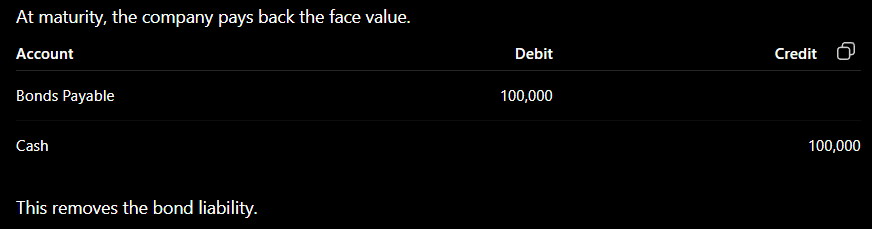
Paying bonds at maturity
At maturity, the company pays back the face value.
Bonds at discount or premium
A bond does not always sell for exactly face value.
It depends on the contract rate compared to the market rate.
Situation | Result |
|---|---|
Contract rate = Market rate | Bond sells at par |
Contract rate < Market rate | Bond sells at discount |
Contract rate > Market rate | Bond sells at premium |
Simple meaning:
If the bond pays less interest than investors want, it sells for less.
If the bond pays more interest than investors want, it sells for more.
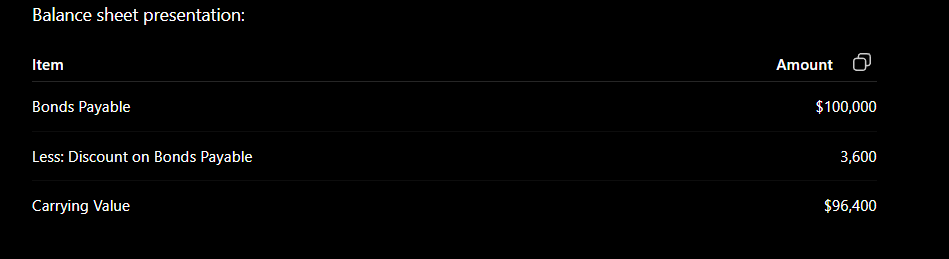
Discount on Bonds Payable
is a contra-liability account.
That means it reduces the carrying value of the bonds.
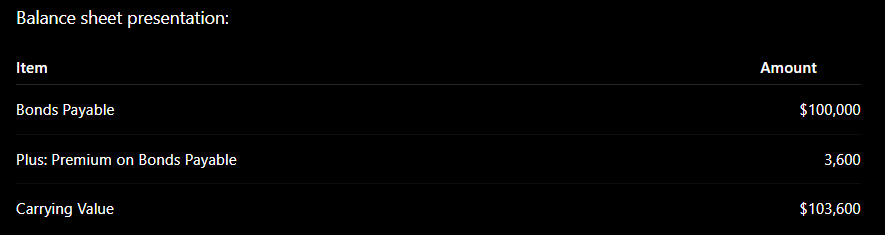
Premium on Bonds Payable
is an adjunct-liability account.
That means it increases the carrying value of the bonds.
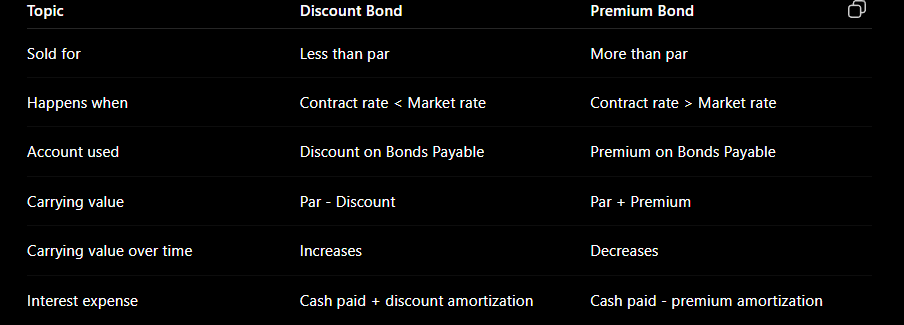
Discount vs. premium comparison
Easy memory:
Discount adds to interest expense.
Premium subtracts from interest expense.
Straight-line amortization
Discount or Premium ÷ Number of Interest Periods = Amortization per Period