Law 402 midterm 1 MC questions
 Studied by 0 people
 Call Kai
 Learn
Learn Practice Test
 Spaced Repetition
 Match
Match Flashcards
 Knowt Play
1/64

There's no tags or description
Looks like no tags are added yet.
Name | Mastery | Learn | Test | Matching | Spaced |
|---|
No study sessions yet.
65 Terms
How is psychology and law defined?
The application of psychological knowledge or research methods to advise, evaluate, and reform the legal system
How do psychology and the law differ in terms of goals, methods, style of inquiry, and justice?
Goals
-Laws tell us how we ought to behave
-Psychology tells us how people actually behave
Methods
-Law: rulings, based on authority, precedent–stare decisis
-Psych: data, based on empiricism
Style of inquiry
-Law: advocacy, adversarial system
-Psych: objectivity, researchers try to remain neutral, science is a self-correcting process overtime
What are some roles played by psychologists in psychology and law?
Advisors
-Trial consultants: they use psych to mold the trial in order to lean to a favorable outcome
-Writing amicus briefs: Written arguments that summarize the
findings and conclusions of research
-Expert witnesses:
Evaluators
-They evaluate research and the effectiveness of rehabilitation programs
-Formative assessment: how a program works or doesn’t
-Summative evaluations: if a program works or doesn’t
Reformers
-To actively promote change in the legal system, psychologists must step away from objective role as scientist
What are some pathways that psychologists used to influence the legal system?
Expert witnesses
Cross-disciplinary education (Judges and legal actors can take workshops or attend conferences to better understand the psychological mechanisms in the legal system)
Writing amicus briefs (Summaries providing the court with unique expert intel by a person associated with neither party)
Broad dissemination of research findings (Publishing, media, conferences)
Influencing legislatures and public policy (Advocating for legal reforms based on psychological research)
Federal Rules of Evidence (Rule 702)
Experts may testify if their specialized knowledge will help the trier of fact (judge or jury). Witnesses can assist the triers of the facts (judge and jury) by educating them on the specialized area, explaining evidence, and evaluating credibility. They canNOT make determinations about guilt.
Daubert Trilogy
3 cases were used as precedent to evaluate validity and relevance for witness testimony and determining its admissibility in court
1. Daubert v. Merrell Dow Pharmaceutical, Inc. (1993): Established four factors: Testability (falsifiability), Peer review/publication, Known error rate and General acceptance in the field
2. General Electric Co. v. Joiner (1997): Concluded appellate courts should defer to trial judges’ decisions about admitting/excluding expert testimony
3. Kumho Tire Co. Ltd. v. Carmichael (1999): Daubert standards apply to all expert testimony, not just scientific
Roles by expert witnesses
Conduit-educator: providing objective, factual information from their area of expertise to the judge and jury
Philosopher advocate: uses philosophical thinking and methods to actively identify, clarify, and oppose perceived injustices. Allows personal values to shape testimony
Hired gun: intentionally shapes the testimony to help the side off hiring attorney
How do courts influence psychologists?
Helps determine standards of care and malpractice
APA ethical guidelines (Courts often look to these guidelines to help decide if a psychologist acted ethically and responsibly.)
Civil law (Ex: if a therapist breaches confidentiality or engages in an inappropriate relationship with a client)
Objective vs. subjective justice
Objective punishment: Based on outcomes and accuracy (did the right person get punished)
Subjective justice: People’s perceptions of fairness in the process. (Concerned with whether people perceive system, institution, procedures, or agents as legitimate)
Outcome-based vs Process-based justice
Outcome based result: satisfied because the case is dismissed
Process based result: dissatisfied because process judged as unfair irrespective of the outcome
Why do we obey the law and cooperate with authorities?
Instrumental theories say we obey the law to avoid punishment and receive rewards
Procedural justice theories say we obey the law because we perceive legal authorities and the law as legitimate
Tom Tyler’s Theory Processed Based Model of Social Control
People obey the law more when they see legal authorities as legitimate.
Legitimacy comes from fair processes, not just fear of punishment.
Key factors:
Procedural justice (being treated with respect, having a voice, neutrality).
Trust in authorities’ motives.
When people feel the system is fair, they comply voluntarily — even if outcomes aren’t in their favor.
People care more about being treated fairly than winning/losing
Impacts of the perception of the criminal justice and legal system
Past experiences
Media portrayals
Community trust in police and courts
Transparency and fairness processes
True or false: Most people will experience at least one trauma in their lives.
What are some common reactions to trauma?
Acute stress symptoms: shock, dissociation, intrusive memories, nightmares.
PTSD: re-experiencing, avoidance, negative mood/cognition, hyperarousal.
Depression, anxiety disorders, substance misuse.
Sleep disturbance, somatic complaints, changes in trust/relationships, anger, grief.
Functional effects: work/school problems, interpersonal conflict.
What are some barriers to talking about trauma?
Stigma management
Unacknowledged victims
Cultural values
Reactions from others: Strong predictor of long-term well being
Things to do or avoid when talking about trauma
Avoid “silver lining” phrases
Be ok with silence and allow space to process
Engage in empathy rather than sympathy
When is a criminal case considered closed?
1. Arrest (must meet all three conditions)
Arrested
Charged with offense
Case turned over to court for prosecution (whether following arrest, court summons, or police notice)
2. Exceptional means
Identified the suspect
Gathered enough evidence for #1
Identified the suspect’s exact location
Encountered some circumstance outside the control of law enforcement
How often are violent crimes reported to police, according to the National Crime Victimization (NCVS) survey?
less than 50% of violent crimes are reported
Factors in deciding whether or not to report a crime
• Cognitive factors (cost-benefit analysis)
– Likelihood of positive outcome
– Level of inconvenience
– Risk, fear of retaliation
• Emotional factors – Level of fear
• Social factors* (most significant predictor)
– 12x more likely to report if were advised to do so
Which type of crime gets reported more often – violent or property?
Violent crimes (44.7%) tend to be reported more often than property crimes (29.9%)
When are individuals less likely to report crimes to the police?
Less likely to report if know perpetrator of crime
May fear risk further victimization if report to police (Less likely to report crimes if fear reprisal)
May not want to get the perpetrator in trouble (This can include perceived or real familial or societal expectations and pressures to keep harmony)
Types of witness intimidation
• Fear of Reprisal: – “Someone might hurt me for telling the police.”
• Threat of Reprisal: – “Someone told me they’d hurt me if I talked to police.”
• Actual Reprisal: – “Someone actually hurt me for talking to police”
How do race/ethnicity, age, and contact with the police predict attitudes about the police?
Peak risk for being killed by police is between ages 20-35 across all racial and ethnic groups
Stop and Frisk programs disproportionately target BIPOC (e.g., Kramer & Remster, 2018)
Compared with White people, Black and Brown individuals are more likely to be:
frisked
searched
arrested
have force used against them
Increased police contact is associated with decreased well-being
Young Black men face the highest lifetime risk
What are some long-term effects of negative police contact on
Well-being
Educational attainment for Black and Latinx youth
Intergenerational transmission of trauma
Lower likelihood of reporting crimes after high profile police brutality
How do implicit biases affect perceptions of danger and decision-making?
Implicit biases lead people to perceive danger from BIPOC faces, especially in ambiguous/neutral situations
Black children are perceived as significantly less innocent than other children starting at age 10
Contributes to shooter bias: higher likelihood of mistaking harmless objects (e.g., wallet, phone) as weapons when held by BIPOC compared to White individuals.
Issues with combating implicit biases
Has limited and sometimes short-lived effects;
Structural and policy changes (supervision, accountability, incentives, altered procedures) plus ongoing evaluation are needed to reduce biased outcome
What are the problems with militarized policing?
More likely to be deployed in Black & Brown communities.
Does not improve public safety or reduce crime.
Reduces public trust and confidence in police.
Militarized policing: when police departments adopt the weapons, equipment, tactics, and mindset of the military rather than traditional community-based policing
What is “warrior training” in policing?
Training that expects violence from citizens.
Emphasizes force over de-escalation.
Opposite of “guardian” approach.
What are predictors of excessive force in policing?
Individual officer characteristics.
Racial bias.
Anger management issues (bad temper).
Insecure masculinity.
Social dominance orientation.
What are legal challenges in police reform?
Close police–prosecutor relationships.
Union contracts protect officers, tied to increased misconduct.
Qualified immunity shields officers from personal liability for constitutional violations.
Rehiring/transferring problematic officers spreads misconduct across units.
What were the reforms proposed by the APA (2020)?
–Promote community policing
–Ban chokeholds and strangleholds
–Invest in Crisis Intervention Teams (CITs)
–Increase the number of mental and behavioral health professionals in law enforcement agencies
–Involve psychologists in multidisciplinary teams to implement police reforms
–Encourage private/public partnerships between mental health organizations and local law enforcement
–Discourage police management policies and practices that can trigger implicit and explicit biases
Others proposed in class:
–Evidence based policing–body cameras, community policing, procedural justice training
What are some challenges to implementing these reforms?
Transparency and accountability (Some districts allow officers to choose when to turn on their cameras; issues with quality of video)
Prosecution of police officers is very difficult
Officers who are fired for misconduct are frequently rehired
Ronald Cotton and Jennifer Thompson case
-Basics of the case: Jennifer Thompson was a college student who was raped in 1984. She identified Ronald Cotton as her attacker. Cotton was convicted and served over 10 years before DNA evidence proved his innocence. The real perpetrator was Bobby Poole.
-Perpetrator: Bobby Poole
-Innocent suspect: Ronald Cotton
-Factors associated with the wrongful conviction: Mistaken eyewitness ID, confidence inflation, lineup errors
What role do eyewitness IDs play in wrongful convictions, and how are exonerees compensated?
Mistaken eyewitness ID is involved in ~70% of DNA exonerations.
This does not mean 70% of IDs are wrong — it means eyewitness mistakes are the leading cause of wrongful convictions.
Wrongful imprisonment statutes: laws that compensate exonerees; amount and proof required vary by state.
What are archival analyses of eyewitness memory? Pros/cons?
Use real crime case files.
Pro: Very high external validity (real-world relevance).
Con: Correlation ≠ causation; can’t prove a factor caused wrongful conviction.
Ground-truth problem: Can’t ever know guilt/innocence with 100% certainty.
What are field studies of eyewitness memory? Pros/cons?
Collect lineup outcome data from real police investigations.
Pro: Naturalistic setting (real-world, less artificial).
Con: Ground-truth problem remains; can’t assess accuracy or “false IDs” because suspects are assumed guilty.
Researchers look at overall pick rates (suspect IDs + foil IDs).
What are laboratory experiments on eyewitness memory? Pros/cons?
Controlled, staged crimes (mock videos, slideshows, live enactments).
Pros: Control over variables; known guilt/innocence (no ground-truth problem).
Cons: May lack real-world stress/emotions; weaker external validity.
What is the basic procedure for lab eyewitness studies?
Participants view a mock crime.
Later given a lineup task (perpetrator present or absent).
Measure accuracy under controlled conditions.
Use only staged crimes (not real crimes) for ethical reasons.
What are the possible responses in lineup studies?
Target-present lineup:
Correct = ID suspect (perpetrator).
Incorrect = ID foil or no ID.
Target-absent lineup:
Correct = no ID.
Incorrect = ID suspect (innocent) or foil.
Estimator vs. System variables
Estimator variables: Outside the control of the criminal justice system.
Examples: weapon focus, inadequate opportunities to observe, own race effect/cross-racial ID, unconscious transference, and relation between stress and memory.
System variables: Under the control of police and courts.
Examples: lineup instructions, double-blind administration, number of fillers, interviewing style.
What is the Yerkes-Dodson Law in relation to stress and memory?
Stress has an inverted U-shaped effect.
Performance peaks at moderate arousal.
Very low or very high stress reduces memory accuracy.
What is the purpose of a pre-lineup interview?
Conduct before lineup.
Document description of perpetrator, viewing conditions, prior familiarity.
Instruct witnesses not to consult co-witnesses or social media.
What is the misinformation effect?
Exposure to misleading post-event info decreases eyewitness accuracy.
What is the funnel approach in eyewitness interviews?
Start with free recall (“Tell me everything”).
Follow with open-ended cued recall (based on what witness already said).
Exhaust free recall before specific questions.
How does the Cognitive Interview (CI) differ from FLETC?
Similarities: Both start with open recall, then specific questions.
Differences:
CI = uses special memory techniques (context reinstatement, varied recall).
FLETC = shorter, structured, easier for police to use.
What is evidence-based suspicion in lineup administration?
Only conduct a lineup if independent evidence links suspect to the crime.
What is double-blind administration in lineups?
Neither witness nor administrator knows the suspect’s identity.
Prevents verbal/nonverbal cues and post-ID feedback effects.
What are best practices for lineup fillers?
1 suspect + at least 5 fillers.
Avoid stand-out suspects.
Foil selection:
Resemble-to-suspect (look like suspect).
Match-to-description (match witness description).
Blended (combo of both).
What are the two debated lineup presentation techniques?
Simultaneous: all shown at once.
Sequential: shown one at a time.
What are unbiased pre-lineup instructions?
Suspect may or may not be in lineup.
No obligation to pick anyone.
“Don’t know” is acceptable.
Confidence rating will be asked.
Investigation continues even without an ID.
Why are confidence statements important in eyewitness IDs?
Confidence may change by trial.
Confidence immediately after ID correlates with accuracy.
Must be documented at time of decision.
Why should lineup procedures be video-recorded?
Record interview, instructions, decision, confidence.
Prevents reliance on incomplete/inaccurate court reports.
Encourages use of best practices.
Why should repeated IDs be avoided?
Prior exposure makes suspect seem familiar.
Commitment effect: Witness more likely to pick someone they picked before.
Why should showups be avoided?
Only one person shown (the suspect).
Highly suggestive, no foils for comparison.
Often used in the field but risk of false IDs is high.
What is forensic identification?
Process of linking a piece of physical trace evidence to an individual, usually a criminal suspect
Trace evidence
May be left behind at the scene of a crime (e.g., fingerprints, hair, skin cells)
May be carried away from the scene (e.g., carpet fibers, blood from victim)
What does it mean to make a source attribution in forensic science?
Determining if two samples come from a common source (e.g., evidence and suspect).
Different ways of reporting: qualitative (ex: probable), simple match (evidence and source shares class characteristics), match + statistics (Match accompanied by statistical likelihood of trait in population), or individualization (Match is so detailed it is deemed unique to one person/object).
Types of forensic evidence
–False positive = False accusation (innocent person tied to evidence).
–False negative = False dismissal (real culprit wrongly excluded).
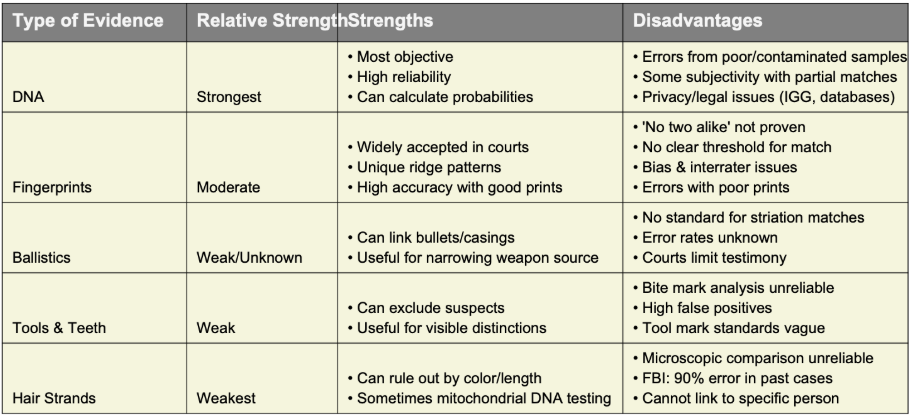
What makes DNA evidence both objective and subjective, and when can errors occur?
DNA is the most objective forensic measure.
Subjectivity: Partial matches, degraded samples, or deciding how close is “close enough.”
Errors: Poor-quality/contaminated samples, or mistakes in collection, handling, or interpretation.
What is Investigative Genetic Genealogy (IGG) and what are its benefits and concerns?
Definition: Combines DNA testing + genealogical databases (family trees) to identify suspects.
Databases: Public (GEDMatch) often usable without consent; private (Ancestry, 23andMe) usually require warrant/subpoena.
Cases: Golden State Killer (2018), Idaho murders (2022).
Concerns:
Privacy (relatives can identify you).
Fourth Amendment limits (3rd party data not protected).
Healthcare misuse (“shadow forensics” like newborn blood samples).
Ethical debate: use for only serious crimes vs. minor crimes.
What are the main challenges and sources of error in fingerprint analysis?
Claim “no two fingerprints alike” is unproven.
Errors: Poor print quality (surface, pressure, smudges).
Interrater reliability: Disagreement between experts.
Threshold problem: No universal standard for match vs. mismatch.
Dissimilarity doctrine: In theory, one dissimilarity = no ID, but often violated.
What psychological biases can influence fingerprint interpretation?
Contextual effects: Emotions or expectations shape judgment.
Confirmation bias: Analysts may seek evidence that confirms initial beliefs.
Commonality of ridge characteristics: Often not discussed in court, but can affect judgments of uniqueness.
What are some areas of weak or unknown scientific validity in forensic evidence?
Ballistics: Bullet striations linked to gun barrels, but reliability questioned.
Tools & teeth: High false positives (bite mark analysis ID’d innocents 63%).
Hair analysis: No strong evidence that hair reliably links to a specific suspect.
What is the CSI Effect, and why is it misleading?
Belief that every crime has abundant, clear forensic evidence.
Reality: Labs are underfunded, backlogged, analyses are slow & error-prone.
No strong link between CSI TV viewing and real jury verdicts.
How do jurors interpret trace evidence, and what problems arise?
Jurors underweight probabilities & misunderstand statistics.
Fingerprint evidence: Easier to understand than DNA, but jurors unaware of its limits.
Clearer communication & presenting probabilities in multiple ways improves comprehension.