AP Chemistry - Unit 4 Chemical Reactions
 Call Kai
 Learn
Learn Practice Test
 Spaced Repetition
 Match
Match Flashcards
 Knowt Play
1/43

Earn XP
Description and Tags
Name | Mastery | Learn | Test | Matching | Spaced | Call with Kai | Chat |
|---|
No analytics yet
Send a link to your students to track their progress
44 Terms
Physical Change
Change in properties, but not a change in composition. Change in intermolecular forces. Examples: Changes in the phase of a substance (solid, liquid, gas) or formation/separation of mixtures.
Chemical Change
Substances are transformed into new substances, typically with different compositions. Bonds are broken and formed. Evidence: energy change/production of heat or light, formation of a precipitate, or color change. Example: combustion (fire), oxidation (rust).
Ions that are soluble in water
Na+, K+, NH4+, NO3-
Molecular Equation
A balanced equation showing the complete chemical formulas of reactants and products

Complete Ionic Equation
A balanced equation with all soluble strong electrolytes shown as ions

Spectator Ions
Ions that stay the same on both sides of the complete ionic equation. These play no direct role in the reaction.

Net Ionic Equation
A balanced equation that includes only ions and molecules directly involved in the reaction

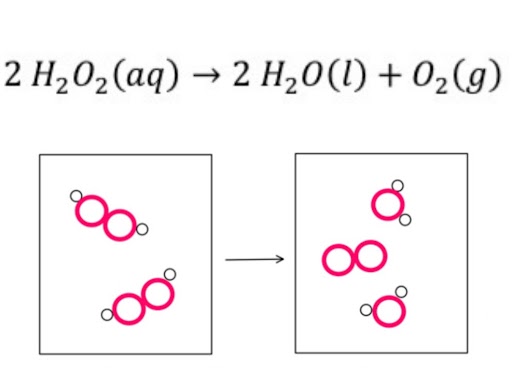
Representations of Reactions
The reaction indicates that for every two moles of H2O2 consumed, two moles of H2O and one mole of O2 will be produced
Excess Reactant
The reactant that remains upon completion of the reaction
Limiting Reactant
One reactant will be completely consumed during the chemical reaction, effectively limiting the amount of product(s) produced.
Dissociation of a salt
Can be argued as both a physical and chemical change. The breaking of the ionic bonds within the salt is a chemical change. The ion-dipole interaction between the water and the individual ions is a physical change.
Stoichiometry
The coefficients of the reaction indicate the mole ratio of the reactants consumed. The problem tells you how much of the reactant is present.
Same Coefficients, Different Quantities
If the coefficients are the same, the reactants are used at the same rate and the reactants with fewer moles will be limiting.
Different Coefficients, Same Quantities
If you are given the same amount of each reactant, the substance with the greater coefficient is used at a faster rate and is therefore the limiting reactant
Gas Laws
The pressure in the container is directly proportional to the moles of the gas, with the coefficients of the balanced equation representing the moles. If moles decrease pressure also decreases.
Molarity/Concentration formula
M=mol/liters
Mole to mole conversion formula
Mole given (wanted coefficient/given coefficient)
If the filter paper is still wet
The measured mass of the filter paper and the precipitate would be too high. Then the calculated moles would be too high. Then the calculated concentration would be too high.
Brønsted-Lowry Theory
Acid-Base reactions exchange protons, H+. The acid functions as the proton donor. The base functions as the proton acceptor.
Hydronium ion, H3O+
The ion formed when water functions as a Brønsted-Lowry base.
Hydrogen ion, H+
The ion formed when water functions as a Brønsted-Lowry acid.
Hydroxide ion, OH-
The ion formed when a base dissociates in water.
Base
Gains H+, forms conjugate acid
Acid
Loses H+, forms conjugate base
Amphoteric
A substance that can function as either an acid or a base
Amine groups, NH2
H+ will be attracted to the amine groups converting NH2 to NH3+
Carboxyl groups, COOH
The electronegative nature of oxygen contributes to the release of the hydrogen ion, leaving the remainder of the molecule unchanged in the reaction. COOH turns into COO-
Strong Acids
HCl, HBr, HI, HClO4, H2SO4, HNO3
Strong bases
Group one and group two (columns)
Oxidation Number
The charge of the ion or equals zero in a free element
Oxidation
An increase in oxidation due to the loss of electrons
Reduction
A decrease in oxidation due to the gaining of electrons
Half-reactions
Shows which substance is gaining or losing electrons
Writing Balanced Redox reactions from half-reactions
Use the least common multiple of the electrons in each half-reaction to make the electrons equal and cancel them out
Precipitation Reactions
Double replacement reaction, often in aqueous solution, resulting in the formation of a solid
Acid-Base Reactions
Also referred to as proton transfer reactions or neutralization reactions. These reactions produce water and a salt. Involve the exchange of a hydrogen ion, H+.
Oxidation-Reduction Reactions
Redox reactions involve the transfer of one or more electrons between reactants.
Standard Solution
One of known concentration, is combined with an unknown solution in order to determine the concentration of the unknown
Analyte
In the flask, the unknown solution
Titrant
Added through the burette, the standard solution
Equivalence Point
Where the analyte completely reacts with the titrant. Moles of titrant added is equal to the moles of analyte present in the flaskl.
End Point
When the indicator used changes color
pH Meter
Used to track the change in pH throughout the experiment.
Titration curve
Represents the data collected from the pH meter. Can be used to determine the equivalence point and several other factors about the analyte.